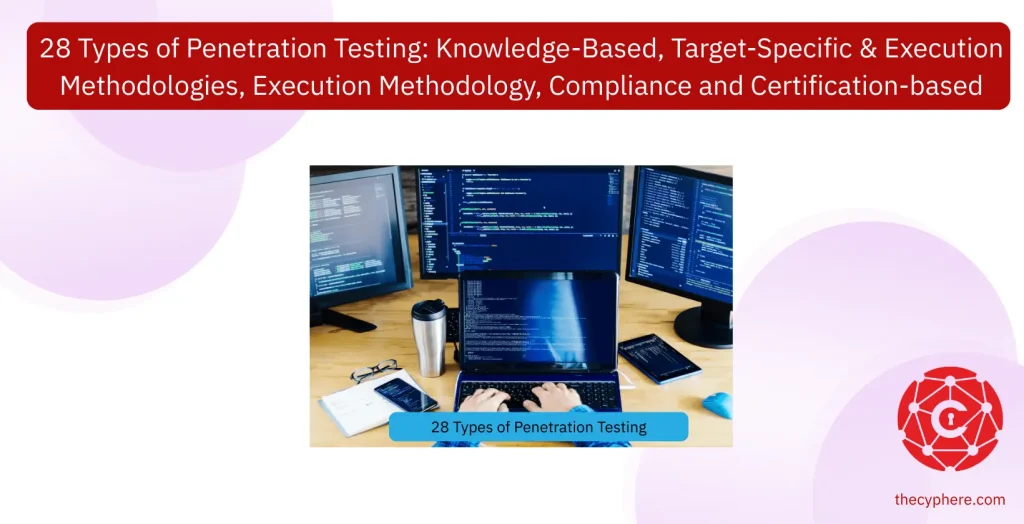
Penetration testing types in cybersecurity define the recognised testing approaches used by security professionals to assess the security of systems and networks through authorised attack simulations. Types of penetration testing help to choose the correct testing approach for each system, regulation, and threat scenario.
We categorise penetration testing into five main areas:
Knowledge-based types of penetration testing include Black Box testing, White Box testing, Grey Box testing, and Double-Blind testing.
Target-specific types of penetration testing include Network penetration testing, Web application penetration testing, Cloud penetration testing, Physical penetration testing, Social engineering testing, Application Programming Interface (API) testing, Internet of Things (IoT) penetration testing, and Operational Technology (OT) testing.
Execution methodology types of penetration testing include Automated penetration testing, Agile penetration testing, Continuous penetration testing, and Crowdsourced penetration testing.
Compliance-based types of penetration testing include Payment Card Industry Data Security Standard (PCI DSS) penetration testing and Health Insurance Portability and Accountability Act (HIPAA) penetration testing.
Certification or standard-based types of penetration testing include CREST (Council of Registered Ethical Security Testers) testing and CHECK (Commercial Evaluation and Assurance Scheme) testing.
Below, we have listed 28 types of penetration testing in detail.
1. Black Box Penetration Testing
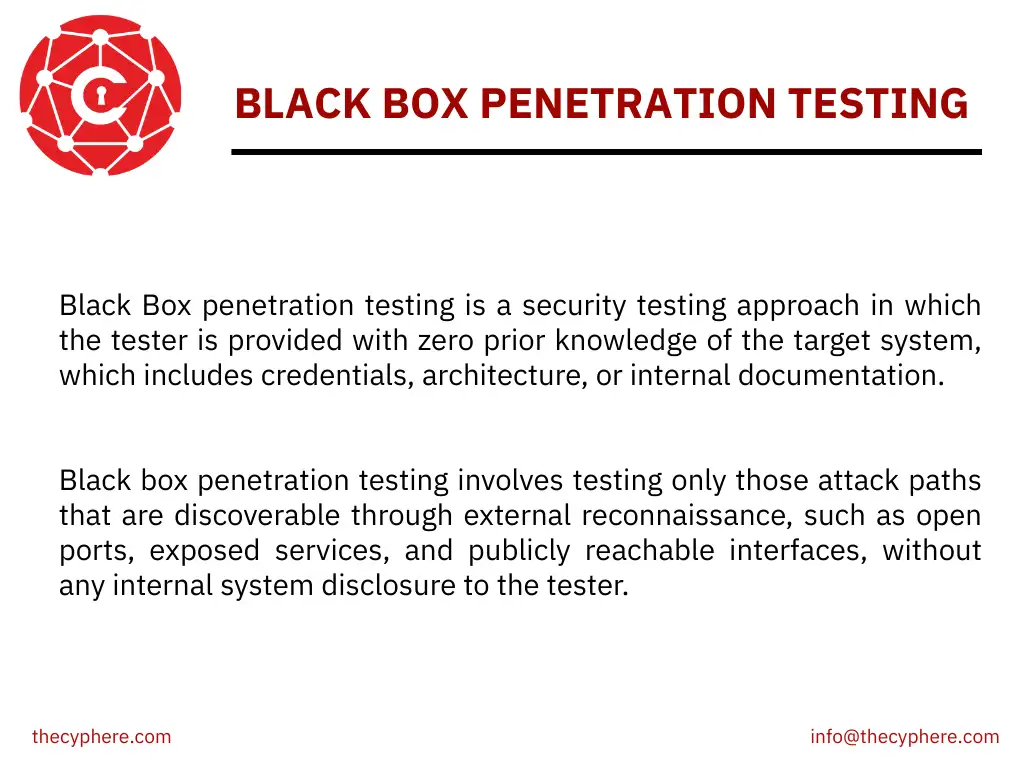
Black Box penetration testing is a security testing approach where the tester receives zero prior knowledge of the target system. This means no credentials, architecture details, or internal documentation are provided. You may also hear this approach referred to as external penetration testing. The testing focuses only on attack paths that are discoverable through external reconnaissance, such as open ports, exposed services, and publicly reachable interfaces, without any internal system disclosure to the tester.
Certified security professionals, also known as ethical hackers, perform black-box penetration testing by planning authorised attack paths, executing safe exploitation techniques, and documenting verified weaknesses. This approach suits scenarios where organisations require an accurate view of external exposure before product launches, infrastructure changes, internet-facing deployments, or regulatory reviews. Black box penetration testing exposes genuine entry points but limits visibility into internal logic testing approaches. Common examples include network scanning, vulnerability scanning, password attacks, fuzzing, web application attacks, and port scanning.
We recommend that black-box penetration testing is carried out by trained security professionals with hands-on penetration testing experience and recognised credentials, such as CREST Registered Tester or CHECK Team Member status. This testing demands strict scope definition, written legal permission, controlled exploitation limits, and impact safeguards to prevent service disruption or data integrity issues. Black box penetration testing provides decision-ready insight into real-world attack exposure whilst supporting risk prioritisation, security investment planning, and external assurance reporting.
2. White Box Penetration Testing
White Box penetration testing is a form of testing where the tester receives full access to internal system information. This includes source code, configurations, and credentials, enabling the examination of security weaknesses from an internal perspective. You may also know this approach as internal penetration testing. The methodology involves analysing applications, networks, and infrastructure using full internal system knowledge, including source code, configurations, and authenticated access.
Our penetration testers perform this testing by reviewing system logic, validating access controls, testing trust boundaries, and confirming exploitability under authorised internal conditions. White box penetration testing is ideal for environments that require deep coverage after development phases, or before compliance assessments that demand proof of internal control effectiveness. It delivers comprehensive vulnerability coverage but reduces the realism of external attackers. Common examples of white-box penetration testing include secure code review of web applications, internal network testing with authenticated access, and database permission validation.
This type of testing requires experienced penetration testers with strong application security knowledge, infrastructure expertise, and recognised qualifications such as CREST Certified Tester or equivalent enterprise security credentials. White box penetration testing demands controlled access management, strict handling of sensitive documentation, segregation of test credentials, and audit logging to prevent misuse or data exposure. The approach supports secure system design, remediation accuracy, and long-term risk reduction by validating security from an internal control perspective.
3. Grey Box Penetration Testing
Grey box penetration testing is a balanced approach where pentesters have partial knowledge of the system, such as user credentials or network diagrams. This type of testing combines the realism of black box testing (no knowledge) with the efficiency of white box testing (full knowledge) to simulate insider threats or authenticated attackers. The goal is to efficiently find vulnerabilities in user roles and data access controls. You may also hear this referred to as translucent box testing.
Grey box penetration testing focuses on access-dependent weaknesses, including role permissions, session handling, and data visibility, rather than perimeter exposure alone. Our pen testers perform this testing using approved, limited information to validate internal controls without full system disclosure. This type of testing suits environments that need real-world attack coverage with limited prior knowledge, such as staging systems, role-based platforms, and regulated applications. It delivers more accurate vulnerability findings whilst taking less time than full-knowledge testing.
Examples of grey-box penetration testing include authenticated web application testing (customer portals, admin dashboards, internal tools), restricted Active Directory role validation (standard users, power users, delegated admins), and limited application programming interface testing (user tokens, service keys, scoped endpoints).
Grey Box Pen Testing requires trained penetration testers or ethical hackers with experience in access-controlled environments and recognised credentials (CREST Registered Tester, CHECK team member) for UK-regulated engagements. Grey box penetration testing demands a defined scope, controlled credential handling, written authorisation, and session monitoring. It supports remediation accuracy by confirming weaknesses that depend on partial access conditions rather than theoretical exposure.
4. Double-Blind Penetration Testing
A Double-Blind Penetration Test is a realistic security assessment where neither the ethical hackers nor the internal IT or security team knows when the test is happening. This setup creates a true stress test for the organisation, helping to assess how well incident response and defence systems would perform during a real cyberattack scenario. You may also know this approach as covert penetration testing.

This testing type measures detection capability and response behaviour, including escalation speed and incident handling, rather than focusing purely on vulnerability discovery. External cybersecurity specialists conduct double-blind penetration testing under executive authorisation whilst operating without notifying security operations teams. Double-blind penetration testing applies to environments that require validation of real incident readiness, such as security operations centres, managed detection services, and internal response teams. The testing outcome reflects operational performance instead of theoretical security posture.
Examples of this testing include assessments of internet-facing services, remote access gateways, cloud entry points, unannounced phishing campaigns, and live response validation exercises targeting security monitoring teams, escalation chains, and incident playbooks. Explicit executive approval, legal documentation, safety boundaries, and emergency stop procedures remain mandatory to prevent business disruption or compliance breaches during blind engagements. Double-blind penetration testing strengthens organisational readiness by validating detection, communication, and response capability under genuine attack conditions.
5. Network Penetration Testing
Network penetration testing is a target-specific testing type that assesses security controls applied to network infrastructure and communication layers. This includes routers, switches, firewalls, and servers. You may also hear this referred to as infrastructure penetration testing or external network penetration testing. The methodology involves analysing network exposure, assessing trust boundaries, and verifying traffic flow across internal and external segments. Our cybersecurity professionals perform network penetration testing by validating segmentation rules, protocol security, and access enforcement.
Network penetration testing is suitable for environments that require validating perimeter defence and internal movement resistance. This testing type highlights real entry points created by weak segmentation and exposed services. Examples include corporate gateways, VPN endpoints, firewall rules, east-west traffic, enterprise Wi-Fi, authentication mechanisms, and encryption settings.
We recommend that network penetration testing be performed by trained penetration testers or ethical hackers with infrastructure security experience. CREST or CHECK accreditation is required for regulated UK environments. Network penetration testing requires written authorisation, strict scope boundaries, traffic impact controls, and monitoring safeguards. These measures prevent service disruption or unintended access escalation.
6. Web Application Penetration Testing
Web application penetration testing is a target-specific testing type that assesses security weaknesses in web-based software and its server-side logic. This includes login systems, dashboards, and transactional platforms. You may also know this as application penetration testing. This testing area focuses on application behaviour and data handling rather than network routing. Our pen testers perform web application penetration testing to validate authentication flows, role enforcement, and input processing under controlled conditions.
Web application penetration testing is necessary during application launches, major feature updates, or regulatory reviews that involve personal or financial data. This testing type exposes business-logic flaws and access-control failures whilst providing limited visibility into lower-level network weaknesses. Examples include authentication testing (login flows, session expiry), authorisation testing (admin features, role separation), and data handling review (file uploads, form submissions).
We ensure that web application penetration testing is performed by penetration testers with application-security expertise, secure development knowledge, and recognised credentials. CREST-certified testers are commonly engaged for UK commercial engagements. Web application penetration testing requires defined test accounts, rate-limit safeguards, input safety controls, and written permission. These controls help avoid service disruption or data corruption.
7. Mobile Application Penetration Testing
Mobile application penetration testing assesses security weaknesses in mobile software and its connected backend components. This covers Android applications, iOS applications, and application programming interfaces. You may also hear this referred to as mobile security testing. Our application security testers assess the application’s client-side components, server-side APIs, and data storage mechanisms. We use a combination of manual testing techniques and automated tools.
Mobile applications process high-risk data categories. These include authentication tokens, personal identifiers, and payment references. This makes exposure impact immediate and user-facing rather than theoretical. Examples include local storage review, backend interaction testing, and platform control validation.
We recommend that mobile application penetration testing is carried out by penetration testers with practical experience in mobile operating systems and backend integration. CREST-aligned professionals are commonly engaged for regulated UK assessments. Mobile application penetration testing supports accurate risk reduction by exposing flaws that directly affect user data confidentiality and account integrity, rather than hypothetical attack paths.
8. Cloud Penetration Testing
Cloud penetration testing identifies security weaknesses within an organisation’s cloud infrastructure through authorised cyberattacks. This includes platforms such as AWS and Microsoft Azure. You may also hear this referred to as cloud security testing. Cloud penetration testing involves assessing exposure created by identity permissions, service configurations, and publicly reachable cloud resources. Our ethical hackers perform this testing by validating identity policies, service access rules, and configuration boundaries under provider-approved conditions.
Organisations use cloud penetration testing after cloud migrations, identity model changes, or regulatory audits involving personal, financial, or operational data. This testing type reduces configuration-driven breach risk whilst excluding cloud-provider-managed components, which remain outside customer responsibility. According to the Cloud Security Alliance 2025 report “Top Threats to Cloud Computing,” misconfigured identity and access controls continued to cause cloud incidents. The report identified identity and access misconfiguration as one of the leading contributors to the analysed cloud security failures. Examples include identity role assessment, object permissions, public access settings, and management interface evaluation.
Cloud penetration testing requires penetration testers with cloud-platform expertise, identity security experience, and formal authorisation. CREST-accredited providers are commonly engaged for regulated UK assessments. Cloud penetration testing requires explicit provider permission, a defined testing scope, service-impact controls, and proper credential handling.
9. Physical Penetration Testing
Physical penetration testing is an authorised security testing type that assesses the effectiveness of an organisation’s physical security controls. This includes protection of buildings, restricted areas, and physical assets against unauthorised access attempts. You may also know this as on-site penetration testing. The methodology involves attempting controlled physical access using real-world attacker techniques whilst operating under strict legal authorisation and agreed rules of engagement. Our security professionals conduct physical penetration testing by assessing entry controls, surveillance coverage, guard response, and staff behaviour without causing damage or disruption.
Organisations use physical penetration testing when they need assurance over site security, regulatory compliance, or protection of sensitive operations. This testing approach exposes weaknesses in access control and human response, whilst providing limited insight into purely digital vulnerabilities. Examples include entry control testing, perimeter assessment, and secure area validation.
Organisations mainly engage CREST-accredited providers, whilst larger enterprises depend on internal red teams with executive authorisation. Physical penetration testing requires professionals with substantial practical experience in physical security systems. Security professionals should hold a QNUK Level 4 Award in Physical Penetration Testing Operations, CREST Simulated Attack certifications, or equivalent red-team credentials.
10. Social Engineering Penetration Testing
Social engineering penetration testing validates organisational resilience through authorised simulation of human-focused attacks. This tests how employees and processes respond to manipulation attempts such as phishing, vishing, and pretexting. You may also know this as human hacking testing. The methodology involves a structured attack simulation against human behaviour. Our internal security teams conduct social engineering penetration testing by researching public information, executing controlled simulations, monitoring staff responses, and documenting outcomes for corrective action.
This testing suits organisations that depend on employee decision-making in particularly sensitive environments. This includes those handling regulated or sensitive data such as financial services, healthcare providers, and government contractors. The approach exposes behavioural risk and policy breakdown whilst offering limited insight into purely technical misconfigurations.
Social engineering penetration testing is performed by penetration testers, social engineering consultants, or red team members. UK organisations engage CREST-accredited firms, Cyber Scheme-certified providers, or internal red teams operating under executive authorisation. Effective social engineering penetration testing requires ethical discipline, psychological awareness, formal authorisation, and recognised certifications such as CEH, GPEN, CRTOP, or SEPP.
11. API Penetration Testing
API penetration testing identifies weaknesses in application programming interfaces by testing endpoints, authentication and authorisation mechanisms, business logic, and data exposure. This covers REST, SOAP, and GraphQL APIs. You may also hear this referred to as application interface penetration testing. The methodology involves a combination of automated scanning and manual analysis to identify flaws in API behaviour and underlying server-side functionality.
Our white hat testers check endpoint logic, request handling, authentication workflows, and object access paths. This determines whether APIs enforce security boundaries correctly. Organisations use API penetration testing when they expose business logic through integrations, mobile backends, or third-party services. This approach highlights direct data access risks and logic abuse scenarios but provides limited coverage of user-interface vulnerabilities. The OWASP API Security Top 10 remains a primary reference framework for professional API assessments. It identifies recurring risks such as broken object-level authorisation and excessive data exposure.
API penetration testing requires skilled security professionals with application and network security expertise. Organisations depend on in-house penetration testers, specialised third-party security firms, or vetted freelance ethical hackers engaged through structured programmes such as bug bounty initiatives. Effective API penetration testing requires proficiency in programming languages, API technologies, cloud architectures, and standard testing methodologies. Professional certifications include Certified Ethical Hacker (CEH), Offensive Security Certified Professional (OSCP), GIAC Penetration Tester (GPEN), GIAC Web Application Penetration Tester (GWAPT), and Certified API Pentester (C-APIPen).
12. Wireless Penetration Testing
Wireless penetration testing simulates authorised attacks against wireless networks to identify exploitable weaknesses. This covers encryption, access configuration, and device trust across Wi-Fi networks, Bluetooth systems, and Zigbee devices. You may also hear this referred to as wireless network testing. The methodology involves analysing signal exposure, authentication behaviour, and access point configuration using controlled attack simulation. Our internal security teams perform wireless penetration testing through scoped planning, vulnerability analysis, controlled exploitation, and evidence-based reporting.
According to recent UK cyber security survey statistics, 67% of medium and 74% of large-sized UK organisations experienced a cyber breach during 2024-2025. Attackers frequently gain internal access within days through weak Wi-Fi services acting as entry points into the internal networks (corporate networks). Additionally, 85% of UK users continue to use Wi-Fi networks without changing default SSIDs, adding to the larger attack surface. Examples include signal coverage mapping (SSID visibility, signal leakage), authentication testing (handshake capture, credential strength), and deception scenarios (evil twin networks).
Wireless penetration testing requires practitioners with protocol-level expertise and recognised credentials. These include Offensive Security Wireless Professional (OSWP), Offensive Security Certified Professional (OSCP), GIAC Penetration Tester (GPEN), or CREST accreditation. Wireless penetration testing improves security by identifying exploitable wireless entry points before misconfigurations lead to internal compromise.
13. IoT Penetration Testing
IoT penetration testing involves authorised cyberattacks across Internet of Things ecosystems to identify security weaknesses. This covers communication protocols and connected applications such as smart devices, industrial sensors, and medical equipment. You may also know this as IoT security testing. The methodology involves evaluating the complete IoT lifecycle. This covers physical device access, firmware integrity, network communication, and backend service interaction. Our IoT pen testers perform the testing by analysing firmware images, testing device authentication, inspecting communication protocols, and validating cloud or mobile application integrations.
IoT penetration testing applies to large-scale or innovative connected device deployments where compromise affects safety, privacy, or operations. It exposes risks such as default credentials, weak encryption, and misconfigured communication channels. The UK IoT device market is projected to expand from USD 4.76 billion in 2025 to over USD 8.9 billion by 2030. This growth will significantly increase the number of connected endpoints requiring security validation.
IoT penetration testing is performed by penetration testers, IoT security specialists, or offensive security engineers. These professionals work within in-house teams, specialised security firms, or accredited consultancies. The testing requires recognised professional certifications such as Certified Ethical Hacker (CEH), Offensive Security Certified Professional (OSCP), GIAC Penetration Tester (GPEN), CREST accreditation, or equivalent IoT-focused credentials. The testing demands strict authorisation, safe handling of physical devices, controlled firmware analysis, and careful coordination with product teams.
14. Firewall Penetration Testing
Firewall penetration testing validates firewall effectiveness by attempting controlled network traffic bypass techniques. This exposes unnecessary open ports, insecure policies, and outdated firewall controls. Our pen testers attempt to bypass firewall rules, identify exposed services, and test whether filtering logic blocks unauthorised connections as intended.
Organisations use firewall penetration testing when they rely on perimeter security to protect internal systems. This is especially important after firewall configuration changes, network expansion, or security incidents. This testing exposes risks such as misconfigured rules, open ports, and outdated firewall software whilst offering limited insight into application-level flaws. Examples include external firewall testing (internet-facing rule sets), internal firewall testing (segmentation and insider-threat simulation), and configuration review testing (policy consistency and update gaps).
Firewall penetration testing is performed by penetration testers or ethical hackers working within internal security teams. Red teams operating under authorised attack scenarios also conduct this testing. It requires strong knowledge of firewall technologies and traffic analysis, as well as proper certifications such as Certified Ethical Hacker (CEH), Offensive Security Certified Professional (OSCP), or CREST accreditation. Firewall penetration testing must be conducted under explicit written authorisation, a defined scope, and controlled testing windows.
15. Active Directory (AD) Penetration Testing
Active Directory (AD) penetration testing exposes security weaknesses inside an organisation’s identity infrastructure. This involves exploiting misconfigurations, excessive privileges, trust relationships, and credential flaws. You may also hear this referred to as Internal Network Penetration Testing (AD-focused). Our security professionals analyse domain controllers, Group Policy Objects (GPOs), organisational units (OUs), service accounts, and authentication protocols such as Kerberos, NTLM, LDAP, and SMB.
Organisations use this testing after initial access scenarios or following incidents involving credential compromise. The approach exposes risks such as unrestricted admin privileges, weak delegation controls, insecure trust relationships, and poor password hygiene. Examples include domain privilege escalation testing (admin rights, service accounts), lateral movement analysis (east-west movement paths), and post-compromise simulations.
Active Directory penetration testing is performed by red team operators working within internal security teams. Specialised external security firms with experience in complex Windows enterprise environments also deliver this testing. It requires hands-on experience and certifications such as HTB Certified Active Directory Pentesting Expert (HTB CAPE), GIAC Penetration Tester (GPEN), Certified Active Directory Penetration eXpert (C-ADPenX), or Practical Network Penetration Tester (PNPT).
16. Hardware Penetration Testing
Hardware penetration testing attacks physical devices directly to confirm how real attackers gain access. This includes targeting firmware, exposed ports, embedded chips, and device communications. You may also know this as device security testing. Our hardware security professionals interact with circuit boards, firmware images, boot processes, and communication interfaces to highlight weak protections.
Organisations use hardware penetration testing during embedded and IoT product development, before device deployment, or when devices operate in uncontrolled environments. This testing reveals risks such as insecure firmware updates, exposed debug interfaces, hardcoded credentials, and weak device authentication. Examples include testing of bootloaders, update files, Bluetooth, Wi-Fi, and storage access.
Hardware penetration testing is conducted by offensive security engineers working within internal security teams or authorised red teams. The testing demands hands-on experience with embedded systems, operating systems, and low-level communications. It operates under strict authorisation, defined scope, non-destructive techniques, and controlled testing conditions.
17. Client-Side Penetration Testing
Client-side penetration testing attacks software running on user machines by interacting with browsers, email clients, and desktop applications. This testing focuses on risks in the user environment. Malicious files, links, scripts, or intercepted traffic cause security issues that server-side controls do not detect. Our security professionals inspect client-side code execution, local storage usage, session handling, plugins, and application logic.

Organisations use client-side penetration testing when they depend on browser workflows, email communication, or desktop tools for daily operations. This approach exposes weaknesses such as injected scripts, stolen session tokens, unsafe file execution, and insecure client-to-API communication. Client-side penetration testing demands strong knowledge of web technologies, operating systems, and application behaviour. Our ethical hackers have hands-on experience and certifications such as OSCP, CEH, and GPEN. CREST accreditation is required for UK-regulated environments.
Client-side penetration testing operates under a defined scope, user-impact safeguards, and legal authorisation. These controls prevent accidental malware spread, data exposure, or service interruption. Client-side penetration testing strengthens security by revealing attack paths that depend on user interaction rather than direct server compromise.
18. Blockchain Penetration Testing
Blockchain penetration testing attacks blockchain systems by executing controlled exploits against smart contracts, nodes, and decentralised applications. The goal is to expose security failures before production deployment. Security teams place this testing within Web3 risk programmes because decentralised logic and immutable ledgers introduce attack paths that standard application testing never covers. Our security specialists analyse source code, execute dynamic attacks, and stress-test network rules. This surfaces flaws such as logic manipulation, unchecked permissions, and unsafe cryptographic handling.
Organisations depend on blockchain penetration testing before mainnet launches, after protocol upgrades, and during dApp expansion. The testing highlights irreversible risks created by faulty code, weak validation, and unsafe consensus assumptions. Our blockchain security teams conduct this testing under explicit authorisation and defined engagement rules. It requires deep knowledge of distributed ledger technology, consensus mechanisms, and smart contract development.
We enforce strict scope limits, transaction safeguards, test-net usage, and change controls during blockchain penetration testing. These measures prevent irreversible asset loss or network disruption. Blockchain penetration testing strengthens decentralised security by exposing exploitable logic and protocol weaknesses before attackers exploit immutability and trust assumptions.
19. Artificial Intelligence (AI) Penetration Testing
Artificial Intelligence penetration testing attacks AI systems by examining data handling and access paths to expose weaknesses that affect system control. Cybersecurity teams perform this testing as a separate area because AI systems create risks in model training, decision-making processes, and data usage. Our AI testers analyse model inputs, outputs, training data flow, APIs, and surrounding infrastructure.
Organisations use artificial intelligence penetration testing before production deployment, after model updates, during large-scale data integration, or when AI systems influence identity decisions. This testing highlights risks such as manipulated outputs, leaked training data, unauthorised model access, and unsafe automation. Standard security reviews fail to detect these issues. Attack activity targets manipulated inputs, unsafe prompt handling, exposed model responses, poisoned data pipelines, and weak API controls.
Specialist security firms, experienced ethical hackers, and internal red or purple teams perform this testing under defined authority and controlled environments. AI penetration testing requires strong penetration testing fundamentals combined with applied knowledge of machine learning lifecycles, model architectures, data science workflows, and adversarial ML techniques.
20. Operational Technology (OT) Penetration Testing
Operational Technology penetration testing assesses industrial control systems, networks, and field devices to identify security gaps. These gaps impact safety, production, and operational reliability. OT penetration testing deals with live operational environments rather than office IT systems. Testing activity focuses on systems that control physical processes. This includes manufacturing equipment, energy distribution, water treatment, and transport operations. Our security professionals analyse industrial control systems such as Programmable Logic Controllers (PLCs), Supervisory Control and Data Acquisition (SCADA) platforms, and Human-Machine Interfaces (HMIs). We also assess the industrial networks that connect these systems.
Organisations apply OT penetration testing during plant modernisation, remote access rollout, IT–OT integration, or after operational disruptions linked to cyber incidents. This testing highlights risks such as unauthorised control commands, insecure legacy protocols, weak segmentation, and unsafe remote connectivity.
Specialised OT security consultants and authorised red teams conduct OT (Operational Technology)penetration testing alongside plant engineers. This collaboration maintains safety and operational stability. OT penetration testing requires deep knowledge of industrial environments, real-time system constraints, and protocols such as Modbus (Modular Bus), DNP3 (Distributed Network Protocol 3), PROFINET (Process Field Network), and OPC (Open Platform Communications). We apply strict scope limits, safety controls, change approvals, and controlled testing windows during OT penetration testing. These measures prevent safety incidents.
21. Automated Penetration Testing
Automated penetration testing uses security tools to run repeatable attack checks in systems and applications. This uncovers known issues such as misconfigurations, weak authentication, exposed services, weak encryption, and insecure protocols. Automation is suitable for security programmes that require frequent testing in large environments. This includes cloud assets, APIs, and continuously changing applications. Our security teams configure automated tools to scan networks, applications, and configurations for exposed services and common vulnerability patterns.
Organisations adopt automated penetration testing during continuous integration and deployment cycles, after configuration changes, or when compliance frameworks demand regular security validation. This approach delivers speed and coverage whilst offering limited insight into complex logic flaws, chained attacks, and business-specific abuse paths. Automated findings typically surface through exposed ports, outdated libraries, weak encryption settings, insecure API endpoints, and misconfigured access controls.
The testing depends on strong tool configuration, accurate asset inventory, and vulnerability triage skills. Our security teams control automated testing scope, execution timing, and alert thresholds. These controls prevent service disruption, false positives, or unnecessary operational noise. Automated penetration testing improves security visibility by identifying recurring and known weaknesses early. This allows teams to reserve manual testing for high-risk and complex attack scenarios.
22. Agile Penetration Testing
Agile penetration testing integrates security testing into development sprints. This enables teams to find and fix vulnerabilities whilst features are still under active development. Teams adopt this approach in fast delivery environments where weekly or continuous releases make end-stage penetration testing impractical. Our security testers work alongside developers during sprint cycles. We review new code paths, test changed components, and validate exposed functionality as soon as it appears.
According to a 2025 UK industry analysis by cybersecurity market researchers titled “UK Penetration Testing Market Outlook,” embedding penetration testing into Agile workflows resulted in faster vulnerability remediation. Fix turnaround times reduced by up to 40%. Organisations depend on agile penetration testing when authentication logic, APIs, and cloud configurations change frequently across sprints. This approach surfaces flaws early but requires disciplined coordination to avoid fragmented findings across parallel releases.
Our penetration testers perform agile penetration testing during sprint planning, backlog refinement, and release reviews. Agile penetration testing demands hands-on penetration testing skills combined with working knowledge of Agile workflows, CI/CD pipelines, and secure coding practices. Development teams manage testing scope sprint-by-sprint and apply fixes immediately to prevent security debt from accumulating across releases.
23. Continuous Penetration Testing
Continuous penetration testing is an ongoing security testing approach that checks systems, applications, and cloud assets regularly instead of once a year. You may also hear this referred to as continuous attack surface penetration testing (CASPT). Our security teams run frequent automated checks to catch known weaknesses. Experienced testers then step in for targeted manual testing when changes occur. This includes new code releases, infrastructure updates, or exposed services.
Fast-moving businesses adopt continuous penetration testing when their systems change often. This includes cloud platforms, SaaS products, and agile development pipelines. This testing improves response speed by identifying issues early. However, it does not replace deep, scenario-driven manual assessments for complex attack paths. Examples include constant monitoring of cloud assets, repeated testing of internet-facing applications after each deployment, and regular checks on APIs and mobile backends as features change.
Certified security professionals, internal security teams, and specialised third-party providers deliver continuous penetration testing. This often combines in-house oversight with external expertise. Our security teams tightly control scope, timing, and alert thresholds to avoid service disruption and unnecessary noise. This is especially important in production environments.
24. Crowdsourced Penetration Testing
Crowdsourced penetration testing is a security testing model where organisations invite approved external ethical hackers to identify real security weaknesses. Testing occurs across defined systems under controlled legal and technical boundaries. You may also know this as bug bounty testing. The methodology involves exposing selected assets to a vetted pool of independent testers through a managed platform. This includes web applications, APIs, cloud services, or mobile platforms. Pen testers work independently, submit verified findings with technical evidence, and internal security teams validate each report before remediation begins.
Crowdsourced penetration testing fits organisations with public-facing systems, frequent releases, or rapidly changing attack surfaces. In the UK, this model gained traction as the penetration testing market approached $90.74 million in 2025, growing at over 17% annually. This approach improves coverage and speed whilst lowering fixed costs. However, it requires strong validation controls to manage false positives and protect sensitive data. Examples include private bug bounty programmes for financial web portals, continuous API testing for SaaS platforms, cloud configuration testing, and vulnerability discovery programmes.
Crowdsourced penetration testing is performed by certified penetration testers accepted by the platform. They commonly hold CEH, OSCP, GPEN, or CREST credentials, which typically determine eligibility. Organisations apply strict scope definitions, access limitations, legal authorisation, and report triage processes. These controls prevent service disruption or data exposure. UK organisations increasingly use crowdsourced penetration testing to manage the national skills shortage in cybersecurity. This approach also helps respond to the sharp rise in serious incidents reported by the National Cyber Security Centre.
25. PCI Penetration Testing
PCI penetration testing is a mandatory security assessment under the Payment Card Industry Data Security Standard (PCI DSS). It evaluates the effectiveness of systems protecting payment card data to prevent unauthorised access. You may also hear this referred to as PCI DSS penetration testing. The methodology involves controlled security testing of systems that transmit cardholder data. This includes internal networks, external-facing systems, applications, databases, and segmentation controls. A Qualified Security Assessor (QSA) validates firewall rules, access controls, authentication paths, network segmentation, and application logic using manual testing techniques.
PCI penetration testing is required at least once every 12 months. It is also required after significant changes such as application upgrades, firewall changes, infrastructure refreshes, or cloud migrations. The approach confirms the effectiveness of security controls and reduces compliance risk. However, it requires skilled testers and careful scoping to avoid business disruption. Examples include external testing of internet-facing payment portals, internal testing of CDE (Cardholder Data Environment) networks and databases, and segmentation testing between CDE and non-CDE zones.
Most organisations hire external testers with recognised certifications such as OSCP, OSCE, CEH, GPEN, or CREST. Some regulated environments also require involvement from a Qualified Security Assessor (QSA). PCI penetration testing requires formal authorisation, a clearly defined scope, and strict handling of cardholder data to avoid data exposure.
26. HIPAA (Health Insurance Portability and Accountability Act) Penetration Testing
HIPAA penetration testing assesses healthcare systems’ protection of electronic patient data. It examines real access paths and data-exposure risks across networks, applications, and user roles that handle electronic protected health information (ePHI).
HIPAA penetration testing involves targeted testing of systems that create, store, access, or transmit ePHI. This includes internal networks, cloud-hosted services, APIs, remote access solutions, and identity controls. Our security professionals manually verify authentication strength, privilege boundaries, data exposure paths, and configuration weaknesses. Organisations use HIPAA penetration testing as part of periodic security evaluations. It is also conducted after operational changes such as new EHR deployments, cloud migrations, network redesigns, or third-party integrations.
Examples include internal network testing of hospital systems, role-based access testing for clinical staff accounts, wireless testing in care facilities, and segmentation testing between medical devices and administrative networks. HIPAA testing is performed by experienced penetration testers working at healthcare-focused security firms or in internal security teams. Professionals should have certifications such as OSCP, OSWE, CEH, GPEN, CISSP, or CREST. Practical experience with healthcare workflows and compliance-driven testing is essential. Healthcare organisations face sustained cyber pressure, with the sector recording some of the highest breach costs globally and a steady rise in attack attempts across UK healthcare systems.
27. CREST Penetration Testing
CREST penetration testing is a security assessment delivered by a CREST-accredited organisation. It evaluates how well an organisation protects its systems, applications, and data against real security risks. You may also know this as CREST-accredited pen testing. The methodology focuses on identifying weaknesses in networks, applications, cloud platforms, and internal systems through controlled security testing activities. Our CREST-certified testers assess access controls, system configurations, privilege boundaries, and data exposure paths. We follow strict governance around scope, evidence handling, and reporting quality.
Organisations use CREST penetration testing when they need trusted, third-party assurance. Common use cases include compliance requirements, customer confidence, supplier onboarding, or high-risk infrastructure changes. The main advantage of CREST penetration testing is credibility and consistency. The main trade-off is higher cost and stricter engagement rules compared to informal testing providers. Examples include enterprise network testing, web and API security assessments, cloud environment reviews, internal access testing, and segmentation validation.
CREST-accredited companies provide CREST penetration testing. Testing is carried out or overseen by CREST-registered or CREST-certified testers. CREST penetration testing requires explicit authorisation, a well-defined scope, and coordination with internal teams to avoid service disruption. Organisations should plan remediation timelines so findings translate into measurable security improvement rather than static reports.
28. CHECK Penetration Testing
CHECK penetration testing is a penetration testing service delivered by a CHECK-approved organisation. It provides independent security assurance for systems, applications, and data. You may also know this as ethical hacking. The CHECK penetration testing standard defines who is authorised to perform testing, how testing engagements are approved, and how testing findings are documented and reported. Our CREST-certified testers examine authentication controls, authorisation rules, system configuration settings, privilege boundaries between user roles, and data exposure points within the tested environment to identify security weaknesses.
Organisations use CHECK penetration testing when they operate systems that require security assurance recognised within the UK government security assurance framework. CHECK penetration testing provides organisations with an accepted assurance route for systems that sit within government assurance boundaries or interact with government-assured services. The testing limits flexibility because testing activities must conform to predefined CHECK requirements rather than organisation-specific commercial testing preferences.
Examples include network penetration testing, application penetration testing, and infrastructure penetration testing performed under an approved CHECK engagement. CHECK-approved companies deliver CHECK penetration testing, and CHECK-approved testers perform or supervise all testing activities. CHECK penetration testing requires written authorisation, a defined scope of testing, and coordination with system owners before testing begins.
How does pentesting methodology change based on the penetration testing type?
The penetration testing methodology changes significantly based on four major factors. These factors are the level of knowledge provided, the target in scope, the execution model, and the compliance requirements.
- The level of knowledge provided defines the starting position and depth of analysis during testing. Full access to architecture details, credentials, and documentation allows testers to trace weaknesses directly to configuration or design flaws with minimal delay. Limited or no prior access forces security testers to build visibility from scratch. This increases discovery time but exposes weaknesses that external attackers commonly exploit.
- The target in scope determines the technical focus and testing techniques used throughout the engagement. Application penetration testing concentrates on input handling, authentication, and access control failures that dominate breach reports across web and API platforms. Network and infrastructure testing shifts attention to segmentation gaps, firewall rules, and trust boundaries that frequently enable lateral movement after initial access.
- The execution model shapes the intent and outcome of the assessment. Objective-driven pen testing prioritises reaching a defined business impact. This includes access to sensitive data or administrative control using chained attack paths. Collaborative pentesting strengthens defensive monitoring and response by validating alerts and detection logic alongside offensive activity.
- The compliance requirement defines strict boundaries for scope, evidence, and reporting structure. Regulatory testing enforces fixed rules on asset coverage, testing depth, and documentation to satisfy audit and legal expectations. Organisations follow these constraints closely because regulatory findings remain a leading cause of financial penalties and enforced remediation programmes.
Does every penetration testing type use the same methodology?
No, every penetration testing type does not use the same methodology. The methodology changes based on the information the organisation shares, the asset being tested, and the outcome the test must achieve. White box, grey box, and black box testing each shape the workflow differently. Testers either analyse internal code, validate authenticated access, or map systems from an external attacker’s point of view. Web applications, APIs, networks, cloud platforms, and Active Directory environments then require their own technical playbooks because each asset exposes different risks. Compliance-driven tests add further constraints by fixing scope, evidence format, and reporting structure. This directly affects how testing is executed and documented.
What penetration testing type is mostly used by Cyphere?
External network penetration testing is commonly delivered by Cyphere as part of its penetration testing services. External network penetration testing is combined with web or API penetration testing and follows a grey-box methodology. This approach enables testers to evaluate internet-facing infrastructure whilst also validating authenticated access paths and security controls. Organisations prefer a combination of external network penetration testing and API testing because this approach provides realistic attack coverage, faster execution, and more reliable risk validation. Active Directory–focused internal penetration testing and SaaS tenant security assessments are requested after security incidents or significant environmental changes.
Are the same pentesting tools used for all penetration testing types?
No, the same pentesting tools are not used for all penetration testing types. Penetration testing tools vary by testing type because each environment exposes a different attack surface and technical behaviour. Penetration testing tools are specialised software and scripts that security professionals use to emulate real attack techniques and uncover exploitable weaknesses across systems, networks, and applications.
Which penetration testing type is most commonly used?
Web application penetration testing is the most commonly used penetration testing type. UK market data confirms this dominance because organisations expose web applications publicly and face direct regulatory pressure to secure them. A 2024 Mordor Intelligence market analysis reported that web application testing holds 36% of the global penetration testing market by type. The 2025 SANS Institute survey found that 68% of organisations conduct web application penetration testing as part of their security programmes.
Which penetration testing type is best for small businesses?
External network penetration testing is best for small businesses. External network penetration testing combined with grey box web or API testing is the most effective choice because it targets internet-facing systems where most real attacks begin. UK data support this approach. The Cyber Security Breaches Survey 2024 reports that over 50% of UK small businesses experienced a cyber incident. Web services and external access points were cited as the most common entry routes. Industry studies also show that web and external network testing account for the highest share of penetration testing engagements. This reflects their relevance to smaller organisations with limited internal complexity.
Which penetration testing type is best for online retail platforms?
Web application penetration testing combined with external network penetration testing is best for online retail platforms. Customer data, payments, and authentication operate on publicly exposed systems, making these testing types essential. Industry analysis shows that nearly 10% of internet-facing web application vulnerabilities are rated high or critical. This directly impacts checkout and payment flows. This approach aligns with compliance and risk trends, with the penetration testing market growing at over 12% annually.