Firewall penetration testing examines the firewall as a security control and identifies the weaknesses that allow unwanted traffic to reach internal systems.
It helps to make the network secure by checking that inbound and outbound filtering rules block unwanted traffic correctly. It also protects the perimeter by keeping internal-to-external boundaries intact and preventing external probes from reaching sensitive systems.
The main process to perform firewall penetration testing includes detecting the firewall through network probes, scanning accessible ports, reviewing visible services, tracing filtering behaviour through firewalking, checking NAT translation paths, reviewing rule decisions, and inspecting logging coverage for blind areas.
The tools used for this testing include Nmap, Masscan, Zmap, Hping3, Scapy, PackETH, Ostinato, Firewalk, Fwknop, Netcat, and Socat.
The main vulnerabilities found during firewall penetration testing include weak administrative access controls on the firewall, permissive rule sets, exposed NAT translations, fragmented or tunnelled traffic bypasses, and logging gaps.
What is Firewall Penetration Testing?
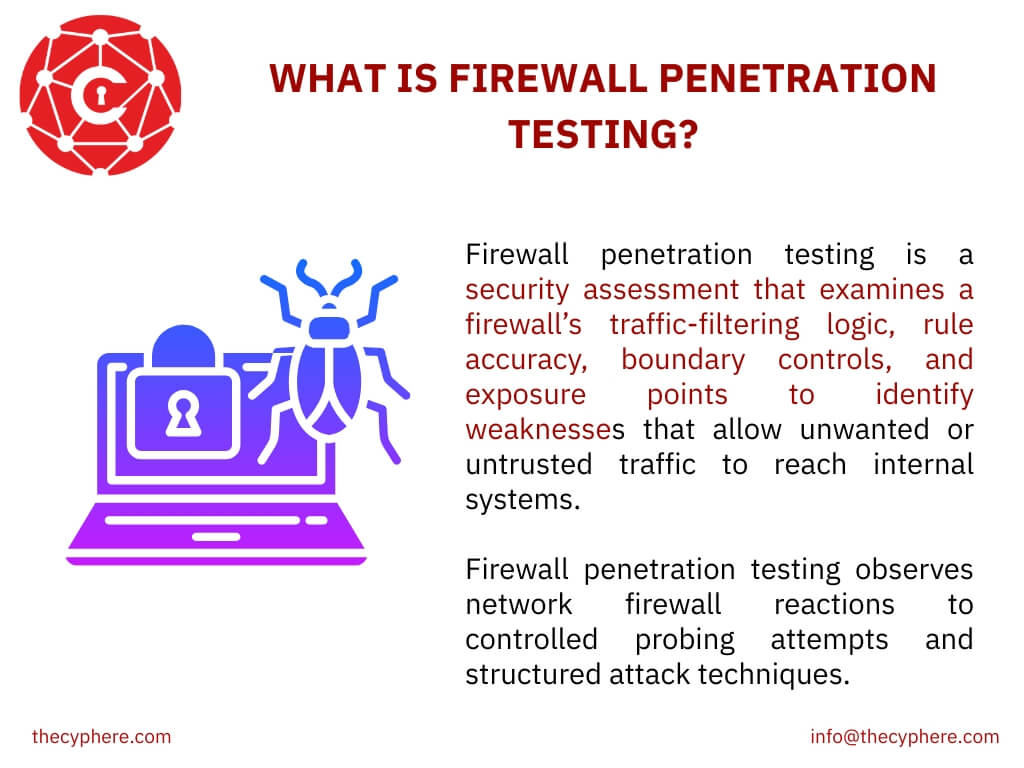
Firewall penetration testing is a security assessment that examines a firewall’s traffic-filtering logic, rule accuracy, boundary controls, and exposure points to identify weaknesses that allow unwanted or untrusted traffic to reach internal systems. Firewall penetration testing observes network firewall reactions to controlled probing attempts and structured attack techniques. This testing appears in broader security literature under related terms such as penetration testing, vulnerability assessment and penetration testing (VAPT), ethical hacking, security testing, network penetration testing, and the Flaw Hypothesis Methodology (FHM).
Firewall penetration testing includes crafted packets, analysing traffic responses, reviewing exposed services, checking authentication paths, and assessing management interfaces. The evaluation covers the firewall’s handling of fragmented packets, scanning sequences, redirected flows, and other traffic behaviours that reveal configuration weaknesses. Firewall penetration testing focuses on checking rule accuracy, observing real traffic-filtering behaviour, identifying high-impact configuration weaknesses, and revealing exposure points that automated scanners often miss.
How does firewall penetration testing work?
The firewall penetration testing works by sending controlled traffic toward the firewall and noting the point where the firewall allows, blocks, inspects, or logs that traffic. The process records real behaviour by observing which ports respond and which packets drop without notice. It also notes which flows trigger logging and which services return banners. These observations show which traffic patterns cross intended security boundaries and where exposure points exist.
This procedure identifies weaknesses inside the network, such as misconfigured filtering rules, exposed management paths, weak traffic-control boundaries, and forwarding decisions. The goal of firewall penetration testing, inside broader network penetration testing, is to verify that the firewall enforces its policies correctly and prevents external or internal traffic from reaching resources that remain outside the permitted scope.
What is the scope of firewall penetration testing?
The scope of firewall penetration testing defines which firewall devices, network segments, rule sets, and management interfaces are authorised for testing. A comprehensive scope document typically covers perimeter firewalls, internal segmentation firewalls, cloud-based firewalls (such as AWS Security Groups or Azure NSGs), and virtual firewall appliances. It also specifies the IP addresses and network ranges to be tested, permitted source locations for testing traffic, and whether management interface testing is included.
The scope should clearly define the testing methodology whether black-box (no rule-set access), grey-box (partial configuration visibility), or white-box (full rule-set access and documentation). Equally important are the exclusions and constraints, including production traffic disruption limits, denial-of-service testing restrictions, testing windows, and any third-party managed firewalls requiring separate authorisation. Clear scope definition ensures testing activities remain within authorised boundaries, avoid unintended production impact, and deliver actionable findings aligned with the organisation’s security priorities.
What authorisation is required for firewall penetration testing?
Firewall penetration testing requires explicit written authorisation before testing begins. The following documentation should be in place.
- Letter of Authorisation (LOA): This is an authorisation letter signed by an authorised representative of the organisation. It specifies firewall devices, IP addresses, and network ranges in scope, defining testing dates and permitted testing windows. Sometimes, additional details such as authorised testers and contact details are also included.
- Rules of Engagement (ROE): This document defines the operational boundaries for the testing engagement. It outlines permitted testing techniques and traffic types, specifies prohibited activities such as denial-of-service testing or actions that could cause production disruption, and establishes escalation procedures for critical findings. The ROE also includes emergency stop procedures with relevant contacts and details data handling requirements for any traffic captured during testing.
- Stakeholder Notification: Before testing begins, relevant internal teams must be informed. This includes ensuring network operations team awareness, notifying the security operations centre (SOC) of planned testing activities, and obtaining change management approval where organisational policies require it.Testing without proper authorisation may violate the Computer Misuse Act 1990 and expose both the tester and organisation to legal liability.
How to perform firewall penetration testing?
Firewall penetration testing methodology is a guided security process that evaluates a firewall by running targeted probes, observing its filtering decisions, and following a clear sequence of discovery, scanning, rule assessment, and traffic-behaviour validation.
Listed below are the 14 steps to perform firewall penetration testing.
1. Discover the firewall using ICMP/TCP/UDP probes.
Discovering the firewall in firewall penetration testing identifies the firewall’s network position and packet-handling behaviour by sending ICMP (Internet Control Message Protocol), TCP (Transmission Control Protocol), and UDP (User Datagram Protocol) probes that expose the device controlling the traffic path. Pen testers perform this step by generating crafted probe packets toward selected targets. They review the timing, the rejections, and the silent drops that appear in response to pinpoint the firewall’s position and understand which protocols it processes first.
This procedure reveals the firewall’s presence, the protocols that trigger inspection, the ports that respond under restricted conditions, and the response traits that highlight the device’s inspection depth. This stage improves the accuracy of the full assessment because early firewall discovery shows which ports respond externally, which protocols accept or reject traffic, and which boundary points are visible from outside the network. Research published by SANS and ISC handlers notes that attackers often begin reconnaissance with firewall discovery, as external responses guide them toward the next service, rule set, or interaction point to examine. Pen testers commonly rely on Nmap, Hping3, Scapy, and Nemesis to perform this discovery step.
Firewall discovery activities align with MITRE ATT&CK Reconnaissance (TA0043), specifically Active Scanning (T1595) and Network Service Discovery (T1046).
2. Perform comprehensive port scanning (TCP/UDP)
Performing comprehensive port scanning in firewall penetration testing examines the firewall’s reaction to TCP and UDP probes across a wide port range to determine which services remain reachable under filtered conditions. Pen testers scan selected TCP and UDP ports and review open, filtered, or blocked responses to understand the firewall’s service visibility and rule behaviour.
This procedure exposes reachable services, inconsistent filtering patterns, protocol combinations that trigger deeper inspection, and ports that indicate configuration gaps.
According to recent US threat-intelligence analysis on external exposure, misconfigured or unnecessary ports consistently appear in a significant share of confirmed intrusion paths, which elevates port-level review as a critical stage in firewall penetration testing. Pen testers use Nmap, Masscan, Unicornscan, and Zmap for port scanning.
3. Execute banner grabbing for service identification.
Executing banner grabbing in firewall penetration testing captures the visible information that a service returns during connection attempts to identify the application running behind the firewall. Pen testers initiate controlled connection requests over filtered or partially open ports and review the banners, protocol headers, or service responses that disclose application identity.
This procedure reveals the service type, version hints, configuration traits, and communication behaviour that help the tester map the environment behind the firewall.
This step carries clear value because real-world attack-surface observations show that 25–35% of exposed services return identifiable banners, and environments that leak banner information experience higher targeted probing during early reconnaissance activity.
Pen testers commonly use Netcat, Nmap scripts, Telnet, Curl, and custom Python sockets for banner-grabbing tasks during service identification.
4. FingerPrint firewall vendor and firmware version
Fingerprinting the firewall vendor and firmware version in firewall penetration testing identifies the specific firewall platform and software build by analysing the device’s response patterns, protocol signatures, and behaviour traits under controlled probing. Pen testers send crafted TCP, UDP, and application-layer queries and review timing characteristics, header formats, and subtle fingerprint clues that reveal the underlying vendor or firmware family.
This procedure highlights the exact firewall model, its release version, and the configuration tendencies associated with that version, which helps the tester predict rule-handling behaviour and identify potential weaknesses. Research-based security observations indicate that 20–30% of firewall-related findings stem from outdated or unpatched firmware, making firmware identification one of the most influential steps for understanding real exposure. Pen testers commonly use Nmap version detection, Xprobe2, p0f, and custom fingerprinting scripts for this activity.
5. Enumerate firewall rules via packet crafting.
Enumerating firewall rules via packet crafting in firewall penetration testing means uncovering the firewall’s decision logic by sending customised packets that test specific rule paths and reveal how the device processes different traffic combinations. Pen testers craft packets with controlled flags, protocol variations, uncommon port pairs, and fragmentation patterns to trigger distinct rule evaluations and observe the firewall’s responses.
This procedure exposes rule-order behaviour, priority conflicts, silent drops, and conditional allowances that help the tester understand the structure of the firewall’s access-control logic. Industry assessments frequently identify rule-design issues as a common finding category during firewall configuration reviews, making this step one of the strongest indicators of configuration reliability during a firewall test. Pen testers commonly use Scapy, Hping3, Nemesis, and custom packet-builders for rule enumeration.
6. Conduct firewalking to map filtering policies.
Conducting firewalking in firewall penetration testing means tracing the firewall’s filtering path by sending incrementally routed packets that reveal where the device allows, inspects, or blocks traffic during hop-by-hop traversal. Pen testers generate TTL-controlled probes and review the responses that show which traffic types pass through intermediate hops and which ones fail at the firewall boundary.
This procedure exposes the exact filtering depth, protocol restrictions, reachable segments, and misaligned rule behaviours that shape the firewall’s real enforcement path. Attack-surface observations across enterprise assessments show that restricted traffic often leaks through 20–28% of mid-path hops, which makes firewalking one of the most relied-upon techniques for validating layered filtering in complex networks. Pen testers commonly use Firewalk, Nmap trace functions, Hping3, and customised routing probes for this activity.
7. Test NAT and port redirection configurations.
Testing NAT (Network Address Translation) and port-redirection configurations in firewall penetration testing means examining translation rules and forwarded service paths that determine where traffic lands inside the network. According to 2024 network-assessment analyses, these translation behaviours often differ across enterprise environments, with NAT-related weaknesses appearing as recurring configuration issues. Pen testers send controlled inbound and outbound traffic toward translated addresses and observe how the firewall rewrites, redirects, or drops the packets.
This procedure identifies mis-mapped services, exposed internal hosts, inconsistent translation flows, and redirection behaviours that reveal unintended access paths. Enterprise assessment observations show that translation-layer inconsistencies appear in 18–27% of reviewed configurations, which makes NAT validation a critical stage for confirming real exposure boundaries. Pen testers commonly use Nmap, Hping3, Scapy, and customised NAT-probe scripts to complete this check.
8. Test ACL bypasses using fragmentation attacks.
Testing ACL (Access Control List) bypasses using fragmentation attacks in firewall penetration testing means evaluating rule behaviour against fragmented traffic patterns such as overlapping fragments, tiny fragments, and offset-based sequences that attempt to slip past access-control checks. Pen testers generate controlled fragment sets and analyse the firewall’s handling of reassembly, partial matches, or misaligned segments across different ACL rules.
This procedure highlights inconsistent filter actions, overlooked rule conditions, delayed drops, and boundary cases where fragmented packets reach segments that normally remain restricted. Network-assessment observations report that fragmentation-related filtering gaps appear in 15–22% of reviewed environments, which makes ACL bypass testing a reliable indicator of rule-set resilience during adversarial evaluation. Pen testers commonly use Hping3, Scapy, Fragroute, and custom fragmentation scripts to perform this activity.
9. Analyse the rule base for policy conflicts.
Analysing the rule base for policy conflicts in firewall penetration testing means reviewing overlapping, misordered, or contradictory rules such as broad allow statements, shadowed denies, and unused legacy entries that alter the firewall’s intended enforcement path. Pen testers evaluate rule order, cross-rule interactions, and contextual matches to see where earlier rules override, mask, or nullify later conditions.
This procedure identifies rule-shadowing behaviour, unintended allowances, priority clashes, and access paths that emerge solely because two or more rules interact incorrectly. According to 2024 enterprise configuration observations, rule-interaction issues appear in 36% of reviewed firewalls, and this frequency positions rule-based analysis as one of the strongest indicators of configuration accuracy in defensive controls. Pen testers commonly use firewall rule-analysis tools, config-auditing scripts, and structured review methods to evaluate policy consistency.
Fragmentation-based evasion techniques map to MITRE ATT&CK Defence Evasion (TA0005), including Protocol Impersonation (T1001.003) and Traffic Signalling (T1205).
10. Execute evasion via tunnelling techniques.
Executing evasion via tunnelling techniques in firewall penetration testing means checking whether the firewall correctly inspects encapsulated traffic patterns, such as DNS tunnelling, HTTP encapsulation, and ICMP-based carriers that attempt to slip through permitted channels. Pen testers create controlled tunnels that wrap restricted traffic inside allowed protocols and observe how the firewall processes, unwraps, or blocks the encapsulated payloads.
This procedure highlights inspection gaps, decoding limitations, protocol loopholes, and bypass paths that appear when the firewall fails to analyse the encapsulated content in depth. Tunnelling evaluation remains valuable because it reveals weaknesses that traditional rule checks cannot detect and shows how the firewall behaves when traffic disguises itself inside trusted protocols. Pen testers commonly use tools such as DNScat2, Iodine, Chisel, and custom encapsulation scripts to perform this activity.
Tunnelling evasion aligns with MITRE ATT&CK Command and Control (TA0011), including Protocol Tunnelling (T1572) and Application Layer Protocol (T1071).
11. Test from internal network positions
Testing from internal network positions in firewall penetration testing means evaluating the firewall’s enforcement behaviour against traffic generated from trusted zones such as office VLANs (Virtual Local Area Network), internal subnets, and authenticated user segments. Pen testers send structured requests from inside the network and observe which outbound flows succeed, which internal paths remain exposed, and which services respond without expected restrictions.
This procedure highlights weak egress controls, overlooked internal routes, unrestricted service responses, and internal hosts that communicate beyond their intended boundaries. Internal-position testing holds strong practical value because assessment patterns across enterprise networks frequently show that 30–40% of misconfigurations only appear when the firewall processes traffic originating from trusted internal segments. Pen testers commonly use internal scanning utilities, endpoint-based probes, and tools such as Nmap, Hping3, and Netcat to complete this activity.
12. Exploit management interfaces and known CVEs
Exploiting management interfaces and known CVEs (Common Vulnerabilities and Exposures) in firewall penetration testing means examining administrative entry points such as web consoles, SSH panels, and API endpoints to identify weaknesses that allow unauthorised control or configuration access. Pen testers validate authentication paths, check exposed services, review firmware histories, and test publicly documented vulnerabilities linked to the firewall’s vendor and software version.
This procedure identifies weak credential controls, outdated firmware builds, unpatched administrative flaws, and management surfaces that reveal more information than intended. Assessment trends across enterprise environments show that 22–32% of firewall-related weaknesses originate from outdated or exposed management interfaces, which makes this stage one of the most decisive checks for understanding administrative exposure. Pen testers commonly use vulnerability scanners, CVE validation scripts, version-check utilities, and tools such as Nmap NSE, Metasploit modules, and custom exploit probes for this activity.
Management interface exploitation corresponds to MITRE ATT&CK Initial Access (TA0001) via Exploit Public-Facing Application (T1190) and External Remote Services (T1133).
13. Test logging evasion and identify blind spots.
Testing logging evasion and identifying blind spots in firewall penetration testing means reviewing the firewall’s recording behaviour against traffic patterns such as fragmented requests, low-rate probes, and disguised protocol sequences, according to a 2025 network-observability report titled “Enterprise Traffic Monitoring and Blind Spot Review 2025” that highlights logging gaps across monitored environments. Pen testers generate controlled traffic that imitates low-noise attacker behaviour and observe which events appear in the logs, which entries remain incomplete, and which flows pass without any recorded trace.
This procedure reveals silent traffic paths, missing event chains, inconsistent log entries, and inspection decisions that reduce operational visibility. Blind-spot checks remain valuable because firewall assessments regularly reveal visibility gaps when processing fragmented, rate-limited, or protocol-shifted traffic. Pen testers commonly use packet-crafting utilities, SIEM (Security Information and Event Management) correlation checks, and tools such as Scapy, Hping3, and custom log-validation scripts to perform this activity.
14. Document findings with rule recommendations
Documenting findings with rule recommendations in firewall penetration testing means producing verified evidence of filtering weaknesses and rule-design flaws, such as permissive allow entries, shadowed deny lines, and legacy rules that no longer enforce the intended policy, according to a 2025 configuration-analysis report titled “Firewall Policy Review and Enforcement Practices.” Pen testers capture packet traces, review rule interactions, and convert each confirmed finding into a targeted configuration change.
This procedure delivers structured findings, corrected rule orders, refined filtering decisions, and actionable recommendations that align the firewall with the defined security boundaries. This stage remains decisive because configuration reviews repeatedly expose clusters of rule-interaction issues that only become clear when findings are documented with accurate evidence and mapped to the enforcement layers. Pen testers prepare consolidated reports, rule-mapping sheets, and corrective action summaries supported by packet logs, trace outputs, and configuration-audit results.
How much does firewall penetration testing cost?
The cost to perform firewall penetration testing in the UK typically ranges from £2,000 to £10,000+ per project, with an average price of £3,000 to £6,000 for configuration-focused assessments of high-availability clusters. The minimum cost ranges from £2,000 to £3,000 for a single virtual firewall or network security group review, whilst the maximum cost exceeds £8,000 for layered enterprise firewall architectures.
Small-scope firewall penetration testing costs around £2,000 for rule-based reviews of single office firewalls. Medium-scope engagements cost approximately £5,500 for segmentation audits across campus networks, and large or enterprise reviews exceed £12,000 for global SD-WAN and multi-layer deployments. For example, a mid-tier retail bank typically pays around £4,000 for a week long audit of Palo Alto firewalls to meet PCI DSS v4.0 requirements. Several factors increase the base cost, including rulebase volume (cost is sometimes rules based due to extended analysis time), virtual firewall instances (adding around £1,500), and egress testing (adding approximately £1,200 because data-exfiltration paths require deeper validation).
What are the three ways to perform firewall penetration testing?
Listed below are three ways to perform firewall penetration testing.
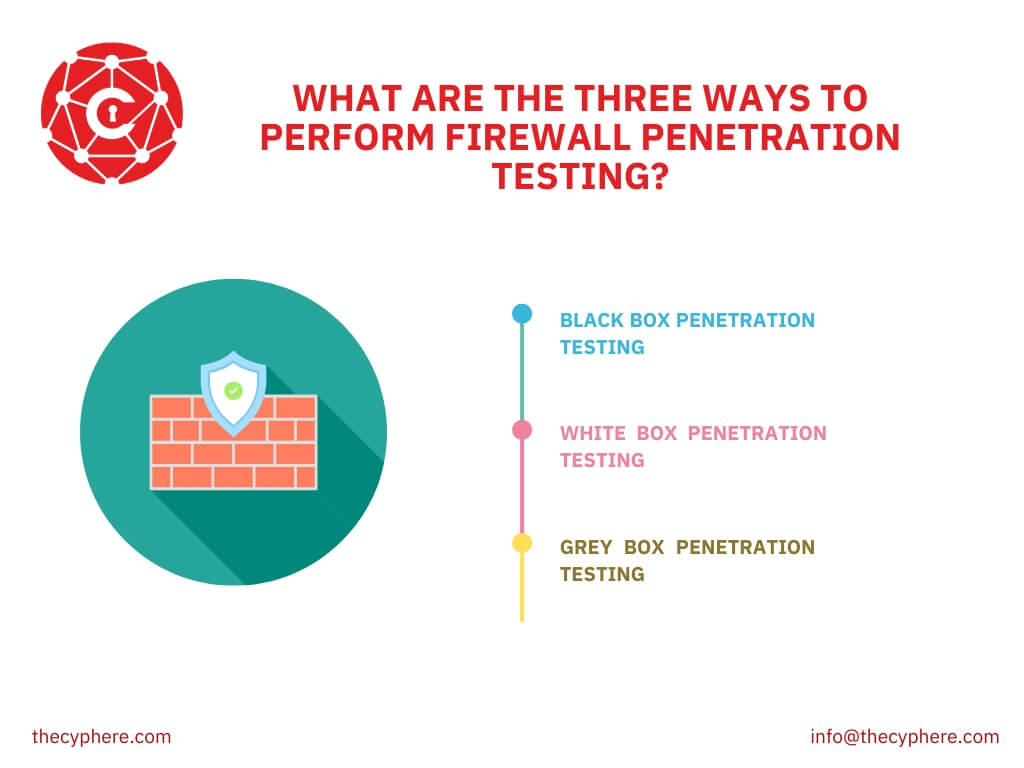
- Black Box Penetration Testing: Performing firewall penetration testing using black box techniques involves evaluating the firewall from an external attacker’s perspective with no internal knowledge of rule sets, network layout, or filtering structure. This approach includes reconnaissance activities such as public-surface mapping, scanning to locate exposed ports and services, vulnerability identification based on externally visible behaviour, exploitation attempts, and limited post-exploitation steps that simulate real threat campaigns. Black Box assessments are used for perimeter validation and typically run at least once a year. External reviews repeatedly show that roughly 1/10 of visible touchpoints require immediate rule tightening. This method reveals vulnerabilities such as exposed management surfaces, weak perimeter rules, externally reachable services, filtering inconsistencies, and misconfigured access paths that remain visible from outside the network boundary.
- White Box Penetration Testing: Applying white box penetration testing to a firewall involves analysing it with complete internal visibility, including access to configuration assets such as rule sets, architecture diagrams, and translation paths. This approach includes rule-interaction checks, translation-layer validation, internal traffic modelling, and privilege-escalation simulations across trusted segments. According to configuration-assurance guidelines, White Box testing should be performed during major redesigns and at least once per year; however, internal audit frameworks recommend running it twice a year when the network carries sensitive workloads or undergoes frequent rule changes. White box penetration testing uncovers weaknesses such as misordered rules, legacy entries, unrestricted internal flows, incorrect NAT behaviour, and segmentation gaps.
- Grey Box Penetration Testing: Conducting grey box penetration testing on a firewall involves assessing it with partial internal knowledge, such as limited access details, sample rule sets, or controlled visibility into selected zones. This approach includes targeted rule-path checks, controlled internal-external flow mapping, semi-informed traffic probing, and verification of mixed visibility segments. Grey Box testing is used when organisations need deeper insight than Black , Box but do not require full configuration disclosure. It is commonly performed during change cycles or whenever hybrid risk assessment is needed across internal and external routes. Grey Box testing should occur once per year to validate mixed-visibility behaviour. Hybrid-risk guidelines suggest running it twice per year when the firewall controls multiple segments or when partial-trust routes change frequently. Grey box penetration testing identifies vulnerabilities such as conditional rule failures, segmentation weaknesses, configuration drift between zones, restricted-flow inconsistencies, and pathways that depend on partial knowledge to identify.
Can you perform firewall penetration testing online?
Yes, you can perform firewall penetration testing online by using cloud-based scanners, hosted security platforms, and remote testing services. These methods assess your firewall from the internet’s perspective and do not require physical access to your environment. Online penetration testing runs firewall and perimeter assessments through remote platforms, where the testing workflow does not depend on human physical presence or on-site system interaction. The term describes external scanning, exposure mapping, rule-path checks, and filtering analysis that you run through a hosted security engine instead of installing tools locally. Online testing works by sending controlled traffic from cloud-based systems toward your public IP addresses. This approach helps you identify open ports, misconfigurations, exposed services, and the behaviour patterns that appear in your firewall’s filtering logic.
What tools are used to perform firewall penetration testing?
Firewall penetration testing tools are specialised network-level utilities that map exposed services, craft controlled packets, analyse filtering behaviour, and verify rule enforcement under an authorised testing scope.
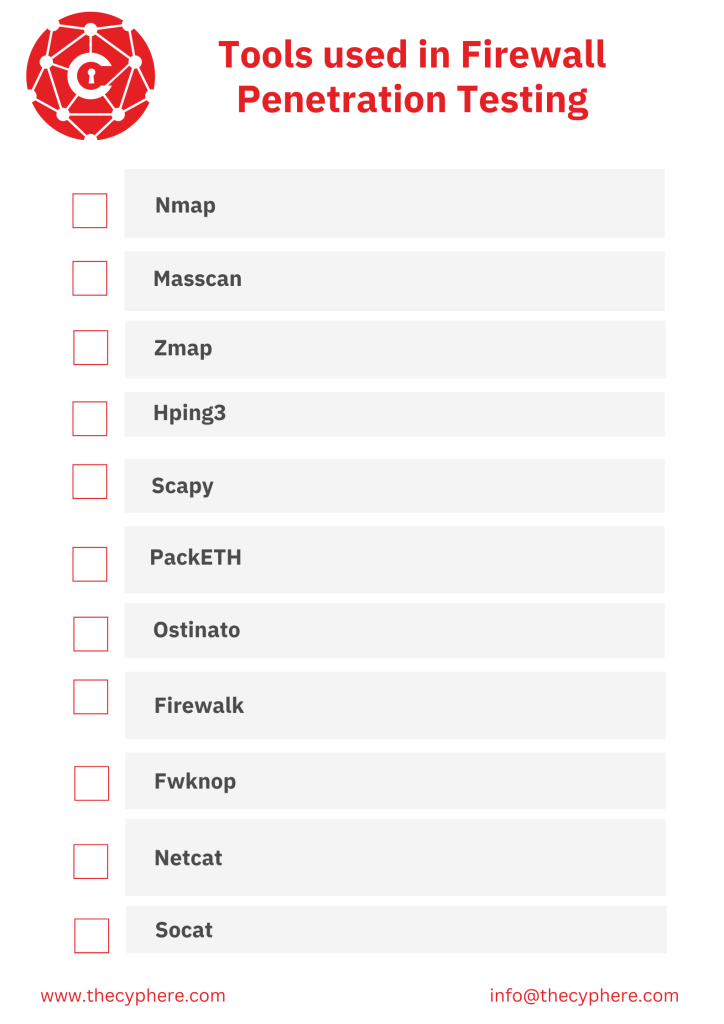
Listed below are the 11 firewall penetration testing tools.
- Nmap: Nmap is a network-scanning utility that identifies live hosts, open ports, and reachable firewall services across public and internal networks. Nmap includes script-based automation through NSE (Nmap Scripting Engine), protocol fingerprinting for identifying service behaviour, structured service enumeration for mapping exposure points, and adaptive timing controls. Nmap targets exposure points such as open ports, weak filtering paths, service banners, and reachable interfaces that reveal the firewall’s external behaviour. Nmap is used in the scanning and active-reconnaissance phase, where it maps the firewall’s accessible attack surface before deeper testing begins. Nmap finds firewall-related vulnerabilities such as misconfigured filtering rules, exposed management ports, inconsistent TCP/UDP handling, and services that bypass intended perimeter restrictions.
- Masscan: Masscan is a high-speed port-scanning tool designed to sweep large IP ranges and identify externally reachable services with exceptional throughput. The tool uses asynchronous packet transmission, supports high-speed scan cycles, and performs high-volume probing. Masscan targets firewall-exposure issues such as externally visible ports, incomplete blocking rules, high-risk services, and network segments that respond beyond expected boundaries. Masscan is used in large-scale reconnaissance phases where high-throughput scans help determine which perimeter elements require deeper inspection. Masscan finds vulnerabilities such as unintended service exposure, incomplete perimeter lockdowns, stale rule entries, and open ports that should not be internet-reachable.
- Zmap: Zmap is a single-packet network scanner engineered to rapidly enumerate open services and firewall reachability across very large IP spaces. The tool performs one-probe-per-host scanning, uses modular probing engines to adjust testing sequences for different protocols, and carries out a high-speed survey. Zmap targets exposure issues such as globally reachable services, weak perimeter controls, and externally visible ports across distributed environments. Zmap is used in early reconnaissance when wide-area visibility is required to understand which assets the firewall exposes at scale. Zmap identifies vulnerabilities such as globally open ports, unfiltered network blocks, unmanaged public interfaces, and firewall gaps across cloud or multi-region deployments.
- Hping3: Hping3 is a packet-crafting utility that generates custom TCP, UDP, and ICMP packets to analyse how a firewall processes and filters controlled traffic patterns. The tool offers flag-level manipulation, builds raw packets, maps rule behaviour, and runs protocol-specific fuzzing. Hping3 targets issues such as weak packet inspection, incomplete TCP flag validation, inconsistent rule responses, and inadequate protocol filtering. It is used during the packet-manipulation and rule-evasion phase, where testers examine filtering depth, flag-handling logic, and boundary conditions. Hping3 identifies firewall vulnerabilities such as loose flag combinations, unfiltered UDP behaviour, bypass-prone ICMP paths, and rules that fail under customised packet sequences.
- Scapy: Scapy is a programmable packet-engineering toolkit that lets testers build, send, capture, and analyse packets across layers such as Ethernet, IP, TCP, UDP, and ICMP. The tool provides complete protocol-stack manipulation, packet forging, custom dissectors, fuzzing modules, and automated behavioural testing through Python scripting. Scapy targets issues such as rule-handling inconsistencies, partial packet drops, protocol parsing weaknesses, and fragmented-traffic behaviour. It is used during advanced rule-analysis and fragmentation-testing phases where granular control over packet structure is required. Scapy uncovers vulnerabilities such as fragment-handling flaws, partial reassembly issues, protocol-parsing weaknesses, and firewall decisions that shift under non-standard packet formats.
- PackETH: PackETH is a Linux-based GUI packet generator used to create custom Ethernet, IP, TCP, UDP, and ICMP packets for visualised firewall testing. The tool builds layer-by-layer packet assembly, real-time traffic sending, and an interface that allows structured manipulation without scripting. PackETH targets issues such as incorrect layer-filtering behaviour, protocol-specific misconfigurations, and rule interactions that depend on packet structure. It is used in the packet-crafting phase where testers validate how the firewall reacts to structured, malformed, or boundary-case traffic. PackETH finds vulnerabilities such as malformed-packet acceptance, broken protocol filters, incorrect rule interpretation, and filters that allow traffic they should block.
- Ostinato: Ostinato is a packet-crafting and traffic-generation tool that sends customised multi-flow streams to observe how a firewall handles sustained or varied packet sequences. The tool replays multiple traffic streams, pcap-based traffic injection, GUI workflow, and protocol-level modification. Ostinato targets issues such as flow-handling weaknesses, rule saturation points, misconfigured rate-limits, and inconsistent behaviour under traffic variety. It is used during stress-testing and flow-validation phases to measure how the firewall behaves under controlled multi-stream traffic. Ostinato identifies vulnerabilities such as rate-limit failures, sequence-handling inconsistencies, misinterpreted flows, and rules that collapse under repeated or multi-type traffic.
- Firewalk: Firewalk is a rule-path discovery tool that determines which protocols and ports can pass through a firewall by sending TTL-controlled probes toward a target network. The tool analyses filtering behaviour at each hop to show where packets move or drop, controlled TTL (Time To Live) sequencing, and path-specific rule verification that shows exactly where traffic is allowed or stopped. Firewalk targets firewall issues such as misaligned rule ordering, partially open paths, protocol-specific allowances, and upstream filtering weaknesses. Firewalk is used during the rule-path enumeration phase, where testers measure boundary behaviour across intermediate hops and filtering checkpoints. Firewalk finds vulnerabilities such as unintended pass-through routes, incorrectly filtered protocols, open mid-path ports, and rule inconsistencies that expose internal segments.
- Fwknop: Fwknop is a Single-Packet Authorisation tool that evaluates whether a firewall correctly processes SPA-protected services and externally triggered access controls. Its unique features include encrypted SPA (Single Packet Authorisation) packet generation, access-trigger simulation, and verification of port-knocking or SPA-based exposure controls. Fwknop targets issues such as misprotected management ports, improperly configured SPA rules, unintentionally exposed services, and SPA bypass conditions. Fwknop is used during the access-control assessment phase, where external triggers and SPA sequences are tested for correctness and reliability. It finds vulnerabilities such as SPA failures, unprotected service exposure, misconfigured knock sequences, and firewall behaviours that open ports without proper authorisation.
- Netcat: Netcat is a lightweight network utility that creates direct TCP or UDP connections to observe how a firewall responds to specific ports, services, and traffic patterns. The tool collects service banners, performs manual port probes, handles reverse connections, and moves data through simple sockets. Netcat targets issues such as unfiltered service ports, exposed management interfaces, weak inbound rules, and unintended open pathways. It is used during the connection-testing phase, where testers verify whether ports respond, reset, or silently drop connections behind the firewall. Netcat identifies firewall vulnerabilities such as exposed ports, incomplete filtering, weak service restrictions, and ports that allow interaction despite deny rules.
- Socat: Socat is a multi-purpose relay and tunnelling tool that connects, forwards, or redirects traffic between endpoints to observe how a firewall handles complex connection flows. Its unique features include multi-protocol bridging, encrypted relays, port redirection, and flexible socket manipulation across TCP, UDP, SSL, and pipes. Socat targets issues such as incorrect outbound restrictions, misconfigured forwarding rules, tunnel-friendly ports, and behaviours that expose unintended traffic paths. It is used in the connection-control and tunnelling-validation phases where testers simulate chained flows and hybrid traffic routes. Socat identifies firewall vulnerabilities such as incorrect egress filtering, tunnel bypass points, unrestricted redirection behaviour, and flows that pass through ports meant to be controlled.
What kind of vulnerabilities are found in firewall penetration testing?
Listed below are the vulnerabilities identified during firewall penetration testing.
- Misconfigured firewall rules
- Exposed or unnecessarily open ports
- Outdated firewall firmware
- Shadowed or conflicting rule entries
- Weak authentication controls
- Weak outbound filtering
- Improper NAT configurations
- Fragmentation-handling weaknesses
- Incorrect protocol filtering
- ICMP handling gaps
- Unrestricted administrative interfaces
- Inadequate logging and monitoring
- Poor network segmentation
- Rule-ordering errors
- Default or insecure services enabled
How can organisations benefit from firewall penetration testing?
A firewall is a boundary-control system that manages traffic between network zones by applying rule sets that decide which connections are allowed into the environment and which are blocked at the perimeter. Scanning the perimeter traffic helps uncover exposed services, weak filtering paths, and points where unwanted packets slip deeper into the network, giving organisations a clear picture of their defensive gaps. This visibility supports safer configurations, stronger access control, and timely fixes that reduce real attack opportunities through a firewall security assessment services.
Firewall penetration testing helps organisations strengthen their networks by uncovering misconfigurations early, reducing unnecessary internet-facing exposure, improving segmentation accuracy, and preventing external traffic from reaching internal assets.
What are the uses of firewalls in a network?
Listed below are the 7 uses of firewalls in a network.
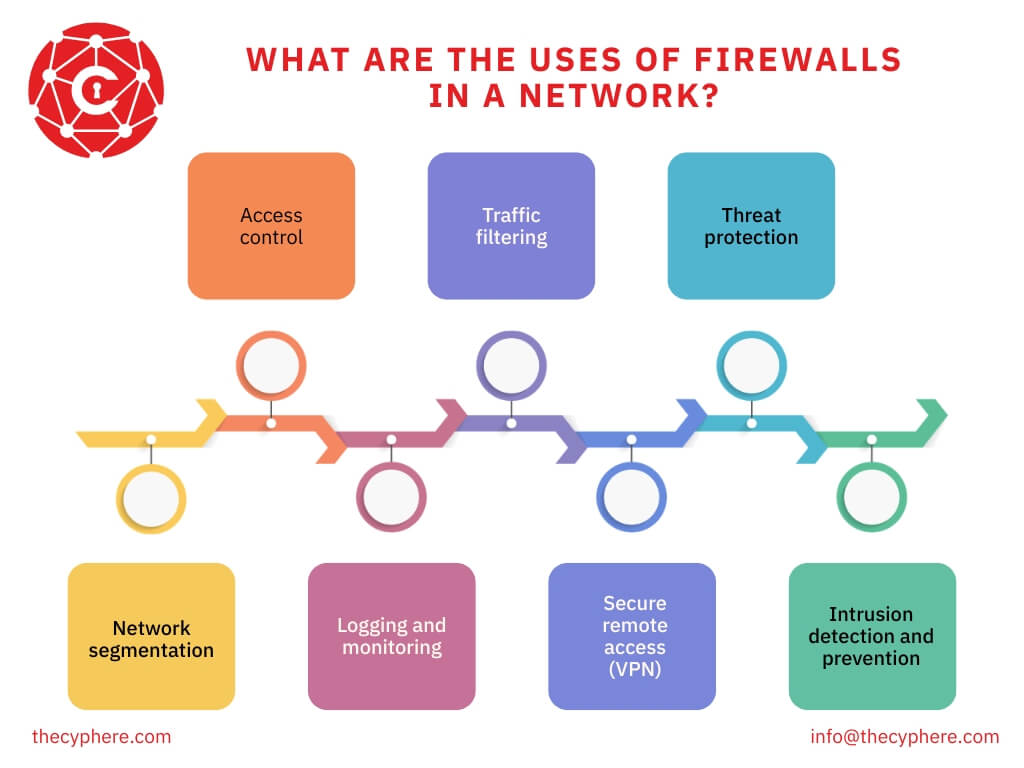
- Access control: Firewall limits access control by regulating which users, devices, and services may reach protected network zones, and pen testers verify these restrictions through tools such as Nmap and Netcat.
- Traffic filtering: Firewall filters traffic by controlling packet movement across protocols such as TCP, UDP, and ICMP, and testers examine this behaviour with tools such as Hping3 and Scapy.
- Threat protection: Firewall protects the organisation from threats by blocking intrusion attempts, malware flows, and external scans at the perimeter, and testers assess these exposures with scanners such as Masscan and Zmap.
- Network segmentation: Firewall segments the network by dividing internal, external, and DMZ (Demilitarised Zone) zones to reduce lateral movement, and testers map these boundaries using tools such as Firewalk.
- Logging and monitoring: Firewall records activity through logging and monitoring to support security review and policy checks, and testers confirm visibility gaps with tools such as Scapy and Netcat.
- Secure remote access (VPN): Firewall secures remote access by supporting encrypted VPN connectivity for off-site users, and testers analyse reachable VPN paths with tools such as Nmap, Masscan, and Socat.
- Intrusion detection and prevention: Firewall detects and stops intrusions by reacting to suspicious traffic patterns and malformed packets, and testers simulate these events using tools such as Scapy, Hping3, and Ostinato.
How often should firewalls be pentested to make a network secure?
Firewalls should be pentested on a quarterly schedule (every three months) to maintain network security in most environments. This frequency keeps pace with perimeter changes, external exposure, and the steady appearance of new threat patterns noted across industry assessments.
Some organisations use annual or biannual testing cycles, but these longer intervals usually fit slower-changing networks and provide less protection in environments where systems, rules, or access points shift regularly. Firewall penetration testing is also required after major changes such as new deployments, significant rule updates, segmentation redesigns, or any incident that modifies traffic flow across network boundaries.