Continuous penetration testing is a proactive digital security methodology that involves the ongoing and immediate evaluation of a firm’s digital assets by security experts and automated mechanisms. Continuous security testing identifies and fixes problems immediately as they occur.
According to 2025 research by Nivedita Palatty titled “83 Penetration Testing Statistics: Key Facts and Figures,” 73% of successful corporate breaches were carried out by penetrating vulnerable web applications. The average time for an attacker to gain full control of an internal network is often as short as four days, according to a 2024 study by PurpleSec. According to research by Ioana Popa, titled ‘100+ Essential Penetration Testing Statistics‘, 75% of companies perform penetration tests to measure their security posture or for compliance reasons. According to a 2024 study by Xiaolu et al., titled “Data Security Assessment Method Based on Penetration Testing,” continuous penetration testing achieves critical vulnerability detection rates of up to 85% in simulated enterprise environments, with detection response times as low as 0.15 seconds.
Continuous penetration testing is not the same as automated penetration testing because of human-led assessment, continuous attack path validation, and adaptive threat modelling.
According to the 2025 study by Pabitra titled “What is continuous penetration testing? Process and benefits, the main features of continuous penetration testing are real time integration and continuous frequency, hybried testing, dynamic scope and asset discovery and real time reporting. The benefits for an organisation of continuous penetration testing include reduced risk, a proactive security posture, cost-effectiveness, improved compliance, and real-time visibility.
Continuous penetration testing differs from traditional penetration testing due to its methodology and frequency. Traditional penetration testing is performed on an annual basis, while continuous penetration testing runs constantly and offers immediate feedback and security.
What is Continuous Penetration Testing?
Continuous penetration testing is a modern security practice that integrates the ongoing scrutiny of an organisation’s digital assets directly into its development and operational workflows, according to a 2024 article by Hacker News titled “The Facts About Continuous Penetration Testing and Why It’s Important.”
According to a 2025 study by Gal Malachi titled “Continuous Penetration Testing: Examples, Methodologies, and Objectives,” continuous penetration testing is a security assessment methodology that involves simulating real-world attack scenarios to uncover vulnerabilities.
The other names of continuous penetration testing are continuous security testing, penetration testing as a service, continuous attack surface penetration testing, continuous threat exposure management, and cyber asset attack surface management.
How does continuous penetration testing work?
Continuous penetration testing works as an adaptive process that utilises penetration testing as a service for automated arrangement and diagnostics. Continuous security testing starts with continuous asset discovery and automated scanning tools, then engages expert human penetration testers, and ensures real-time reporting. According to a 2025 study by Sanjiv Kumar, titled ‘Continuous Penetration Testing: Benefits and How It Works,’ this hybrid approach combines automation with human expertise.
According to a 2025 study by Gal Malachi titled “Continuous Penetration Testing: Examples, Methodologies, and Objectives,” the primary goal of continuous penetration testing is risk reduction, cyber resilience, proactive security, operational efficiency, and compliance. The purpose of continuous penetration testing is to reduce the window of exploitability, aligning security with modern speed, maintain a constantly strong security posture, achieve long-term cost efficiency, and ensure continuous compliance.
What is the scope of continuous penetration testing?
The scope of continuous penetration testing defines which digital assets, systems, and security controls are subject to ongoing assessment. Unlike traditional penetration testing with fixed scope boundaries, the continuous testing scope evolves dynamically as the organisation’s attack surface changes. Here are the main components of the continuous penetration testing scope:
Digital assets in scope:
Web applications (production, staging, development environments)
APIs (REST, GraphQL, SOAP endpoints)
Cloud infrastructure (AWS, Azure, GCP accounts and services)
Network infrastructure (external and internal network segments)
Mobile applications (iOS, Android)
Third-party integrations and SaaS connections
Dynamic scope considerations:
New assets are automatically included through attack surface discovery
Decommissioned assets are automatically excluded
Configuration changes trigger targeted testing
Code deployments initiate security validation
Testing methodology scope:
Automated scanning coverage and frequency
Manual testing depth and focus areas
Attack simulation scenarios and objectives
Social engineering inclusion (if applicable)
Exclusions and boundaries:
Third-party systems requiring separate authorisation
Production data handling limitations
Testing windows and blackout periods
Denial-of-service testing restrictions
Reporting and integration scope:
Real-time dashboard access
Ticketing system integration
SIEM and SOAR connections
Compliance reporting requirements
A clear scope definition ensures continuous testing activities align with business priorities, compliance requirements, and risk tolerance whilst avoiding unintended impacts on production systems.
Who provides continuous penetration testing?
Continuous penetration testing providers are specialist cybersecurity organisations that deliver ongoing security assessments combining automated scanning with expert human validation to identify and remediate vulnerabilities in real time.
According to a 2024 article by Aktira titled “The Essential Role of Continuous Penetration Testing in Protecting Digital Assets,” the roles and responsibilities of continuous security testing are high-frequency tasks (to automate scanning, asset discovery, and real-time reporting) and skilled ethical hacking (for vulnerability validation, complex attack simulation, remediation guidance, and retesting).
According to a 2025 study by Kevin Mitnick titled “Become a pen tester: The essential guide,” continuous penetration testing needs relevant education and skills to understand the depth of penetration testing and strong skills in real-time communication, process integration, and automation.
The essential technical skills for continuous security testing include automation, cloud protection, network enterprise, and tool proficiency. The key professional skills for continuous pen testing are analytical thinking, communication, reporting, and continuous learning.
According to a 2025 research by Chris Dale & Casey Cammilleri, titled “Continuous Penetration Testing: Closing the Gaps Between Threat and Response,” the certifications required for continuous penetration testing are Offensive Security Certified Professional (OSCP), Certified Ethical Hacker (CEH), CompTIA PenTest+, and GIAC Penetration Tester (GPEN).
What are the features of continuous penetration testing?
The four main features of continuous penetration testing are listed below.
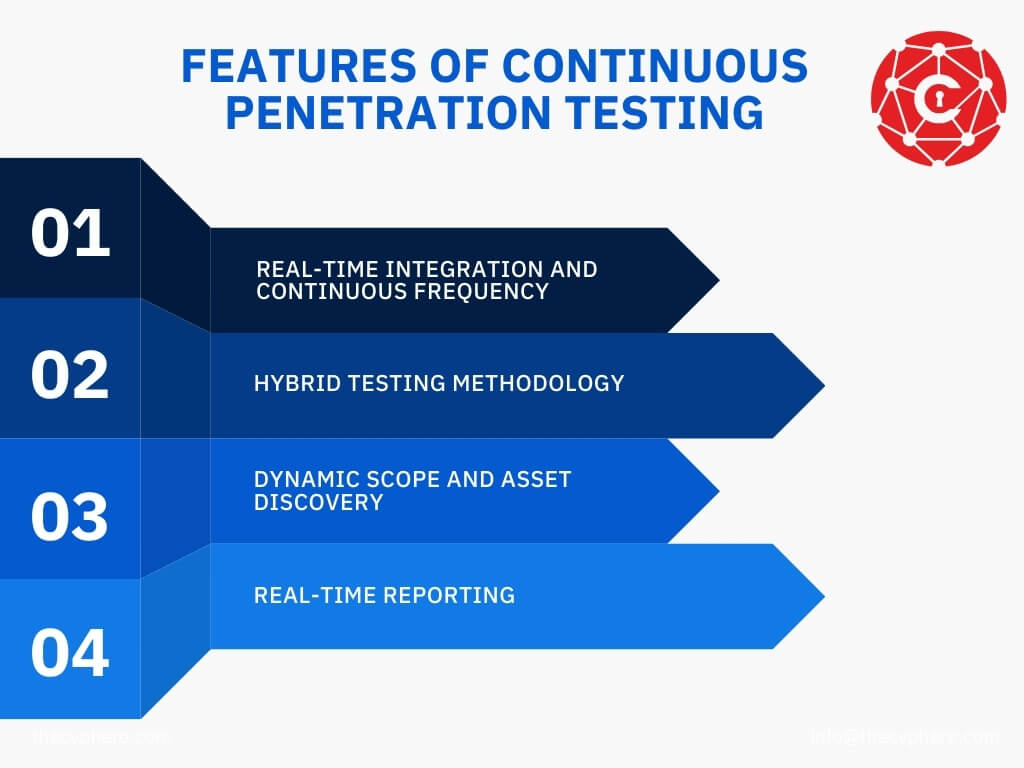
- Real-time integration and continuous frequency: Continuous penetration testing offers continuous frequency and real-time integration to help in ongoing assessment, event-driven testing, and DevSecOps integration.
- Hybrid testing methodology: Continuous penetration testing uses a hybrid testing methodology to offer intelligent automation, expert human validation, and complex attack simulation.
- Dynamic scope and asset discovery: Continuous penetration testing employs dynamic scope and asset discovery to provide an evolving scope and real-time threat alignment. This feature ensures that the testing is relevant to the latest trends, techniques, and procedures.
- Real-time reporting: Continuous penetration testing does real-time reporting to help in live dashboards, direct workflow integration, and fast retesting.
Is continuous penetration testing the same as automated penetration testing?
No, continuous penetration testing is not the same as automated penetration testing because of the human element, false positives, depth of testing, goal, and methodology.
According to a 2025 study by Lindsay Drozdik titled “Continuous Penetration Testing vs. Automated Scanning: Why the Human Element Still Matters,” continuous security testing is delivered through a penetration testing as a service (PTaaS) framework to organise human testing and automation in a continuous loop. Continuous security testing and automated pen testing are not the same because of their hybrid and static methodologies and deep and shallow depths.
What is not involved in continuous penetration testing?
Listed below are the aspects that are not involved in continuous penetration testing.
- Limited frequency and delayed testing: Limited frequency and delayed testing are not involved in continuous penetration testing because of annual or semi-annual testing schedules, testing only at the end of SDLC (Software Development Lifecycle), and a static security snapshot.
- Manual reporting: Traditional manual reporting is not a defining part of continuous penetration testing, as it avoids delayed reports, slow remediation, non-actionable raw scanner output, and fragmented communication channels.
- Isolated expertise: Isolated expertise is not involved in continuous penetration testing because of the exclusion of human validation and a non-evolving scope.
- Excessive focus on physical security: Excessive focus on physical security is not involved in continuous penetration testing because it focuses on digital assets (such as networks, web applications, APIs, and cloud environments).
What are the benefits of continuous penetration testing for an organisation?
Continuous penetration testing enhances proactive cybersecurity by continuously detecting vulnerabilities, strengthening the overall security posture, mitigating risks, and reducing the likelihood of data breaches while improving organisational resilience.
Listed below are the benefits of continuous penetration testing for an organisation.
- Identifies new and emerging vulnerabilities: Continuous penetration testing (CPT) performs systematic security assessments across networks, endpoints, web applications, APIs, cloud infrastructure, and OT systems. It identifies vulnerabilities such as unpatched software, misconfigurations, weak authentication and authorisation mechanisms, insecure coding patterns, and exposed sensitive data. CPT reduces the attack surface and prevents exploitation by threat actors before breaches occur by detecting these issues in real time.
- Reduces exposure by enabling rapid remediation: Continuous penetration testing provides prioritised vulnerability reports based on risk severity, exploitability, and potential business impact. Security operations teams can remediate critical findings within hours or days, significantly shortening the mean time to remediation (MTTR) and minimising the window during which assets are exploitable.
- Strengthens defences against evolving threats: Continuous penetration testing evaluates the effectiveness of security controls against advanced attack techniques, including zero-day exploits, lateral movement, privilege escalation, ransomware, and advanced persistent threats (APTs). It validates network segmentation, endpoint protection, access controls, intrusion detection/prevention systems (IDS/IPS), and cloud security configurations to ensure defences adapt to the dynamic threat landscape. Continuous penetration testing evaluates security controls against MITRE ATT&CK techniques, including Initial Access (TA0001), Privilege Escalation (TA0004), Lateral Movement (TA0008), and Exfiltration (TA0010). This alignment enables organisations to prioritise defences against documented attacker behaviours.
- Supports compliance with regulatory standards: Continuous penetration testing generates audit-ready documentation and actionable evidence of security control effectiveness, supporting compliance with ISO 27001, PCI DSS, SOC 2, HIPAA, NIST CSF, GDPR, and other frameworks. Continuous assessment ensures that control gaps are promptly identified and remediated, reducing the risk of regulatory penalties and demonstrating adherence to industry standards.
- Simulates real-world attacks to reveal weaknesses: Continuous penetration testing replicates attacker tactics, techniques, and procedures (TTPs), including phishing, brute-force attacks, SQLi (SQL injection), cross-site scripting (XSS), lateral movement, and exploitation of misconfigured cloud services. These simulations provide organisations with actionable insights into operational, technical, and human-factor vulnerabilities.
- Accelerates testing and improves accuracy: AI-driven automation and orchestration enable frequent, large-scale testing across complex infrastructures, enhancing overall accuracy. Automated scanners detect anomalous patterns, misconfigurations, and potential attack vectors with reduced false positives. This allows human security analysts to focus on validating critical findings and conducting targeted exploitation tests.
- Speeds up detection and response to incidents: Continuous monitoring combined with CPT enables early detection of anomalous behaviour, unauthorised access attempts, and indicators of compromise (IoCs). Security operations centres (SOCs) can initiate incident response procedures immediately, reducing the potential impact on systems, data integrity, and business continuity.
- Provides actionable insights for strategic decisions: Continuous penetration testing produces detailed, prioritised risk reports, including Common Vulnerability Scoring System (CVSS) metrics, exploitability analysis, and remediation recommendations. These insights inform IT and security leadership for resource allocation, risk-based decision-making, and strategic security investments.
- Enhances risk resilience by minimising the window of exploitation: Continuous penetration testing reduces the exposure period for critical vulnerabilities, limiting opportunities for attackers to compromise systems. This contributes to cyber resilience, ensuring that organisational processes, assets, and data remain protected against persistent and evolving threats.
- Improves operational and financial efficiency by reducing mean time to remediation: Continuous penetration testing allows organisations to detect and remediate vulnerabilities proactively, avoiding costly breach incidents, reducing emergency response expenses, and optimising personnel and tool usage. It also enables the identification of redundant or ineffective security controls, streamlining operations and improving return on security investment (ROSI).
- Aligns security with strategic compliance and DevSecOps practices: Continuous penetration testing integrates security testing into continuous integration and continuous delivery (CI/CD) pipelines, ensuring that software and infrastructure are validated against security policies throughout the development lifecycle. This enables automated compliance verification, secure coding enforcement, and proactive vulnerability management, aligning security with operational and regulatory objectives.
How much does continuous penetration testing cost?
The cost of continuous penetration testing typically ranges from £15,000 to £80,000+ annually, depending on scope, frequency, and service model. Continuous penetration testing follows subscription-based pricing rather than project-based pricing used in traditional assessments.
- Basic PTaaS subscription: Small organisations with a limited attack surface can avail this on a monthly basis, service costing £15,000-£30,000 per year
- Standard continuous testing: This covers infrastructure and web applications for a mid-sized organisation with moderate complexity, costing £20,000-£35000 per year
- Enterprise continuous testing: This covers large organisations with complex, dynamic infrastructure costing £35,000-£80,000 per year
Continuous penetration testing typically costs more than traditional annual penetration testing but delivers ongoing value through reduced breach risk, faster remediation, and continuous compliance evidence. Organisations should evaluate the total cost of ownership, including avoided breach costs and operational efficiencies, when comparing pricing models.
How is continuous penetration testing different from penetration testing?
Listed below is a table comparing continuous penetration testing with traditional penetration testing.
Feature | Continuous Penetration Testing (CPT) | Penetration Testing (PT) |
Frequency | The frequency of continuous penetration testing is continuous (daily, hourly, weekly, and event-triggered). | The frequency of penetration testing is periodic (annually, semi-annually, and before a major release). |
Scope | The scope of continuous penetration testing is dynamic, which automatically updates the scope and evolves attack surfaces (such as cloud resources and new APIs). | The scope of penetration testing is static, meaning it is limited to a fixed set of assets defined at the project’s outset. |
Methodology | The methodology of continuous penetration testing is hybrid (sometimes human expertise and sometimes automation). The testing is integrated into the DevSecOps framework. | The methodology of penetration testing is a manual effort based on a separate audit. |
Vulnerability Fixes | Continuous penetration testing enables real-time remediations. CPT finds errors and fixes them immediately. | Penetration testing delays remediation, which means that vulnerabilities are often compiled weeks after they are fixed. |
Security Posture | The security posture of continuous penetration testing offers an evolving and live view of risk. | The security posture of penetration testing offers a static snapshot of risk that becomes outdated quickly. |
Goal | The goal of continuous penetration testing is to reduce the window of exploitability and achieve continuous resilience. | The goal of penetration testing is to validate security for compliance at a particular time. |
Continuous penetration testing is best for firms with dynamic infrastructure that demand continuous assurance, as it is important for shrinking the window of exploitability. The penetration testing is best for companies with static systems for real-time remediation, as it offers deep results and formal documentation to establish initial security. According to a 2025 study by Pabitra titled “What is the difference between pentesting vs continuous pentesting,” the best companies now use continuous penetration testing for fast and efficient results and use traditional penetration testing for mandatory annual audits and full-scope system baselines.
What is the process of continuous penetration testing?
Continuous penetration testing is a structured process that blends automated tools with expert human intelligence to change security tests from a one-time audit to an ongoing and hybrid service, according to a 2025 study by Ihor et al., titled “Continuous Penetration Testing: Importance, Benefits, Best Practices.”
The process of continuous penetration testing is listed below.
- Define continuous penetration testing scope and objectives: The continuous penetration testing scope is defined as the evolving digital assets (such as web apps, cloud environments, APIs, and configurations) for real-time security examinations. The scope of continuous penetration testing is continuously monitored through attack surface management tools. According to a 2025 study by Gal titled “Continuous Penetration Testing: Examples, Methodologies, and Objectives,” this step ensures that the testing coverage is aligned with the new changes of DevOps systems.
- Map infrastructure assets and dependencies continuously: Mapping infrastructure assets and dependencies is the continuous process of identifying all software, hardware, cloud services, network components, and their interconnections. Mapping infrastructure assets and dependencies continuously implies using attack surface management tools to monitor changes in real time, according to a 2023 study by Gilad David Maayan titled “Application Dependency Mapping: A 2024 Guide.” This step allows better risk prioritisation and ensures the updated CPT scope.
- Integrating automated testing into CI/CD pipelines: Integrating automated testing into CI/CD pipelines is the process of embedding security testing tools into the software delivery process. Integrating automated testing into CI/CD pipelines configures security checks to run automatically whenever developers commit new code or during application deployment stages. According to 2025 research by Rohith Sreeramulu titled “CI/CD Test Automation: Key Strategies, Tools, and Challenges,” this step finds and fixes vulnerabilities in the development lifecycle, where they are cheaper and easier to remediate.
- Collect cyber threat intelligence feeds: Collecting Cyber Threat Intelligence (CTI) feeds is the continuous ingestion of external data about current and emerging threats, such as attacker tactics, new malware signatures, and recently discovered zero-day vulnerabilities. Collecting Cyber Threat Intelligence (CTI) feeds systematically gathers timely data from various external sources about active threats to inform and prioritise security defences. According to the 2025 report by Greg Zemlin titled “The 13 Must-Follow Threat Intel Feeds,” this process allows continuous penetration testing to constantly update its methodology, focus resources on testing for vulnerabilities, and maximise risk reduction.
- Execute recurring automated vulnerability scans: Recurring automated vulnerability scans are the scheduled and event-triggered execution of software tools designed to quickly check an organisation’s digital assets for known security weaknesses. Recurring automated vulnerability scans automatically run security checks across the entire attack surface to identify common flaws triggered by changes in the environment. According to the 2025 study by Jesse Boye titled “How to run a vulnerability scan,” automation is fast, but it cannot validate or find complex logic flaws, which is why this feature is paired with human expertise in the continuous penetration testing hybrid model.
- Validate exploitable vulnerabilities through penetration attempts: Validation through penetration attempts is a manual and expert-driven process of actively confirming whether a potential security flaw identified by automated scanning tools is genuinely exploitable and poses a real risk. Validation through penetration attempts uses ethical hacking techniques to prove the viability of a flagged vulnerability, distinguishing true security holes from false positives. According to a 2025 study by Mohammad Khalil titled “Vulnerability Assessment vs Penetration Testing 2025: Key Differences & Best Practices,” this validation step ensures that development teams only spend time and resources remediating vulnerabilities that pose a tangible threat, which maintains the efficiency and credibility of the continuous penetration testing.
- Simulate real-world attack scenarios: Simulating real-world attack scenarios is the manual process where expert penetration testers mimic the Tactics, Techniques, and Procedures (TTPs) used by actual malicious actors to test an organisation’s defence capabilities. Simulating real-world attack scenarios involves ethically replicating sophisticated attack chains and common hacker strategies (such as phishing, malware, and network attacks) to uncover vulnerabilities (such as business logic flaws, chained exploits, and operational changes) that lead to high-impact breaches. According to a 2025 study by Josh Schneider titled “What is breach and attack simulation?”, this is essential for finding complex business logic flaws or vulnerabilities that require chaining multiple steps (such as initial low-privilege access leading to full system control). Automated tools are incapable of contextual attack execution, as human simulation provides the most realistic risk assessment. Attack simulations align with MITRE ATT&CK tactics and techniques, enabling organisations to validate defences against documented adversary behaviours. Continuous testing maps findings to ATT&CK techniques, providing standardised threat intelligence that supports detection engineering and defensive improvements.
- Assess and prioritise security risks quantitatively: Quantitative risk assessment and prioritisation is the process of assigning measurable, numerical values (often based on potential financial loss or standardised scoring models) to validated security risks to determine their true impact and remediation urgency. Quantitative risk assessment and prioritisation use numerical metrics and standardised formulas to evaluate the severity of identified vulnerabilities that allow teams to rank them based on business impact. According to a 2024 study by John Berti titled “Security Risk Assessment Methods for CISSP Preparation,” this quantitative approach ensures that development teams prioritise fixing the flaws that pose a measurable threat to the business, which maximise the efficiency of the continuous remediation efforts.
- Remediate identified critical security weaknesses: The Remediation of identified critical security weaknesses is the immediate and corrective action taken by development and operations teams to fix the validated, highest-priority security vulnerabilities found during the Continuous Penetration Testing. Remediating identified critical security weaknesses implements necessary code changes, configuration updates, or architectural modifications to fully neutralise the most exploitable security flaws. According to a 2024 study by Jason Firch titled “Vulnerability Remediation: How to Automate Your Process,” the efficiency of this step is measured by the Mean Time to Remediation (MTTR), as continuous penetration testing aims to drastically reduce and shrink the window of exploitability.
- Monitor attack surface for configuration changes: Monitoring the attack surface for configuration changes is the continuous and automated surveillance of an organisation’s exposed digital assets to detect any modifications, additions, or deletions in their settings, access permissions, or underlying infrastructure. Monitoring the attack surface for configuration changes watches the public-facing and internal environment for adjustments that introduce or expose a security weakness. According to 2025 research by SentinelOne titled “What is Attack Surface Monitoring?,” when a change is detected, it serves as an event trigger for automated scanning or targeted human testing that ensures the security validation occurs alongside the change rather than waiting for a scheduled audit.
- Document security findings in a centralised repository: Document security findings in a centralised repository is the process of immediately logging and storing all validated vulnerability details, associated risk scores, and remediation steps in a single, accessible, and integrated data platform. Documenting security findings in a centralised repository automatically records all discovered security issues and their remediation status in a shared tracking system for real-time visibility and workflow management. According to a 2024 study by Anoop G Kumar titled “Mastering Document Management With Centralised Repository Systems,” this centralisation ensures consistent risk prioritisation that provides an audit trail for compliance and allows all stakeholders to access the latest. The accurate security status instantly enables rapid and coordinated remediation efforts.
- Retest and Refine Penetration Testing Scenarios Iteratively: Retest and refine penetration testing scenarios iteratively is the circular workflow of repeating security validations after a weakness patch. Then, continuously modify the complete validation strategy based on the results and perpetual adversary information. Retesting and refining penetration testing scenarios iteratively verify the effective correction of a defect and upgrade the validation approach to better detect that category of weakness. Refinement examines gathered information to amend automatic routines and train security personnel on new exploit methods. According to a 2024 study by Boris Goncharov titled “Retesting 101: How to Validate Your Penetration Test Fixes,” incorporating acquired knowledge into the secure development process makes the testing work more directed and effective in the next cycle.
What tools are used in continuous penetration testing?
Continuous penetration testing platforms combine automated scanning capabilities with workflow management for human-led testing. These tools differ from traditional penetration testing tools by providing continuous monitoring, real-time reporting, and integration with development pipelines.
Listed below are the tools used in continuous testing.
- PTaaS Platforms (Penetration Testing as a Service): Commercial platforms that combine automated scanning with on-demand human testing. These platforms typically include asset discovery, vulnerability scanning, manual testing coordination, and real-time reporting dashboards.
- Attack Surface Management (ASM) Tools: Tools that continuously discover and monitor external-facing assets. ASM platforms identify new domains, subdomains, cloud resources, and exposed services as they appear, ensuring the testing scope remains current.
- Vulnerability Scanners: Automated tools such as Nessus, Qualys, and OpenVAS that perform scheduled scans across network infrastructure, web applications, and cloud environments. These provide baseline vulnerability detection for continuous programmes.
- Web Application Scanners: Tools such as Burp Suite Enterprise, OWASP ZAP, and Acunetix that automate web application security testing. These integrate with CI/CD pipelines for continuous application security validation.
- Cloud Security Posture Management (CSPM): Tools such as Prowler, ScoutSuite, and cloud-native security services that continuously assess cloud configurations against security benchmarks.
- CI/CD Security Integration Tools: SAST (Static Application Security Testing) and DAST (Dynamic Application Security Testing) tools that integrate directly into development pipelines, including Checkmarx, Snyk, and Veracode.
An efficient continuous penetration testing programme combines multiple tool categories with human expertise to achieve comprehensive, ongoing security validation.
What are the best practices to perform continuous penetration testing?
Listed below are the best practices to perform continuous penetration testing.
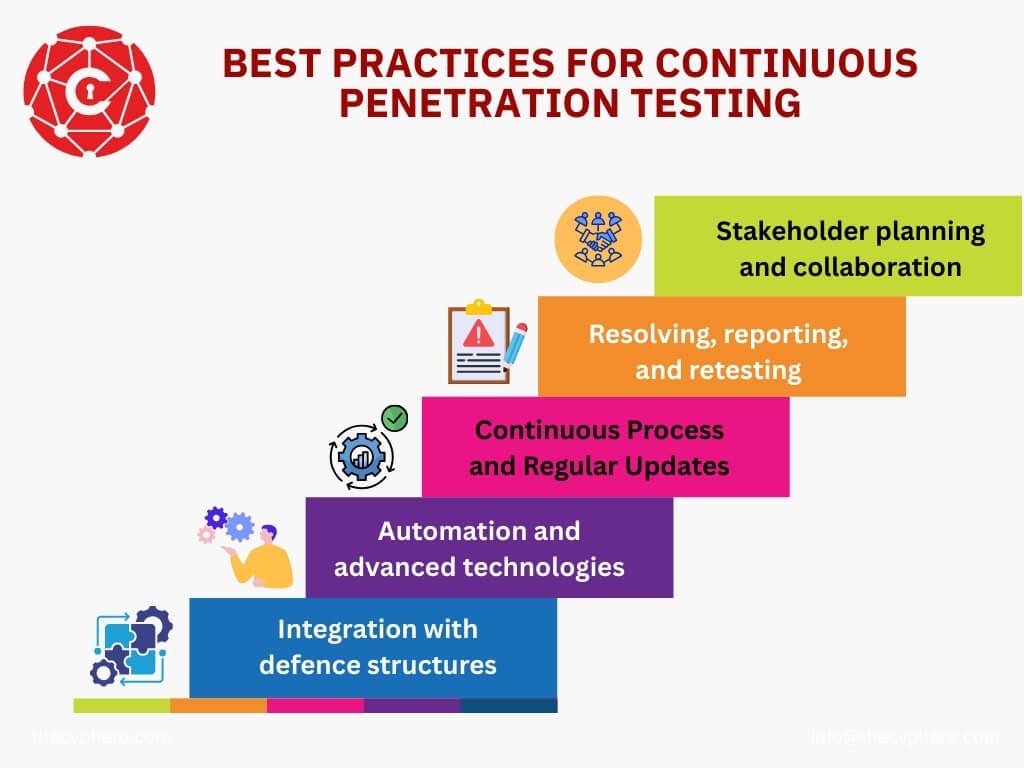
- Integration with defence structures: Implement recognised security frameworks such as the NIST Cybersecurity Framework (CSF), OWASP Testing Guide, and MITRE ATT&CK to structure testing methodologies and ensure comprehensive coverage during continuous penetration testing. Secondly, modernise organisational directives and regulatory obligations to ensure that business and regulatory needs are fulfilled.
- Automation and advanced technologies: Employ automation tools to boost performance, flexibility, and frequency for intricate and large systems for continuous penetration testing. Secondly, use automated scanning, risk classification, and update control to concentrate on the most dangerous infiltration. Lastly, hire an expert with knowledge and subjective evaluation to enhance decision-making and adapt to the modern procedures.
- Continuous Process and Regular Updates: Integrate penetration testing into standard operations to ensure vulnerabilities are discovered and remediated promptly as part of continuous security validation. Secondly, modernise evaluation approaches and tools continuously to be updated with new infrastructure developments and risks.
- Resolving, reporting, and retesting: Create detailed reports that specify defects, infiltration methods, and correction procedures in continuous penetration testing. Secondly, employ remediation determined by the risk and conduct follow-up audits post-correction to verify protective upgrades.
- Stakeholder planning and collaboration: Protect executive support and establish evaluation limits explicitly to validate the company’s alignment and asset distribution in continuous penetration testing. Secondly, involve appropriate interested parties (such as compliance, security, and IT) in the process for optimal execution and monitoring.
When to consider continuous penetration testing?
Listed below are the conditions to consider for continuous penetration testing.
- Enhanced Security Posture Requirements: Continuous penetration testing provides proactive, resilient protection when traditional perimeter defences alone are insufficient against sophisticated, evolving cyber threats. Organisations experiencing security incidents despite existing controls benefit from continuous validation.
- High Frequency and Complexity of Security Threats: Companies that experience frequent and advanced cyberattacks must adopt continuous penetration testing to detect and address security gaps as they occur without depending on occasional follow-ups.
- Dynamically Changing Infrastructure: Businesses with fast-paced infrastructure (such as regular software updates, cloud transitions, and recent installations) gain from continuous penetration testing to verify that new security gaps are identified in real time.
- Regulatory and Legal Requirements: Industries with strict governing rules (such as banking and healthcare) need constant security assurance to uphold compliance and prove the necessary effort to secure confidential data.
- Critical Asset Protection and Risk Mitigation: Organisations with essential resources or protected data information use continuous pentesting to decrease the danger of intrusion, financial damage, and tarnished image by addressing security gaps before malicious exploitation.
- Showing Security Responsibility: Regular and ongoing testing assists companies in fostering assurance with patrons and investors by demonstrating adherence to leading cybersecurity protocols.
When should continuous penetration testing not be considered?
Listed below are the aspects not to consider in continuous penetration testing.
- Static or Legacy Systems: Continuous penetration testing is not justified if the organisations have applications and infrastructure that are infrequently upgraded, deactivated, or revised (such as legacy systems with no active build cycles or internal reporting tools with robust source code). The security state does not change enough to warrant continuous validation.
- Minimal or Infrequent Releases: The constant charge and effort of continuous penetration testing is not reasonable for organisations that work on a long release cycle (such as yearly or semi-annual) and execute detailed and manual testing before every deployment. Testing development, deployment, or quality assurance systems relies on automated security tools (such as SAST and DAST (Dynamic Application Security Testing)) and internal quality assurance. Continuous external testing is not needed except if the testing environment has an identified vulnerability that allows a direct connection to production.
- Low Interconnectivity, Fewer Resources, and Small Teams: Continuous penetration testing offers systems that are completely isolated or have limited external connectivity access, and no modern APIs benefit from the dynamic testing. Small security teams in a small- to medium-sized enterprise (SME) lack the internal personnel or budget to handle continuous penetration testing. Assets are better assigned to essential security measures (such as a strong flaw management system, security awareness training, and hardening parameters).
- Business Effect and Budget Limitations: Software that deals with no confidential data and whose infiltration has a trivial operational and monetary impact on the business (such as internal and non-essential informational websites) is secured efficiently with less intensive strategies. Continuous penetration testing includes access agreements to advanced platforms and retainer deals with independent security organisations. Limiting the budget makes continuous penetration testing more expensive than traditional penetration testing. The cost outweighs the risk reduction if the assets are of less worth.
- Absence of Vulnerability Management and No Secure Development Lifecycle: Continuous penetration testing continually highlights known and easily repairable issues that waste the time of expensive penetration testers if the company is not regularly fixing systems or using conventional vulnerability scanners. Continuous penetration testing finds the same flaws (such as XSS and SQLi) that show a process breakdown if developers are not trained in secure coding and the development process does not include Static Application Security Testing (SAST) or peer feedback.
How can Cyphere help you with continuous penetration testing?
Cyphere helps continuous penetration testing (CPT) by blending human skill with continuous procedures. Cyphere achieves this by employing a hybrid approach where automated tools scan for common vulnerabilities. Cyphere’s CREST-accredited penetration testers perform manual testing to find complex business logic flaws. Cyphere emphasises continuous attack surface management, which actively tracks for new resources and changes within your system to ensure immediate inclusion. Cyphere’s service delivery focuses on immediate reporting and supplementary re-evaluation of essential vulnerabilities. Cyphere ensures developers get precise guidance and that the fix is authenticated, which efficiently concludes the security loop in coordination with modern DevSecOps cycles.