The social engineering penetration testing is a controlled assessment that measures employee responses to realistic deception that imitates real attacker tactics. Authorised penetration testers or red-team operators deliver scenarios via email, telephone (vishing), SMS (smishing), and authorised on-site pretexting to replicate organisation exposures.
According to the Cyber Security Breaches Survey 2025 by the UK government, phishing remains a dominant attack vector (most UK organisations report it) (UK DSIT / Home Office). According to a UK Parliament brief titled “Cybersecurity in the UK”, 85% of UK businesses that identified a cyberattack reported that they had been targeted by phishing. According to a Trustwave-published summary of UK survey data, UK businesses experienced an estimated 8.58 million cybercrimes over the past year, and each affected business saw an average of 30 attacks.
Social engineering pentesting has become a common element in mature security programs, as organisations incorporate testing into their annual red-team exercises and assurance frameworks (such as ISO 27001 certification, Cyber Essentials, PCI DSS, and SOC 2) to assess human risk. The main process of social engineering penetration testing includes contractual scoping and legal authorisation, OSINT reconnaissance, credible pretext development, multi-vector execution (email, phone, SMS), and evidence collection.
The tools used for social engineering penetration testing include the Social Engineer Toolkit (SET), GoPhish, Maltego, King Phisher, and Evilginx. Social engineering penetration testing improves security by quantifying human risk, prioritising targeted awareness, and validating technical controls. The social engineering penetration testing directs targeted awareness modules, policy changes, and technical controls that reduce repeat failures and strengthen organisational security culture.
What is social engineering Penetration testing?
The social engineering penetration testing is an authorised ethical-hacking exercise that measures employees’ responses to deception that imitates real attacker tactics (personalised emails, vishing calls, rogue Wi-Fi captive-portal traps).
Social engineering penetration testing is also known as human hacking, social engineering assessment, human-factor penetration testing, red-team social engineering exercise, security awareness testing and social engineering simulation. Social engineering penetration testing involves assessing the resilience of people, organisational procedures, and security protocols against deception techniques such as phishing, impersonation, and unauthorised access attempts.
How does social engineering penetration testing work?
The social engineering penetration testing works by measuring click-rate, credential-submission rate, and time-to-report in controlled human-targeted campaigns. The social engineering penetration testing measures credential-submission rates near 3% in simulation datasets and records a median time-to-first-click of roughly 82 seconds in campaign telemetry.
The social engineering penetration testing identifies employee susceptibility, publicly exposed information, and process gaps that attackers exploit. The social engineering test identifies specific policy and process weaknesses (weak reporting workflows, insufficient MFA (Multi Factor Authentication) adoption, excessive public staff contact details) that require remediation. The goal of social engineering penetration testing is to reduce organisational risk by raising awareness and strengthening technical controls such as email authentication, advanced filtering, secure gateways, and protective DNS. According to vendor benchmarks, social engineering testing programmes lower phishing-prone rates by more than 40 % within a few months.
How to perform social engineering penetration testing methodology?
Social engineering penetration testing methodology includes Scope & Authorisation, Reconnaissance, Target Profiling, Attack Execution, and Reporting.
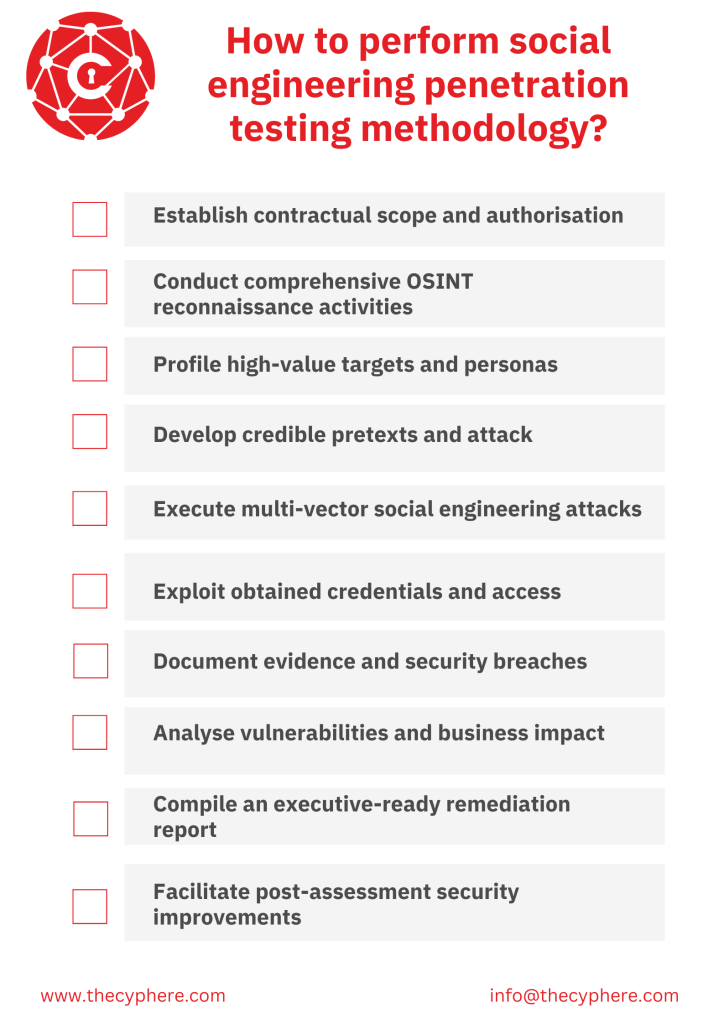
Listed below are the 10 steps of the social engineering penetration testing methodology.
- Establish contractual scope and authorisation
- Conduct comprehensive OSINT reconnaissance activities
- Profile high-value targets and personas
- Develop credible pretexts and attack
- Execute multi-vector social engineering attacks
- Exploit obtained credentials and access
- Document evidence and security breaches
- Analyse vulnerabilities and business impact
- Compile an executive-ready remediation report
- Facilitate post-assessment security improvements
1. Establish contractual scope and authorisation
Establishing contractual scope and authorisation involves obtaining documented written approval from senior legal stakeholders that specifies permitted attack methods and escalation contacts for social engineering penetration testing. Security professionals establish contractual scope and authorisation by conducting a formal kick-off meeting and securing sign-off through governance and contract tools.
The tools used for establishing contractual scope and authorisation include Confluence, DocuSign, OneTrust, SharePoint, Jira, and ServiceNow. Establishing contractual scope involves practical checks, HR consultation, health and safety review, insurer notification, and escalation contacts for live social engineering penetration testing.
Legal and ethical guards for social engineering penetration testing require explicit named signatories, documented consent boundaries, data-minimisation rules, and a formal safety pause.
2. Conduct comprehensive OSINT reconnaissance activities
Conduct comprehensive OSINT reconnaissance activities methodology to collect verifiable public information to map attacker-facing exposure for social engineering penetration testing. Security professionals conduct comprehensive OSINT reconnaissance activities by running structured searches with OSINT tools ( Maltego, theHarvester) and by using targeted Google queries to locate exposed corporate webpages and employee data.
The tools used in the OSINT reconnaissance activities step include Maltego, theHarvester, Shodan, SpiderFoot and Google Dorking. This step ensures data accuracy by removing sensitive information, documenting privacy and GDPR compliance checks, and transferring only verified material to scenario authors for secure scenario development.
3. Profile high-value targets and personas
Profiling high-value targets and personas, identify and rank specific individuals and job roles whose compromise would cause operational or financial harm to the organisation. Penetration testers profile high-value targets and personas by analysing role privileges, access rights, and external-facing activity using HR systems (Workday), identity directories, and access-review tools to produce a ranked target list.
The tools used for profiling high-value targets and personas include Workday, Microsoft Entra ID (Azure AD), Okta, SailPoint, Active Directory audit logs and SIEM platforms such as Splunk. This step focuses on high-risk groups (finance, HR) and prioritises the top 5–10% of privileged accounts ( domain admins, payroll approvers).
4. Develop credible pretexts and attack
Developing credible pretexts and attacks creates realistic scenario scripts, message templates, and call flows for social engineering penetration testing. Penetration testers develop credible pretexts during social engineering pen testing by analysing target roles and daily routines to craft believable communications using verified public context.
The tools used for developing credible pretexts and attacks include Confluence, SharePoint, Google Workspace, Microsoft 365 (Outlook), GoPhish, KnowBe4, Twilio, and RingCentral. This step applies data protection, GDPR compliance, and harm-minimisation checks to prevent unsafe or misleading activities. This step uses dossier-style notes and content libraries (invoice requests, IT maintenance notices, travel itineraries) to increase plausibility. The outcome of the Develop Credible Pretexts phase includes finalised message templates, approved call scripts, peer-review records, and a signed scenario pack for safe test execution.
5. Execute multi-vector social engineering attacks
Executing multi-vector social engineering attacks delivers controlled, ethically authorised campaigns across email, voice, SMS and approved on-site checks as part of social engineering penetration testing. Red Teaming experts execute multi-vector social engineering attacks by scheduling coordinated mail campaigns, sending approved SMS lures, and running escorted physical checks to observe escalation behaviours. Analysts design campaign cadence, monitor engagement signals, and capture interaction artefacts to quantify user susceptibility and inform remediation priorities.
The tools used for executing multi-vector social engineering attacks include GoPhish, Twilio, MessageBird, RingCentral, Vonage, and logging/SIEM platforms such as Splunk and the Elastic Stack. Pentesting teams obtain written sign-off, limit sensitive data collection, and include a safety-pause process to halt activity if real-world harm is detected. Executing multi-vector social engineering attacks step delivers campaign schedules, interaction artefacts (emails, headers, call logs, SMS receipts), aggregated engagement metrics, and a findings pack with prioritised remediation recommendations.
6. Exploit obtained credentials and access
Penetration testers exploit obtained credentials and access to protect forensic artefacts (token lifetimes, access timestamps, mail logs) and produce a validated exposure statement that lists specific systems at risk (shared drives, payroll systems).
Consultants perform exploit obtained credentials in penetration testing by conducting non-destructive checks, such as read-only directory queries and account listings, to map likely lateral paths. Analysts validate token lifetimes, review access timestamps and mail logs, and perform read-only directory and file inventory queries to confirm exposure without altering production data.
The tools used for exploiting obtained credentials and access include ldapsearch, PowerShell Get-AD cmdlets, BloodHound, Splunk, Elastic Stack, QRadar, FTK Imager and Velociraptor. Pentest teams limit queries to pre-agreed scopes, avoid any data exfiltration or destructive changes, and coordinate with incident-response and legal stakeholders. The deliverables from the exploit obtained credentials are a validated exposure statement listing affected systems, read-only query logs, prioritised remediation recommendations, and mitigation steps.
7. Document evidence and security breaches
Penetration testers document evidence and security breaches to collect verifiable forensic records (mail headers, call transcripts) to validate observed events for investigators, remediation teams and regulators during social engineering pen testing.
Consultants perform document evidence during social engineering by collecting evidence with forensic tooling (EDR logs, SIEM searches), preserving chain-of-custody records and storing evidence in access-controlled repositories.
The tools used for documenting security breaches include CrowdStrike, Carbon Black, FTK Imager, Velociraptor, Splunk, Elastic Stack, QRadar, and mail-header parsers. This step links reserved records to measured threat volumes, highlighting the scale of conducted attacks (such as phishing, pretexting, baiting, and vishing). Industry data shows that social engineering accounts for over 36% of incident responses, with the human element involved in roughly 68% of all breaches.
8. Analyse vulnerabilities and business impact
Analysing vulnerabilities and business impact involves turning observed failures into a prioritised list of risks, which is supported by measurable data that reflects each risk’s level of exposure. Red Team professionals analyse vulnerabilities during social engineering penetration testing by counting affected accounts, processes, and business functions, and by mapping the services those accounts support (supplier payments, payroll and customer databases).
The tools used for analysing vulnerabilities and business impact steps include Splunk, Elastic, CrowdStrike, SentinelOne, Azure AD, Okta, and Jira. Testing professionals apply conservative financial assumptions (industry breach-cost benchmarks) and measured human-risk metrics (Unit 42 initial-access = 36%) to produce a plausible cost range in analysing vulnerabilities step.
9. Compile an executive-ready remediation report
Compiling an executive-ready remediation report involves creating a concise board-level summary that converts technical findings into actionable priorities, assigns ownership, and defines realistic timelines during social engineering penetration testing. Penetration testers compile executive-ready remediation reports during testing by presenting the highest-risk scenarios (phish-prone percentage, credential submissions) so executives see immediate exposure and approve resources.
The tools used for compiling executive-ready remediation reports include PowerPoint, Word, PDF/A, Excel, Jira, and preserved artefact exports from SIEM and EDR for technical appendices. Reports from social engineering penetration testing measure impact using vendor data, such as KnowBe4’s phish-prone rate of about 33–34%, and IBM’s average breach cost of around USD 4.88 million. The combined metrics help boards understand risk levels and make informed security investment decisions.
10. Facilitate post-assessment security improvements
Facilitating post-assessment security improvements involves coordinating role-specific awareness programmes, process changes and technical hardening to reduce the human risk revealed by social engineering penetration testing. Pentesting professionals facilitate post-assessment security improvements during social engineering penetration testing by scheduling role-based training for affected groups, updating incident-reporting workflows, and delivering technical changes (email-filter rules, MFA rollouts).
The tools used for facilitating post-assessment security improvements include Moodle, Cornerstone, KnowBe4, GoPhish, Jira, ServiceNow, Proofpoint, Mimecast, Microsoft Defender for Office 365, Duo, and Okta MFA. The post-assessment activity step checks progress by retesting and tracking fewer phishing clicks, as well as more user reports. Structured employee training in the post-assessment activity step helps staff reduce phishing risk by over 40% within a few months.
Social engineering penetration testing follows a repeatable process: scope and authorisation, OSINT reconnaissance, pretext development, controlled execution, evidence capture, analysis and remediation. The social engineering security testing includes 3 modes: Remote mode assesses phishing and social-media attacks, On-site mode tests physical security, and Hybrid mode combines remote simulations with limited on-site verification.
Where can social-engineering penetration testing be performed?
Social-engineering penetration testing is performed across physical and remote environments to validate human, technical, and physical controls and to produce auditable evidence for remediation teams.

Listed below are the 3 execution modes of social-engineering penetration testing.
- On-site social engineering pentesting
- Off-site social engineering pentesting
- Hybrid social engineering pentesting
On-Site Social Engineering Pentesting
On-site social engineering penetration testing is a formal, authorised assessment that uses physical, realistic human scenarios and supervised on-premises checks to evaluate physical access controls. The other names of on-site social engineering pentesting are physical social engineering assessments, physical red-team checks, and in-person social tests.
On-Site Social Engineering Pentesting involves evidence capture from access control systems, CCTV, visitor logs, and witness statements for forensic review. Pentestors conduct on-site social engineering pentesting by planning scenarios with facilities and security, obtaining written authorisation, assigning a safety steward, and executing supervised tests that stop on predefined safety triggers.
The main techniques used in on-site social engineering pentesting are reception testing, tailgating or tailing, escorted or unescorted visitor flows, inert package or mail drops, and executive approaches. Testing professionals prefer on-site social engineering pentesting when organisations require verification of physical access controls, when facility interactions represent a material business risk, or when leadership needs direct assurance of on-premises processes.
Organisations rely on on-site testing to surface physical control gaps that remote testing cannot reveal. Security professionals avoid on-site Social Engineering Pentesting when client environments cannot provide controlled supervision, when the risk to people or critical operations exceeds organisational tolerance, or when legal and regulatory limits forbid in-person checks.
Primary controls exercised during on-site penetration testing include visitor sign-in and ID checks, physical access systems (badge readers, turnstiles and door locks), reception escalation and security-guard response, and mailroom screening such as X-ray and tamper checks; authorised testers and site security collect badge-scan timestamps, CCTV stills/clips, visitor logs, witness statements and mailroom X-ray records.
The mitigations involved in on-site social engineering pentesting are obtaining written authorisation, assigning a trained safety steward, scheduling tests in low-impact windows, and establishing an immediate safety-pause. The risks of on-site social engineering pentesting are alarm activation, operational disruption to front-line services, physical confrontation, and unintended exposure of visitors or sensitive activities.
Off-Site Social Engineering Pentesting
Off-Site Social Engineering Pentesting is a controlled remote testing approach that evaluates an organisation’s defences against digital social-engineering attacks such as phishing, vishing and smishing. Remote social engineering identifies weaknesses in email security settings, user awareness, and incident-reporting protocols, and guides updates to filters, training content, and incident-response playbooks.
The other names of off-site social engineering pentesting are phishing simulations, vishing campaigns, SMS/text-lure testing, and remote social-engineering assessments. Off-Site Social Engineering Pentesting involves designing realistic message templates and call scripts, delivering them through managed platforms, and capturing telemetry from mail gateways, web servers and SIEM systems.
Penetration testers perform off-site social engineering pentesting by obtaining written authorisation, selecting approved target cohorts, configuring campaign platforms, and running staged waves with monitoring and kill-switch controls. The main techniques used in off-site social engineering pentesting are targeted spear-phishing emails, mass phishing campaigns, managed phishing sessions, SMS/text lures, malicious-but-safe landing pages, and credential-sink capture.
Off-site social engineering pentesting is preferred when organisations require scalable measurement of user risk across many employees or when physical testing creates an unacceptable operational burden. Off-site social engineering pentesting is avoided when target lists include high-risk individuals, when legal constraints forbid remote lures to specific groups, or when remote tests would produce unacceptable third-party impact. Primary controls exercised during off-site testing include email gateway filtering and URL reputation services, web-proxy, URL-blocking controls, and SMS carrier filtering. Evidence captured during testing includes mail headers, SMTP traces and gateway logs; click telemetry, short-URL logs and landing-page submission records.
The mitigations involved in off-site social engineering pentesting are using trap domains and secure credential sinks, limiting each campaign wave to small cohorts, purging captured credentials within agreed timeframes, and enabling an immediate kill-switch for live campaigns. The risks of off-site social engineering pentesting are accidental credential capture, mass exposure from misconfigured target lists, reputation damage to sender domains, and regulatory complaints if testing crosses forbidden boundaries.
Hybrid Social Engineering Pentesting
Hybrid social-engineering penetration testing combines remote and on-site engagements to assess linked digital and physical attack paths. Hybrid testing identifies chained-attack risk and shows end-to-end impact from an initial remote lure to any subsequent physical or credential-based exposure.
The other names for hybrid social engineering pentesting include blended social-engineering assessments, multi-vector phishing and onsite testing, and integrated social-engineering simulations. Hybrid Social Engineering Pentesting involves designing cohesive test scenarios that align remote lures with physical engagement attempts, such as unauthorised access or media drops.
Red teaming professionals conduct hybrid testing by obtaining written authorisation from governance and legal stakeholders, defining cross-environment boundaries, and synchronising both digital and physical test components through managed coordination platforms. Common techniques used in hybrid social engineering pentesting include spear-phishing emails, phone-based pretexting, document drops paired with phishing messages, and coordinated campaigns that test both cyber and physical awareness simultaneously. Hybrid social engineering pentesting is chosen when organisations need to validate end-to-end resilience or when critical sites demand both human and technical readiness verification.
Hybrid social engineering testing is avoided in highly sensitive operational environments, where simultaneous testing could disrupt services, or where legal frameworks restrict cross-domain simulations. Primary controls reviewed during hybrid testing include identity verification protocols, facility access management systems, endpoint protection responses, email and web security gateways, and user-reporting channels. Evidence captured includes access logs, camera footage, badge-event records, mail headers, phishing telemetry, and user-report timestamps. Mitigations applied in hybrid social engineering pentesting include limiting live test overlap across teams, coordinating escalation protocols for physical incidents, and ensuring immediate suspension mechanisms for live campaigns.
The main risks involve potential confusion with real security incidents, disruption to business operations, unintentional exposure of sensitive data, and compliance implications if cross-domain actions exceed authorised scope.
On-site and off-site social engineering penetration testing use different methodologies and tools. On-Site testing requires physical coordination, facility access, and observational evidence collection, whereas Off-Site testing uses automated platforms, managed voice/SMS providers, and centralised telemetry (mail gateways, web proxies, SIEM).
What tools are used to perform social engineering penetration testing?
Social engineering penetration testing tools are platforms (phishing simulators, OSINT suites, browser and Wi-Fi exploit kits) used to test employees and processes responding to social attacks.
The 10 main social-engineering penetration-testing tools are described below.
- The Social Engineer Toolkit (SET): The Social Engineer Toolkit (SET) is an open-source penetration-testing toolkit used to automate realistic social-engineering attacks against people, processes, and physical controls during authorised engagements. The Social Engineer Toolkit (SET) features a menu-driven interface, pre-built modules, and integration with Metasploit for controlled payload delivery and deeper technical validation. The Social Engineer Toolkit (SET) finds human-element failures (employees clicking phishing links), endpoint-policy failures where removable scripted payloads execute, and procedural gaps in reception and phone handling revealed by scripted pretexts. Authorised testers use the Social Engineer Toolkit (SET) to run controlled phishing, website-cloning, and payload-delivery scenarios against scoped targets. The Social Engineer Toolkit (SET) captures telemetry such as clicks, form submissions and server logs for correlation with SIEM and incident-response timelines. The Toolkit highlights human and procedural gaps that automated technical scans miss and enables repeatable attack scenarios that teams use to benchmark training and measure remediation impact. The SET focuses on human and process weaknesses and requires strict legal authorisation and scoped consent before any run.
- GoPhish: GoPhish is an open-source phishing-simulation platform used in penetration testing to simulate email-based social-engineering attacks against employees during authorised engagements. GoPhish runs as a cross-platform web application with official binaries and a Docker image. The unique features of GoPhish are a simple web UI, an inline HTML template editor and built-in campaign scheduling. GoPhish finds employee susceptibility by measuring email-open, link-click and credential-submission rates on cloned landing pages and configuration gaps in mail delivery. Security teams use GoPhish to build target lists, design pixel-accurate phishing templates, and schedule staged campaign waves. Operators route clicked links to safe landing pages or secure credential sinks and capture telemetry for SIEM correlation and incident timelines. GoPhish reduces tool friction with fast deployment, a focused UI that non-developers operate and an open-source MIT licence. GoPhish focuses on email and web lures, but it does not provide built-in voice (vishing) or physical on-site checks.
- Maltego: Maltego is an OSINT and link-analysis platform used in social-engineering penetration testing that collects, correlates and visualises public data to map relationships between domains, IPs and online accounts for investigation. The unique features of Maltego include interactive node-link visualisations, support for custom transforms and integrations (such as Shodan), and tiered editions ranging from a free community build to paid commercial licenses. Maltego finds reconnaissance and attribution facts such as exposed email addresses, linked social profiles, DNS/WHOIS traces, geolocation signals and organisational relationships that reveal pretextual points and weak links for social attacks. Security professionals use Maltego to collect OSINT, verify public context for pretexts, map vendor and partner relationships, and produce visual evidence that testers use to craft believable messages and to brief stakeholders. Maltego accelerates pretext development, turns disparate public data into evidence-grade visual maps for decision makers, and reduces manual research time while supporting repeatable investigative workflows. Maltego’s limitations are dependent on publicly available data, the quality of transform sources, potential false positives requiring analyst validation, and licensing or data-access constraints for advanced commercial integrations.
- The Browser Exploitation Framework (BeEF): The Browser Exploitation Framework (BeEF) is an open-source penetration-testing framework that focuses on client-side web security and uses modular exploits to demonstrate real-world browser-based attack paths. The Browser Exploitation Framework (BeEF) features a remote control of “hooked” browsers for post-hook interaction, a library of exploit modules for XSS/session attacks, and easy integration into lab and test workflows. The Browser Exploitation Framework (BeEF) exposes client-side vulnerabilities ( XSS, clickjacking, session hijacking), and harvests browser and plugin fingerprints that reveal exploitable vectors. The Browser Exploitation Framework (BeEF) is used to hook targets through fake phishing or malicious landing pages, run chained modules to collect telemetry or demonstrate data exfiltration, and validate the impact of browser-based lures within an authorised, controlled engagement. The Browser Exploitation Framework (BeEF) highlights the browser as a critical attack surface, provides realistic proofs-of-concept that help prioritise fixes and user training, and serves as a free, modular platform for education and controlled demonstrations. The Browser Exploitation Framework (BeEF) focuses only on client-side issues rather than servers or networks, triggers endpoint detections that require careful scenario tuning, and demands strict legal authorisation.
- King Phisher: King Phisher is an open-source phishing-simulation platform used in penetration testing to simulate realistic email- and web-based social-engineering attacks against employees during authorised engagements. King Phisher’s unique features are highly customizable campaign templates and landing pages, multi-user team operation, detailed analytics, and integration hooks for automation and reporting. King Phisher identifies phishing susceptibility by tracking who opens emails, clicks links or submits credentials, detects credential-harvesting success, and reveals security-awareness gaps across teams and departments. Security teams use King Phisher to design specific campaigns, run staged waves against scoped targets, collect interaction telemetry, and feed results into targeted feedback and training programs. King Phisher provides realistic, repeatable phishing scenarios that measure human risk, supports team-based testing at low cost, and supplies analytics that drive prioritised training and policy changes. King Phisher focuses on email/web lures and requires correct SMTP and sender-reputation management, careful scenario tuning to avoid false positives, and strict written authorisation to prevent legal or reputational harm.
- Evilginx: Evilginx is a testing tool that makes a fake but functional website act like the real website and quietly captures the login tokens users send, and shows how attackers impersonate users even after two-factor checks. Evilginx’s unique features are its reverse-proxy design that captures session tokens, template-based phishing pages, quick deployment options, and open-source community maintenance. Evilginx identifies web-session vulnerabilities by capturing session cookies and authentication tokens, demonstrates how attackers bypass multi-factor authentication, and reveals weak session-management settings (missing Secure/HttpOnly flags, long session lifetimes). Testers deploy Evilginx in authorised phishing campaigns to proxy victim traffic, hook target browsers, and collect session and HTTP telemetry for forensic analysis. Evilginx delivers realistic, high-fidelity proofs-of-concept that expose MFA-bypass and session-hijack risks, which help teams to prioritise phishing-resistant authentication and session-hardening remediations. Evilginx focuses only on web-session attack paths and requires strict written authorisation and scoped consent due to legal and ethical risks.
- Wifiphisher: Wifiphisher is an open-source unauthorised access-point tool used in social-engineering penetration testing to create fake Wi-Fi networks and captive portals that phish WPA passphrases and web credentials. The unique features of Wifiphisher are open-source availability, rapid setup for evil-twin and captive-portal attacks, customizable landing pages, and automated phishing workflows suitable for field exercises. The functions of Wifiphisher are wireless and human weaknesses, such as users joining rogue SSIDs, submitting credentials to fake portals, and devices exposing unencrypted or intercepted traffic. Testers deploy Wifiphisher to stand up rogue SSIDs, present deceptive captive-portal pages, capture credentials and HTTP telemetry, and observe user behaviour for remediation. Wifiphisher accelerates the identification of user behaviour and Wi-Fi configuration gaps, delivers low-cost, realistic evidence for training and fixes, and reduces manual reconnaissance time for pretext development. Wifiphisher’s limitations are dependence on physical proximity and device behaviour, strict legal and ethical requirements, and reduced effectiveness against up-to-date devices without careful scenario tuning.
- Real Phish: Real Phish tools are phishing-simulation platforms used in social-engineering penetration testing to replicate authentic phishing campaigns and measure employee susceptibility to credential theft and data exposure. The unique features of Real Phish are open-source, fast deployment, user-friendly campaign editors, template libraries, automation APIs and built-in analytics for tracking opens, clicks and submissions. The functions of Real Phish are to identify credential-harvesting events, gaps in reporting and escalation workflows, and browser/system indicators that reveal which users or groups require targeted training. Testers use Real Phish to build target lists, deploy staged email or web campaigns, capture interaction telemetry, and produce reports that feed remediation and training workflows. Real Phish tools provide realistic, repeatable simulations that improve awareness, measure training effectiveness, support compliance, and lower the cost of running large-scale exercises compared with bespoke campaigns. Real Phish tools focus on email/web vectors and exclude voice and physical channels without additional tooling and require strict written authorisation and careful sender-reputation.
- Ghost Phisher: Ghost Phisher is an open-source wireless and Ethernet phishing toolkit used in social-engineering penetration testing to emulate rogue access points, host captive portals, and collect credentials during authorised exercises. The unique features of Ghost Phisher are integrated DHCP/DNS/HTTP servers for hosting captive pages, Ethernet phishing modules, ARP-spoofing tools, and fast local deployment for on-site testing. This tool finds network and human weaknesses such as devices joining fake Wi-Fi networks, users entering credentials on attacker-hosted captive pages, which enables traffic interception, and exposed session tokens vulnerable to hijacking. Testers use Ghost Phisher in social-engineering penetration testing for deploying rogue SSIDs, serving fake captive portals, capturing credentials and HTTP telemetry, and demonstrating wireless risks to stakeholders. Ghost Phisher provides realistic on-site validation of wireless social attack vectors, rapid setup for field exercises, and concrete artefacts that support training and configuration fixes. Ghost Phisher demands a strict need for written authorisation and scoped consent, legal and privacy risk if misused, and reduced effectiveness against modern devices and network protections without careful tuning.
- thHarvester: thHarvester is an open-source OSINT reconnaissance tool used in social-engineering penetration testing to collect public emails, subdomains, hosts and employee names from search engines and public repositories. thHarvester contains multi-source harvesting from search engines, PGP keyservers and DNS records, a compact command-line interface for fast runs, and simple exportable reports. This tool finds exposed email addresses, subdomains, virtual hosts and personnel names that form the public attack surface for crafting credible pretexts. Security professionals use thHarvester in for building target lists, verifying public context for pretexts, and supplying contact and domain data for tailored lures. thHarvester provides rapid reconnaissance, repeatable OSINT collection that reduces manual research time, and concrete leads for targeted social campaigns. thHarvester limitations are dependent on publicly available sources, risk of false positives that require analyst verification, and rate-limiting or API restrictions that limit depth without commercial services.
The tools listed above are not enough to run a full social-engineering penetration test. Non-commoditised aids such as custom pretext kits, burner devices and SIMs, call-centre scripts, and signage/props fill the practical gaps that software tools do not. Custom pretext kits provide specific identity materials and briefing notes that make a scenario credible at first glance. Call-centre scripts give callers consistent phrasing and escalation triggers so phone pretexts sound natural and collectors capture the correct information.
What attacks are used in social engineering penetration testing?
Social engineering penetration testing attacks are authorised simulations that manipulate employees into revealing sensitive information or performing unsafe actions to measure and strengthen an organisation’s procedural and technical resilience against real-world social-engineering threats.

Listed below are 8 attack types of social-engineering penetration testing.
- Phishing: Phishing is a social-engineering tactic where attackers pretend to be trusted people or organisations via email, message, or fake websites to trick users into sharing login details, personal data, or clicking harmful links. A phishing attack occurs when an attacker sends deceptive messages or hosts cloned pages that harvest credentials or deliver payloads. Phishing is an off-site attack because it uses email and web infrastructure rather than physical presence. APWG recorded 1,025,968 phishing attacks in Q1 2022 (APWG Phishing Activity Trends Report Q1 2022). Large phishing-simulation datasets report a 3% global credential-submission rate in controlled campaigns (Terranova/Fortra benchmarks).
- Smishing: Smishing is SMS-based phishing that uses fraudulent text messages and malicious links to lure recipients into revealing credentials or clicking harmful URLs. A smishing attack occurs when attackers send fake SMS messages that mimic trusted services and push victims to enter data or visit malicious pages. Smishing is an off-site attack because it targets mobile users over the cellular/SMS channel rather than requiring physical access. According to Keepnet Labs, 28% of phishing attacks in 2023 were attributed to SMS. AP News reported that investigators linked 10,000+ domains to road-toll smishing campaigns in 2024.
- Tailgating: Tailgating is following an authorised person through a controlled entry (slipping in behind someone holding a secure door). Tailgating occurs when an attacker exploits a lack of security awareness or a distraction to gain physical access without credentials. Tailgating occurs on-site because it relies on physical proximity and access points within buildings. According to Keepnet Labs, 70% proportion of organisations report feeling vulnerable to tailgating (Boon Edam survey).
- Vishing: Vishing is voice-phishing that uses phone calls, voicemail or VoIP to manipulate people into revealing credentials, authorising payments, or transferring funds. A vishing attack occurs when callers impersonate trusted parties and use urgency or authority to coerce victims over the phone. Vishing is an off-site attack because it exploits telephony channels without on-premises presence. FBI IC3 reported $16.6 billion in total losses to internet-enabled scams and fraud in 2024, with phishing and spoofing among the top complaint types (FBI IC3, 2024).
- Whaling: Whaling is CEO-fraud or executive-targeted social engineering that uses highly personalised pretexts to trick senior staff into data disclosure or wire transfers. Whaling attack occurs when attackers craft tailored messages or calls that exploit executive duties and approval workflows. Whaling is an off-site attack because it uses email or phone channels, though it may be complemented by on-site reconnaissance.
- Impersonation: Impersonation is assuming a credible identity (contractor, vendor or executive) to persuade employees to grant access or disclose information. An impersonation attack occurs when the attacker uses forged credentials, public data or social cues to present a believable identity and lower staff suspicion. Impersonation is an on-site attack when attackers present physically (badges, uniforms) and off-site when attackers use email/phone; the vector depends on the chosen pretext.
- Baiting: Baiting is leaving a tempting item (USB labelled “Payroll”) to coax victims into connecting devices or following instructions that compromise systems. Baiting attacks occur when curiosity or greed drives a user to plug an infected device or download promised content that installs malware or reveals data. Baiting is an on-site attack when using physical media (USB drops), but it is off-site when delivered as online “free offers”. Elie Bursztein’s USB-drop experiments found 45–98% of users plug USB drives into workstations, depending on study conditions. An Army Cyber Command study found 20% of participants opened files or clicked links on found media.
- Dumpster Diving: Dumpster diving is searching discarded physical or digital waste to retrieve documents, media or storage devices that reveal credentials, accounts or sensitive plans. Dumpster diving attack occurs when attackers examine trash, recycling or discarded devices to extract usable intel such as account lists, internal memos or backup media. Dumpster diving is on-site because it requires physical access to targeted waste streams, skip bins or recycling areas. Research and industry write-ups show dumpster diving remains a practical low-tech vector for identity theft and data leakage, and many organisations still lack robust shredding policies.
Social engineering has a direct impact on employees, as it transforms routine actions such as clicking links, answering calls, and plugging in devices into attack paths that enable attackers to steal credentials.
How does social-engineering penetration testing improve employee security training?
Social engineering pentests affect employees in an organisation by exposing them to realistic deception scenarios, such as fraudulent emails, fake identities, and crafted interaction attempts. The test strengthens employee judgment and accountability by producing measurable data on vulnerabilities and improving security awareness in organisational policies.
According to the 2023 KnowBe4 Security Awareness Report, phishing simulations reduced employee click rates on malicious links from 37% to 4.6% after 90 days of structured training. The organisations can deal with human-targeted risks through Cyber Security Awareness Training, because consistent, role-specific education teaches employees to respond quickly and reduce the success rate of social engineering attacks.
According to Harman Singh (Owner of Cyphere):
“The best use of social engineering penetration testing is that it trains employees to recognize and resist cyber threats.”
Cyber Security Awareness Training is a structured learning program that educates employees to detect, avoid, and report cyber threats such as phishing, malware, and social engineering through continuous, evidence-based instruction. Cyber Security Awareness Training improves employees’ chances of recognising social engineering by integrating realistic simulations and continuous feedback that strengthen critical thinking before engagement with malicious content.
How does Social engineering penetration testing help employees of an organisation?
Social engineering penetration testing helps employees of an organisation by building measurable security awareness, practical defence skills, and psychological resilience against manipulation.
Listed below are the 5 benefits of Social Engineering Penetration Testing for employees.
- Improve employee security awareness: Social engineering penetration testing improves employee security awareness and behaviour by exposing staff to realistic phishing, baiting, and impersonation attempts that teach them to detect and reject malicious communication.
- Increases employee confidence and reduces stress: Social engineering penetration testing increases employee confidence and reduces stress because employees understand attack patterns and respond decisively instead of feeling uncertain about cyber risks.
- Enhances employee job satisfaction: Social engineering penetration testing enhances employee job satisfaction and morale, as continuous learning shows that the organisation values their growth and safety in a secure workplace.
- Promotes accurate responses and safer practices: Social engineering penetration testing promotes accurate responses and safer practices through repeated simulations that cut breach rates by 45–65%.
- Encourages continuous learning: Social engineering penetration testing promotes continuous learning through ongoing simulations that reinforce new security behaviours and threat recognition skills.
What are the social engineering penetration testing best practices?
Social engineering penetration testing best practices include defining a clear scope, obtaining written authorisation, simulating realistic attacks, and maintaining ethical boundaries.
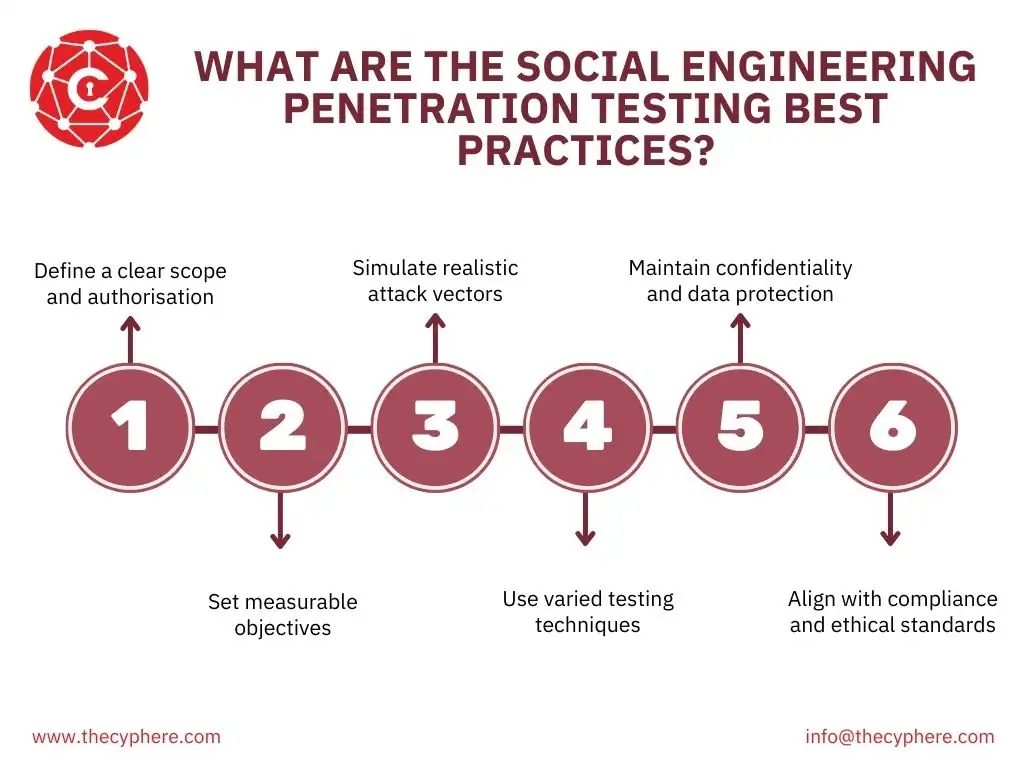
Listed below are the 6 best practices of social engineering penetration testing.
- Define a clear scope and authorisation: Penetration testers should define a clear scope and authorisation to ensure social engineering attacks are legal, safe, and approved, protecting both employees and the organisation.
- Set measurable objectives: Penetration testers should set measurable objectives to evaluate employee behaviour, awareness, and policy compliance, providing actionable insights for security training.
- Simulate realistic attack vectors: Penetration testers should simulate realistic attack vectors to test employees against authentic phishing, impersonation, and physical manipulation attempts without causing harm.
- Use varied testing techniques: Penetration testers should use varied testing techniques to comprehensively assess employee vigilance across email, voice (vishing), SMS (smishing), and in-person attacks.
- Maintain confidentiality and data protection: Penetration testers should maintain confidentiality and data protection to safeguard sensitive information and anonymise employee identities in reports.
- Align with compliance and ethical standards: Penetration testers should align with compliance and ethical standards to follow frameworks like NIST SP 800‑115, ISO/IEC 27001, and local data-protection laws, ensuring ethical integrity of social engineering tests.