Black Box Penetration Testing, or Closed Box Penetration Testing, provides a defined approach to assess a System’s defence parameters from an outsider’s perspective. In black box penetration testing, security experts or ethical hackers simulate a real attack to break into the system without any internal knowledge of the application, network, or system.
The main feature of black box testing is that it is a realistic and attacker-oriented approach. Pen testers have no prior knowledge of the target system and attempt to breach the organisation’s defence from the perspective of an actual external hacker. The goal is to help organisations secure their defences before a real attacker could exploit the security weaknesses. Penetration testers conduct this testing in an authorised way, following black box testing methodologies and using both automated tools (nmap, Metasploit, BurpSuite, etc) and manual testing methods.
According to MDPI in its research, ICVTest: A Practical Black-Box Penetration Testing Framework for Evaluating Cybersecurity of Intelligent Connected Vehicles, published on December 25, 2023, ICVTest is a black box penetration testing framework that simplifies cybersecurity assessment in intelligent connected vehicles (ICV) and allows beginner pen testers to assess security risks effectively.
Multiple types of security assessments (Web application security, network security, mobile application security) widely use black box testing to detect vulnerabilities without the system’s internal knowledge. In external penetration testing, black box testing targets public-facing systems to assess the organisation’s perimeter security. The black box method is used in social engineering tests to exploit human vulnerabilities and test employee awareness. Physical penetration uses this approach to simulate a physical unauthorised access attempt to identify vulnerabilities in device security. In network penetration testing, black box pen testers act as an external attacker to uncover issues in firewall policies, VPNs and exposed network interfaces. Black box testing is used in web application testing to detect SQL injection, XSS and authentication bypasses.
What is black Box Penetration Testing?
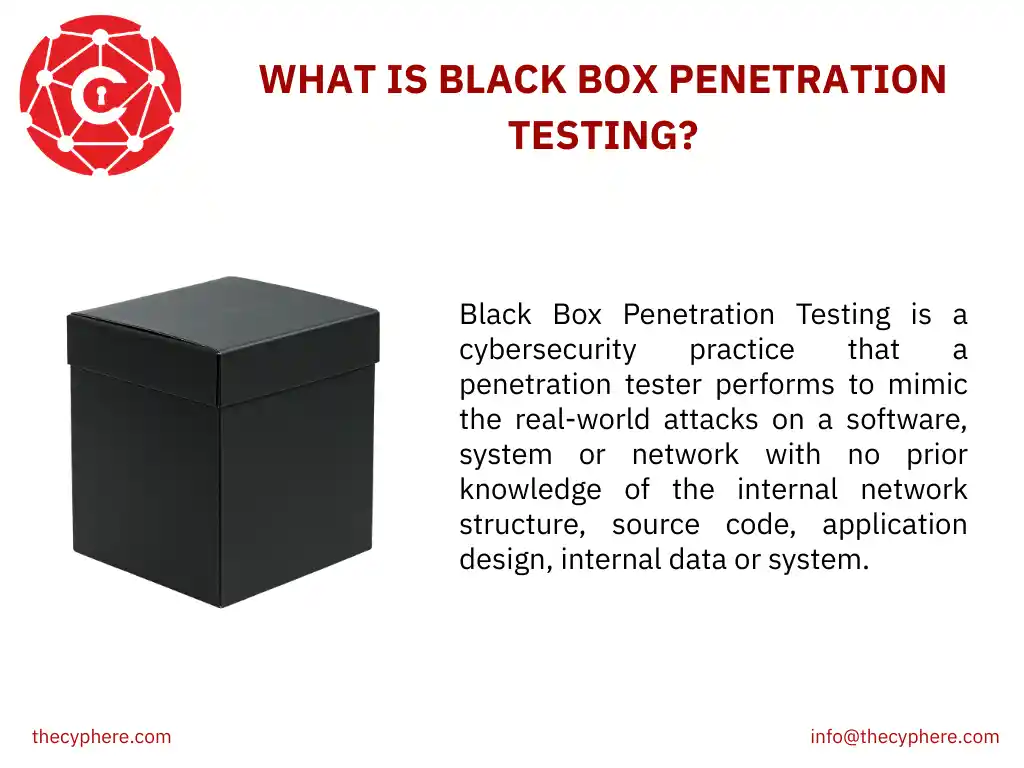
Black Box Penetration Testing is a cybersecurity practice that a penetration tester performs to mimic the real-world attacks on a software, system or network with no prior knowledge of the internal network structure, source code, application design, internal data or system credentials.
Black box penetration testing is also known as Zero-Knowledge Testing, Black Box Testing, and Closed-Box Penetration Testing. Ethical hackers or penetration testers enter the application as an external or unauthorised attacker to compromise security.
The key objective of this penetration test is to identify vulnerabilities and assess the defence mechanism of the system’s perimeter, and close all the entry points that can be exploited by real attackers. According to Yue Zhang et al, in their research ‘Improved Deep Recurrent Q-Network of POMDPs for Automated Penetration Testing’, published on Oct 14, 2022, states that black box penetration testing allows ethical hackers to interact with the target environment as an external attacker and find vulnerabilities that are missed in internal analysis, helping organisations to discover weaknesses that can be exploited in real-world attacks.
According to Link: Black-Box Detection of Cross-Site Scripting Vulnerabilities Using Reinforcement Learning, published by Soyoung Lee, Seongil Wi, and Sooel Son on April 25, 2022, the Link framework found 45, 213, and 60 cross-site scripting (XSS) vulnerabilities using black box testing in Firing-Range, OWASP, and WAVSEP benchmarks, respectively, with no false positives.
Black box penetration testing has a unique feature, which is its realistic attack simulation approach. This unique feature of black box penetration testing makes it different from other penetration testing types. A black box penetration tester provider depends on automated tools, machine learning and reinforcement learning because of limited insider knowledge.
How does black box penetration testing work?
In black box pen testing, an external user or ethical hacker simulates real attacks on the system, application or network with as much insider knowledge as the real-world attackers would have.
Black box penetration testers perform the attack by collecting publicly available information, such as IPs, domains, employee credentials, emails and technologies used. Pentestors use tools like Nmap, Burp Suite for deeper scanning and gather information about open ports, running services, and versions of the operating systems. As a result of scanning, a penetration tester finds the user accounts, network shares and entry points, which further disclose the system’s vulnerabilities like known CVEs, misconfiguration, outdated software versions, etc.
Now, pen testers identify exploitable entry points and penetrate in an authorised manner to gain initial access to gather sensitive information being compromised. After successful exploitation, testers gain complete access to the system and analyse the further compromise and the severity of the breach.
This security testing gives an unbiased assessment of how secure your system is under real attack, uncovers weaknesses in the authentication mechanism, exposed interfaces and overall security posture. This is especially valuable in testing the system’s resilience, improving incident response readiness and ensuring compliance with cybersecurity standards.
Who performs black box penetration testing?
Penetration Testers (Pen Testers), also known as ethical hackers, perform black box penetration testing. They are specialised security professionals having skills (reconnaissance, identification of vulnerabilities, exploitation) similar to malicious attackers, but they work legally in a controlled and authorised manner. Most black box penetration testers work independently as third-party experts, and some testers are employed in-house by the organisation.
The primary goal of the black box penetration testers is to uncover the exploitable vulnerabilities and provide effective remediation steps for the organisation to fix the gaps. According to A Theory of Black-Box Tests, published by Mohammad Dashti, D. Basin on June 18, 2020, Black box testing finds both security vulnerabilities and confirms that requirements are met, connecting results from testing, verification and enforcement.
Pen testers mimic the tactics of real attackers to breach the system without having insider knowledge. They have a unique approach and skills to identify security vulnerabilities. Penetration testers rely on external or publicly available information to find the gaps and penetrate the application or system because they have a limited or partial understanding of the target system. Their technical expertise covers the network, protocols, APIs, operating systems (Windows/Linux), cloud platforms and web technologies. Pen testers also possess a deeper knowledge of tools such as Burp Suite, Nmap, fuzzers, Metasploit, AD tools, and custom scripts.
Most penetration testers hold industry-recognised certifications to demonstrate their expertise in ethical hacking, such as CPTE (Certified Penetration Testing Engineer), CEH (Certified Ethical Hacker), OSCP (Offensive Security Certified Professional), CompTIA PenTest+ and GPEN (GIAC Penetration Tester). Organisations highly value a proven track record to validate the tester’s technical standards, like public write-ups, engagements and bug bounty history.
What methodology is used to perform black box penetration testing?
The black box penetration testing methodology is a structured, step-by-step process that involves gathering information, planning the assessment, utilising automated tools, and conducting manual verifications to identify vulnerabilities, followed by creating reports and retests to verify the remediation steps.
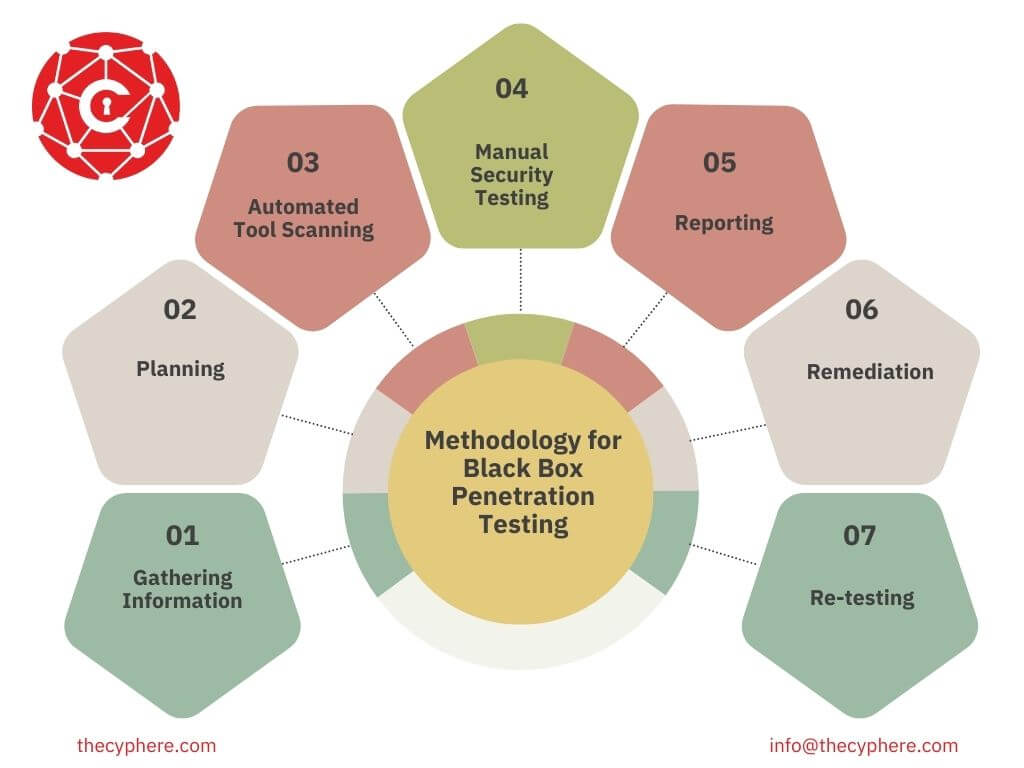
Black box penetration testing methodology includes 7 main steps.
Gathering Information
Planning
Automated Tool Scanning
Manual Security Testing
Reporting
Remediation
Re-testing
The detailed black box penetration testing methodology is written below.
1. Gathering Information
Gathering information is the process of collecting data about the target through public and external means so that pen testers can map the attack surface without insider access. Pen testers can gather information about the target through passive reconnaissance, which includes WHOIS, public IP ranges, DNS records, LinkedIn/company websites, certificate transparency logs, public code repos, job posts, social media and search engines. The active reconnaissance process covers DNS lookups, port scans, subdomain enumeration, and banner grabs.
The attacker aims to find an entry point to test the system through collected data, such as asset inventory (domains, IPs, services), web apps, APIs, and admin panels. The tools used for gathering information include whois, dig, nslookup, cert.sh, Shodan, Censys, subfinder, amass, Google dorking, LinkedIn, GitHub search
2. Planning
Planning of a black box penetration testing is the process of defining scope, rules of engagement, goals, risk/impact controls, timelines and reports. Pen testers set the in-scope hosts, out-of-scope items, high-risk targets, and safety controls (backup windows, business hours). They define the test goals like gaining access to web apps, taking sample data and demonstrating lateral movement. The planning process focuses on high-priority objectives and prevents legal/operational issues.
3. Automated Tool Scanning
Automated tool scanning is the process of finding common vulnerabilities using automated scanners to create a baseline map of a target in black box penetration testing. Pen testers run non-intrusive discovery scans for port/service discovery, and to find deeper issues, they run authenticated scans. They use web scanners (like Burp Scanner, OWASP ZAP), network vulnerability scanners (Nessus/OpenVAS), and SAST/DAST, where applicable.
These tools interact with applications or networks through their public interfaces to automate repetitive tasks and systematically detect vulnerabilities. Automated scanning helps identify frequent vulnerabilities quickly and saves manual time for more in-depth testing.
4. Manual Security Testing
Manual security testing is an expert-led black box penetration testing process where testers search for insecure endpoints, vulnerabilities, logic flaws and misconfigurations by creating and using payloads of SQL injection, XSS and replay attacks.
Manual security testing includes business logic testing, ZAP testing, and exploitation. Business logic testing includes pen testers performing parameter tampering, attempting actions in unusual sequences and abusing role privileges. ZAP testing comprises pen testers performing session fixation, authentication bypass, OAuth flaws, CSRF, and IODR. Exploitation includes searching exploit databases, adapting public PoCs and writing custom payloads (e.g. SQLi and XSS payloads). Pen testers execute exploits to show the impact of an attack without causing unnecessary harm. After successful exploitation, attackers attempt lateral movement, persistence, and gain unauthorised access to data.
Manual security testing finds vulnerabilities such as privilege escalation, broken access control and client/server-side validation bypass that automated tools miss. It discovers chained vulnerabilities, configuration mistakes, and real exploitation paths. Pen testers get a verified vulnerability list with Proof of Concept (PoC), impact analysis, logs and risk remediation suggestions. Manual security testing reduces the number of false alarms and, compared to automated scans, gives more accurate results.
5. Reporting
The Reporting process includes creating documents of all findings, evidence and analysis from the black box penetration test. Reporting simplifies complex technical results into clear, actionable information for the management and technical teams.
The purpose of reporting in black box testing is to analyse what vulnerabilities were found, how they can be exploited, how severe the impact is and how to fix them. The results from both automated and manual testing are collected and categorised into an executive summary and technical details after the exploitation phase. The executive summary includes a non-technical overview defining key risks, business impact and overall security posture. Technical details give a detailed list of each vulnerability, including affected assets, risk level (High, Medium, Low), with a custom rating or CVSS (Common Vulnerability Scoring System) score and recommended remediation actions.
6. Remediation
The remediation process in black box testing is about fixing vulnerabilities identified in the reporting and implementing technical fixes such as patching software, updating security controls and reconfiguring systems. Developers fix the vulnerabilities using the black box testing report, which should be prioritised based on the risk.
The goal of remediation is to strengthen the security measures of the system and prevent future exploitation. The technical team review the penetration testing report provided by the pen testers and assesses each vulnerability based on its severity, exploitability and business impact.
Implementing fixes includes patching software, updating configurations (restricting admin access, disabling weak encryption), improving network controls (such as adding firewalls, WAF rules, or intrusion detection), improving authentication through strong passwords or MFA, and securing code.
7. Re-testing
Re-testing, or regression testing, is the process of verifying whether the vulnerabilities have been resolved or not. Re-testing ensures that applied patches, security controls or configuration changes effectively remove vulnerabilities found during the initial test. It also assesses if any new issues have been introduced after the remediation.
The organisation give details of all fixes implemented to the pen tester after the remediation process. Pen testers check each previously reported vulnerability and categorise it into fixed, partially fixed or not fixed. The tester updates the original report with a re-testing overview and describes the status of each vulnerability. The final report helps management ensure that all the critical issues have been resolved and the system is secure.
What is the cyphere approach to perform black box penetration testing?
At Cyphere, in the first step, we first get all the prerequisites for the black box penetration testing from the customer. Black box penetration testing is a zero-knowledge penetration testing, so we just need to know the target in scope. Anything not mentioned in the scope we consider as an out-of-scope item.
The second step is to get the authorisation form signed by our customer. It acts as an official permission to carry out the penetration testing. It is also required to comply with the Computer Misuse Act 1990.
In the third step, we start our preparation for the penetration testing services after we sign the forms. We use specific testing IPs to carry out the black box penetration testing. We share this IP with our customers as well to get this IP whitelisted in their firewall configurations. Because all the scans, exploitation and other requests are sent to the target using that IP address only.
The fourth step is to perform a pre-scan OSINT. We try to gather as much information as possible from the publicly available sites or databases. We use Whois records, publicly available code repos, Shodan and other tools for this purpose.
In the fifth step, we initiate vulnerability scanning and enumeration. In this, we do port scanning, use automated scanners and also do manual validation of the findings. In the manual approach, we test for vulnerabilities based on the target. For example, we test for SQL, XSS, CSRF and other web vulnerabilities in a web application.
The sixth and the last step is to prepare a detailed report including an executive summary, scope and findings. For each finding, we also mention the steps to reproduce and the remediation steps. After
fixes, we also offer targeted retests to validate whether the fixes have been deployed properly or not.
How much does it cost to perform black box penetration testing?
The cost range of performing black box penetration testing in the UK is £4,000–£40,000 GBP ($5,000-$50,000) per test. The cost of black box testing depends on the scope and type of target, the tester’s reputation, the test methodology, and the business type.
Cost rises as the scope increases; more IPs, URLs, APIs, domains or cloud resources take more tester time and effort. Different target types (such as a public web application, external network, internal network, IoT devices or an Active Directory environment) require different tools, skills and deeper investigation, all of which raise the overall price. The tester’s experience and reputation also affect the cost of testing. Top cybersecurity experts and consultancies like NCC, Synack, and Cobalt often cost more but give compliance processes, thorough reporting and reliable results.
Test methodology also influences the cost of testing, as it includes complete scanning, manual exploitation, technical remediation guidance, and retest windows, which require more time and technical resources. Finally, business size and complexity change the budget. The cost of black box testing for a small business generally ranges from £2,400–£12,000 ($3,000 to $15,000). The medium-sized business includes multiple apps, clouds and APIs, so the cost ranges from £8,000 and £32,000 ($10,000 to $40,000). Whereas for a large enterprise, the cost ranges from £40,000–£120,000 ($50,000 to $150,000), depending on the depth of the test and complexity level.
How much time does it take to perform black box penetration Testing?
The time duration for black box penetration testing is several hours per test case. A full black box penetration assessment includes everything from information gathering to reporting, and requires days and weeks.
The time required to perform black box testing depends on several factors, including the complexity of the target system, the methods used (manual/automated) and the scope of testing. For a smaller network or application, the time required is less, whereas a large or complex environment with multiple systems or applications takes a longer time period.
For a small network and application, the manual testing takes between 1 to 3 days of testing as the scope is limited and the number of assets is small. Automated testing for such systems is completed within a few hours to 1 day, as the target surface is small and can be effectively scanned using automated tools.
In case of a medium-sized network or application(multiple web applications, internal or external networks, cloud environments, common infrastructure components and third-party integration and APIs), the manual testing takes several days to 2 weeks, depending on the applications, endpoints, and systems involved. Whereas automated testing takes 1 to 5 days of testing, providing efficiency and coverage.
For a large and complex system (multiple networks, a wide range of applications, cloud and hybrid platforms, complex Active-Directory) manual testing takes 3 to 6 weeks. The longer duration is required due to complex infrastructure, multiple environments (such as cloud, web, and internal systems) and deep manual testing for chained vulnerabilities and business logic flaws. Automated testing takes several days to 1 or 2 weeks for complete scanning across multiple assets and configurations.
What checklist should you follow to complete your black box penetration test?
Listed below is the black box penetration testing checklist.
Reconnaissance & Information Gathering
Vulnerability Discovery
Exploitation
Post Exploitation
Reporting
What tools are used to perform black box penetration testing?
Black box testing tools are the tools that a penetration tester uses to carry out black box penetration testing.
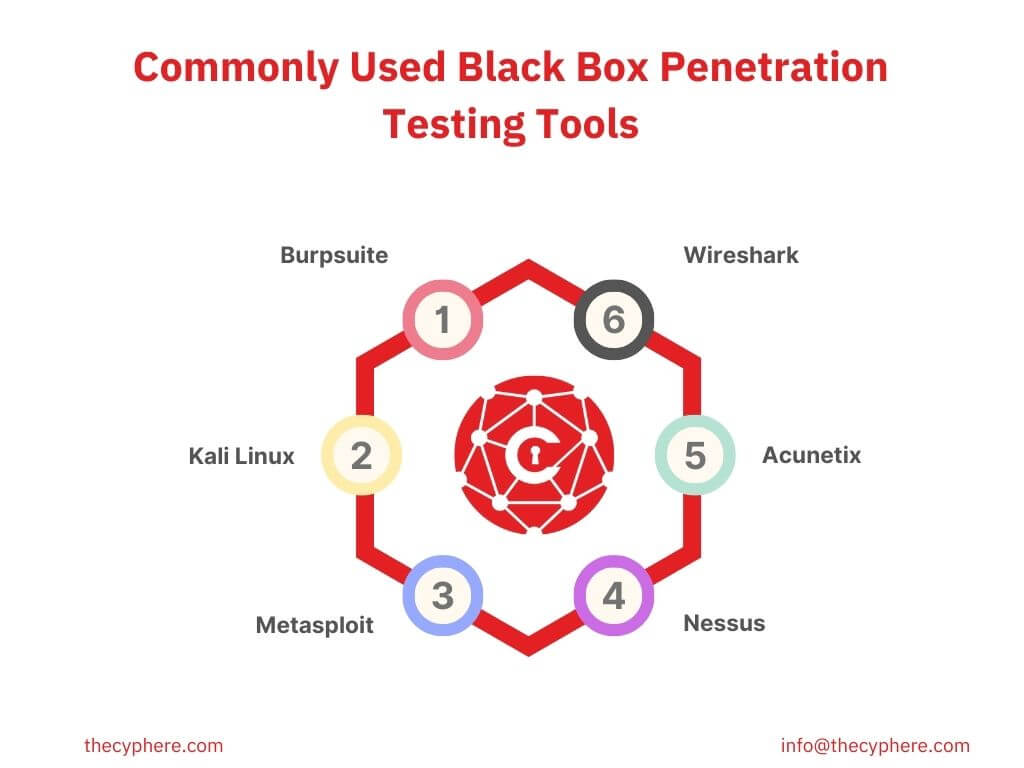
There are 6 commonly used black box penetration testing tools.
- Burp Suite: Burp Suite is a web application security testing tool which includes components like scanner, intruder, proxy server, repeater, decoder and sequencer. This tool helps to identify and exploit web application vulnerabilities during black box penetration testing for a web application.
- Kali Linux: Kali Linux is a security auditing and advanced penetration testing platform that contains pre-installed 600+ security tools. It allows penetration testers to customise the environment to specific assessment needs. For example, a penetration tester performing black box penetration testing against a network will select the network-related tools among the available tools in Kali Linux.
- Metasploit: Metasploit is a penetration testing framework providing a vast library of exploits and payloads to test multiple systems for weaknesses. It simplifies the process of identifying, exploiting and validating vulnerabilities. This tool especially helps penetration testers in the exploitation phase of black box penetration testing.
- Nessus: Nessus is a widely used vulnerability scanner that gives accurate and fast assessments, including 47000+ unique IT assets. It helps testers to identify vulnerabilities across multiple systems, risk mitigation and compliance efforts during a black box penetration test.
- Acunetix: Acunetix is a web application vulnerability scanner that provides fast scans, detailed reports and remediation recommendations to improve web application security. Pen testers use Acunetix to detect vulnerabilities like cross-site scripting (XSS), SQL injection and other vulnerabilities in a black box penetration test.
- Wireshark: Wireshark is an open source network protocol analyser that gives detailed insight into network communication and helps detect security issues and anomalies. The penetration tester uses Wireshark mostly for a network black box pen test.
The black box penetration testing process does not require entirely new tools; it primarily uses existing tools that are used in other methods, like white box and grey box penetration testing.
Tools like KaliLinux, nmap, Metasploit and Wireshark are commonly used by both black box testing and other pen testing methods. But in black box testing, testers mainly rely on tools that do not require the system’s internals or source code. For example, automated black box web scanners and dynamic application security testing (DAST) tools.
What are the examples of black box penetration testing?
There are 11 common examples of black box penetration testing.
- Vulnerability scanning: In vulnerability scanning, testers identify known vulnerabilities in the application, configuration and network services using an automated vulnerability scanner such as Metasploit. They run the targeted IP address against the vulnerability scanner to check for vulnerabilities such as outdated software or misconfigurations, etc.
- Web application scanning: Web application scanning has both automated and semi-automated testing methods, which detect vulnerabilities such as XSS, SQLi and authentication flaws of web apps and APIs. Pen testers use tools like OWASP ZAP, Burp Suite (Scanner + Intruder), Nikto, Acunetix, w3af and sqlmap to enumerate endpoints and parameters, run scans and target fuzzing.
- Full port scanning: Full port scanning allows pen testers to scan all network ports using tools like Nmap, masscan, Netcat, Unicornscan, and banner grab scripts to identify running services, potential entry points, and TCP/UDP ports. The scanning covers 1000 of the well-known UDP ports and all 65,535 TCP ports.
- OSINT(Open-Source Intelligence): OSINT is a process of gathering information about the target system through Google dorking, GitHub search, Censys, Shodan, SpiderFoot, crt.sh and Amass.
- DNS Enumeration: DNS enumeration includes penetration testers gathering the target’s information through DNS records, including IP addresses, hostnames, mail servers, domains, and subdomains. Testers commonly use tools like Amass, sublis3r, Subfinder, PublicDNSEnum, crt.sh, Shodan and SecurityTrails.
- Fuzzing: Fuzzing or Fuzz tests is a process of sending malformed/invalid inputs to applications to detect errors, crashes and logic failures. For this testing, pen testers use tools such as BurpSuite (Intruder), AFL (binary fuzzing), boofuzz, wfuzz, Peach Fuzzer and honggfuzz.
- Brute-force/password attacks: Brute force attacks are a common attack vector in which attackers gain unauthorised access to a system by running multiple passwords/keys against authentication endpoints. In this password attack, attackers use tools like Hydra, Medusa, BurpSuite (Intruder), Patator and CrackMapExec (for AD) to break through an application.
- Wireless network scanning: Wireless network scanning allows attackers to scan wireless networks to detect poor Wi-Fi security, possible MITM vectors and exposed wireless attack vectors. They perform tasks like password cracking, network discovery, attack simulation and packet sniffing. Also, tools such as Kismet, Aircrack-ng, Wireshark, Bettercap, wlan0 tools (on Linux) and Fern WiFi Cracker are used.
- Exploratory testing: Exploratory testing is a type of testing in which an attacker performs tests without any advance plan or predefined test cases. Testers detect role/permission gaps, workflow bypasses, logic flaws and complex attack chains based on intuition and system responses. They use Burp Suite (proxy), custom scripts (Python), session/token manipulation tools, browser devtool and manual inspection.
- Syntax testing: Syntax testing is a process of identifying vulnerabilities like cross-site scripting (XSS) and SQL injection by giving inputs with broken syntax or special characters. For this attack, testers commonly use Burp Intruder, custom payload lists, OWASP ZAP, regex testers and sqlmap for SQL-specific syntax fuzzing.
- Test scaffolding (sandboxing): Test scaffolding or sandboxing is the process of creating a controlled or isolated testing environment to run malicious payloads safely. Sandboxing allows pen testers to safely perform attacks, exploit vulnerabilities and analyse system behaviour without risking data loss. The goal of test scaffolding is to ensure safety and control during testing. Pen testers use tools like VMware, VirtualBox, and Hyper-V to perform testing.
According to Practical Adversarial Attacks Imperceptible to Humans in Visual Recognition published on ScienceDirect on January 1, 2025, with a success rate of 82.68%, the black box attack technique effectively tricks models and humans.
What are the advantages and disadvantages of black box penetration testing?
Listed below are the 6 advantages of black box penetration testing.
- Realistic attack simulation: Realistic attack simulation is the main feature of black box testing, which allows testers to simulate a real-world attack. The pen tester has no prior knowledge, but so does the real hacker.
- Unbiased Evaluation: In a black box pen test, the tester lacks knowledge about the system’s architecture, code and other information, which allows the tester to give an unbiased evaluation of the system’s security.
- Effective on external defences: Pen testers perform a black box penetration test from an external perspective. They target the system, application and networks to assess perimeter defences.
- Early Detection of Interface Issues: In black box penetration testing, pen testers uncover interface-related vulnerabilities like input validation errors and output discrepancies.
- Compliance: Black box penetration testing also helps organisations to maintain their compliance, as an external form of penetration testing is required by regulatory frameworks like GDPR and PCI-DSS.
- Test Case Design Flexibility: Black box penetration testing provides smart testing coverage by allowing testers to use test case design techniques like boundary value analysis and equivalence partitioning.
Listed below are the 5 disadvantages of black box penetration testing.
- Limited scope: In a black box penetration test, testers have no access to internal knowledge; thus, they miss some hidden vulnerabilities.
- Requires more time: In a black box penetration testing, the tester has to gather information and gain insights from scratch, which makes this process time-consuming.
- Higher false positives: The Tester may fail to achieve full coverage of all system components and may not address all security vulnerabilities. Testers sometimes misinterpret certain systems’ behaviour, which leads to false positives.
- Not suitable for all testing: Black box testing is not alone enough to test some vulnerabilities like internal threats, deeper configuration issues and logic flaws.
- Expensive: As a black box penetration test requires manual efforts and expertise more than other types of penetration testing, black box penetration testing is more expensive than other types of penetration testing.
When should black box penetration testing be performed?
Black box pen testing is valuable when a tester does not have internal knowledge of the system and needs an external attacker’s perspective for the attack.
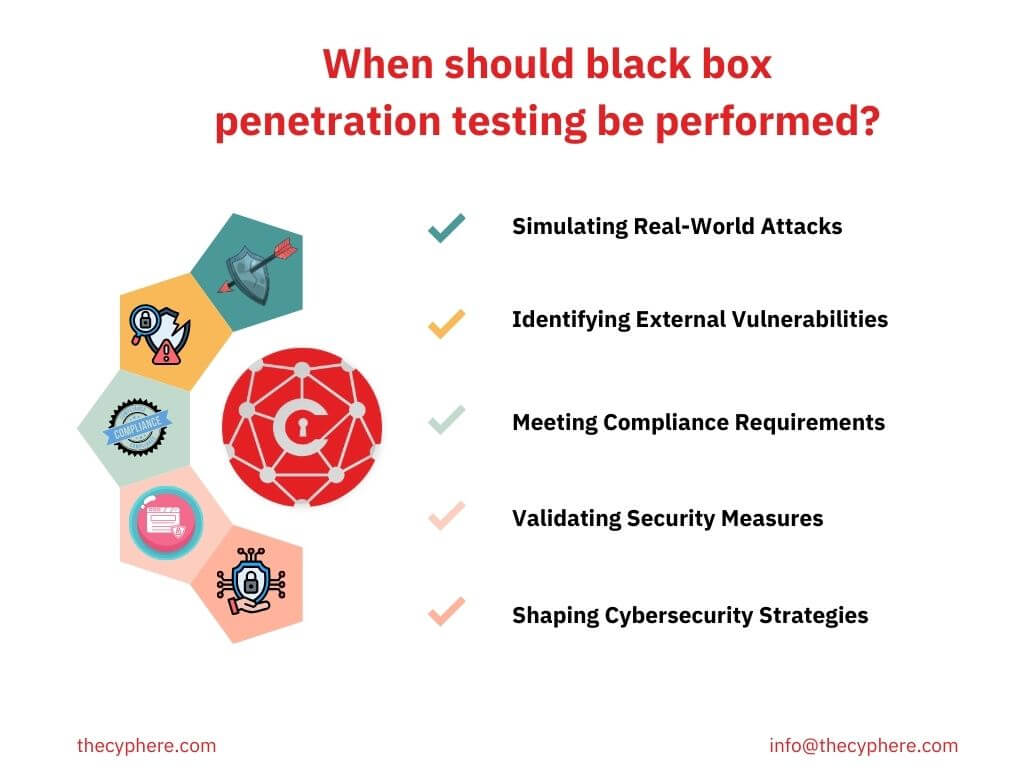
You should consider performing black box testing in the following situations.
- Simulating Real-World Attacks: Black box penetration testing is ideal for simulating external attacks, which gives a real assessment of how a real attacker might breach the system. Simulating real-world attacks provides organisations with insight into attack vectors and helps them prepare beforehand.
- Identifying External Vulnerabilities: With no insider knowledge of the system, testers detect vulnerabilities that might be missed during internal assessment, like misconfigurations, open ports and unpatched systems.
- Meeting Compliance Requirements: Regulatory frameworks or industry standards like Payment Card Industry Data Security Standard (PCI DSS) require external or black box testing for compliance. Other standards like HIPAA, SOC 2, and ISO 27001 also need this testing for specific security practices.
- Validating Security Measures: Through black box penetration testing, security professionals ensure the implemented defence functions protect against external attacks and assess the effectiveness of existing security controls.
- Shaping Cybersecurity Strategies: Black box penetration testing gives an understanding of how to develop a strong cybersecurity strategy.
How is black box penetration testing used in different types of penetration testing?
Many penetration testing types use black box pen testing to discover vulnerabilities using an ‘attacker from outside’ approach.
The use of black box penetration testing within other types of penetration testing is outlined below:
- External penetration testing: External penetration testing uses a black box testing method to simulate a real-world attack from outside an organisation on accessible systems and services such as web servers, email servers, firewalls and public-facing infrastructure (IPs, VPNs, DNS). The black box testing method helps to test the perimeter defence and provide insight into what a remote attacker could exploit without credentials.
- Social engineering penetration testing: Social engineering penetration testing uses black box penetration testing to simulate malicious attacks on employees and users. Black box testing method is used by pen testers to gather publicly available information(LinkedIn, company website, social media, job ads, WHOIS, etc) to create believable scenarios such as phishing (email), vishing (phone), smishing (SMS/WhatsApp), or physical baiting (USB sticks). The Black Box method helps to assess human vulnerabilities and validate the effectiveness of incident response, phishing filters and security awareness.
- Physical penetration testing: Physical penetration testing uses black box testing to gain unauthorised physical access to devices. Pen testers use the black box testing method to gather public information(company address, staff LinkedIn posts, vendor schedules, building floor plans from planning portals, or social media showing uniforms/badges, etc). They try to break through the entry points by tailgating, impersonation, badge cloning, lock bypassing or social engineering on staff.
- Network penetration testing: Network penetration testing uses a black box testing method to perform testing externally through publicly accessible interfaces without internal IP lists, credentials, or architecture diagrams. Testers mimic real attackers’ techniques to gain initial access and identify vulnerabilities in network defences like weak firewall policies, insecure remote access, misconfigured VPNs, exposed management interfaces and flat networks. It helps assess perimeter control (firewalls, WAFs, VPNs) and the effectiveness of detection/response.
- Web application penetration testing: Web application penetration testing uses the black box penetration testing method to discover public endpoints (APIs, subdomains, upload points). Pen testers use black box testing to simulate a malicious attack as an external user to uncover vulnerabilities like XSS, SQL injection, CSRF, authentication bypasses and broken access controls. It helps to discover undocumented endpoints and APIs, validate WAF responses on malicious traffic, test real-world exploitability and assess server-side input handling and auth enforcement.
What are the best practices to perform black box penetration testing?
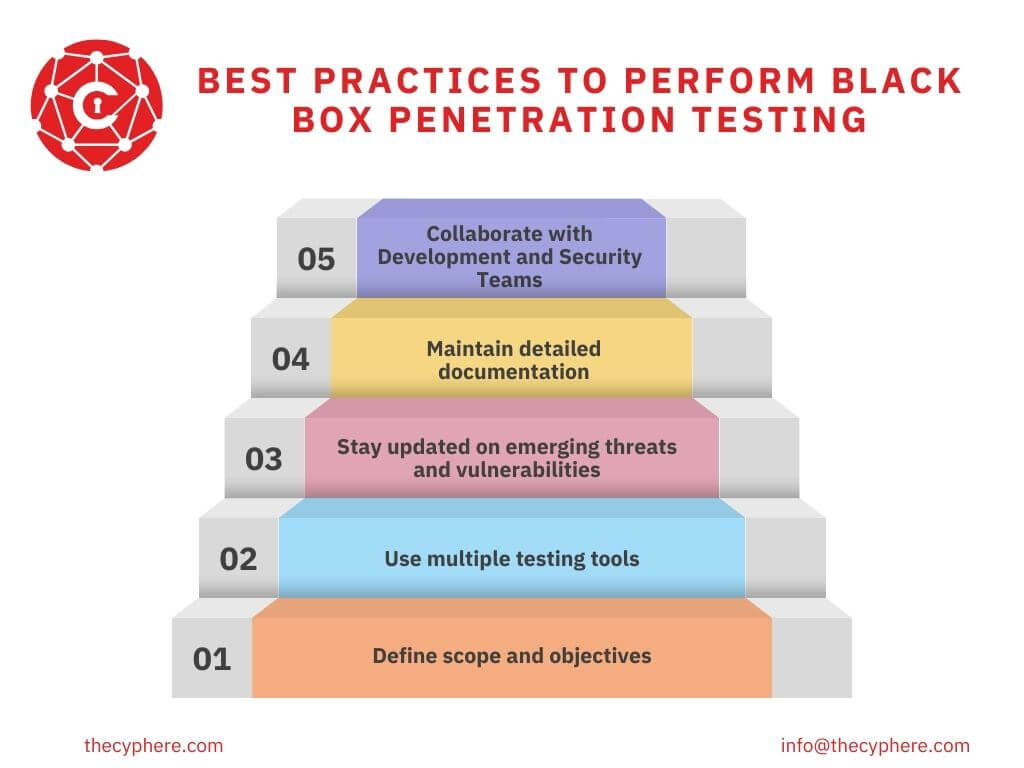
Follow these best practices for effective black box penetration testing.
- Define scope and objectives: Defining scope and objectives is a process where testers list assets, out-of-scope systems, business priorities and success criteria. In this, a penetration tester also assesses the network, system and application for testing.
- Use multiple testing tools: Use both automated scanning tools and manual testing methods for complete coverage and effective vulnerability assessment. A variety of tools improve the depth of black box testing as testers use different tools for their specific tasks. Each tool provides unique insight into different testing phases, such as vulnerability scanning, network scanning and software testing.
- Stay updated on emerging threats and vulnerabilities: You can stay informed about the latest attack vectors, exploitation techniques and emerging vulnerabilities by continuous research and subscription to threat intelligence feeds. Staying updated on emerging threats and vulnerabilities helps to develop a refined testing strategy and gives the organisation a timely insight into mitigating vulnerabilities.
- Maintain detailed documentation: Keeping a detailed record of vulnerabilities found and methodologies, tools used in testing, gives a clear understanding of the security landscape. Proper documentation helps in future testing efforts, provides an audit trail and recommendations.
- Collaborate with Development and Security Teams: Collaboration with development and security teams helps to run timely remediation actions to secure the system defences and to implement findings from black box testing. This approach ensures the testing aligns with the organisation’s goals and addresses long-term risks.
What is the difference between black box and white box penetration testing?
The main differences between black box and white box penetration testing are knowledge of the system and the testing approach. In black box penetration testing, the pen tester has no prior knowledge of the system’s internal architecture, source code or configurations. Black box pen testing allows ethical hackers to simulate real-world attacks from an external attacker’s perspective. In white box penetration testing, the pen tester has complete knowledge of the system, including network diagram, source code and configuration details. White-box testing enables ethical hackers to conduct a comprehensive and detailed security evaluation, identifying both internal and external vulnerabilities.
The black box testing approach includes simulating an outsider’s attack and identifying exploitable vulnerabilities through methods like scanning, fuzzing and exploitation without insider knowledge. Black box testing helps to assess the system’s defence parameters against external attacks. The white box testing approach includes simulating an authorised internal assessment. In white box testing, pen testers follow a structured approach, including code reviews, configuration checks, and logic testing to discover hidden vulnerabilities that are missed by external assessment.
Black box testing and white box testing include another key difference in testing coverage and time efficiency. Black box testing gives limited coverage because of the limited system’s knowledge provided to the pen testers. Whereas white box testing provides comprehensive coverage since pen testers have access to all internal components. White box testing is more time-consuming and needs more resources compared to black box testing, which focuses on identifying external vulnerability.