Vulnerability assessment is a systematic process that finds, assesses, and prioritises vulnerabilities in a system or application. Vulnerability assessment is considered a part of a larger family of vulnerability management.
Vulnerability management is related to vulnerability analysis to identify conditions that lead to decision-relevant outcomes.
The main types of vulnerability assessments are cybersecurity vulnerability assessment, social vulnerability assessment, climate vulnerability assessment, industrial vulnerability assessment, and integrated assessment.
The vulnerability assessment process includes planning and scoping, scanning and testing, analysis and risk prioritisation, and reporting and remediation, according to a 2025 study by Danoe titled “What is vulnerability assessment: benefits, types, and process.”
The cost of vulnerability assessment varies between £1,000 and £50,000. Vulnerability assessment provides regulatory compliance, risk reduction, efficient patching, a security baseline, and better decision-making, according to a 2025 study by Marisa titled “Vulnerability Assessment: Process and Best Practices.”
What is vulnerability assessment in cybersecurity?
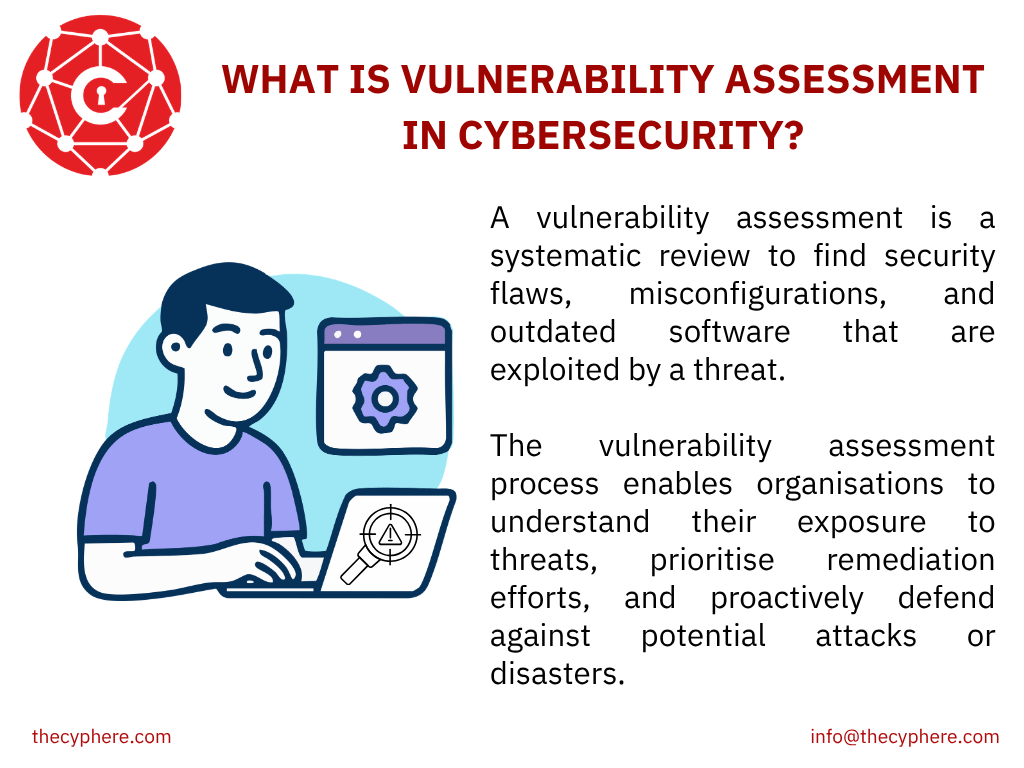
A vulnerability assessment is a systematic review to find security flaws, misconfigurations, and outdated software that are exploited by a threat. The other names of vulnerability assessment are vulnerability scanning, vulnerability analysis, and vulnerability testing.
The unique features of vulnerability assessment are automated scanning, no exploitation, vulnerability prioritisation, remediation suggestions, continuous monitoring, and risk management, according to a 2023 study by Edward Chopskie titled “Vulnerability Assessment Tools: Key Features and 5 Tools You Should Know.”
The vulnerability assessment starts with discovery, scanning, identification, and reporting to identify misconfigurations, missing patches, code flaws, and weak authentication, according to 2023 research by Dabit et al., titled “Identifying Weaknesses: A Guide to Conducting an Effective Network Vulnerability Assessment.” The vulnerability assessment is a part of vulnerability management in which the upper hierarchy includes risk management and information security (InfoSec), according to 2022 research by Tom et al., titled “What is a vulnerability assessment?”
What is the purpose of vulnerability assessment?
The purpose of a Vulnerability Assessment (VA) is to provide organisations with a systematic and data-driven view of their security weaknesses to make informed decisions and reduce cyber risk.
The vulnerability assessment process enables organisations to understand their exposure to threats, prioritise remediation efforts, and proactively defend against potential attacks or disasters.
According to a 2024 study by Reddy et al., titled “Adaptive Vulnerability Matching Assessment: A Holistic Approach for Cybersecurity Resilience,” vulnerability assessment helps organisations detect and address flaws before attackers can exploit them to protect data, assets, and operations.
Vulnerability assessment is important because of risk reduction, compliance (PCI DSS, HIPAA, and NIST), cost efficiency, and business assurance, according to a 2013 study by Kakareka et al., titled “What is Vulnerability Assessment.”
What are the types of vulnerability assessment?
Listed below are the types of vulnerability assessment.
1. Network-Based Vulnerability Assessment
A Network-Based Vulnerability Assessment identifies security weaknesses and misconfigurations across an organisation’s entire infrastructure, encompassing both internal and external-facing assets. The primary goal is to determine how an attacker could exploit these gaps to gain unauthorised access or move laterally across the network. This process targets critical hardware (routers, switches, firewalls, load balancers) and essential services (DNS, DHCP, Mail, VPNs) to identify flaws such as unpatched firmware, weak encryption, default configurations, and unnecessary open ports. Using industry-standard scanners like OpenVAS, Qualys, and Nmap, this assessment is crucial for securing the organisation’s perimeter and internal pathways, especially following major architectural changes.
2. Host-Based Vulnerability Assessment
A host-based vulnerability assessment focuses on the security posture of individual systems, or “hosts,” such as servers, workstations, and endpoints. This assessment requires credentialed access to the host to perform a deep, localised examination of the operating system and installed software. This assessment includes operating systems (Windows, Linux, macOS), installed applications and local software, configuration settings, registry settings, system files, user accounts, and permissions. The host-based vulnerability assessment finds vulnerabilities such as missing operating system patches (unpatched vulnerabilities), outdated or vulnerable third-party software (old Java, Flash), incorrect file or registry permissions (allowing privilege escalation), weak local user passwords, or unnecessary accounts.
3. Application-Based Vulnerability Assessment
An application-based vulnerability assessment finds security flaws within custom-developed software, commercial off-the-shelf (COTS) applications, web applications, and mobile apps. This assessment includes web applications (front-end and back-end logic), mobile applications (Android, iOS), application source code (static analysis), and runtime behaviour (dynamic analysis). Application-based vulnerability assessments find vulnerabilities such as injection flaws (SQL injection, command injection), cross-site scripting (XSS), broken authentication and session management, and insecure direct object reference (IDOR) (vulnerabilities often listed in the OWASP Top 10).
4. API Vulnerability Assessment
An API vulnerability assessment is a specialised assessment that focuses exclusively on the security of Application Programming Interfaces (APIs), which serve as the communication backbone for modern web, mobile, and cloud applications. It is often considered a deep subset of application-based VA. This assessment includes API endpoints (REST, SOAP, GraphQL), authentication and authorisation mechanisms (OAuth, API keys), and input/output data validation. API vulnerability assessment finds Broken Object Level Authorisation (BOLA) (the most critical API vulnerability), lack of resource and rate limiting, excessive data exposure, and improper asset management (unretired old APIs).
5. Database Vulnerability Assessment
A database vulnerability assessment is a targeted process for identifying security weaknesses in database management systems (DBMS) and the configuration of the databases themselves, which store the organisation’s most sensitive data. This assessment includes Database Management System software (Oracle, MS SQL, PostgreSQL), database configuration and patch levels, and user privileges, roles, and access controls. Database vulnerability assessment finds default or weak administrative credentials, missing security patches for the DBMS software, excessive user privileges (over-privileged user accounts), and insecure configuration (audit logging disabled).
6. Wireless Network Vulnerability Assessment
A wireless network vulnerability assessment assesses the security of an organisation’s wireless infrastructure (Wi-Fi, Bluetooth) to prevent unauthorised network access and data interception via wireless means. This assessment includes Wireless Access Points (WAPs), wireless controllers and authentication servers, and wireless security protocols. A wireless network vulnerability assessment finds weak or obsolete encryption protocols (WEP or outdated WPA2), misconfigured authentication (weak PSK or poor RADIUS configuration), rogue access points (APs) (unauthorised devices connected to the network), and man-in-the-middle (MITM) attacks via “evil twin” APs.
7. Cloud Vulnerability Assessment
A cloud vulnerability assessment focuses on security flaws, misconfigurations, and compliance issues within cloud infrastructure and services (IaaS, PaaS, SaaS). It is distinct because it often leverages cloud-native tools and respects the Shared Responsibility Model. This assessment includes cloud infrastructure misconfigurations (AWS Security Groups, Azure Network Security Groups), container security (Docker, Kubernetes), serverless function misconfigurations (overly permissive IAM roles), and Identity and Access Management (IAM) policy weaknesses. Cloud vulnerability assessment finds overly permissive IAM roles and S3 bucket policies, exposed storage buckets (public S3 buckets), unpatched images within container registries, and misconfigured network security groups allowing unnecessary public access.
8. SCADA and ICS Vulnerability Assessment
A SCADA and ICS vulnerability assessment targets the security of Industrial Control Systems (ICS), which manage critical infrastructure like power grids, manufacturing plants, and water treatment facilities. This assessment is highly sensitive, as improper scanning can cause operational disruption. SCADA and ICS vulnerability assessment includes SCADA (Supervisory Control and Data Acquisition) systems, PLCs (Programmable Logic Controllers) and RTUs (Remote Terminal Units), and Proprietary industrial network protocols (Modbus, Profinet) SCADA and ICS vulnerability assessment finds legacy systems running outdated, unpatched operating systems; a lack of segmentation between the IT (Information Technology) and OT (Operational Technology) networks; insecure industrial protocols that lack authentication or encryption; and hard-coded or default passwords in HMI (Human-Machine Interface) systems.
9. Social Engineering Vulnerability Assessment
A social engineering vulnerability assessment identifies weaknesses in security policies, processes, and employee awareness to gain unauthorised access to systems and confidential data. This type of vulnerability assessment includes scoping, reconnaissance, attack execution, data collection and analysis, and reporting. A social engineering vulnerability assessment finds vulnerabilities such as a lack of security awareness, weak policy enforcement, information leakage, data exposure, and poor physical security. The tools used in social engineering vulnerability assessment are email phishing platforms (GoPhish), OSINT tools (Maltego and Shodan), and web page cloning tools. Social engineering vulnerability assessment quantifies human risk, prioritises training, and validates controls. Social engineering vulnerability assessment is used under pre- and post-training, high-value targets, after a security incident, and for audits.
10. Endpoint Vulnerability Assessment
An Endpoint Vulnerability Assessment is an automated process of identifying, classifying, and prioritising security vulnerabilities on devices that connect to an organisation’s network. Endpoints include employee laptops, desktop computers, mobile devices, servers, and IoT (Internet of Things) devices. This assessment finds security flaws before an attacker exploits them to gain unauthorised access, steal data, or deploy malware. Endpoint Vulnerability Assessment includes asset discovery, vulnerability scanning and analysis, validation, and continuous monitoring. This assessment finds vulnerabilities such as missing security patches, security misconfigurations, weak authentication, unnecessary software and services, and insecure software versions. This assessment uses tools such as Tenable Nessus, Qualys VMDR, Rapid7 InsightVM, OpenVAS, nmap, CrowdStrike Falcon, Microsoft Defender Vulnerability Management, SentinelOne, Microsoft SCCM/Intune, BigFix, and Ivanti. This assessment reduces attack surface, aids compliance, and informs risk strategy. Endpoint vulnerability assessment is used in hybrid work environments, after major software deployments, and before and after penetration testing and high turnover.
How to perform a vulnerability assessment?
Listed below are the steps to perform a vulnerability assessment.
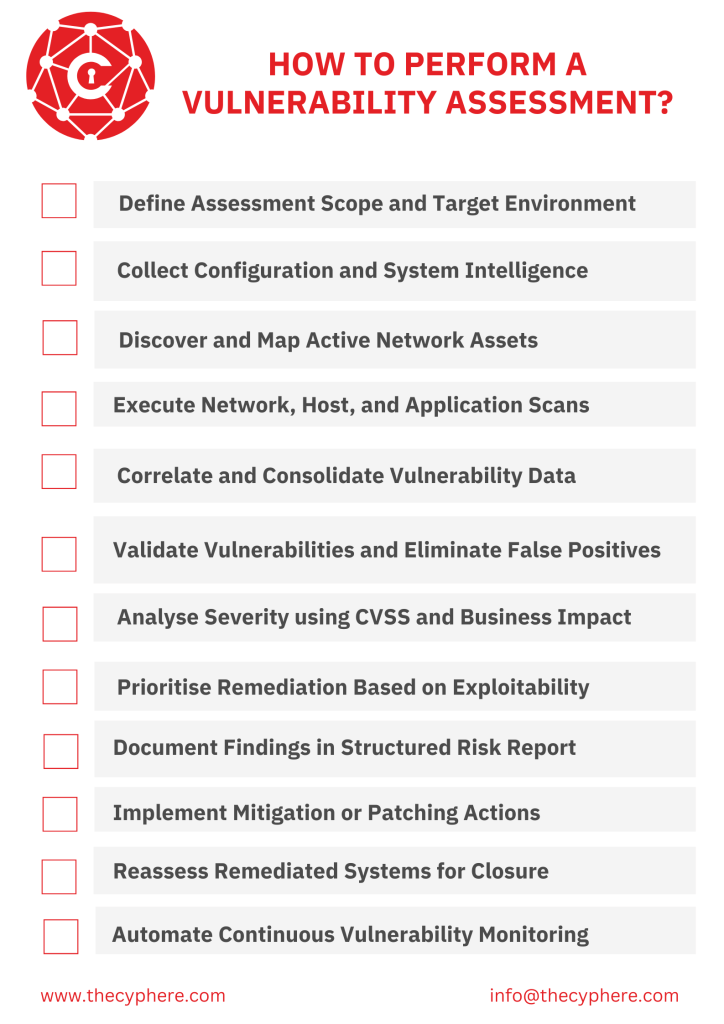
1. Define Assessment Scope and Target Environment
Defining the assessment scope and target environment in a vulnerability assessment formally establishes the boundaries and targets of the assessment. This step defines the target environment (public-facing web servers, internal HR network, specific application versions) and specifies in-scope IP ranges, URLs, systems, and credential requirements (credentialed vs. non-credentialed scans). This step also defines the success criteria and required outputs like report format and remediation deadlines.
2. Collect Configuration and System Intelligence
Collecting configurations and system intelligence in vulnerability assessment gathers the prerequisite information needed for effective scanning. This step collects system inventory, network diagrams, security policies, and known system configurations and obtains administrative credentials for credentialed scanning, ensuring necessary permissions are in place.
3. Discover and Map Active Network Assets
Discovering and mapping active network assets creates a current and accurate inventory of all live devices. This step uses tools like Nmap to perform passive and active discovery of all active hosts and open ports. This mapping process reveals the network topology and fingerprints operating systems, ensuring that no active device within the scope is overlooked during the vulnerability scan.
4. Execute Network, Host, and Application Scans
Executing network, host, and application scans runs automated checks against the discovered assets. This step executes specialised scans such as network scans (for infrastructure vulnerabilities), host scans (credentialed, for OS and configuration flaws), and application scans (DAST/SAST for web/mobile apps).
5. Correlate and Consolidate Vulnerability Data
Correlating and consolidating vulnerability data merges results from various scanning tools into a single dataset. This step aggregates raw scan data, removes redundant entries, and normalises data format using a common identifier for systems and flaws for consistent analysis.
6. Validate Vulnerabilities and Eliminate False Positives
Validating vulnerabilities and eliminating false positives ensures the reported flaws are genuine and exploitable weaknesses. This step involves manually reviewing high-severity findings, verifying the existence of the vulnerability through nondestructive testing or configuration checks. This step also removes all false-positive issues reported incorrectly by the scanner.
7. Analyse Severity using CVSS and Business Impact
Analysing severity using CVSS and business impact determines the true risk level of each confirmed vulnerability. This step calculates the severity of each vulnerability using the Common Vulnerability Scoring System (CVSS) base score and overlays the CVSS score with the business impact (data sensitivity, system criticality) to determine the final risk rating.
8. Prioritise Remediation Based on Exploitability
Prioritising remediation based on exploitability creates an ordered list of fixes for the remediation teams. This step ranks vulnerabilities based on the final risk rating (high, medium, or low). It gives higher priority to critical vulnerabilities that are currently being actively exploited in the wild or have readily available exploits.
9. Document Findings in Structured Risk Report
Document findings in a structured risk report and communicate the findings, risk levels, and mitigation actions to stakeholders. This step generates a formal report containing an executive summary (high-level risk), detailed findings (per vulnerability, including CVSS and impact), and specific, actionable remediation recommendations.
10. Implement Mitigation or Patching Actions
Implementing mitigation or patching actions corrects the identified vulnerabilities. In this step, security and IT teams execute the remediation plan: apply patches, reconfigure settings, deploy compensating controls (WAF rules), or update source code. The tools used in implementing mitigation or patching actions include Patch Management Systems (SCCM) or Configuration Management tools (Ansible). The output of implementing mitigation or patching actions is the remediation confirmation and closure of related IT tickets.
11. Reassess Remediated Systems for Closure
Reassessing remediated systems for closure verifies that the mitigation actions were effective. This step runs verification scans targeting the previously identified vulnerabilities on the fixed systems. This step verifies that the original vulnerability is gone and that the fix did not introduce any other issues. The output of reassessing remediated systems for closure is an Assessment Closure Report, which signs off that the identified risks are addressed.
12. Automate Continuous Vulnerability Monitoring
Automating continuous vulnerability monitoring shifts to a proactive, continuous security posture. This step schedules automated, recurring vulnerability scans (daily/weekly for critical assets) and integrates VA reporting into a vulnerability management platform for continuous tracking and alert generation.
What is the cost of a vulnerability assessment process?
The cost of a vulnerability assessment process falls between £1,000 and £10,000 for an average test. Complex risk assessments exceed £50,000.
The price is driven by the scope and complexity of the environment (IP addresses, applications, or cloud services like Azure), the depth of testing, and the frequency of the assessments, according to a 2022 study by Alazmi et al., titled “A Systematic Literature Review on the Characteristics and Effectiveness of Web Application Vulnerability Scanners.”
The vulnerability assessment analyst salary averages around £86,000 to £108,500 annually, and a basic network vulnerability assessment starts around £1,000 for external scanning.
Cloud solutions like Azure’s vulnerability assessment are included in the cost of Microsoft Defender for Servers Plan 2 (approx. £14.60 per server/month). The securing platforms like WordPress can range from free plugins to £149–£1,250 per year for premium security services.
What are the benefits of vulnerability assessment?
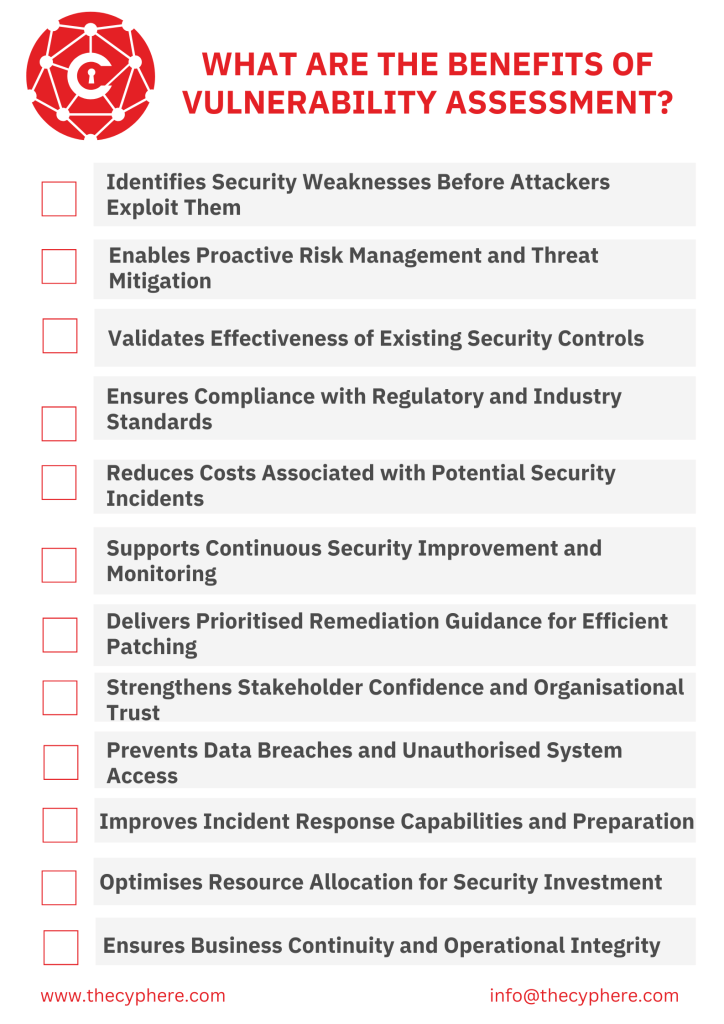
Listed below are the benefits of vulnerability assessment.
- Identifies Security Weaknesses Before Attackers Exploit Them: A vulnerability assessment scans the environment for known security flaws (outdated software, misconfigurations, or unpatched systems) and highlights them before malicious actors can discover and leverage them. This allows an organisation to fix the flaw while maintaining control over the situation, according to a 2025 study by Louis Trout titled “What are the benefits of conducting regular vulnerability assessments?”
- Enables Proactive Risk Management and Threat Mitigation: A vulnerability assessment moves security from a reactive to a proactive discipline. It catalogues all existing vulnerabilities, assigns them a severity score (like CVSS), and maps them to potential threats, according to a 2020 paper by Al-Mohannadi et al., titled “A Review of Vulnerability Assessment and Penetration Testing.” This proactive risk management offered by vulnerability assessment allows security teams to allocate resources based on the highest-risk items.
- Validates Effectiveness of Existing Security Controls: Vulnerability scanning tests the environment through the lens of existing security tools such as firewalls, intrusion detection systems (IDS), and web application firewalls (WAFs). The vulnerability assessment validates the weakness or failure of the control and ensures that the controls are configured correctly and functioning as intended, according to a 2024 study by Sonny titled “The Benefits of Vulnerability Assessment.”
- Ensures Compliance with Regulatory and Industry Standards: A vulnerability assessment ensures compliance with regulatory and industry standards (PCI DSS, HIPAA, and GDPR), mandating regular vulnerability scanning or assessments. Conducting a vulnerability test offers the necessary documented evidence and reduces the risk of hefty non-compliance fines, according to a 2025 study by Louis Trout titled “What are the benefits of conducting regular vulnerability assessments?”
- Reduces Costs Associated with Potential Security Incidents: The cost of an incident response, data breach notification, lost revenue, and reputational damage far outweighs the cost of a VA. The vulnerability assessment delivers a massive return on investment and justifies its expense.
- Supports Continuous Security Improvement and Monitoring: A vulnerability assessment is not a one-time process and is performed continuously or at regular intervals. This repeated process helps the security team track their progress over time, ensuring that newly introduced assets or configuration changes do not introduce new security gaps. This cyclical nature is integral to the Plan-Do-Check-Act (PDCA) model of continuous improvement, according to a 2025 study by Louis Trout titled “What are the benefits of conducting regular vulnerability assessments?”
- Delivers Prioritised Remediation Guidance for Efficient Patching: Vulnerability scanners provide a list of flaws and assign a Common Vulnerability Scoring System (CVSS) score, which is a standardised severity metric. This prioritisation allows security teams to focus their limited time and resources on patching the high-severity flaws first and maximise the reduction of risk with minimal effort.
- Strengthens Stakeholder Confidence and Organisational Trust: Regularly performing VAs demonstrates a commitment to security diligence to customers and business partners. They have a proactive security posture, which strengthens their brand and reputation. This is particularly important for businesses handling sensitive customer data, according to a 2024 study by Sonny titled “The Benefits of Vulnerability Assessment.”
- Prevents Data Breaches and Unauthorised System Access: The most direct security benefit of vulnerability assessment is the preemptive prevention of data exposure. It finds and fixes vulnerabilities, such as SQL injection flaws, broken access controls, or weak encryption. The vulnerability assessment closes the doorways that hackers rely on to gain unauthorised access to sensitive data, intellectual property, or critical systems, according to a 2025 study by Marisa titled “Vulnerability Assessment: Process and Best Practices.”
- Improves Incident Response Capabilities and Preparation: A vulnerability assessment focuses on the prevention of security breaches. The process of documenting vulnerabilities often forces teams to establish clearer asset inventories, ownership, and communication channels, according to a 2025 study by Danoe titled “What is vulnerability assessment: benefits, types, and process.” This improved documentation is an essential component of an effective Incident Response (IR) plan and makes teams better prepared to handle a real security event when it occurs.
- Optimises Resource Allocation for Security Investments: The vulnerability report provides concrete data on the weakest areas of the infrastructure. This data justifies future security spending and ensures that the budget is allocated to upgrading an older system and maximising security investment efficiency.
- Ensures Business Continuity and Operational Integrity: Vulnerability assessment ensures business continuity and operational integrity. The unpatched critical flaws lead to system crashes, denial-of-service conditions, or ransomware attacks that halt operations. The vulnerability assessment directly supports the organisation’s ability to maintain normal business operations without interruption, according to a 2020 paper by Al-Mohannadi et al., titled “A Review of Vulnerability Assessment and Penetration Testing.”
Can a vulnerability assessment cause a slowdown in your network performance?
Yes, a vulnerability assessment can cause a noticeable slowdown in network performance as the scanner generates a high volume of traffic and requests. Vulnerability assessment consumes significant network bandwidth, which slows down business traffic, according to a 2024 study by Alyssa titled “Network Testing: How to Test Network Performance.”
The constant probing temporarily exhausts CPU and memory resources on target systems such as older servers and firewalls. Security teams schedule VAs to run outside of peak business hours (nights or weekends) to prevent this performance impact, according to a 2025 study by Mohammed titled “Vulnerability Assessment vs. Penetration Testing 2025: Key Differences and Best Practices.”
How often should vulnerability assessments be performed?
Vulnerability assessments should be performed at least once per quarter (every 4 months). The frequency of vulnerability assessments depends on the organisation’s particular risk profile and environmental changes. The quarterly scans are mandated by compliance standards (PCI and DSS) to ensure regular checking, according to 2025 research by Vinugayathri titled “How Frequently Should We Run a Vulnerability Scan?” Vulnerability scanning must be done weekly for public-facing assets such as external servers and web applications.
Can you perform a vulnerability assessment online?
Yes, a vulnerability assessment can be performed online with two methods, including external and internal servers. The process involves Software-as-a-Service (SaaS) security platforms and cloud-based scanning tools (DAST or Dynamic Application Security Testing). The organisation provides the public-facing IP addresses, websites, or domain names to the vendor and the cloud-hosted scanner, which requires no installation or local infrastructure from the client. The vulnerability assessment is managed online for internal network scanning, which allows security teams or third-party consultants to control, schedule, and retrieve the results remotely.
Is online vulnerability assessment the same as automated vulnerability assessment?
No, online vulnerability assessment is not the same as automated vulnerability assessment. Automated vulnerability assessment relies on specialised software scanners to rapidly check systems against a database of known flaws for speed and scale. Online vulnerability assessment defines the location or accessibility and targets public-facing assets and is delivered as a SaaS (Software-as-a-Service) model. “Automated” describes how the scan is executed, while “online” describes where the scanner and the target system are located relative to each other.
What tools are used to perform vulnerability assessment?
Listed below are the tools that are used to perform vulnerability assessment.
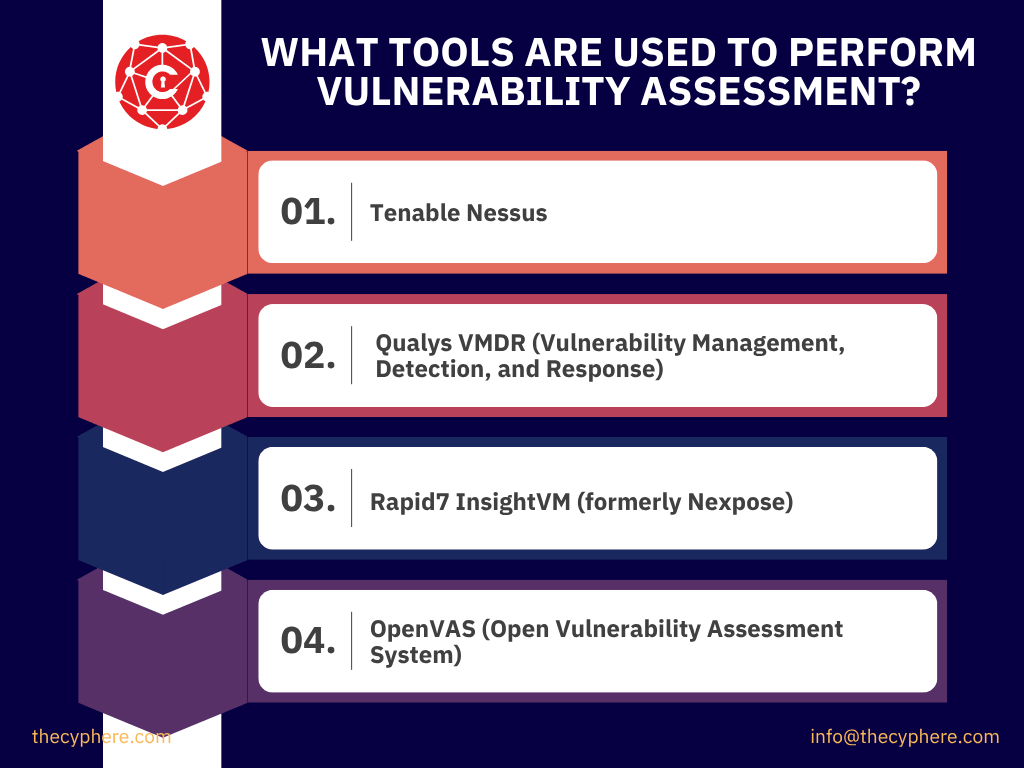
- Tenable Nessus: Nessus is one of the widely recognised and trusted vulnerability assessment tools. It detects vulnerabilities across operating systems, network devices, and applications. Nessus provides detailed reports and risk scoring (including VPR and CVSS) to help security teams.
- Qualys VMDR (Vulnerability Management, Detection, and Response): Qualys is a cloud-based vulnerability management platform that specialises in large-scale environments. Its SaaS model allows for continuous monitoring across cloud and containerised systems through lightweight agents. Qualys excels in compliance reporting and integrates vulnerability scanning with detection, response, and automated patch management workflows.
- Rapid7 InsightVM (formerly Nexpose): Rapid7 InsightVM is a modern vulnerability management solution that emphasises live visibility and real-time risk analysis. The platform calculates risk using a predictive risk score based on exploitability. InsightVM integrates seamlessly with the broader Rapid7 security platform for advanced analytics and threat intelligence.
- OpenVAS (Open Vulnerability Assessment System): OpenVAS is a powerful open-source vulnerability scanner. It offers a highly customizable solution that performs both authenticated and unauthenticated scans. This tool is often favoured by smaller organisations, educational institutions, and users who require a robust, cost-free solution.
The best vulnerability assessment tools are OpenVAS, Tenable Nessus for single-user and medium-sized businesses, and Qualys VMDR for large enterprises, according to 2024 research by Sharma et al., titled “OpenVAS vs the Rest: Unveiling the Competitive Edge in Vulnerability Scanners.”
What are the vulnerability assessment best practices to follow?
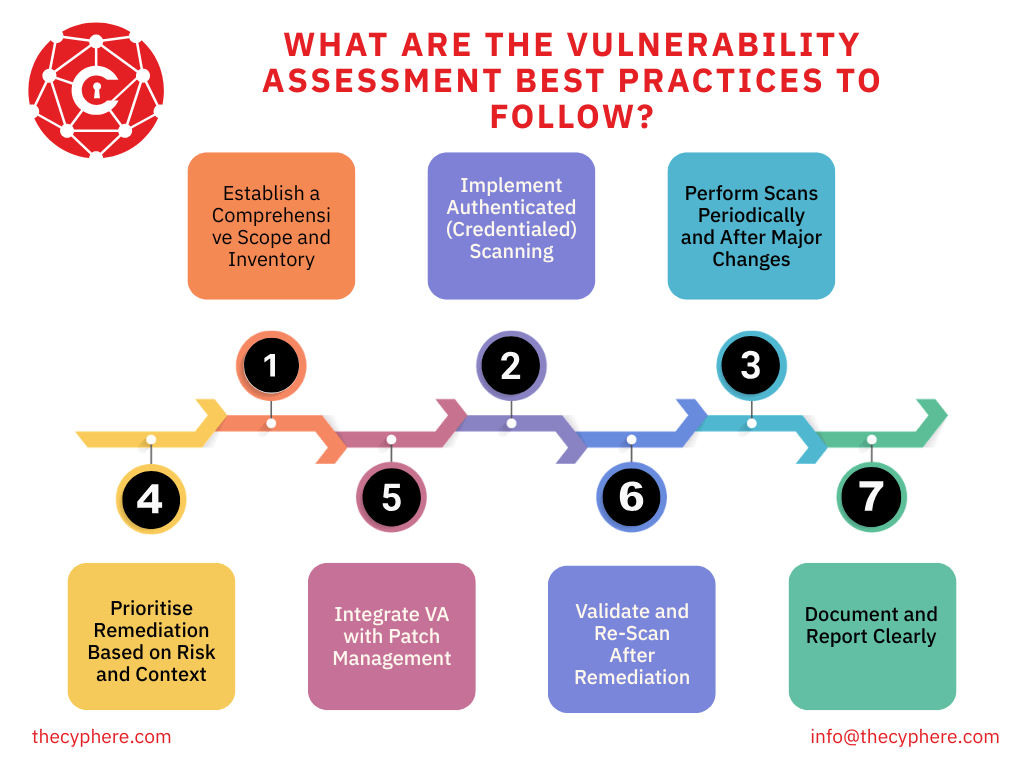
Listed below are the best practices of vulnerability assessment to follow.
- Establish a Comprehensive Scope and Inventory
- Implement Authenticated (Credentialed) Scanning
- Perform Scans Periodically and After Major Changes
- Prioritise Remediation Based on Risk and Context
- Integrate VA with Patch Management
- Validate and Re-Scan After Remediation
- Document and Report Clearly
Is vulnerability assessment better than penetration testing?
No, a vulnerability assessment is not better than penetration testing, but both of them are complementary and serve different purposes in a security program. Penetration testing is better than vulnerability testing because of real-world impact, human intelligence, creative attack paths, and testing of security controls and defences.
A vulnerability assessment is a broad and automated scan that uses tools like Nessus or Qualys to identify and prioritise the maximum number of known security flaws (a focus on breadth). Penetration testing is a manual exercise conducted by ethical hackers to exploit a limited number of flaws and prove whether an attack is feasible and determine the depth of access an attacker could achieve.
A penetration tester uses tools like Metasploit and Burp Suite and provides concrete evidence of business risk. Vulnerability assessment is run first to provide a prioritised list of weaknesses, and penetration testing attempts to exploit the highest-risk items for maximum effectiveness. Vulnerability assessment vs. penetration testing provides the organisation with a robust understanding of both its vulnerabilities and its true exploitability, according to a 2020 paper by Al-Mohannadi et al., titled “A Review of Vulnerability Assessment and Penetration Testing.”
What are the best vulnerability assessment companies?
Listed below are the top 3 vulnerability assessment companies.
1. Cyphere
Cyphere is a global cybersecurity company that offers a range of security services, such as CREST accredited penetration testing, managed security services (MSS), incident response, IASME Cyber Essentials Assessments, cyber security compliance services and vulnerability assessment services. Cyphere was founded by Harman Singh in 2021, with its headquarters in Manchester, United Kingdom and serves fintech, online retail, healthcare, professional services, SaaS, higher education, housing and social care, technology sectors. Cyphere is the best vulnerability assessment company because it focuses on a service-oriented approach to vulnerability assessment. Cyphere vulnerability assessment services include asset discovery and profiling, risk-based prioritisation, actionable remediation plans, and continuous vulnerability management.
2. NCC Group
NCC Group is a major international cybersecurity and software resilience company. NCC Group is headquartered in Manchester, United Kingdom, and was founded in 1999. They offer services such as consultancy, managed detection and response (MDR), software escrow, and penetration testing. NCC Group is a top choice due to its technical expertise and globally recognised reputation in security consulting and assurance.
3. Darktrace
Darktrace is a global cybersecurity company headquartered in Cambridge, United Kingdom, founded in 2013. Darktrace specialises in Artificial Intelligence (AI) and Self-Learning Technology to provide solutions (Enterprise Immune System for network threat detection and Autonomous Response). Darktrace is considered a top provider, as its technology offers a form of continuous, behaviour-based vulnerability detection. It spots high-risk changes within a network that standard signature-based scanners miss and identifies system weaknesses and misconfigurations in real time.