Automated penetration testing is the use of specialised software tools and algorithms to simulate cyberattacks on a computer system, network, or application.
Automated penetration testing involves a structured process that includes planning, scoping, exploitation attempts and remediation.
The main tools for automated penetration testing are vulnerability scanners (Nessus, OpenVAS, and Acunetix), penetration testing frameworks (Metasploit), and web application scanners (Burp Suite).
Automated penetration testing is different from manual penetration testing in speed and frequency, coverage and depth, false positives, and cost.
What is automated penetration testing?
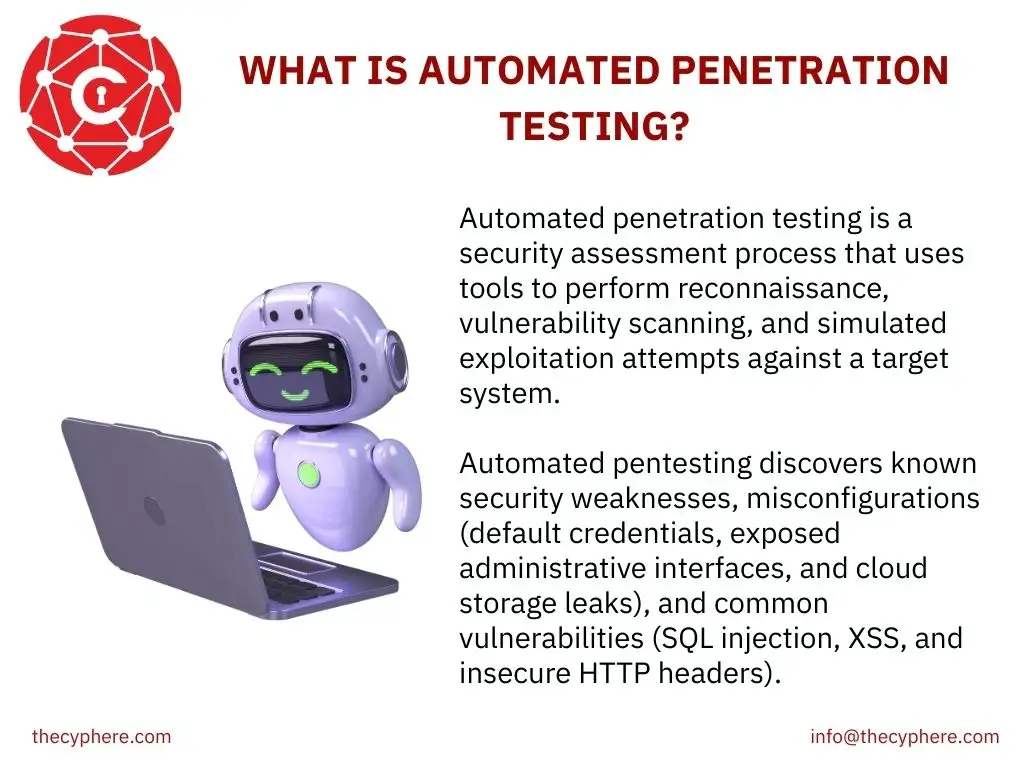
Automated penetration testing is a security assessment process that uses tools to perform reconnaissance, vulnerability scanning, and simulated exploitation attempts against a target system. Automated pentesting discovers known security weaknesses, misconfigurations (default credentials, exposed administrative interfaces, and cloud storage leaks), and common vulnerabilities (SQL injection, XSS, and insecure HTTP headers).
Penetration testing can be automated, but not completely, as penetration testing is considered a hybrid process. Automation handles the breadth scanning for known issues, and human experts handle the depth testing, complex logic and verifying critical findings.
Automated penetration testing is also called ethical hacking, automated pen testing, and continuous penetration testing.
Automated penetration testing is used more by organisations in comparison to other types of penetration testing (network, wireless, and web penetration testing). Automated pen testing includes high-frequency and continuous monitoring and is cost-effective and scalable. Manual pentesting is conducted only once or twice a year, uncovers complex vulnerabilities and validates automated findings.
How does automated penetration testing work?
Automated penetration testing follows the same structured lifecycle as a human tester: reconnaissance, vulnerability identification, active exploitation, and reporting. Unlike simple vulnerability scanners that merely list potential flaws, automated pentesting solutions validate these flaws by attempting to safely exploit them.
Pentesters view this technology as a “force multiplier.” It handles the repetitive, heavy lifting of testing thousands of assets, allowing human experts to focus on complex, logic-based attacks.
For CISOs and managers, the primary value is continuous validation. While manual audits typically occur only once a year, automated pentesting runs continuously (e.g., weekly or daily). This provides a real-time security posture and bridges the dangerous “visibility gap” between annual assessments, ensuring scale and consistent security hygiene.
What is the process of automated penetration testing?
Automated penetration testing involves executing hacker techniques against a digital environment to provide verified evidence of risk, moving beyond simple identification into active proof-of-concept.
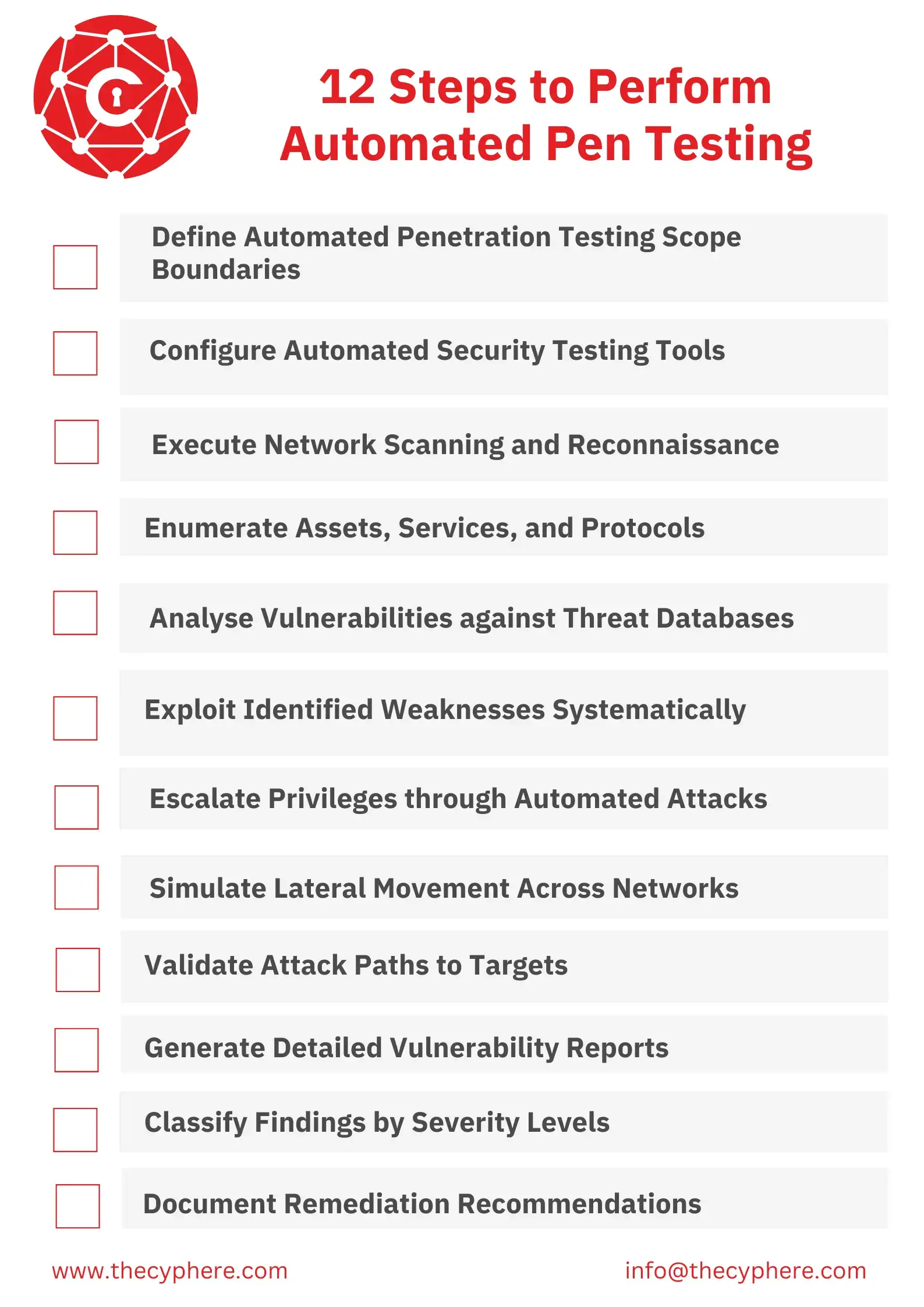
Listed below is the process of automated penetration testing.
1. Define the Automated penetration testing scope boundaries
2. Configure automated security testing tools
3. Execute network scanning and reconnaissance
4. Enumerate assets, services, and protocols
5. Analyze vulnerabilities against threat databases
6. Exploit identified weaknesses systematically
7. Escalate privileges through automated attacks
8. Simulate lateral movement across networks
9. Validate attack paths to targets
10. Generate detailed vulnerability reports
11. Classify findings by severity levels
12. Document remediation recommendations
1. Define Automated Penetration Testing Scope Boundaries
Defining automated penetration testing scope boundaries acts as the legal and technical fence for the test. Defining the scope boundaries of automated penetration testing defines asset identification that includes IP ranges, subdomains, and cloud environments. It specifies the testing hours, excluded assets, and allowed depth of exploitation. The approach selection in automated penetration testing is between black, white, and grey box penetration testing, which decides how much information and access you give the software before it starts the attack.
2. Configure Automated Security Testing Tools
Configuration is the most critical phase to ensure safety and accuracy. Unlike standard Vulnerability Scanners (like Nessus or OpenVAS), which only identify potential flaws, Automated Penetration Testing platforms (such as Pentera, Horizon3 NodeZero, or Metasploit Pro) must be configured to safely exploit those flaws without disrupting business operations.
Infrastructure: The pentester defines the Scope of Engagement (IP ranges) and sets “Safety Thresholds” to prevent the tool from crashing fragile legacy systems or OT devices.
Web Applications: For tools like Burp Suite Enterprise or Acunetix, the tester must configure authentication. Note on MFA: Since standard recording tools cannot replay One-Time Passwords (OTP), the tester must usually provide a test account with MFA disabled or configure a specific session token macro.
Finally, the tools are often integrated into the CI/CD pipeline or SIEM to provide continuous feedback and alert validation.
3. Execute Network Scanning and Reconnaissance
This phase involves executing automated scans to identify live hosts and probe for open ports across the infrastructure. During this step, the tool does not look for “breached” data, but rather for information leakage, such as detailed server headers, public DNS records, and banner grabbing.
This process is a multi-stage sequence of discovery designed to mirror how a human hacker gathers intelligence (OSINT). It is the most critical step in the workflow, as the quality and depth of the reconnaissance directly determine the success of all subsequent exploitation attempts.
4. Enumerate Assets, Services, and Protocols
Enumerating assets, services, and protocols in automated penetration testing identifies specific versions of software (Apache 2.4.49) and active protocols (SSH, SMB, RDP). Automated penetration testing enumerates assets, services, and protocols to map out the topology of the network and create an inventory of every reachable service. Enumerating assets, services, and protocols in automated pentesting extends to cloud-native discovery, where scripts query public APIs to uncover misconfigured storage buckets or exposed management consoles that serve as the initial entry points for an attack.
5. Analyse Vulnerabilities against Threat Databases
The system compares its findings against real-time threat intelligence sources, such as the Common Vulnerabilities and Exposures (CVE) list and the National Vulnerability Database (NVD). This process identifies known weaknesses, including missing patches, standard web flaws, and service-specific vulnerabilities.
Crucially, unlike basic scanners, an automated penetration testing engine goes deeper by checking the underlying configuration. It verifies if the vulnerable feature is actually enabled and reachable. If the specific environment required for an exploit is missing (e.g., a vulnerable module is installed but disabled), the system intelligently downgrades the risk or skips the exploitation attempt entirely, significantly reducing false positives.
6. Exploit Identified Weaknesses Systematically
Once a vulnerability is validated, the tool attempts to actively exploit it. Unlike a manual hacker, the automated system executes this step systematically and safely. For example, it might inject a non-destructive payload (like a sleep command or a harmless data retrieval) into a login form to prove that an SQL Injection vulnerability is truly present, without damaging the database.
This phase removes the latency of human decision-making. The automated engine can pivot through a network at “machine speed,” chaining together a sequence of misconfigurations and exploits to compromise deep internal systems before a security team even begins to triage the initial alert.
7. Escalate Privileges through Automated Attacks
Escalating privileges through automated attacks (vertical privilege escalation and horizontal privilege escalation) in automated pentesting gains a low-level foothold and tries to go vertical. The vertical privilege escalation, such as kernel exploits, SUID/SGID binaries, and unquoted service paths (Windows), moves from a restricted user to a system-wide controller. The horizontal privilege escalation, such as Insecure Direct Object Reference (IDOR) and Credential Dumping (Mimikatz), gains access to another user’s account who has the same level of power but different data access. Escalate privileges through automated attacks in automated penetration testing, which looks for misconfigured permissions, cleartext passwords in memory using techniques like Mimikatz, or unpatched OS kernels to gain admin or root access.
8. Simulate Lateral Movement Across Networks
Once initial access is secured, the automated system uses that foothold to scan internal network segments that were not visible from the outside. It attempts to pivot laterally, hopping from a low-level workstation to high-value targets, such as a Domain Controller or database server.
Crucially, this process leverages legitimate administrative protocols, such as SMB, RDP, and WMI, rather than malicious exploits. By using these standard tools, the automated test demonstrates how a sophisticated intruder “lives off the land” to blend in with normal network traffic, often evading traditional signature-based detection systems.
9. Validate Attack Paths to Targets
Validating attack paths to targets in automated penetration testing chains involves identifying several small flaws together to see if they lead to a high-value asset. This shows how an attacker could move from a public website all the way to a private database, providing a visual attack path. This validation ensures that security teams fix the specific sequence of errors that leads to a breach, rather than patching individual bugs in a vacuum. Automated penetration testing validates attack paths to transform penetration testing from a periodic snapshot into a continuous validation of resilience. It ensures defences that protect the targets remain effective against evolving techniques as the network changes.
10. Generate Detailed Vulnerability Reports
The final output of an automated pentest is a comprehensive report that translates complex technical findings into actionable items. The document is typically structured into two distinct sections: an Executive Summary for leadership (focusing on business risk and scores) and Technical Findings for developers and engineers.
A high-quality automated report goes beyond simple lists. It provides a clear remediation roadmap prioritised by actual risk. Crucially, it includes evidence of exploitation, such as screenshots of compromised systems, dumped password hashes, or command outputs proving that the vulnerabilities were real and not just theoretical false positives.
11. Classify Findings by Severity Levels
Classifying findings by severity levels in automated penetration testing ranks vulnerabilities (Critical, High, Medium, Low) using the CVSS (Common Vulnerability Scoring System). The categorisations of findings, such as Critical, High, Medium, and Low, allow organisations to move away from vulnerability fatigue. It also focuses limited engineering resources on the flaws that pose the most significant threat to the business’s continuity and data integrity. Classifying findings by severity levels in automated penetration testing allows teams to prioritise critical exploits that represent an immediate threat.
12. Document Remediation Recommendations
The process concludes by providing actionable advice to close the security gaps. A high-quality remediation entry typically follows a three-part structure: the Immediate Fix (patching the specific hole), the Root Cause Analysis (understanding why it happened), and the Verification Step (how to prove it is fixed).
This phase provides developers and system administrators with clear technical instructions, such as specific code snippets, configuration changes, or required software upgrades. By mapping these recommendations to industry standards like the OWASP Proactive Controls, the report helps organisations move from a reactive state of “patching holes” to a proactive state of building secure systems by design.
What are the automated penetration testing tools?
Automated penetration testing tools play an important role in assessing the security of applications and networks by simulating real-world attacks to identify vulnerabilities, automate testing tasks, and offer security teams insights into potential risks.
Listed below are the 10 main automated penetration testing tools.
- CIPHER (Cybersecurity Intelligent Penetration-testing Helper for Ethical Researchers): CIPHER is a specialised Large Language Model (LLM) to guide ethical researchers through the penetration testing lifecycle using expert-level reasoning. CIPHER was developed in 2024-2025 to bridge the gap for beginners to offer a large language model on pentesting data to assist ethical hackers with expert reasoning. It uses the FARR flow (Findings, Action, Reasoning, and Results) to structure expert-level reasoning. Functioning as a “copilot,” CIPHER automatically interprets scan results, suggests the next command, and generates exploit payloads. It is designed to bridge the skills gap, helping beginners chain complex vulnerabilities with the logic of a senior pentester.
- Nmap (Network Mapper): Nmap is the undisputed open source tool for network discovery and reconnaissance. While primarily a scanner, its Nmap Scripting Engine (NSE) allows for automated vulnerability detection and light exploitation. It is extremely fast and lightweight, serving as the foundation for the reconnaissance phase of almost every automated pentest to handle host discovery, port scanning, and OS fingerprinting.
- Intruder: Intruder is a cloud-based vulnerability scanner designed for Attack Surface Management (ASM). Intruder attack surface management automates attack surface management by scanning as new threats emerge or systems change. Intruder automates tasks with continuous perimeter monitoring, cloud integration (AWS/Azure) syncing, and emerging threat scans. Intruder has a low false-positive rate and is highly user-friendly. Intruder is ideal for startups needing SOC2 compliance without a full-time security team.
- Nessus: Nessus is the industry-standard vulnerability assessment tool developed by Tenable. Nessus automation focuses on large-scale automated scanning of networks, cloud infrastructure, and web applications. Nessus automates patch audit checks, compliance auditing, and malware detection. Nessus offers a massive vulnerability database, highly trusted by auditors. Nessus is mandatory for corporate compliance (PCI DSS, HIPAA).
- APTT (Automated Penetration Testing Tool): APTT is a general category of tools (GitHub projects) designed to chain discovery and exploitation. APTT focuses on full-lifecycle automation from zero to domain admin. APTT automates lateral movement, credential harvesting, and privilege escalation. APTT replaces real-time testing with continuous attack simulations.
- OWASP ZAP (Zed Attack Proxy): OWASP ZAP is an open-source web application security scanner. ZAP is the world’s most popular free DAST tool. It is highly favoured in DevSecOps because it can be fully controlled via a single YAML file in CI/CD pipelines. ZAP automates tasks such as AJAX spidering, API fuzzing, and active scanning, making it an essential, extensible tool for modern web application security.
- PentestGPT: PentestGPT is an AI agent powered by LLMs (GPT-4) specifically for penetration testing. PenetestGPT automates the logic chain of a pentest. PentestGPT tells why a script failed and tries a different one, while automation runs a script. PentestGPT automates interpretation, payload brainstorming, and report drafting.
- Acunetix: Acunetix is a high-performance web scanner known for its “Proof-Based Scanning” technology. It automatically validates vulnerabilities (like SQL Injection) to prove they are real, drastically reducing false positives. It is particularly strong at handling Single Page Applications (SPAs) and integrating with issue trackers to create tickets for developers automatically.
- AutoPT: AutoPT is an automated penetration testing framework used in lab environments and academic research. AutoPT’s focus is on scripted attack paths that execute sequentially. AutoPT automates vulnerability scanning and basic exploitation scripts. AutoPT is good for repeatable and standardised testing of simple networks.
- Deep Exploit: Deep Exploit is a fully automated penetration testing tool that uses reinforcement learning (Deep Q-Network). Deep Exploit focuses on AI-driven exploitation that learns from its environment. Deep exploit automates finding the optimal attack path through a network. Deep Exploit gets smarter over time and can find paths a human might miss in massive networks. Deep Exploit is used in complex and dynamic networks where traditional logic fails.
Automated penetration testing tools differ from pentesting tools in the human element, frequency, speed, and approaches. Automated penetration testing tools (Veracode and Terra Security) use predefined algorithms, are the best in speed, efficiency, and broad coverage, and identify known vulnerabilities (OWASP top 10). Penetration testing tools (Burp Suite, Metasploit, and Nmap) do deep analysis and creative analysis paths and have fewer false positives.
What is the difference between automated and manual penetration testing?
Manual penetration testing and automated penetration testing differ in coverage and speed between scale and depth. Automated penetration testing is a software-driven approach designed for speed and consistency. Automated pentest uses algorithms to scan thousands of assets simultaneously for known vulnerabilities. Manual penetration testing is a human-led process where a security expert uses intuition and sophisticated techniques to find out-of-the-box flaws, such as complex business logic errors or multi-stage attack chains that software often misses. Manual penetration testing vs automated penetration testing provides a high-frequency safety net for common risks and a deep-dive surgical strike that uncovers the most critical threats.
Is automated penetration testing the future of penetration testing?
Yes, automated penetration testing is the future of penetration testing. The skilled human testers remain necessary to design tests, interpret results, handle edge cases, and uncover high‑impact vulnerabilities that automation alone is not yet able to reliably find.
Automated penetration testing outperforms manual methods in speed and scalability. Automated pentesting does routine vulnerability discovery in large or complex networks and minimises testing time by 50-75% while improving detection rates, according to 2022 research by Ghanem et al., titled “Hierarchical reinforcement learning for efficient and effective automated penetration testing of large networks.”
Automated pentesting, human validation and creative exploration are the most robust strategies, rather than full replacement of manual testing, according to a 2023 study by Alhamed et al., titled “A Systematic Literature Review on Penetration Testing in Networks: Future Research Directions.
What are the pros and cons of automated penetration testing?
Listed below are the pros of automated penetration testing.
- Provides Continuous Security Validation: Automated pentesting offers a real-time view of security with continuous security validation through weekly, daily, or event-triggered scans. Security validation ensures that every code change is analysed immediately to prevent new vulnerabilities with CI/CD integration and automated regression techniques (automated vulnerability retesting, scripted configuration audits).
- Gives Unmatched Speed and Scale: Automated pentesting provides fast awareness across multiple endpoints and massive codebases by executing high-speed parallel scanning. It completes surface-level assessments in hours that take humans months to finish with multithreaded crawling and automated fingerprinting techniques (TCP/IP stack fingerprinting, HTTP header and cookie analysis).
- Saves Costs for SMBs: Automated pentesting provides cost-effective security and delivers scalable vulnerability management through autonomous exploitation techniques (automated payload injection, automated credential stuffing and brute-forcing). This reduces the financial burden of hiring high-level consultants for every routine check and makes comprehensive testing accessible to smaller organisations.
- Boosts Consistency and Compliance: Automated pentesting boosts consistency and regulatory compliance (PCI DSS, HIPAA, SOC 2 Type II) and provides standardised audit trails using rule sets and OWASP Top 10 techniques. It ensures that every standard security check is performed flawlessly and identically across all systems.
- Increases Resource Optimisation: Automated pentesting offers better workload distribution via handling vulnerabilities using automated patch detection and credential-guessing techniques (brute-force attacks, credential stuffing, and password spraying). This helps pentesters to focus their specialised expertise on the most complex attack vectors that automation cannot reach.
Listed below are the cons of automated penetration testing.
- Ignores Complex Logic Flaws: Automated pentesting fails to detect sophisticated system errors due to its context blindness to business logic. It cannot understand if a user is bypassing a payment step or manipulating a shopping cart, as these actions do not technically break the code.
- Generates a False Positive Burden: Automated pentesting creates a manual workload for developers with theoretical risk alerts through speculative scanning techniques (fuzzing and error-based service identification). This flags vulnerabilities that are not exploitable, which leads to severe alert fatigue and the potential for teams to ignore threats.
- Struggles with Limited Attack Chaining: Automated pentesting fails to execute multi-stage intrusions via isolated vulnerability snapshots. It struggles to see how low-risk bugs are chained together to compromise a target.
- Remains Blind to Zero-Day Threats: Automated pentesting limits defensive awareness by employing security checks based on known vulnerability databases (CVEs). It does not identify zero-day threats because the software depends on established signatures and historical data techniques.
- Risks potential Service Disruption: Automated pentesting creates operational instability through executing high-volume exploitation techniques. It crashes legacy servers, locks databases, and degrades production performance.
Does the Cyphere provide automated penetration testing services?
Yes, Cyphere provides automated penetration testing services with a hybrid approach. The automated scanning tools handle the high-frequency detection of known vulnerabilities, which is verified by security experts to eliminate false positives.
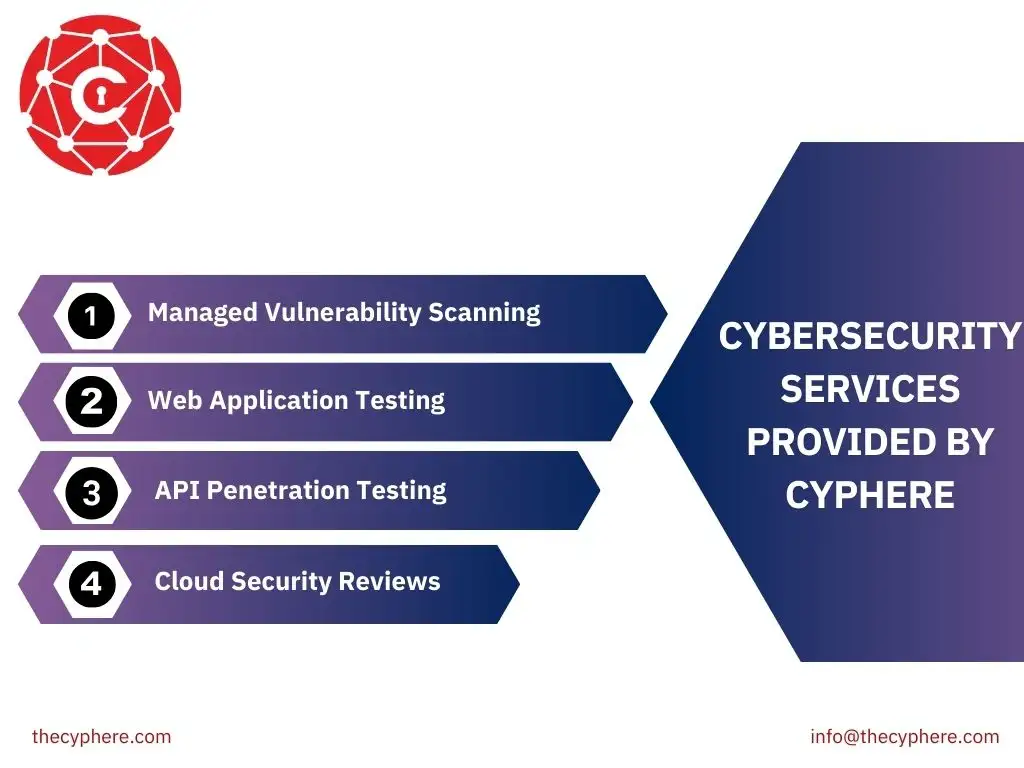
Listed below are the cybersecurity services provided by Cyphere.
- Managed Vulnerability Scanning: Cyphere provides managed vulnerability scanning services that monitor the internal and external perimeter 24/7. Vulnerability scanning identifies unpatched software and misconfigurations and provides a real-time review of your attack surface.
- Web Application Testing: Cyphere offers web application penetration testing services that combine automated fuzzing with manual business logic testing. Web application pentesting identifies flaws in your web apps and APIs (OWASP Top 10) before they can be exploited.
- API Penetration Testing: Cyphere offers API penetration testing services to find security vulnerabilities, misconfigurations, and logic flaws before hackers can exploit them.
- Cloud Security Reviews: Cyphere provides cloud penetration testing services designed for AWS, Azure, and GCP environments. This service uses automated configuration audits to find security gaps in your cloud architecture and ensure storage and identity controls are hardened.