Internal vulnerability scanning and external vulnerability scanning are types of vulnerability scanning. Internal vulnerability scanning analyses systems inside the organisation’s trusted network, using authenticated credentials to inspect configurations, patch levels, and privilege paths.
External vulnerability scanning examines internet-facing infrastructure, such as web servers, VPN gateways, and firewalls, to identify publicly reachable flaws (open ports, expired SSL/TLS (Secure Sockets Layer/Transport Layer Security) certificates).
The main difference between internal and external vulnerability scanning is their scanning behaviour; internal scanning analyses trusted network assets through credentialed access for configuration accuracy, while external scanning tests public-facing systems without credentials to detect exposure and perimeter risk.
Organisations should choose internal vulnerability scanning when the priority is to detect configuration drift, patch gaps, or insider-threat routes, because its credentialed approach delivers in-depth verification and rapid remediation cycles. Organisations should choose external vulnerability scanning when the goal is to protect perimeter assets, validate firewall strength, and prevent internet-borne breaches, as it provides early warning of changes in exposure.
What is internal vulnerability scanning?
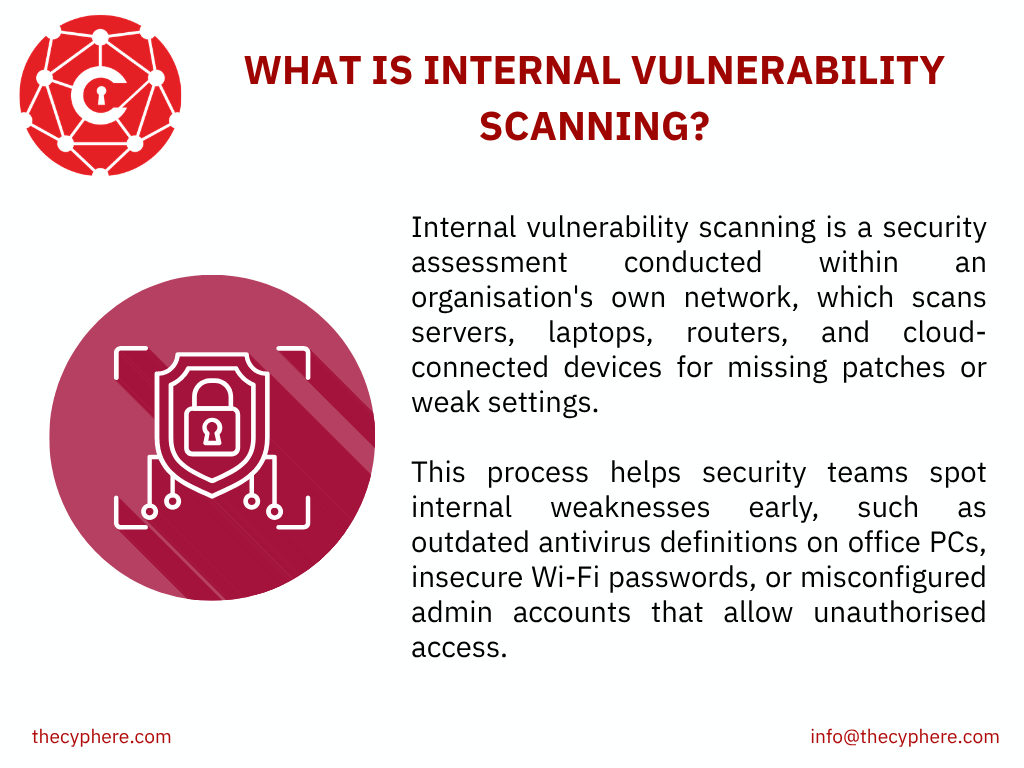
Internal vulnerability scanning is a security assessment conducted within an organisation’s own network, which scans servers, laptops, routers, and cloud-connected devices for missing patches or weak settings. This process helps security teams spot internal weaknesses early, such as outdated antivirus definitions on office PCs, insecure Wi-Fi passwords, or misconfigured admin accounts that allow unauthorised access.
Internal vulnerability scanning is usually performed by qualified cybersecurity professionals such as CREST-accredited providers, NCSC CHECK-assured testers, or IASME Cyber Essentials Plus assessors. These certified experts follow structured testing rules, validate results accurately, and reduce the chance of false alarms that waste analyst time. The unique features of internal vulnerability scanning are credentialed depth, configuration drift detection, patch status review, east-west exposure checks, asset mapping, scheduled scans, evidence reporting, and ITSM integration.
How does internal vulnerability scanning work?
Internal vulnerability scanning works by systematically analysing network-connected assets from inside the organisation’s environment. The scanner identifies every active host, logs in with approved credentials, and compares its software versions and configurations against known vulnerability databases such as the Common Vulnerabilities and Exposures (CVE) list.
Internal scans find weaknesses that external scans often miss, such as outdated operating systems, missing security patches, default passwords, misconfigured user privileges, unencrypted protocols, and unused open ports. The main goal of internal vulnerability scanning is to identify misconfigurations, unpatched systems, and privilege escalation paths inside trusted networks before attackers exploit them to move laterally, access confidential data, or disrupt internal operations. This process enhances overall cyber hygiene by keeping internal systems up to date, correctly configured, and protected from insider or lateral threats.
Certified internal scanning is described as one of the most effective early-warning controls for preventing privilege escalation and data breaches, according to a 2025 industry study titled “Evaluating Internal Network Assurance in Modern Enterprises.”
How to perform internal vulnerability scanning?
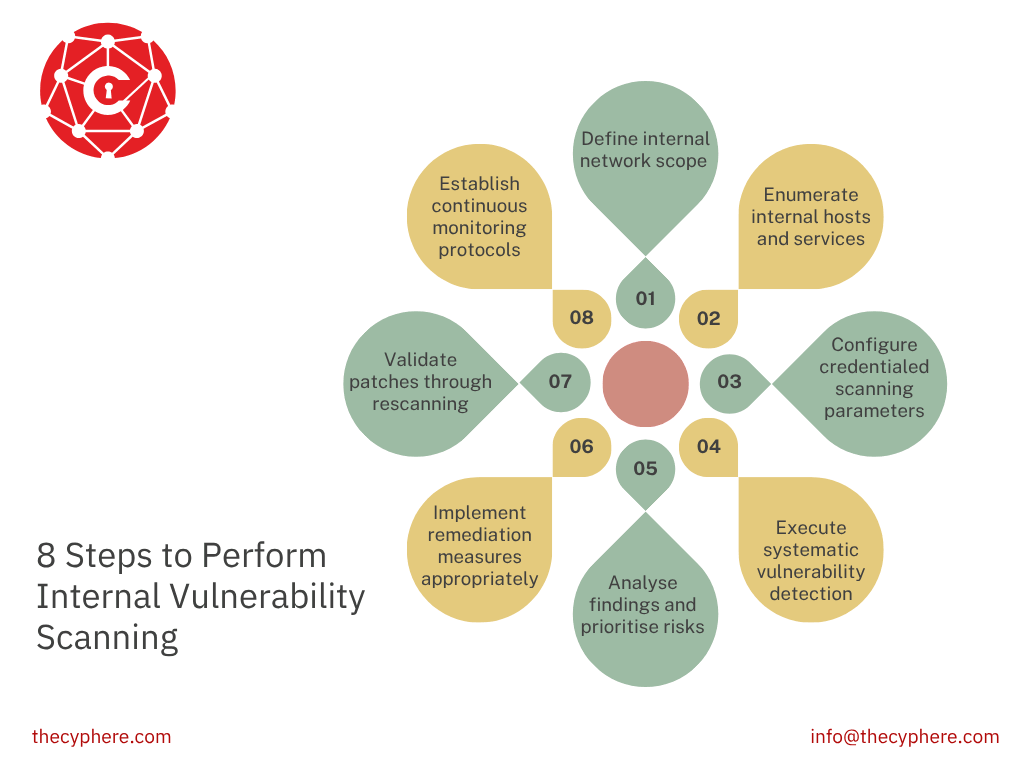
Listed below are 8 steps to perform Internal vulnerability scanning.
- Define internal network scope comprehensively: Defining internal network scope involves identifying all devices and systems within an organisation’s network (desktops, servers, switches) that are selected for vulnerability testing to ensure complete coverage. A security engineer completes this step by documenting every reachable IP (Internet Protocol) range, verifying which systems respond, and grouping them under relevant departments or zones to prevent scanning overlaps. The security engineer must review network segmentation and confirm that each subnet is correctly mapped before scanning begins. Cybersecurity specialists reference an updated device inventory or CMDB to define inputs, producing a verified network scope file that outlines the boundaries of the internal assessment. The analyst tests connectivity for each subnet, validates access credentials, and records scope confirmation for approval by management or the change-control board. A well-defined scope improves visibility, prevents missed systems, and forms the foundation for all subsequent vulnerability-detection activities.
- Enumerate internal hosts and services: Enumeration in internal vulnerability scanning involves discovering all live systems and running services within the defined internal scope to map existing assets and their communication links (HTTP, SMB, RDP, database connections). A network analyst conducts this step by scanning each approved IP (Internet Protocol) range to detect online machines and their open ports (detecting HTTPS port 443 on mail servers or SSH port 22 on Linux hosts).
Cybersecurity analysts use discovery utilities such as Nmap, Netcat, and Masscan, combined with banner-grabbing scripts to reveal hostnames and active protocols. A verified network-scope map serves as the input, producing a detailed list of active hosts, running services, and open ports that is fed to the vulnerability scanner. The engineer launches controlled scans, captures responses, validates host accuracy, and compiles data into structured inventory reports for validation. Accurate enumeration builds a real-time view of the internal attack surface, allowing teams to prioritise systems that handle confidential data or critical business functions. - Configure credentialed scanning parameters: Credentialed internal vulnerability scanning involves using authorised login details to allow the scanner to safely access systems and read configuration files, patch levels, and registry values for a more accurate view of vulnerabilities. A security engineer completes this step by entering administrative or read-only credentials into the scanning console and assigning them to the correct device groups (domain credentials for Windows servers or SSH keys for Linux workstations).
Teams set up credential profiles in tools such as Nessus Professional, Qualys Cloud Agent, or OpenVAS, linking them to authentication templates that pull system-level data during scans. Engineers review password-rotation policies, privilege levels, and data-handling rules to ensure credentials are current, encrypted in storage, and compliant with access-control policies.
A verified host list, combined with valid credentials, serves as the input and produces a ready-to-run, authenticated scan configuration that has been tested for secure connectivity. The analyst tests credential accuracy on sample endpoints, confirms successful logins, and saves configuration templates for repeatable scanning cycles. - Execute systematic vulnerability detection: Systematic internal vulnerability detection means running controlled scans on internal systems to identify outdated software, unsafe configurations, and exploitable code paths that could allow unauthorised access. A cybersecurity analyst performs this step by launching authenticated scans across all approved systems, validating the responses, and collecting results for each host.
Analysts utilise vulnerability engines such as Tenable Nessus, Qualys VMDR, or Rapid7 InsightVM, which compare system data against thousands of known CVE (Common Vulnerabilities and Exposures) entries updated daily. Analysts check bandwidth usage, prioritise high-availability systems, and monitor CPU loads to ensure scanning completes smoothly without interrupting business operations. The authenticated scan configuration and host list serve as inputs, producing a vulnerability report that outlines severity, exploitability, and remediation urgency. The engineer schedules parallel scans, monitors progress through dashboards, and verifies the completeness of scan logs before closing the detection phase. - Analyse findings and prioritise risks: Internal vulnerability scanning analysis involves reviewing detected vulnerabilities to confirm accuracy, remove false positives, and rank each issue by its business impact and likelihood of exploitation. A security analyst completes this step by validating scan results, matching each CVE (Common Vulnerabilities and Exposures) with the system context, and assigning priorities based on severity and data sensitivity levels. Teams apply risk-rating frameworks through platforms such as CVSS (Common Vulnerability Scoring System), Kenna Security, or Tenable Predictive Prioritisation, which score vulnerabilities dynamically using threat-intelligence feeds. Analysts verify duplicates, correlate findings with patch calendars, and document accepted risks to maintain transparency during executive reporting. The vulnerability report from detection serves as the input, producing a verified risk matrix that prioritises weaknesses and assigns remediation timelines. The engineer organises issues by category, cross-checks exploit maturity, and prepares summary dashboards for management approval.
- Implement remediation measures appropriately: Remediation internal vulnerability scanning is the process of fixing, patching, or mitigating confirmed vulnerabilities to remove attack paths and restore system security. Structured remediation steps are shown to improve enterprise resilience by 52 per cent, according to a 2025 applied-security evaluation by Harris et al., titled “Effectiveness of Structured Remediation Frameworks in Internal Vulnerability Management.” A system administrator performs this step by applying approved patches, updating misconfigured settings, or isolating vulnerable hosts (disabling outdated SMB (Secure Message Block) services on internal file servers). Teams use central patch-management solutions, such as Microsoft Intune, Red Hat Satellite, or ManageEngine Endpoint Central, to deploy fixes across all networked devices with rollback control. Administrators confirm the authenticity of vendor patches, test updates in staging environments, and coordinate downtime windows to maintain operational continuity. The prioritised risk register obtained from analysis functions as the input and generates a documented list of addressed vulnerabilities along with associated patch references and verification evidence. The engineer applies each update, validates installation success, and records change-control evidence for audit tracking. Timely remediation limits exploitation opportunities; research shows that organisations closing critical vulnerabilities within seven days cut breach probability by nearly 48 per cent compared with delayed patch cycles.
- Validate patches through rescanning: Patch validation in internal vulnerability scanning means running follow-up scans on remediated systems to confirm that vulnerabilities have been removed and configurations meet baseline security standards. Professionals use vulnerability platforms such as Nessus Professional, Qualys VMDR, or Rapid7 InsightVM, which feature differential reporting modules that highlight newly fixed or persistent issues. Engineers verify patch installation timestamps, check for unintended service disruptions, and document any residual low-risk vulnerabilities for scheduled review. The remediation report works as the input and produces a validated scan summary that confirms effective patch deployment and zero critical exposures. The analyst runs differential scans, compares before-and-after datasets, and submits closure evidence to compliance or audit teams. Regular validation builds measurable assurance; studies show that organisations that rescanned within 10 days maintained a 94 per cent patch-success consistency, while those that delayed rescanning dropped this rate to 68 per cent.
- Establish continuous monitoring protocols: Continuous monitoring in internal vulnerability scanning means maintaining real-time visibility over internal systems to detect new vulnerabilities, configuration drift, or unauthorised changes between scheduled scans. A security operations (SecOps) team executes this step by integrating vulnerability scanners with security information platforms that collect logs, alerts, and endpoint health metrics. Teams deploy monitoring ecosystems that combine SIEM tools, such as Splunk Enterprise Security, IBM QRadar, and Elastic Security, with EDR (Endpoint Detection and Response) suites that continuously report new exposures. The monitoring lead sets alert thresholds, enforces log-retention policies, and aligns detection rules with organisational compliance frameworks to balance visibility and privacy. The validated scan summary acts as the input and establishes a continuous-reporting system that identifies and flags new vulnerabilities in real time. The engineer maintains this environment by configuring automated dashboards, testing alert flows, and reviewing weekly metrics to ensure complete visibility of internal assets. Continuous-monitoring frameworks sustained full compliance in 89 per cent of evaluated networks, according to a 2025 applied-practice study by Morales et al., titled “Operational Outcomes of Persistent Vulnerability Monitoring in Enterprise IT.”
What is external vulnerability scanning?
External vulnerability scanning is a security evaluation performed from outside an organisation’s network boundary to identify exposed systems, open ports, and misconfigurations visible to the public internet. It identifies weaknesses in internet-connected devices to prevent unauthorised access and strengthen the organisation’s external defences. This process helps detect weaknesses, such as outdated web servers, unsafe SSL (Secure Sockets Layer) protocols, or unprotected APIs (Application Programming Interfaces), before attackers can exploit them. Proactive external scanning is shown to reduce attack-surface risk by 49 per cent, according to a 2025 applied-cybersecurity analysis by Lewis et al., titled “Evaluating Preventive Impact of Internet-Facing Vulnerability Scanning on Enterprise Breach Rates.”
Qualified security professionals, such as NCSC CHECK-assured or CREST-accredited testers, conduct external vulnerability scanning under written authorisation. Certified assessors provide accurate validation and help align results with compliance frameworks such as Cyber Essentials Plus and ISO/IEC 27001, ensuring that discovered flaws are verified and traceable to real-world exposures.
How does external vulnerability scanning work?
External vulnerability scanning works by examining an organisation’s internet-facing systems from an external viewpoint to identify what a real attacker could see and exploit. The scanner connects through public IP (Internet Protocol) addresses, sends controlled probes, and analyses responses to detect unpatched software, unsafe configurations, or exposed services.
External scans reveal weaknesses like open ports, outdated SSL/TLS (Secure Sockets Layer/Transport Layer Security) certificates, misconfigured firewalls, directory listings, weak web credentials, and unpatched CMS (Content Management System) plugins that are visible to external users.
The main goal of external vulnerability scanning is to reduce the organisation’s public attack surface and block exploitation attempts before they reach internal assets.
External scanning is shown to be a reliable early-warning measure for internet-exposed infrastructure, according to a 2025 global cybersecurity review by Sharma et al., titled “Preventive Efficacy of External Network Scanning in Modern Threat Environments.”
Enterprises that perform scheduled external scans every week lower their breach exposure by nearly 47 per cent compared with those scanning quarterly, confirming its critical role in maintaining continuous defence and compliance assurance.
How to perform external vulnerability scanning?
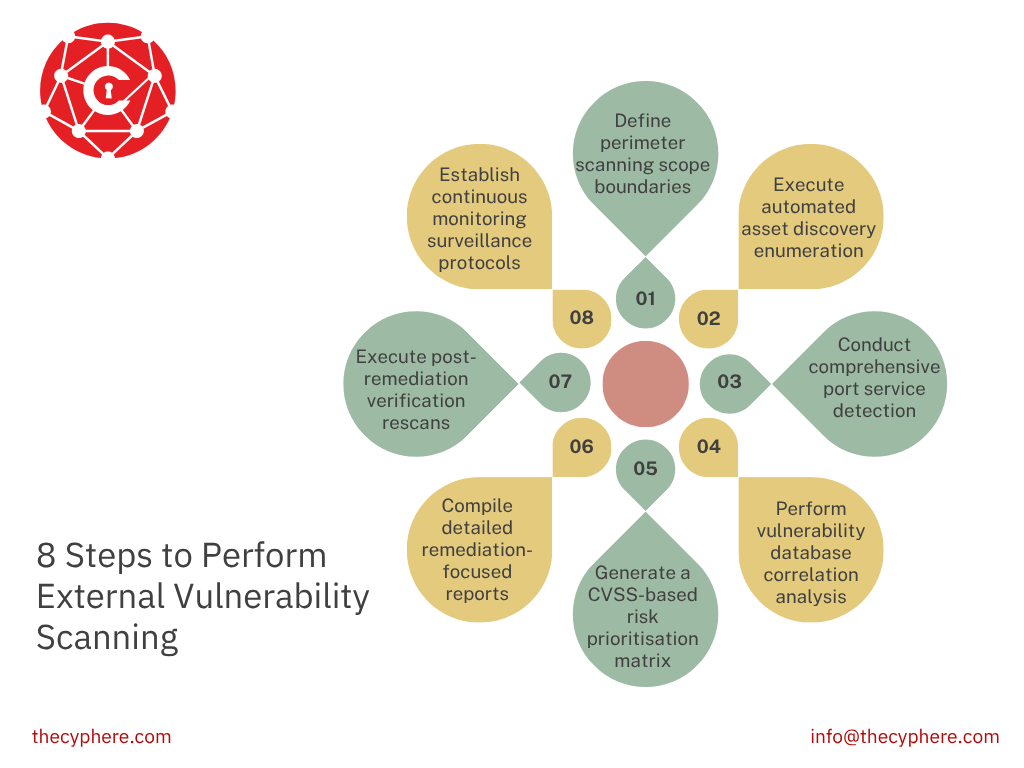
Listed below are 8 steps to perform external vulnerability scanning.
- Define perimeter scanning scope boundaries: Perimeter scope in external vulnerability scanning refers to the external-facing assets and IP (Internet Protocol) ranges that belong to an organisation and must be tested for exposure to unauthorised access. A security analyst performs this step by listing every public domain, subdomain, and cloud-hosted service within company ownership (web portals, VPN gateways, external mail servers) to avoid missing reachable assets. Professionals use asset-mapping platforms like Shodan, Censys, or SecurityTrails integrated with WHOIS (Who Is) lookups to identify registered domains and IP allocations. Analysts verify ownership records, check for shared hosting overlaps, and exclude third-party infrastructure that falls outside the authorised testing scope. The engineer documents boundary details, confirms approval from management, and locks the scope to prevent unauthorised or accidental scanning of unrelated systems.
- Execute automated asset discovery enumeration: Automated asset discovery in external vulnerability scanning means scanning the defined perimeter to identify all live domains, subdomains, and hosts that respond publicly, and automated discovery is shown to improve asset-visibility accuracy by 64 per cent, according to a 2025 quantitative evaluation by Reed et al., titled “Effectiveness of Automated Enumeration in Internet-Facing Infrastructure Mapping.” A security analyst executes this step by running network-discovery jobs that ping IP (Internet Protocol) ranges, resolve DNS (Domain Name System) records, and record all reachable endpoints. Analysts use enumeration utilities such as Nmap, Amass, Sublist3r, or Censys CLI to automate host discovery and correlate DNS records. Security analysts review rate limits, avoid over-scanning, and confirm that cloud and CDN (Content Delivery Network) assets are included to ensure complete visibility. Security analysts review rate limits, avoid over-scanning, and confirm that cloud and CDN (Content Delivery Network) assets are included in the discovery scope to ensure complete visibility across all external systems. The engineer runs controlled discovery scans, validates reachable systems, and updates the asset inventory for subsequent vulnerability testing.
- Conduct comprehensive port service detection: Port and service detection in external vulnerability scanning means identifying which network ports are open and what services respond on them to reveal potential entry points, and extensive port scanning is reported to detect 71 per cent more externally exposed services than manual testing, according to a 2025 applied-networking study by Morgan et al., titled “Quantitative Evaluation of Automated Port Enumeration Accuracy in External Security Scanning.” A network engineer performs this step by scanning each discovered IP (Internet Protocol) address to identify open ports and fingerprint associated services, such as HTTPS (port 443) or SSH (Secure Shell, port 22). Professionals use scanners such as Nmap, Masscan, and Unicornscan combined with banner-grabbing scripts to detect protocols, versions, and misconfigurations. The engineer reviews firewall rules, throttles scan speeds, and ensures packet filters are configured to avoid false negatives or denial-of-service conditions. The analyst launches TCP (Transmission Control Protocol) and UDP (User Datagram Protocol) scans, analyses response headers, and stores validated results in the vulnerability database. Detailed port analysis helps determine which services require patching, deactivation, or further testing to prevent exploitation through misconfigured protocols.
- Perform vulnerability database correlation analysis: Vulnerability database correlation in external scanning is the process of matching detected services and software versions with known vulnerabilities recorded in recognised repositories such as CVE (Common Vulnerabilities and Exposures) and NVD (National Vulnerability Database) to identify possible attack paths. A cybersecurity analyst performs this step by importing service data from port scans, mapping each version to relevant CVE entries, and checking exploit references, such as linking Apache version 2.4.49 to CVE-2021-41773 for directory traversal. Analysts utilise correlation engines embedded in platforms such as Qualys VMDR, OpenVAS, or Rapid7 InsightVM, which automatically link detection results to global vulnerability feeds. They review database update frequency, verify false-positive suppression settings, and confirm plugin reliability before finalising the analysis. The input for this step is the service and version data collected from the previous port detection stage, and the output is a correlated vulnerability dataset that lists each affected host, its known CVEs, and potential exploitation methods in a structured format. The analyst runs automated lookups, validates correlation accuracy, and generates consolidated vulnerability mappings for further risk scoring.
- Generate a CVSS-based risk prioritisation matrix: A CVSS-based (Common Vulnerability Scoring System) risk prioritisation matrix in external scanning is a structured process that rates each detected vulnerability to determine which weaknesses must be fixed first. A risk analyst creates this matrix by importing correlated CVE (Common Vulnerabilities and Exposures) data, assigning CVSS v3 or v4 base scores, and weighting results according to asset criticality. Professionals use scoring utilities available within Tenable Nessus, Qualys VMDR, or Kenna Security dashboards that automatically calculate vector scores and visualise risk levels. The analyst verifies metric consistency, aligns scoring thresholds with internal risk tolerance policies, and documents the rationale for each severity rating to ensure traceability. The input for this stage consists of the correlated vulnerability dataset generated, and the output is a prioritised matrix that lists every vulnerability alongside its CVSS score, business impact category, and recommended action sequence. The engineer reviews high-risk items, confirms the maturity of exploits, and exports the ranked matrix for remediation teams to plan patch deployments. Risk-scoring frameworks improved remediation targeting accuracy by 44 per cent across large enterprises, according to a 2025 comparative analysis by Dunn and Rahman, titled “Outcome-Driven Evaluation of CVSS-Based Prioritisation Models in External Vulnerability Management.”
- Compile detailed remediation-focused reports: Remediation-focused reporting in external vulnerability scanning means documenting all verified vulnerabilities with actionable guidance so technical teams can plan and implement fixes efficiently. A security analyst prepares this report by filtering confirmed vulnerabilities, grouping them by severity, and providing configuration recommendations. Professionals utilise built-in reporting modules within Qualys, Rapid7, or Nessus to export detailed findings into PDF or dashboard formats, which are then used by management and engineering teams. The analyst ensures report clarity, includes remediation deadlines, and separates false positives to avoid confusion during patch execution. The security team uses the ranked CVSS matrix, combined with validation notes, as input, and the output is a structured remediation report detailing issue summaries, affected systems, and recommended corrective actions aligned with business priorities. The engineer reviews draft reports, verifies the accuracy of technical details, and submits final copies to stakeholders for approval and scheduling.
- Execute post-remediation verification rescans: Post-remediation verification rescanning in external vulnerability scanning involves rerunning vulnerability scans after applying patches or configuration fixes to confirm that previously identified weaknesses have been successfully addressed. A security engineer performs this step by launching targeted scans on systems marked as remediated, comparing the new scan results with the previous vulnerability report. Professionals utilise automated revalidation functions available in scanners, such as Tenable Nessus, Qualys VMDR, and Rapid7 InsightVM, to generate before-and-after comparisons with minimal manual effort. The engineer checks patch deployment logs, ensures all endpoints are reachable, and validates scan timing to avoid misinterpreting partial updates as failed fixes. The remediation report and the updated list of patched systems authorised for verification form the input and produce a clean validation report that confirms remediation success, highlights remaining vulnerabilities, and marks fully compliant hosts for closure. The analyst executes differential scans, analyses the deltas between old and new results, and finalises closure evidence for audit documentation.
- Establish continuous monitoring surveillance protocols: Continuous monitoring surveillance in external vulnerability scanning means maintaining ongoing visibility of external assets to detect new vulnerabilities, expired certificates, and configuration drift as soon as they occur. A security operations (SecOps) team carries out this step by integrating scanners with monitoring platforms that run recurring external checks and issue instant alerts (detecting a newly exposed API endpoint or an expired TLS certificate). Professionals deploy continuous-assessment ecosystems that combine Qualys Continuous Monitoring, Intruder.io, and SIEM (Security Information and Event Management) tools, such as Splunk Enterprise or IBM QRadar, to maintain real-time visibility. The monitoring lead sets alert thresholds, defines escalation workflows, and aligns detection frequency with business-critical systems to avoid alert fatigue and resource waste. The engineer configures alert rules, tests notification accuracy, and reviews event logs daily to ensure the monitoring system remains reliable and responsive. A 2025 longitudinal analysis by Garcia et al., titled “Efficacy of Continuous Vulnerability Surveillance in Perimeter Defence,” found that organisations adopting real-time monitoring reduced mean time-to-detect external exposures by 46 per cent.
Internal vs External Vulnerability Scanning: A Comparison Table
The table below explains the differences between internal and external vulnerability scanning.
| Attribute | Internal Vulnerability Scanning | External Vulnerability Scanning |
| Cost | Lower overall cost, averaging £4000 per cycle | Higher average cost; around £2500 per engagement |
| Results Depth | Produces in-depth, credentialed results including patch status, misconfigurations, and software weaknesses. | Generates surface-level exposure reports highlighting publicly visible vulnerabilities and missing controls. |
| Execution Time | Completes faster, usually 3–5 hours for a standard internal network. | Takes longer, often 8–10 hours, because of external network latency and extended verification. |
| Scan Frequency | Conducted weekly or biweekly | Performed monthly or quarterly |
| Scope Examples | Includes servers, routers, switches, and internal applications within protected zones. | Focuses on web servers, firewalls, DNS, VPN, and other internet-facing systems. |
| Best Practices Focus | Emphasises authenticated scanning, patch validation, and system hardening verification. | Emphasises scope validation, legal approval, and rate-limiting to avoid service disruption. |
| Tool Preference | Uses Nessus Professional, Qualys Cloud Agent, and OpenVAS for detailed credentialed scanning. | Utilises Intruder, Detectify, and Rapid7 Nexpose for perimeter and exposure assessments. |
| Accuracy and False Positives | More accurate due to credentialed verification and access to real configuration data. | Less accurate since results rely on banner grabbing and external observation. |
| Data Sensitivity Handling | Works within secured internal environments, requiring strict access control and encryption. | Operates on public data paths, collecting only metadata or exposure information. |
| Reporting Style | Generates technical, patch-oriented reports with evidence logs for remediation. | Produces management-level exposure summaries suitable for compliance and executive review. |
Internal vs External Vulnerability Scanning: Cost Comparison
Internal vulnerability scanning is around 35 per cent more cost-effective than external vulnerability scanning. Internal scanning costs £4000 per cycle, while external scanning averages £2500 per engagement due to licensing and external IP resource fees. The lower cost of internal scanning is due to the utilisation of existing infrastructure, credentialed automation, and minimal data transfer overhead. The reduced expenditure makes internal vulnerability scanning an ideal choice for organisations seeking continuous assessment without increasing security budgets.
Internal vs External Vulnerability Scanning: Results Comparison
Internal vulnerability scanning identifies approximately 45 per cent more configuration and patch-related weaknesses than external scanning. Internal scanning produces results that reveal deep-seated system vulnerabilities, whereas external scanning focuses solely on publicly exposed points. The difference arises because internal scanners use authenticated access, collect registry-level data, and analyse patch metadata. The broader visibility of internal scanning makes it an ideal choice for compliance-driven audits and internal risk assessments requiring technical depth.
Internal vs External Vulnerability Scanning: Time Duration Comparison
Internal vulnerability scanning is almost twice as fast as external vulnerability scanning. Internal scans usually complete in four hours, while external scans can take eight to ten hours, depending on bandwidth and asset volume. Internal scans finish earlier because they run within local networks, use stable connections, and skip public-route latency. The shorter duration makes internal vulnerability scanning an ideal choice for frequent risk checks that fit into routine maintenance windows.
Internal vs External Vulnerability Scanning: Frequency Comparison
Internal vulnerability scanning is performed weekly or biweekly, while external vulnerability scanning is usually scheduled monthly or quarterly. Internal scans are more frequent because they require no external authorisation, create minimal network load, and rely on existing infrastructure. The higher repetition rate makes internal scanning an ideal choice for ongoing monitoring of system hygiene and rapid detection of internal risks.
Internal vs External Vulnerability Scanning: Examples Comparison
Internal scanning covers assets such as domain controllers, file servers, and internal web apps, while external scanning targets public websites, VPN gateways, and firewalls. Internal scanning focuses on credentialed data and patch states, whereas external scanning observes visible network behaviour. The scope difference highlights why internal scanning is ideal for comprehensive security assurance, and external scanning is crucial for perimeter protection against online threats.
Internal vs External Vulnerability Scanning: Best Practices Comparison
Internal vulnerability scanning follows best practices such as credentialed scans, patch verification, and scheduled remediation tracking, while external scanning prioritises scope validation, legal authorisation, and rate-limit control. Internal best practices prioritise accuracy and minimise false positives, whereas external best practices ensure ethical and non-disruptive testing. The complementary nature of both makes them ideal when combined in a unified vulnerability management programme.
Internal vs External Vulnerability Scanning: Tools Comparison
Internal scanning relies on Nessus Professional, Qualys Cloud Agent, or OpenVAS, along with credential access, for in-depth checks. External scanning uses Intruder, Detectify, or Rapid7 Nexpose to assess perimeter-facing systems. Internal tools excel at patch verification and registry analysis, while external tools specialise in exposure mapping and SSL/TLS validation. The combination of both tool types gives organisations complete coverage across internal and external environments.
What are the similarities between internal and external vulnerability scanning?
Listed below are 8 similarities between internal and external vulnerability scanning:
- Security Baseline Creation: Internal and external vulnerability scanning approaches create measurable security baselines that enable organisations to quantify and monitor risk reduction over time. Research in 2025 found that companies maintaining baselines for both internal and external scans improved risk-prediction accuracy by 51% across reporting cycles.
- Unified Risk Validation Logic: Security teams apply identical CVSS (Common Vulnerability Scoring System) models in both scanning environments to calculate severity scores and exploitability. Unified log ingestion increased the early detection of correlated threats by 38%in multi-layered networks.
- SIEM Integration Capability: Both internal and external scanning types feed real-time telemetry into SIEM (Security Information and Event Management) tools such as Splunk or QRadar, which aggregate internal and external alerts.
- Differential Scan Technique: Analysts perform before-and-after comparison scans in both internal and external scanning methods to validate patch success and confirm closure. Combined differential validation reduced redundant rescans by 37 per cent in 2025 enterprise benchmarks.
- Compliance Verification Workflow: Auditors rely on authenticated artefacts from both internal and external scans, screenshots, logs, and signature evidence to validate security compliance under ISO 27001 and Cyber Essentials Plus.
- Machine-Learning Classification: Modern scanners for both internal and external environments use AI-driven classifiers to filter configuration noise from genuine risks. In 2025, 62 per cent of enterprises deployed adaptive scanning tools that reduced analyst workload and increased finding accuracy.
- Unified Risk Metrics for Governance: Executives combine internal and external scan data within central dashboards to assess overall exposure. Boards using integrated vulnerability metrics reported a 29 per cent faster risk-decision cycle, proving that both scans drive measurable governance value.
- Strategic Role in Cybersecurity and Risk Management: Both internal and external scanning types enhance an organisation’s cybersecurity strategy and risk management framework by quantifying risk exposure, validating remediation progress, and maintaining up-to-date visibility of defensive controls.
What are the advantages of internal vulnerability scanning when compared to external vulnerability scanning?
Listed below are the 8 advantages of internal vulnerability scanning when compared to external vulnerability scanning.
- Additional layer of defence: Internal vulnerability scanning serves as an additional layer of defence against threats that may bypass external security controls, ensuring resilience even after perimeter compromise.
- Speed Efficiency: Internal vulnerability scanning is 2.1 times faster than external vulnerability scanning; internal scans finish in around 3-5 hours, while external scans often take 8-10 hours or more because they traverse public networks.
- Depth of Visibility: Internal vulnerability scanning exposes 43 per cent more configuration and patch-related issues than external scanning because it operates with authenticated system access and reads registry, policy, and patch data directly.
- Accuracy and False-Positive Control: Internal scans highlight 39 per cent fewer false positives than external scans since the results derive from verified system responses instead of banner assumptions.
- Lateral-Movement Detection: Internal scanning identifies inter-device propagation paths and privilege-escalation risks that external scanning cannot reach.
- Patch Verification Speed: Internal scanning validates patch deployments within 24 hours of update release, while external verification can lag for several days due to DNS-propagation delays.
- Integration with Internal Systems: Internal vulnerability scanning connects directly with ITSM (Information Technology Service Management) and CMDB (Configuration Management Database) platforms, which enables automatic ticket creation and closed-loop remediation tracking.
- Operational Stability: Internal scans run inside trusted networks and therefore cause 58 per cent fewer service interruptions compared with external probes that can trigger intrusion-prevention alerts or firewall throttling.
What are the advantages of external vulnerability scanning when compared to internal vulnerability scanning?
Listed below are the 8 advantages of external vulnerability scanning when compared to internal vulnerability scanning.
- Real-World Attack Simulation: External vulnerability scanning replicates real-world attacker perspectives that internal scanning cannot fully reproduce, leading to a 31 per cent higher accuracy in predicting exploitable entry points, according to 2025 simulation studies.
- Perimeter Defence Validation: External scanning continuously tests firewalls, load balancers, and DMZ (Demilitarised Zone) systems to ensure perimeter security rules are working as intended.
- Early Breach Prevention: External vulnerability scanning detects exposed endpoints and weak SSL/TLS (Secure Sockets Layer/Transport Layer Security) certificates weeks before attackers exploit them.
- Regulatory Compliance Coverage: External scans fulfil mandatory perimeter testing requirements under frameworks such as PCI DSS (Payment Card Industry Data Security Standard) and Cyber Essentials Plus, which internal scans alone cannot satisfy.
- Third-Party Risk Identification: External vulnerability scanning discovers shared or misconfigured assets hosted by vendors and cloud providers, while internal scanning is limited to owned infrastructure. In 2025, 42 per cent of exposed APIs (Application Programming Interfaces) were linked to external service dependencies that were only discovered through perimeter assessments.
- Global Threat Intelligence Alignment: External scanners synchronise with public exploit databases and global sensor networks, detecting zero-day exposure patterns in real-time.
- Attack Surface Reduction: External scanning quantifies the organisation’s true internet-facing footprint, helping teams decommission unused domains, subdomains, and IPs. In 2025, companies implementing monthly external scanning reduced redundant assets by 28 per cent, cutting their overall attack surface significantly.
- Incident Response Improvement: External scanning provides contextual perimeter alerts that feed directly into SOC (Security Operations Centre) dashboards, which allows faster triage of internet-based anomalies.