API Penetration Testing is the authorised simulation of a cyberattack on an Application Programming Interface (API) designed to identify vulnerabilities before malicious actors can exploit them. APIs are the foundation of modern applications and information transfer. API penetration testing is important, as an exposed API exposes confidential information (such as PII and financial records), allows illegal entry, or allows backend systems to be breached. The primary goal of API penetration testing is to identify and manage security defects to hinder unauthorised access, data leaks, and interruption of service. These goals ensure the discretion, reliability, and accessibility of the API and the data it manages.
The API pentesting features are input validation, rate limiting, resource management, authentication, business logic, and authorisation. According to 2024 research by Kozel et al., titled “Research of Penetration Testing Methods,” the API penetration testing process starts with planning, information gathering, vulnerability analysis, exploitation, reporting, remediation, and retesting.
The tools used in API pentesting are Burp Suite Professional, Insomnia, SOAP UI, ZAP, and Kiterunner. These tools bridge the gap between web application testing and API testing. The common vulnerabilities found in APIs are broken object-level authorisation, broken user authentication, excessive data exposure, lack of resources, broken function-level authorisation, and improper asset management, according to a 2025 study by Tania et al., titled “6 most common vulnerabilities found during penetration testing.” The cybersecurity services companies resolve these vulnerabilities through performing the pentest, providing remediation consulting, offering API gateway solutions, and providing API security training, according to 2022 research by Amid et al., titled “Testing RESTful APIs: A Survey.”
What is API penetration testing?
API penetration testing is a security test to detect security exposure and blueprint mistakes, protect confidential information, and prevent unwanted access, according to a 2025 study by Ananda et al., titled “What is API Penetration Testing: A Complete Guide.”

The other names of API penetration testing are API pentesting, API security testing, API vulnerability assessment, API fuzz testing, RESTful API testing, web API security testing, and dynamic API security testing.
API penetration testing involves a combination of manual and automated techniques that target both complex and common flaws (such as authentication and authorization, input validation and injection, business logic flaws, data exposure, and rate limiting), according to 2025 research by Pasca et al., titled “LLM-Driven, Self-Improving Framework for Security Test Automation: Leveraging Karate DSL for Augmented API Resilience.”
APIs should be pentested to prevent security exposures, detect logic flaws, guarantee compliance, and maintain credibility. APIs use specific authentication procedures such as API keys, OAuth, or JWT tokens, which need custom testing approaches. According to 2024 research by Shen et al., titled “PentestAgent: Incorporating LLM Agents to Automated Penetration Testing,” API pentesting is a methodical process that involves preparation, reconnaissance, vulnerability analysis, exploitation, reporting, and remediation.
What is the primary goal of API penetration testing?
The primary goal of API penetration testing is to uncover and remediate security vulnerabilities within an Application Programming Interface (API) to prevent unauthorised access, data leaks, and service downtime.
According to 2024 research by Pasca et al., titled “Enhancing API Security Testing Against BOLA and Authentication Vulnerabilities Through an LLM-Enhanced Framework,” the API penetration testing detects security breaches, such as BOLA and BFLA (Broken Function Level Authorisation). This proactive approach is essential because vulnerable APIs are a primary vector for account takeover and data theft. By conducting thorough risk evaluation and reduction, organisations can identify potential service disruptions and privilege escalation paths, delivering practical remediation proposals before attackers can exploit them. Automation and AI further strengthen the efficacy of these tests by covering complex authorisation logic at scale.
What are the features of API penetration testing?
Listed below are the features of API penetration testing.
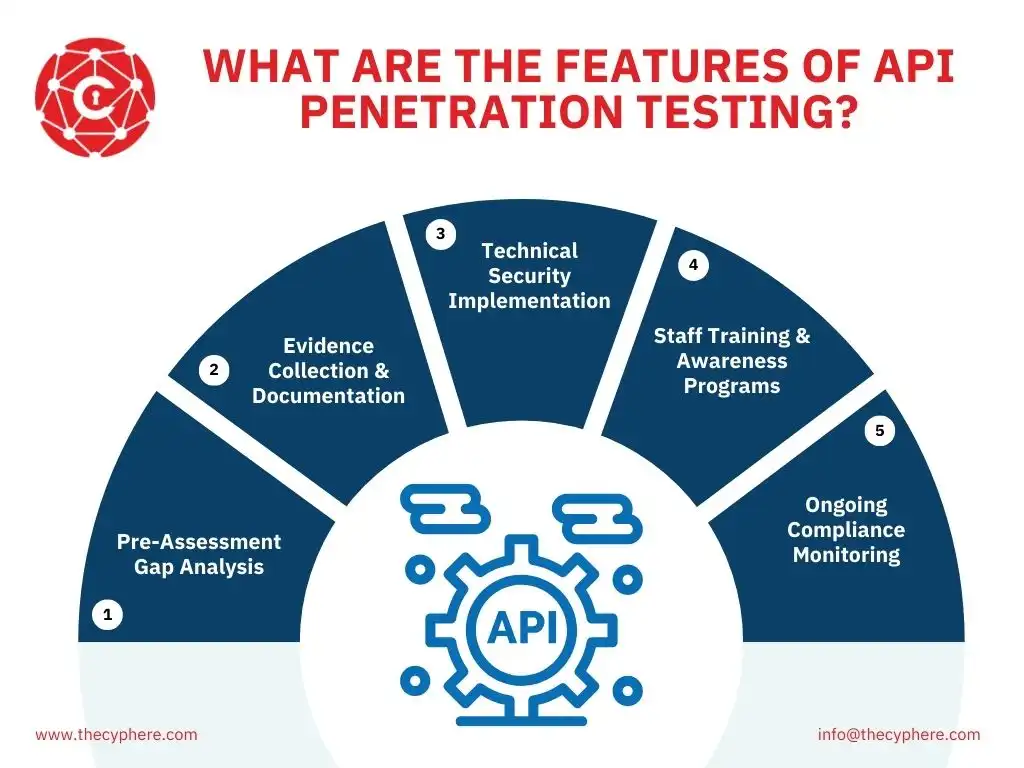
- Authorisation and Access Control Focus: API penetration testing involves Broken Object-Level Authorisation Testing (BOLA) and Broken Function-Level Authorisation Testing (BFLA).
- Authentication and Token Validation: API penetration testing includes token manipulation, secure session management, brute force, and credential stuffing.
- Business Logic Abuse: API penetration testing needs manual expertise to understand the exploit, to rate manipulation, and workflow bypass.
- Input Validation and Schema Enforcement: API penetration testing includes injection flaws and mass assignment testing to focus on how the API consumes and processes the data.
Excessive Data Exposure Check: API penetration testing involves error handling and data breach to ensure the principle of minimum privilege for data outcomes.
How to perform API penetration testing?
Listed below is the process to perform API penetration testing.

1. Define API Pentesting Scope and Objectives
Defining the API penetration testing scope and objectives outlines the authorised and technical limits of the engagement to certify safety and compliance. This step specifies the API models, interfaces, IP networks, and environments that are included and excluded. The primary goals of this step include discovering PII exposure, evaluating a new transaction processor, and achieving adherence. The input of this step is the Rules of Engagement document and network diagrams. The output includes the authorised scope contract and evaluation strategy. This step ensures proper authorisation is received from the data custodian to avoid regulatory conflicts and focus efforts on high-risk and new capabilities.
2. Review API Documentation and Perform Initial Reconnaissance
Reviewing API documentation and performing initial reconnaissance secures a deep understanding of the API’s intended features, layout, and data structure through the lens of a trusted entity. This step is executed to examine the API blueprints (such as OpenAPI, Swagger, and Postman collections) to understand all accessible interfaces, mandatory parameters, projected data formats (schemas), and login procedures. This step provides the blueprint for the complete exposure area. The input of this step includes OpenAPI/Swagger YAML/JSON, Postman Collection, and Developer Portal access. The output of this step includes a map of all known endpoints and their data requirements. The tools used in this step are Postman, Insomnia, and a text editor. This step guarantees specifications are up-to-date and align with the operational API setting under evaluation.
3. Provision an Isolated Test Environment and Accounts
Providing an isolated test environment and accounts describes an evaluator demanding controlled permission to a secure setting to avoid service outage, and allows for thorough testing. This step is performed through setting preparation to ensure a committed and non-production test environment is supplied that reflects the operational interface’s programming and configuration. This step accounts for multiple privilege levels (such as standard user, premium user, and administrator) to test access control effectiveness. The input of this step is authentication data for various roles. The output of this step is validated access to the test environment. The environment must be isolated from production data to prevent unintentional damage or exposure, and test data should be non-confidential but format-accurate.
4. Enumerate Endpoints, Methods, and Schemas
Enumerating endpoints, methods, and schemas involves actively engaging with the API to validate the manuals and uncover any unrecorded or hidden endpoints. This step is executed through employing tools to try to force folders and routes (such as fuzzing endpoint names) according to prevalent labelling protocols. The testing method of this step investigates if endpoints allow unwanted HTTP methods (such as if a GET endpoint also allows PUT or DELETE). The tools used in this step are Kiterunner, FFUF, ZAP, and Burp Suite’s Intruder. The output of this step is a complete, verified list of all available endpoints and methods. Always test for the capacity to use unintended HTTP methods (like using a GET request for a POST-only function).
5. Validate Authentication and Token Lifecycle
Validating authentication and token lifecycle is employed to discover ways to evade login or impersonate a separate individual. This step confirms the security of the account verification process. This step is carried out through forcing logins, testing inadequate password requirements, and determining access denials. The session key review of this step involves intercepting and examining tokens (such as JWTs) for tamperable data elements, breakable signature processes, and incorrect session termination. The tools used in this step are the Burp Suite Repeater/Intruder and JWT Editor extensions. The input of this step is acquired/created session keys. The output of this step is confirmation of secure token validation or evidence of sign-in circumvention. The secure defaults of this step verify that secure defaults are used (such as powerful data obfuscation methods and quick timeout settings).
6. Assess Authorisation and Access-Control Enforcement
Assessing authorisation and access-control enforcement is the most crucial process of API pentesting that concentrates on the two significant OWASP API Top 10 risks (BOLA and BFLA). This step is done through BOLA (Broken Object Level Authorisation) employing a limited authority credential to access an entity (such as a user profile) and subsequently modifying the object’s ID in the query to endeavour to reach a resource owned by another user. BFLA (Broken Function Level Authorisation) uses a low-privilege token to attempt to execute a privileged action. The tools used in this step are Burp Suite Repeater and Authorisation testing extensions. The input of this step requires credentials for two separate user profiles. The output of this step is the evidence of unapproved admittance or operation execution. This step ensures access control reviews are carried out on the back-end for every individual query that retrieves a confidential resource, irrespective of the client-side role.
7. Test Input Validation, Rate Limiting, Error Handling, and Perform Fuzzing
Testing input validation, rate limiting, error handling and performing fuzzing ensures the API is robust to harmful data and high-traffic demands and does not disclose confidential data. This step includes injection testing to send malicious code fragments (such as SQL, XSS, and OS Command Injection) into all parameters. Rate limiting sends a large volume of requests to a single endpoint (such as a login or search) to check for excess burden. This step obliges the API to provide errors (such as faulty entries or badly formed calls) and examines the output for excessive data leakage (such as stack traces and server names). The tools used in this step are Burp Suite Intruder, SQLmap, and specialised fuzzing lists. The output of this step is a proof of effective injection, service disruption risk, or sensitive data leakage in errors. Input validation is performed using a strict whitelisting approach (only allow what is known to be safe) as opposed to blacklisting.
8. Analyse Business-Logic Vulnerabilities and Workflow Manipulation
Analysing business logic vulnerabilities and workflow manipulation employs ingenuity to find weaknesses specific to the application’s main capability. The step is carried out with Process Bypass, which looks for ways to omit mandatory steps (such as skipping payment in a checkout workflow). This step attempts to transmit two requests simultaneously to leverage concurrency vulnerabilities (such as spending the same credit balance twice). This step attempts to alter prices and discount codes to gain unapproved perks. The tool used in this step is Burp Suite Turbo Intruder (for race conditions). The output of this step is the demonstration of a workflow circumvention and profit-seeking breach. This step requires comprehensive familiarity, defies scripting, and relies entirely on the evaluator’s expertise.
9. Run Automated Scans and Triage Results
Running automated scans and triage results acts as a backup and productivity enhancer that quickly identifies common and easy targets. This step sets up specialised API security scanners to navigate the known access points and execute inspections for common issues. This step reviews the scanner outputs to exclude incorrect alerts and focus the non-automated labour on the confirmed and critical issues. The tools used in this step are OWASP ZAP and specialised API security scanners. The input of this step is the endpoint list, and the output is a scan report of low-to-medium risk findings. Automated scans miss complex authorisation, BOLA, and core functionality defects. These scans are a supplement and not a replacement for human-driven inspection.
10. Manually Verify Critical Findings and Confirm Exploitability
Manually verifying critical findings and confirming exploitability detected by any method is mandatory to ensure that the findings are correct and accurately determine the tangible result. This step is performed by simulating the execution phases using simple tools such as Burp Repeater or Postman to show exactly how the API is susceptible. It determines the severity (high, medium, or low) based on the damage that can be imposed (such as total control loss and critical). The tool used in the step is Burp Suite Repeater. The output of this step is verified PoC steps and assigned severity for each finding. The severity of this step is aligned with business risk and not just engineering sophistication, as a low-complexity BOLA is always a critical finding.
11. Document Findings and Produce a Prioritised Remediation Report
Documenting findings and producing a prioritised remediation report is the concluding result that translates technical findings into implementable strategic knowledge. This step creates an organised report, which includes a management brief for administration and detailed technical sections for developers. Each finding includes a concise explanation, impacted address, sequential proof-of-concept, and explicit remediation advice. Findings are ranked by severity, threat rating, and the Final Penetration Test Report (PDF/Docx). Remediation steps are precise and simple for the programming staff to understand and implement.
12. Retest Remediations and Validate Closure
Retesting remediations and validating closures is improved when the vulnerabilities are truly resolved. This step confirms the efficacy of the programming staff’s remediation efforts. The primary checker repeats the proof-of-concept procedures from the report to confirm that the vulnerability no longer exists. This step is done on the fixed verification setup. If the fix holds, the finding is marked as closed. If not, it is marked “Failed Remediation” and resubmitted for subsequent action. The output of this step includes the re-examination findings document and Confirmation of Vulnerability Closure. The meticulous examination ensures that the fix does not bring in new and accidental vulnerabilities (a common occurrence called regression).
What are the 3 API penetration testing approaches?
The API penetration testing approaches establish the degree of confidential details the white-hat hacker receives before starting the risk appraisal and set the authenticity, depth, and efficiency of the test.
Listed below are the 3 API penetration testing approaches.
1. Black Box API Penetration Testing
Black Box API Penetration Testing simulates an intrusion by a pentester who has no preceding familiarity with the target API’s internal workings. According to 2024 research by Kozel et al., titled “Research of Penetration Testing Methods,” the black box API penetration tester is given only open-source information, such as the API’s public URL and possibly a generic user account (if one is required to access the API). The goal of black box API pentesting is to test the API’s resistance against real-world hostile intruders and identify vulnerabilities that are discovered through surveying and active probing from an outside view (exposed endpoints, usage control workarounds, and weak login protocols).
2. White Box API Penetration Testing
White Box API Penetration Testing is a comprehensive assessment where the white-hat expert is granted full knowledge of the API’s system design. It simulates the hazard introduced by a hostile employee or a developer with special entry. The goal is to achieve maximum auditing breadth and identify obscure flaws (such as insecure coding practices), deep logical flaws (external-only tests), and secret links by monitoring data flow directly through the source code. The white box API penetration testing approach is the most thorough but least realistic approach for external threats.
3. Grey Box API Penetration Testing
Grey Box API Penetration Testing is the most common approach that includes elements of both Black and White Box testing. The tester is provided with restricted information about the API’s core mechanisms, typically with access as a typical logged-in client. The goal is to productively detect flaws related to unauthorised promotion and entry restriction from the perspective of an authenticated and authorised party. This approach is highly efficient, as it eliminates the time spent on first-stage mapping and focuses on checking activities in authenticated and highly sensitive components (such as Broken Object-Level Authorisation BOLA and Broken Function-Level Authorisation BFLA).
How much does it cost to perform API penetration testing?
The cost of API penetration testing ranges from £4,500 to £12,000 for a single and comprehensive engagement. The minimum cost to perform API penetration testing is £2,500–£3,500. The maximum cost to perform API pen testing is £15,000-£30,000+ because of a large and complex environment. According to a 2025 study by Ewelina titled “Pricing insights—How much does penetration testing cost?”, the amount paid to the API pentester is decided by some factors based on the time and expertise required for the project. The primary price influencers are the scope and complexity of the API, where a greater quantity of unique access points, complex operational flow (payment processing), and the confidentiality of the data handled (PII or financial data) all boost the testing hours.
The testing methodology is another significant element. Grey Box API testing is the most economical, as it minimises time spent on first-stage mapping. Black Box API testing needs extra effort for discovery, and White Box API testing demands specialised and highly paid skills. The expertise of the consulting firm, the level of reporting required, and whether the estimate covers mandatory correction verification all impact the final fixed-cost or variable billing, according to 2025 research by Jesse titled “How much does penetration testing cost in 2025?”
How much time does it take to perform API penetration testing?
The duration for API penetration testing involves 3 to 15 business days of active testing. API pentesting needs 3 to 7 business days for reporting and quality assurance, according to a 2024 study by Kenneth titled “Breaking Down the Penetration Testing Process: Phases, Steps, Timelines, and Industry-Specific Strategies.” API penetration testing from project initiation to final report takes up 2 to 4 weeks. According to 2023 research by Julio titled “How to prepare for an API penetration test,” the timeline is influenced by several factors (such as scope and size), as more access points and user roles increase the required testing time.
The complexity of business logic is critical, as sequential operations demand more manual labour to uncover defects than simple CRUD (Create, Read, Update, Delete) operations. The Black Box API pentesting needs a longer discovery phase to discover endpoints compared to the Grey Box API approach, which provides documentation (like OpenAPI files) and credentials upfront. The factors, such as the API’s defence standard (a highly secured API takes longer to break) and the client’s responsiveness. These factors provide necessary access and clarification and speed up or slow down the test.
What tools are used to perform API penetration testing?
API penetration testing tools are classified as intermediary gateways (for manual call tampering) and automated scanners (for extensive and quick detection). According to a 2025 study by Gisela titled “Top 6 API Pentesting Tools,” API penetration testing tools help security professionals analyse, alter, and fuzz the queries and responses that flow between the client and the API server.
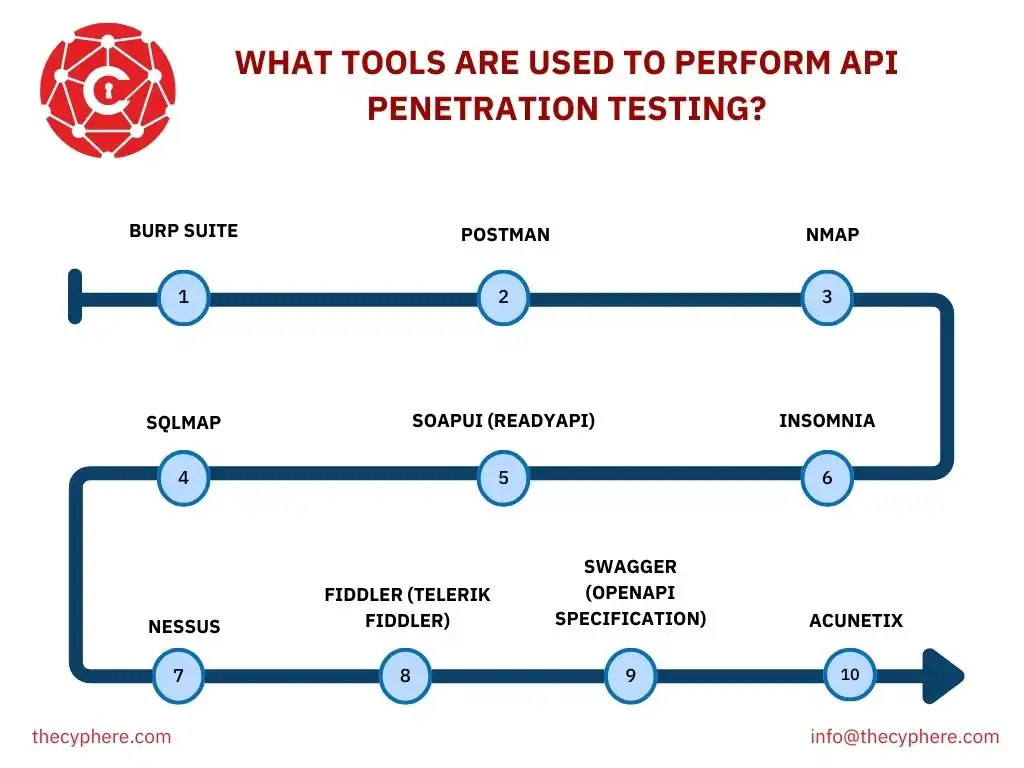
Listed below are the main tools used to perform api penetratio testing.
- Burp Suite: Burp Suite is the industry-standard platform for web application and API security testing and is developed by PortSwigger. Burp Suite contains the intercepting proxy, which allows the tester to view, modify, and analyse all traffic between the browser, client, and the API. Burp Suite features Repeater (for manually re-sending modified requests), Intruder (for automated fuzzing and brute-forcing), and a Scanner (for automated vulnerability detection). Burp Suite targets all API traffic (REST, SOAP, and GraphQL), HTTP headers, parameters, and JSON/XML bodies. Burp Suite finds vulnerabilities such as Broken Object Level Authorisation (BOLA) and injection flaws (SQL/Command), broken authentication, rate limiting issues, and logic errors. Burp Suite is paid (the professional version is essential for pentesting) and free (Community Edition), manual, and best for advanced manual testing and exploitation. It is extensible via its powerful BApp Store.
- Postman: Postman is a collaborative platform designed for API development and functional testing, and its powerful API client capabilities make it invaluable for security testing setup. Postman allows testers to easily create, save, and organise complex API requests (GET, POST, PUT), manage environments (switching between dev/staging/prod variables), and handle various authentication schemes (OAuth, API keys). Postman targets API endpoints, request bodies, headers, and environment variables. Postman finds vulnerabilities primarily as a client/setup tool, but it’s used to manually construct PoCs for BOLA/BFLA and injection testing and to proxy requests to tools like Burp. Postman is a free tier and automated functional testing via scripting and manual request construction. Postman is best for efficiently crafting and organising authenticated requests, especially when combined with an interception proxy.
- Nmap: Nmap (Network Mapper) is a free and open-source utility for network discovery and security auditing. Nmap is used during the reconnaissance phase to discover open ports, identify running services, and fingerprint the operating system and software versions on the API server. Nmap targets network ports and services running on the API server and adjacent infrastructure. Nmap finds vulnerabilities that are security misconfigurations related to exposed ports or unexpected services (such as an unneeded database port exposed publicly). Nmap is best for initial network reconnaissance, mapping network topology, and scriptable vulnerability scanning.
- SQLmap: SQLmap is an open-source tool designed to automate the process of detecting and exploiting SQL injection flaws and taking over database servers. SQLmap automatically tests every possible input and parameter in an API request for various types of SQL injection vulnerabilities (blind, time-based, and error-based). SQLmap targets API parameters or fields that pass user-supplied input directly or indirectly to a backend SQL database. SQLmap finds vulnerabilities such as injection flaws that allow attackers to extract sensitive data or compromise the database. SQLmap is best for deep and reliable testing of SQL injection in API parameters.
- SoapUI (ReadyAPI): SoapUI is a dedicated API testing platform known for testing SOAP (Simple Object Access Protocol) services and capable of testing REST and GraphQL. SoapUI is specialised in generating and executing security tests, like fuzzing (sending malformed data), SQL injection, and checking for XML vulnerabilities (like XXE) specific to SOAP/XML APIs. SoapUI targets SOAP and REST APIs to focus on the XML structure of SOAP requests. SoapUI finds vulnerabilities such as injection flaws, XML External Entity (XXE), and general data tampering issues. SoapUI is free and open-source at its core, with a professional version (ReadyAPI). Manual and Automated. SoapUI is best for security testing legacy SOAP web services and specialised XML attacks.
- Insomnia: Insomnia is a free and open-source API client and design platform, similar to Postman, that offers robust features for API development and ad hoc security testing. Insomnia allows testers to efficiently craft and organise API requests for REST, GraphQL, and gRPC. It supports chaining requests and managing environmental variables, which is useful for setting up complex attack scenarios (such as getting a token, then using it in the next request). Insomnia targets API endpoints, headers, and request bodies. Insomnia finds vulnerabilities, such as the client being used to setting up tests for BOLA, BFLA, and other logic flaws by manipulating parameters. Insomnia is best for setting up complex, authenticated API workflows and acting as a proxy client for Burp Suite.
- Nessus: Nessus is a widely used vulnerability scanner developed by Tenable, focused on network and infrastructure scanning. Nessus scans network assets for misconfigurations, missing patches, policy violations, and known vulnerabilities (CVEs). It may identify web server vulnerabilities hosting the API. Targets of Nessus are the underlying infrastructure and web server hosting the API (such as misconfigured ports and outdated Apache/Nginx versions). Nessus finds vulnerabilities that are security misconfigurations and unpatched software. Nessus’s features are paid (with a free home version limit) and automated. Nessus is best for a comprehensive network and infrastructure security assessment before API-specific testing.
- Fiddler (Telerik Fiddler): Fiddler is a cross-platform web debugging proxy tool developed by Telerik. Fiddler works as an intercepting proxy, capturing, viewing, and modifying HTTP/HTTPS traffic. It’s often used for simple traffic analysis and quick request manipulation during initial reconnaissance. Fiddler targets all HTTP/HTTPS traffic, such as API requests and responses. Fiddler finds vulnerabilities, including excessive data exposure (by examining responses) and simple request manipulation flaws. Fiddler is free (classic version) and paid (Fiddler Everywhere). Fiddler is best for lightweight traffic inspection and debugging without the full power of Burp Suite.
- Swagger (OpenAPI Specification): Swagger is a specification (a machine-readable format like YAML/JSON) that describes the API’s endpoints, parameters, and data models. Swagger provides the blueprint for the API under test. Testers use this file to automatically import all known endpoints into tools like Burp Suite, Postman, or specialised scanners, which saves reconnaissance time. Swagger targets the design of the API. Swagger detects the vulnerabilities to analyse the spec so that testers spot security flaws in design (such as sensitive parameters listed in the documentation). Swagger is an open-source specification standard and is best for initial setup, ensuring comprehensive coverage and automating the discovery phase.
- Acunetix: Acunetix is an automated Dynamic Application Security Testing (DAST) scanner now part of Invicti. Acunetix automatically scans APIs and web applications for various vulnerabilities by sending malicious payloads. It imports OpenAPI files to guide its scanning efforts. Targets: Web applications and APIs. Acuentix identifies vulnerabilities such as common automated flaws like injection flaws, XSS, and known web server misconfigurations. Acunetix is fully automated and best for large-scale vulnerability detection and continuous scanning, especially when integrated into a CI/CD pipeline.
What are the common vulnerabilities found in API penetration testing?
Listed below are the common vulnerabilities found in API penetration testing.
- Broken Object Level Authorisation (BOLA): Broken Object Level Authorisation happens when an API endpoint uses an old user ID to access particular resources but fails to do so. Broken object-level authorisation leads to severe financial, legal, and reputational damage.
- Broken authentication: Broken authentication includes flaws in token generation, poor password management, and poor session handling. Broken authentication is a full account takeover that enables the hacker to operate with the privileges and access to the confidential information.
- Broken function-level authorisation: Broken function-level authorisation occurs when an API fails to enforce entry points at the endpoint level, which allows a user with low privileges. Broken function-level authorisation allows unauthorised mass operations such as deleting all users, modifying application settings, or viewing sensitive audit logs.
- Unrestricted Resource Consumption: Unrestricted Resource Consumption (Rate Limiting) exists when an API does not force limits on the frequency of requests a client can make within a time period. Unrestricted resource consumption is a denial of service that leads to service unavailability and operational costs.
- Improper Inventory Management: Improper Inventory Management is a poor operational security practice, where the organisation lacks proper visibility and lifecycle management over all API access points. Improper inventory management is less secure, which leads to data leakage and easy compromise.
These vulnerabilities may differ in case of LLM apps and APIs, a good starting list of risks to identify would be using OWASP top 10 for LLMs.
A cybersecurity services company offers actionable support to provide security improvement after detecting vulnerabilities through API penetration testing. These vulnerabilities (BOLA, BFLA, improper inventory management, and unrestricted resource consumption) are fixed by cybersecurity services (authorisation policy implementation, API gateway configuration, remediation validation, and secure development lifecycle integration). The cybersecurity services immediately fix these vulnerabilities and build permanent security into the entire development process.
What services does Cyphere provide for API penetration testing?
Cyphere’s core offering is a technical risk assessment that detects and mitigates weaknesses across various API types (such as REST, SOAP, GraphQL, and WebSocket APIs). Cyphere’s approach is accredited and aligns with industry best practices (such as the CREST standard) and specifically targets flaws outlined in the OWASP API Security Top 10.
Cyphere helps find vulnerabilities through employing a structured methodology (scoping, mapping, scanning, exploitation, reporting, and remediation) that goes beyond automated scanning. Cyphere’s security experts use an attacker mentality to manually probe for critical flaws such as Broken Object Level Authorisation (BOLA), Broken Function Level Authorisation (BFLA), Lack of Rate Limiting, and complex Business Logic issues that automated tools often miss. Cyphere api risk assessment services include an explicit Vulnerability Assessment and Penetration Testing (VAPT) report, full coverage against the OWASP Top 10, detailed exploitation with all Proof of Concepts (PoCs), and full mitigation support.
Cyphere’s value extends beyond finding vulnerabilities to providing actionable support and strategic advice. Cyphere’s unique solution offers proactive risk management to evaluate the organisation’s security posture, data sensitivity, and attack surface. Cyphete delivers ongoing support and guidance throughout the pentesting journey and manages the risks effectively. Cyphere’s unique selling proposition specific to API penetration includes Crest accreditation, an independent security provider, and an experienced team.
What are the main API penetration testing challenges?
We at Cyphere came across unique challenges that make securing modern APIs more complex and time-consuming than traditional web application testing as an ethical hacker performing API penetration testing. According to Harman Singh (CEO of Cyphere), these challenges occur because of missing reports and specialised testers, which maximise the time and price of the audit.
Listed below are the main challenges faced in API penetration testing.
Complex Authorisation Logic (BOLA & BFLA)
Lack of Clear Documentation and Specification
State Management and Workflow Dependency
Excessive Reliance on Automated Tools
Managing Different Data Formats and Protocols
Fragmented ownership over api testing processes
Failure to perform ongoing api testing
What are the OWASP API Security Top 10 Vulnerabilities?
The OWASP API Security Top 10 is a common awareness report for developers and security experts that indicates the most critical security threats to Application Programming Interfaces (APIs). The OWASP API Top 10 is updated to reflect the most common vulnerabilities faced by APIs. According to a 2025 study by Allison titled “OWASP API Security Top 10 Risks,” the OWASP API security risks are classified based on intensity, exploitability, and prevalence.
Listed below are the OWASP API Security Top 10 Vulnerabilities.
Broken Object Level Authorisation (BOLA)
Broken Authentication
Broken object property level authorisation
Unrestricted resource consumption
Broken Function Level Authorisation (BFLA)
Unrestricted Access to Sensitive Business Flows
Server-Side Request Forgery (SSRF)
Security Misconfiguration
Improper Inventory Management
Unsafe Consumption of APIs
Listed below are the 8 common vulnerabilities besides the OWASP API Security Top 10 Vulnerabilities.
Injection attacks
Cross-site scripting
Insecure cryptographic storage
Insecure deserialization
Buffer overflows
Improper input validation
Supply chain attacks
Business logic flaws
Why is API security very important to consider?
API security is a set of protocols, tools, and procedures designed to defend the application programming interface from intrusion. According to a 2024 study by Sudheer Kumar titled “Three Reasons Why API Security is Important,” API security highlights executing measures such as authentication, authorisation, access control, and rate limiting to ensure the privacy, integrity, and accessibility of the API. API security is important for security teams, developers, business teams, and customers to prevent data breaches, account takeover, regulatory compliance, brand trust, and confidentiality. API penetration testing helps in API security to ensure all implemented security controls function well in a practical environment. Pentesting seeks complex logical flaws that automated scanners overlook and attempts to bypass them.

Listed below are the seven benefits of how API penetration testing helps organisations.
- Verifies Authorisation Controls: API pentesting confirms that the API is not vulnerable to the single most vital vulnerability (Broken Object Level Authorisation BOLA). The API test verifies that authenticated users access the resources they explicitly own or are authorised for.
- Uncovers Business Logic Flaws: API pentesting uncovers non-standard vulnerabilities unique to the application’s workflow (such as skipping a payment step or exploiting a coupon code limit), which no automated scanner can detect.
- Improves Regulatory Compliance: API pentesting provides the necessary evidence and documentation required by regulations (such as PCI-DSS and HIPAA) to demonstrate due diligence and validate security controls for systems handling sensitive data.
- Minimises Remediation Costs (Shift Left): API pentesting finds flaws in the testing phase and fixes them before a data breach occurs in production, which saves immense time, effort, and financial damage.
- Hardens Against Denial of Service (DoS): API penetration testing rigorously tests the API’s rate-limiting mechanisms to confirm the resilience against high-volume attacks intended to overload the service.
- Protects Brand Image and User Trust: API pentesting public data breaches to protect the organisation’s reputation and ensure customer loyalty.
- Offers a Third-Party Assessment: API penetration testing offers an external perspective (using an adversarial mindset that internal teams may not possess) to result in a more reliable security assessment.
What are the best practices for API penetration testing to improve API security?
Listed below are the best practices for API penetration testing to improve API security.
- Scope the Test Based on the OWASP API Top 10: Scope the test based on the OWASP API Top 10 in API pentest to keep the API secure and guarantee coverage of the high-impact flaws (such as BOLA and BFLA).
- Use the Grey Box Approach: Employ the tester with standard user credentials and the OpenAPI/Swagger specification to improve API security. This allows the tester to focus the limited time on authenticated areas (such as privilege escalation and object access checks).
- Perform Brief Environment and Account Provisioning: Testing occurs in a non-production environment to prevent disruption and data compromise. The tester needs multiple accounts representing every user role (such as Guest, Standard, and Admin). Use these varied accounts simultaneously to test BFLA (low-privilege user attempting admin actions) and BOLA (User A accessing User B’s data).
- Prioritise Business Logic and Workflow Testing: Focus mainly on the API’s unique transaction flows, which are often the source of highly valuable exposures. Manually test workflows such as checkout sequences (attempting to skip payment), password reset flows (looking for brute-forceable tokens), and credit/quota manipulation to find flaws new to the application’s design.
- Validate All Forms of Input and Output: Input validation is tested rigorously for injection flaws (such as SQL, command, and NoSQL). Output validation ensures the API is not leaking confidential information. Use tools like Burp Suite Intruder and SQLmap for injection tests. Manually review API responses across all user roles to confirm there is no Excessive Data Exposure (such as private emails or internal IDs).
- Test Rate Limiting and Restricting: The test verifies that the API has adequate protection against capacity draining and misuse. Target essential interfaces (such as login, password reset, or query) with a high volume of requests to ensure that the rate-limiting rules block or delay exploitative users.
- Provide Actionable Remediation Guidance and Retesting: The final report contains plain and code-level proposals to improve API security. Perform a retest of the affected interfaces after the development team implements fixes to ensure that the vulnerability is genuinely fixed and no additional errors were created.
The best piece of advice based on Harman Singh’s (CEO of Cyphere) experience is to make an API secure is to mandate access controls on the back-end for every asset retrieval. APIs are consistently the most exposed to Broken Object Level Authorisation (BOLA). According to a 2021 study by Munsh et al., titled “The Future of API (Application Programming Interface) Security: The Adoption of APIs for Digital Communications and the Implications for Cyber Security Vulnerabilities,” the best defence is to execute a protection tenet known as restricted access and utilise it precisely.
What API penetration testing checklist should be followed for API security?
An API penetration testing checklist is a methodical list of safety verification and confirmation procedures employed by authorised hackers to confirm that all critical exposure surfaces and vulnerabilities specific to an application programming interface (API) are examined.
According to 2023 research by Vinugyathari titled “The Ultimate API Penetration Testing Checklist,” the API pentesting checklist operates as a mandatory methodological guide to ensure that the examination covers the most high-impact security risks (especially those specified in the OWASP API Security Top 10).
According to a 2023 study by Luke Irwin titled “API Penetration Testing Checklist,” the API pentesting checklist comprises meticulously testing the API’s login processes, permission management, data input and output, resource management, and core operational rules.
The API penetration testing main checklist points are authorisation validation, BOLA (Broken Object Level Authorisation), BFLA (Broken Function Level Authorisation), session management checks, input and output security, rate limiting, resource management, business logic analysis, security misconfiguration, and inventory management.