Vulnerability assessment and penetration testing are categories of cybersecurity risk assessment. A cybersecurity risk assessment is a systematic process that identifies, evaluates, and prioritises risks to an organisation’s digital infrastructure.
A vulnerability assessment is an automated process of identifying, quantifying, and prioritising the security weaknesses in a system.
Penetration testing is a process where ethical hackers simulate a real-world attack on an organisation’s IT assets to exploit found risks.
The main differences between vulnerability assessment and penetration testing lie in goal, method, scope, cost, and time. Vulnerability assessment identifies the security flaw, and penetration testing exploits the identified flaw to analyse the impact. Vulnerability assessment relies on automated tools (scanners), and penetration testing combines scanning with manual testing and ethical hacking. Penetration testing needs highly skilled security experts, and vulnerability assessment requires lower-level security professionals.
Both vulnerability assessments and penetration testing should be used, as both of them address the quantity of your vulnerabilities and the exploitability of penetration testing. Vulnerability assessment and penetration testing are called vulnerability assessment and penetration testing when combined into a process.
Vulnerability assessment is better than penetration testing because of continuous monitoring, an initial security baseline, compliance requirements, and limited budget and resources. Penetration testing is better than vulnerability assessment because of deep validation of security, regulatory audits, testing incident response, and validating vulnerability assessment results.
What is vulnerability assessment?
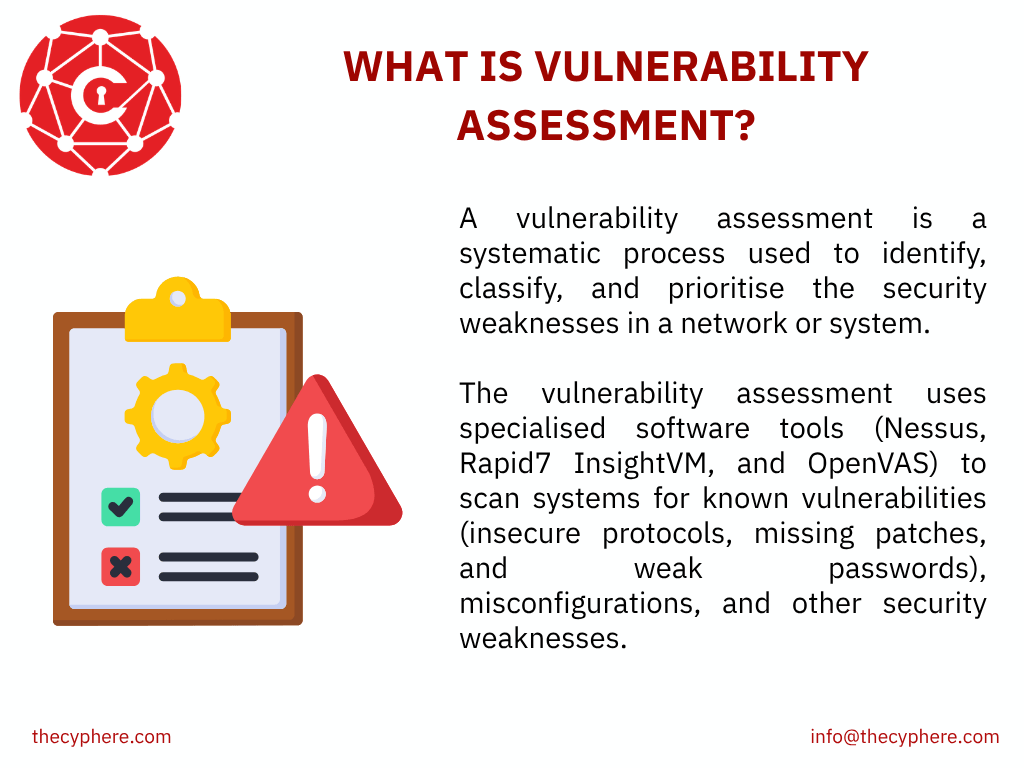
A vulnerability assessment is a systematic process used to identify, classify, and prioritise the security weaknesses in a network or system. The vulnerability assessment uses specialised software tools (Nessus, Rapid7 InsightVM, and OpenVAS) to scan systems for known vulnerabilities (insecure protocols, missing patches, and weak passwords), misconfigurations, and other security weaknesses. These tools generate reports that allow security experts to understand where their defences are weakest.
The vulnerability assessment involves automated scanning tools, vulnerability databases, system analysis, risk scoring, and actionable reports.
What is the purpose of vulnerability assessment?
The main purpose of vulnerability assessment is to systematically identify, evaluate, and prioritise security weaknesses (insecure coding, misconfigurations, outdated components) in systems or software.
Vulnerability assessment enables organisations to reduce risk by addressing the most critical vulnerabilities first. This prioritisation ensures that limited security resources are allocated efficiently, addressing the most impactful vulnerabilities and avoiding wasted effort on low-risk issues, according to a 2025 study by F. R. Parente titled “FRAPE: A Framework for Risk Assessment, Prioritisation and Explainability of Vulnerabilities in Cybersecurity”.
What is the process to perform a vulnerability assessment?
Listed below is the process to perform a vulnerability assessment.
- Identification: The vulnerability assessment process begins with identification with automated scanning tools to probe systems and compare their software against massive databases of known vulnerabilities.
- Analysis: The vulnerability assessment analyses raw data to eliminate false positives and determine the root cause of the genuine weaknesses.
- Risk assessment and prioritisation: The vulnerability assessment performs risk assessment and prioritisation using the Common Vulnerability Scoring System (CVSS) to see the technical score and the business impact of the affected asset.
- Remediation: The vulnerability assessment performs remediation where patches are applied, configurations are corrected, and security controls are secured to complete the vulnerability assessment cycle.
What is penetration testing?
Penetration testing is a simulated cyberattack against a computer system, network, or application to exploit security weaknesses.
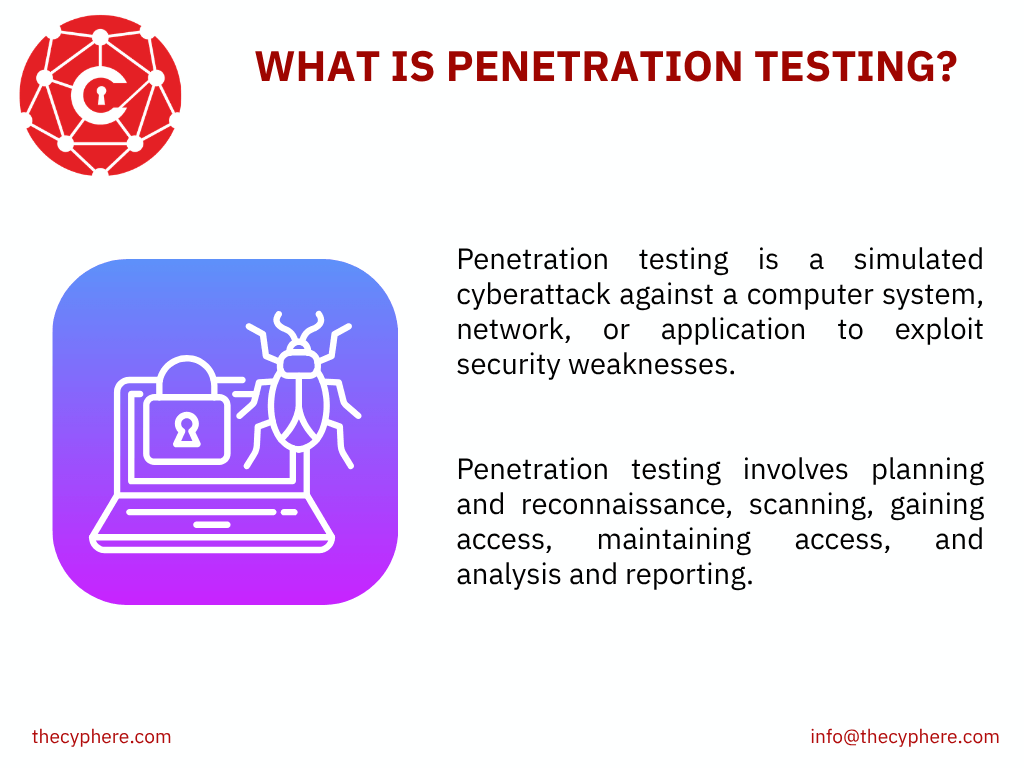
Penetration testing involves planning and reconnaissance, scanning, gaining access, maintaining access, and analysis and reporting. Penetration testing, as explained in “What is penetration testing”, uses manual and automated testing and targets web applications, internal networks, external networks, wireless networks, and cloud environments.
What is the purpose of penetration testing?
The main purpose of penetration testing is to identify security bugs and weaknesses (SQL injection, cross-site scripting (XSS), broken authentication) in systems, networks, or applications that are not apparent in standard functional testing.
Penetration testing aims to inform stakeholders about potential threats (unauthorised access, data breaches, privilege escalation) and the importance of robust security best practices (secure configuration, least-privilege access, regular patching), according to a 2025 study by Willi Lazarov titled “Penterep: Comprehensive penetration testing with adaptable interactive checklists”.
What is the process to perform penetration testing?
Listed below is the process to perform penetration testing.
- Planning and Scoping: Penetration testing defines the test’s objectives, scope, and rules of engagement. The organisation and the pentesters agree on which systems to test and the testing methods to be used (internal or external, black-box or white-box).
- Reconnaissance: Pentesters gather information about the target using various techniques, such as analysing public records (OSINT), domain information lookups (WHOIS), and social engineering research. It helps understand the target environment’s infrastructure, technology stack, and potential attack surfaces.
- Scanning and Vulnerability Analysis: Penetration testing analyses the system to determine how it will respond to different intrusion attempts. This involves using automated tools like port scanners (Nmap) and vulnerability scanners to identify open ports and known weaknesses.
- Exploitation: The penetration testers exploit the identified vulnerabilities to gain access to the system through various techniques, such as SQL injection or cross-site scripting (XSS).
What are the differences between Vulnerability Assessment and Penetration Testing?
The main difference between Vulnerability Assessment and Penetration Testing is that vulnerability assessment identifies and prioritises vulnerabilities, while penetration testing actively exploits them to assess real-world risk.
Vulnerability Assessment focuses on discovering as many potential weaknesses as possible, often using automated tools. It does not attempt to exploit these vulnerabilities, so findings are theoretical and may include false positives. Vulnerability assessments can quickly become outdated and unable to keep pace with fast-moving threats. VA helps meet baseline compliance requirements like PCI DSS, HIPAA, or ISO 27001.
Penetration Testing simulates the actions of a real attacker, attempting to exploit vulnerabilities to determine their actual risk and impact. The penetration testing process is more targeted and manual, providing evidence of what an attacker could achieve if the vulnerabilities were left unaddressed. Pentesting is essential for testing critical systems where a breach would have significant consequences and is required for rigorous regulatory compliance.
Vulnerability assessment is typically broader and less intrusive, while penetration testing is narrower but more in-depth and can potentially disrupt systems if not carefully managed.
Use Vulnerability assessment for regular, comprehensive scans to maintain an up-to-date inventory of vulnerabilities.
Use penetration testing periodically or after major changes to validate security controls and understand the real-world risk of critical vulnerabilities. Penetration testing requires human intervention and is usually carried out by a team of ethical hackers.
Listed below is the differences table of vulnerability assessment and penetration testing.
| Attribute | Vulnerability Assessment | Penetration Testing |
| Primary Goal | Vulnerability assessment identifies all potential vulnerabilities (breadth). | Penetration testing exploits vulnerabilities to demonstrate business impact. |
| Methodology | Vulnerability assessment relies on automated scanning tools and predefined signatures. | Penetration testing relies on manual exploitation and ethical hacker techniques. |
| Focus | Vulnerability assessment focuses on what the weaknesses are and where they exist. | Penetration testing focuses on how an attacker can compromise the system. |
| Output | The output of a vulnerability assessment is a comprehensive list of known flaws, such as false positives. | The output of penetration testing is a prioritised, evidence-based report of successful exploitation paths. |
| Frequency | Vulnerability assessment is performed regularly, often weekly or monthly. | Penetration testing is performed periodically, once or twice a year, or after major changes. |
| Risk of Disruption | Vulnerability assessment risk of service disruption is very low, as it is non-intrusive. | Penetration testing is when the risk of service disruption is higher, as it actively attempts to break systems. |
| Required Skillset | Vulnerability assessment requires basic to intermediate technical knowledge to interpret reports. | Penetration testing requires advanced skills and creative adversarial thinking. |
| Cost | Vulnerability assessment cost is lower and scalable across the entire IT environment. | Penetration testing cost is higher due to the depth of manual effort required. |
| Relation to Risk | Vulnerability assessment provides the inventory of flaws to be assessed. | Penetration testing provides the validation and proof of risk for a risk assessment. |
| Authorization | Vulnerability assessment authorisation is passive and focused on scanning permission. | Penetration testing authorisation is explicit and detailed, permitting attack and penetration. |
| Result Rating | Vulnerability assessments are rated technically, often using the CVSS score. | Penetration testing results are rated based on the real-world impact and business consequences. |
| Nature of Test | The nature of the vulnerability assessment is a compliance and control check. | The nature of the penetration testing is a simulated adversarial attack. |
Vulnerability Assessment vs Penetration Testing: Time Duration Comparison
The vulnerability assessment takes less time than penetration testing. A vulnerability assessment scan can take 1 to 8 hours, whereas penetration testing needs 1 to 4 weeks. Vulnerability assessment is faster, as it relies on automated tools to compare system signatures against a known vulnerability database. Vulnerability scanning is an ideal choice for continuous monitoring, compliance checks, and rapid patch verification. Penetration testing needs a long duration, as it requires manual exploitation efforts and post-exploitation analysis. The frequency of penetration tests is periodic, such as annually or after significant system changes. The penetration testers meticulously attempt to chain weaknesses, bypass controls, and document the real impact.
Vulnerability Assessment vs Penetration Testing: Tools Comparison
The vulnerability assessment uses different tools than penetration testing. Vulnerability assessments use high-speed and open-source vulnerability scanners like Tenable Nessus, Qualys, or OpenVAS. These VA tools are highly efficient at rapidly checking thousands of assets against massive databases of known vulnerabilities (CVEs). VA tools are ideal for continuous and scheduled monitoring to track patch management and configuration drift. Penetration testing uses frameworks like Metasploit, Burp Suite, manual tools like Nmap (for detailed mapping), and custom scripts. The Penetration Testing tools identify the flaw and actively exploit it by chaining together multiple low-risk issues.
Vulnerability Assessment vs Penetration Testing: Certification Comparison
The vulnerability assessment requires a different certification than penetration testing. Vulnerability assessment experts require a CompTIA Security+ certification, a CompTIA CySA+ certification, or an ISC² CISSP certification. These certifications of vulnerability testers validate broad knowledge in security operations, risk management, incident response, and the proper configuration and use of automated scanning tools.
Penetration testers require an Offensive Security Certified Professional (OSCP), a GIAC Penetration Tester (GPEN), or an EC-Council Certified Ethical Hacker (CEH). These certifications of a pentester cover the methodologies and tools necessary to successfully breach and compromise systems.
The vulnerability assessment certification validates the knowledge to manage and reduce the list of vulnerabilities. The penetration testing certification validates the proven ability to exploit those vulnerabilities.
Vulnerability Assessment vs Penetration Testing: Final Report Comparison
The vulnerability assessment final reports are different from the penetration testing final report. A vulnerability assessment final report is a machine-generated list that identifies weaknesses and a standardised severity score. The vulnerability assessment report is valuable to IT operations teams to manage patch cycles and configuration fixes. The penetration testing final report is concise and focuses on critical exploitation paths, proof-of-concept evidence, and business impact. The penetration testing is useful for executive management and security experts to prioritise risk reduction efforts. The vulnerability assessment report covers quantity and coverage, and penetration testing covers quality and demonstrated risk.
What are the similarities between vulnerability assessment and penetration testing?
Listed below are the similarities between vulnerability assessment and penetration testing.
- Offer a Proactive Security Approach: Vulnerability assessment and penetration testing are designed to be proactive, which seeks out weaknesses before a security incident occurs.
- Identify Weaknesses: Vulnerability assessment and penetration testing identify security weaknesses in systems, networks, and applications, such as misconfigurations, unpatched software, or insecure code.
- Reduce Risk Goal: Vulnerability assessment and penetration testing provide actionable intelligence that leads to the remediation of flaws, strengthens the security posture, and reduces security risk.
- Do Initial Scanning: Vulnerability assessment and penetration testing processes begin with scanning (automated or manual) to discover open ports, running services, and the basic configuration of the target environment.
- Provides Compliance Support: Vulnerability assessment and penetration testing reports require documentation for meeting various industry regulatory compliance standards (PCI DSS, HIPAA). Both vulnerability assessments and penetration tests should comply with specific standards to be accepted by governments and legal authorities.
- Require Authorisation Requirement: Vulnerability assessment and penetration testing require explicit authorisation from the asset owners before any test begins to ensure the activities are conducted legally and ethically.
What are the benefits of vulnerability assessment when compared to penetration testing?
Listed below are the benefits of vulnerability assessment when compared to penetration testing.
- Provides Broader Coverage: Vulnerability assessment scans a wide range of systems and assets (breadth) to find all known vulnerabilities, whereas penetration testing focuses on depth within a specific scope.
- Offers Lower Cost: Vulnerability assessment is cost-effective, as it relies on automated scanning tools, whereas penetration testing uses specialised manual security experts. Organisations with limited budgets benefit more from vulnerability assessments due to their lower resource requirements.
- Provides Greater Frequency: Vulnerability assessment runs much more frequently (daily, weekly, or monthly) to provide continuous security monitoring and find new vulnerabilities faster.
- Reduce Risk: Vulnerability assessment is non-intrusive, as it identifies vulnerabilities and does not exploit them. This makes it safer to run against production systems without the risk of causing downtime or damage.
- Gives an Ideal Starting Point: Vulnerability assessment is a resource-efficient approach for organisations that are beginning to establish their security programme.
What are the benefits of penetration testing when compared to vulnerability assessment?
Listed below are the benefits of penetration testing when compared to vulnerability assessment.
- Validates Exploitability: Penetration testing exploits a vulnerability to provide proof-of-concept (PoC) that the weakness is real and can be breached. Vulnerability assessment scanners often report false positives, which penetration testing eliminates through manual testing.
- Demonstrates Business Impact: Penetration testing demonstrates what an attacker achieves (steals confidential data, gains administrator privileges, deploys ransomware) once a vulnerability is exploited. Vulnerability assessment only gives a technical score (like CVSS) without demonstrating the real-world consequences.
- Discovers Complex and Chained Flaws: Penetration testing relies on human creativity to combine multiple low-risk findings into a critical attack chain that automated vulnerability assessment tools cannot detect.
- Tests Security Controls and Human Defences: Penetration testing bypasses perimeter defences, firewalls, and intrusion detection systems (IDS). Penetration testing also assesses the security team’s detection and incident response readiness, which a vulnerability assessment does not test.
- Uncovers Business Logic Vulnerabilities: Penetration testing finds flaws in the way an application is designed that no database-driven vulnerability assessment scanner is equipped to find.
- Provides Actionable Remediation: The penetration testing report details the steps that compromise the system and gives developers and IT members specific instructions for remediation based on the highest risks.
Should you use both vulnerability assessment and penetration testing?
Yes, you should use both vulnerability assessment and penetration testing for comprehensive coverage, efficient risk prioritisation, and a continuous improvement cycle. Organisations with complex IT infrastructures often have the resources and need for both types of assessment.
Choosing between a vulnerability assessment and a penetration test depends on an organisation’s size and maturity.
Choose both vulnerability assessment and penetration testing to assess high-value assets and strict compliance requirements, and launch a new application and major infrastructure change.
Choose vulnerability assessment only for routine and frequent checks, limited budget, and after remediation of a known flaw.
Penetration testing should be employed when organisations need a deeper dive into how an attacker might exploit their environment. Choose penetration testing only to test incident response and for targeted attacks.
Cyphere recommends using both approaches of cybersecurity risk assessment (vulnerability assessment and penetration testing).
Use vulnerability assessment to manage the quantity of risk and use penetration testing to test the quality of security controls and manage the critical threats.
Combining vulnerability assessments and penetration tests leads to a more resilient security posture than either method alone.