Key Takeaways
- Cyber Essentials basic certification is a verified self-assessment: you answer IASME’s question set in the online portal, a director or board member signs a declaration, and an independent assessor marks your answers.
- “Verified” means an assessor checks your answers, not your systems. No scanning or device testing takes place at this level.
- Each answer is marked compliant or non-compliant against the NCSC’s Requirements for IT Infrastructure v3.3. In our marking there is no percentage pass mark, and three areas fail a submission outright.
- You have six months from portal access to submit and two working days to correct a non-compliant answer. A pass gives you a certificate valid for 12 months from the day the application is assessed and marked as a pass.
Cyber Essentials is a UK government-backed scheme designed to help organisations protect themselves against common cyber threats. This guide is for the business owner, IT manager or managed service provider completing the questionnaire for the first time, or returning to it after a year away. It explains the portal, the structure of the question set, how to answer it, the board-level declaration, how marking works, what can cause an automatic fail, and what happens after submission. It does not re-explain the five controls; our Cyber Essentials requirements guide covers that in detail, while passing the assessment shows customers, suppliers and regulators that your organisation takes cyber security seriously.
What is the Cyber Essentials self-assessment?
It is the basic level of Cyber Essentials, the National Cyber Security Centre’s scheme for five technical controls, delivered by IASME (see what Cyber Essentials is). You will see the level called “Cyber Essentials basic”, the questionnaire called the SAQ (self-assessment questionnaire) and the whole process called a verified self-assessment (VSA). They are the same thing.
What does not happen at this level: no indepdendent technical audit such as vulnerability scanning, device testing or connecting to your systems takes place. That is Cyber Essentials Plus, which tests the same controls on a sample of your estate; our comparison of the two levels sets out who asks for which.
How does the IASME portal and your assessment account work?
Your certification body gives you access to the IASME assessment portal, where the question set sits as an online form you can save and return to. Before that, you agree your scope; the NCSC’s v3.3 document states that “you must agree the scope with the Certification Body before assessment begins.”
If you leave part of the organisation out, the same document says “you will need to justify the reason for a partial scope to your assessor.” Our scope guide has worked examples.
The clock starts when you get access. According to IASME’s FAQ, you have six months from being given portal access to complete and submit, after which the assessment account is deleted. That is generous, provided you do the preparation before you ask for access rather than after.
Which question set you answer depends on when your assessment account was created. Accounts created on or after 27 April 2026 use Danzell (v3.3); accounts created before that stay on Willow (v3.2) and must be submitted by 26 October 2026. Our Danzell changes guide explains what changed.
Preview the questions (cyber essentials requirements) and use the readiness tool before you pay
IASME publishes a preview of the self-assessment questions free, in the Willow and Danzell versions and in Welsh, and the self-assessment questionnaire is updated regularly by IASME. Download the version your account will answer, review the question set in advance, prepare draft answers offline, and then use the portal later; it is the cheapest way to judge how much work sits ahead.
IASME’s free readiness tool turns your answers into an action plan, which is the gap analysis most organisations need before they apply, and our Cyber Essentials checklist lists the evidence to gather for each control.
How is the Danzell question set structured?
The question set follows the shape of the NCSC requirements: sections about your organisation and scope, one section per control, then the declaration.
Section | What it asks |
Your organisation | Legal entity, size, sector, who is completing the assessment and who will sign |
Scope of the assessment | Whole organisation or sub-set; the devices to list (“desktop computers, laptops, thin clients, tablets and smartphones”, physical or virtual, plus servers, and firewalls and routers by make and model); every cloud service; home and personal devices |
Insurance | Whether you are eligible for and want the included cyber liability insurance |
Firewalls | Boundary and device firewalls, administrative access, inbound rules |
Secure configuration | Default passwords, unnecessary software and accounts, device locking |
Security update management | Supported software, how updates are applied, the 14-day rule |
User access control | Account creation and removal, administrator accounts, MFA on cloud services |
Malware protection | Anti-malware or application allow listing on every in-scope device |
Declaration | The board-level sign-off described below |
Questions are specific rather than open-ended. Rather than asking whether you manage updates, the set asks which software is in scope, whether all of it is supported, how updates are applied and within what timescale.
We do not reproduce the questions here, because IASME’s preview is the authoritative copy. Read them alongside the NCSC’s Requirements for IT Infrastructure v3.3, the document every answer is marked against; it settles detail the question wording leaves out, such as which updates fall under the 14-day rule.
How to answer the self-assessment questions?
The most useful rule is to describe the configuration, not the policy. An assessor cannot mark “all staff are required to use MFA” as compliant, because it describes an intention. “MFA is enforced for all 42 users and 3 administrators in Microsoft 365 through conditional access, with no exceptions configured” can be marked, because it describes what is in place.
Answer for your estate, specifically. List every desktop, laptop, thin client, tablet and smartphone that touches work data, physical or virtual, personal devices included, because v3.3 states that “A scope that doesn’t include end-user devices isn’t acceptable.”
Name the firewall make and model, the operating systems and versions, the anti-malware product and every cloud service, since “Cloud services cannot be excluded from scope”, and where a question asks for a number, give the number.
Accounts your organisation owns stay in scope when a supplier or managed service provider uses them, and where a provider manages controls for you, v3.3 says you “must be able to confirm that the Cyber Essentials technical controls are being met and be able to demonstrate this in your assessment answers.”
Watch for contradictions across sections. If the scope section lists 60 laptops and the malware section says anti-malware is installed on 55, the assessor will ask about the other five. Have someone who did not write the answers read them against each other before you submit.
Keep the records behind each answer to hand. The NCSC’s v3.3 document states that “you might also be required to supply evidence before your Certification Body can award certification at the level for which you’re applying.”
From the assessor’s desk
It’s common to see hedged answers: ‘mostly’, ‘where possible’, ‘on managed devices’. These answers describe the policy rather than the configuration. And answers that contradict each other across sections. None of them means the security is poor. All of them mean I cannot mark the requirement as met.
Harman Singh, IASME-licensed Cyber Essentials assessor, Cyphere
The board-level declaration
The declaration has to be signed by a director or board member; in a smaller business, the director carries that board responsibility. The rule is deliberate. It puts accountability for the answers with someone who carries responsibility for the organisation, rather than with whoever administers the IT.
Under Danzell, the declaration also commits the organisation to maintaining the controls for the life of the certificate. Whoever completed the question set needs to be able to walk the signatory through the answers. If your IT provider filled it in, the person signing is accountable for this application.
How an assessor marks your verified self-assessment submission?
The assessment is not scored like an exam. In our marking, there is no percentage pass mark: each answer is marked compliant or non-compliant against the requirement behind it, and every non-compliant answer has to be resolved before we can issue a certificate, so one non-compliant answer out of the whole set is still a non-compliant submission.
Where an answer is unclear, the assessor can ask for clarification or evidence rather than marking it down. Where it is non-compliant, you are told what needs to change, and you have two working days to correct the answers and resubmit.
Two working days is enough to fix a sentence, switch on a setting or add a missing device to the inventory. It is not enough to replace unsupported hardware or roll out MFA, and if the fix is a project rather than a correction you apply again, our guide to why organisations fail Cyber Essentials covers what happens next.
The three automatic fails against Cyber Essentials controls
Some requirements leave no room for a partial answer, so check these three before you submit. Under Danzell, three areas fail a submission outright:
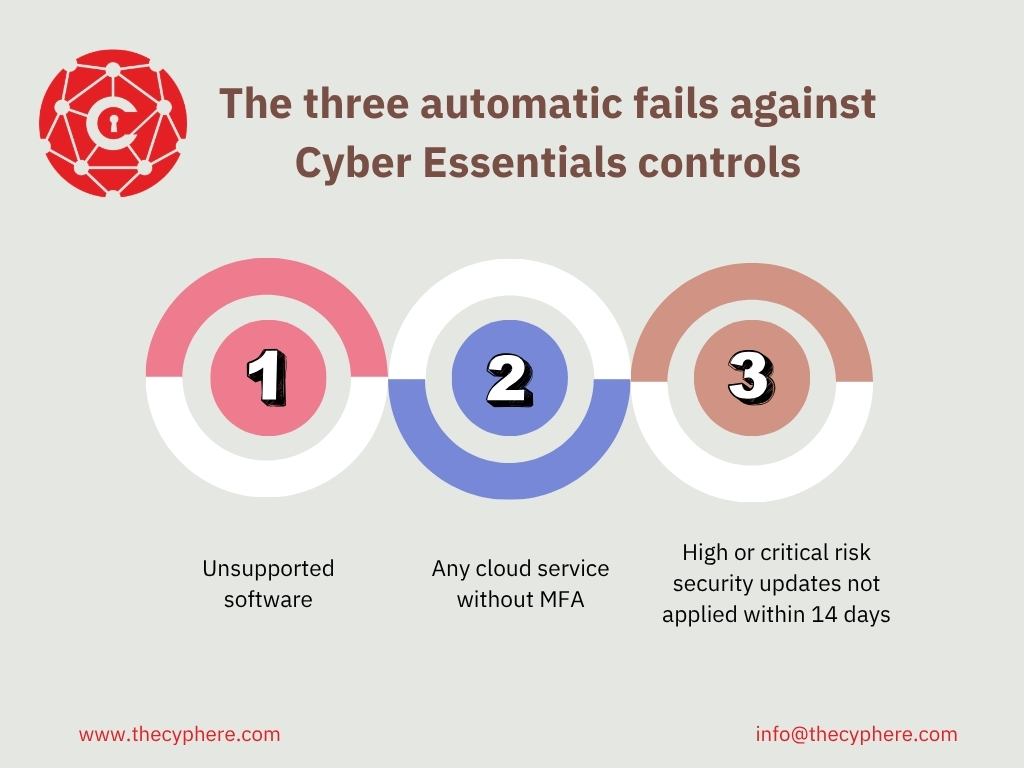
- Unsupported software anywhere in scope, unless it is segregated into a sub-set with no internet traffic in either direction; a replacement planned for next quarter does not count. Our supported operating systems guide lists what counts as supported.
- Any cloud service without MFA, for any user or administrator. Cloud services cannot be excluded from scope, so one SaaS tool without it is enough.
- High or critical risk security updates not applied within 14 days of release are another automatic fail for Cyber Essentials certification. Questions A6.4 (operating systems and firewall and router firmware) and A6.5 (applications) carry this requirement.
The rule behind each of the three, including what counts as high or critical, is in our Cyber Essentials requirements guide.
What happens after a pass?
When every answer is marked compliant, your certification body issues a certificate valid for 12 months from the day the application is assessed and marked as a pass, and lists you on IASME’s public register, which buyers search (our certificate check guide explains what it shows). Where you opted in and are eligible, the cyber liability insurance is included (IASME’s insurance page sets out the conditions).
Renewal is a fresh assessment against whichever question set is current at the time (see our renewal guide). If a buyer has asked for Cyber Essentials Plus, it must be completed within 90 days of the basic certificate, so we run the two as one engagement with the scope agreed once; our guide to how long Cyber Essentials takes sets out the timeline.
How Cyphere marks self-assessments?
We aim to mark submissions within three business days, and most are marked within one.
Talk to an IASME-licensed assessor
Cyber Essentials self-assessment FAQs
What is the Cyber Essentials SAQ?
SAQ stands for self-assessment questionnaire: the IASME question set you complete in the portal for basic Cyber Essentials. Signed by a director or board member and marked by an assessor, it becomes the verified self-assessment.
Can I see the self-assessment questions before I pay?
Yes, and it is free: IASME’s website carries both the Willow and Danzell question sets, so download the one your account will answer, review it in advance, and prepare draft answers before you ask for portal access.
What evidence do I need for the Cyber Essentials self-assessment?
Your written answers are the main evidence, so be specific about products, devices and settings. Keep the asset list, MFA settings for each cloud service, the administrator account list and update reports to hand in case the assessor asks.
How long do I have to complete and submit the assessment?
Six months from the point you are given portal access, after which IASME deletes the assessment account. A prepared applicant can work through the questions in a few hours; see how long Cyber Essentials takes.
Can my IT provider complete the self-assessment for us?
Yes, and many do. If you later move to Cyber Essentials Plus, costs depend on network complexity. The declaration is still signed by a director or board member who owns the answers, and accounts your organisation owns stay in scope when a supplier or managed service provider uses them.
Related Cyber Essentials guides
- Cyber Essentials requirements: the five controls explained
- Cyber Essentials checklist: what to have in place before you apply
- Cyber Essentials vs Cyber Essentials Plus
- Cyber Essentials scope: whole organisation, sub-sets and examples
- Why organisations fail Cyber Essentials
- Cyber Essentials renewal
- Cyber Essentials cost
- April 2026 Danzell changes