Key takeaways
- The official IASME certificate search lists Cyber Essentials and Cyber Essentials Plus certificates issued in the last 12 months. It is free, public and needs no account.
- A listing shows the company name, certificate reference, level, certification date, expiry date and a Score column.
- It does not show scope, so it cannot tell you what was excluded, or whether the controls are still in place today.
- If a company is not listed, the usual reasons are a different registered name, an expired certificate, or no certificate at all.
To check if a company has Cyber Essentials, search the official IASME certificate search by its registered name or certificate number. It takes about a minute, and the register is the only place that shows whether a certificate is still current.
Check a certificate here: official IASME certificate search
How to check a Cyber Essentials certificate on the IASME register?
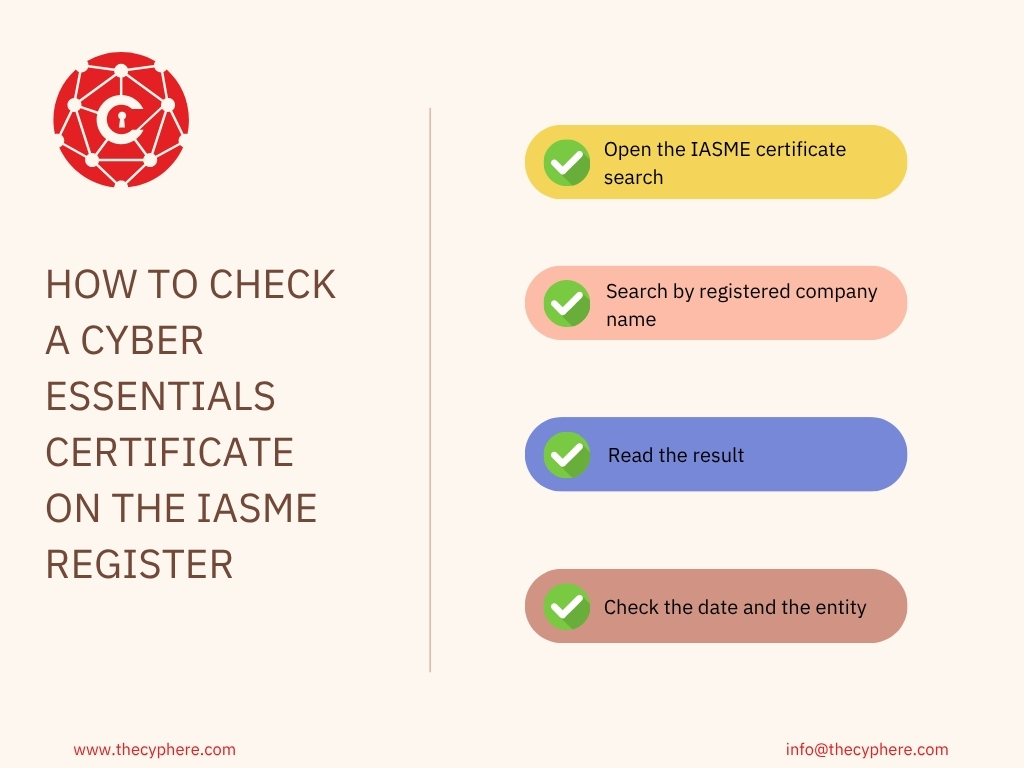
- Open the IASME certificate search. The NCSC owns the Cyber Essentials scheme and IASME, its delivery partner, runs the official search: iasme.co.uk/cyber-essentials/ncsc-certificate-search. It is public and free and needs no login.
- Search by registered company name. Use the registered name rather than a trading name or brand. If nothing returns, try a shorter form of the name.
- Read the result. A listing shows the company name, the certificate reference, the certification level (Cyber Essentials or Cyber Essentials Plus), the certification date, the expiry date and a Score column. The search only lists certificates issued in the last 12 months.
- Check the date and the entity. Confirm the certificate is current and that the entry covers the company you deal with. If you were sent a PDF, check that it matches the listing.
What each field in the Cyber Essentials certificate search result means?
Field | What it tells you | What to check |
Company name | The certified organisation | It is the entity you contract with |
Certificate reference | The unique number on the certificate | It matches the PDF you were sent |
Certificate level | Cyber Essentials or Cyber Essentials Plus | It matches what your contract requires |
Certification date | The day the application was assessed and marked as a pass | How much of the 12 months has passed |
Certification expiry | 12 months from the day the application is assessed and marked as a pass | It is still in the future; diarise it and require evidence of renewal if the contract names certification (how buyers write the requirement) |
If a tender asked for Plus and the register shows basic Cyber Essentials, the requirement is not met. Our comparison of Cyber Essentials vs Cyber Essentials Plus explains what separates the two levels.
What the Cyber Essentials register does not tell you?
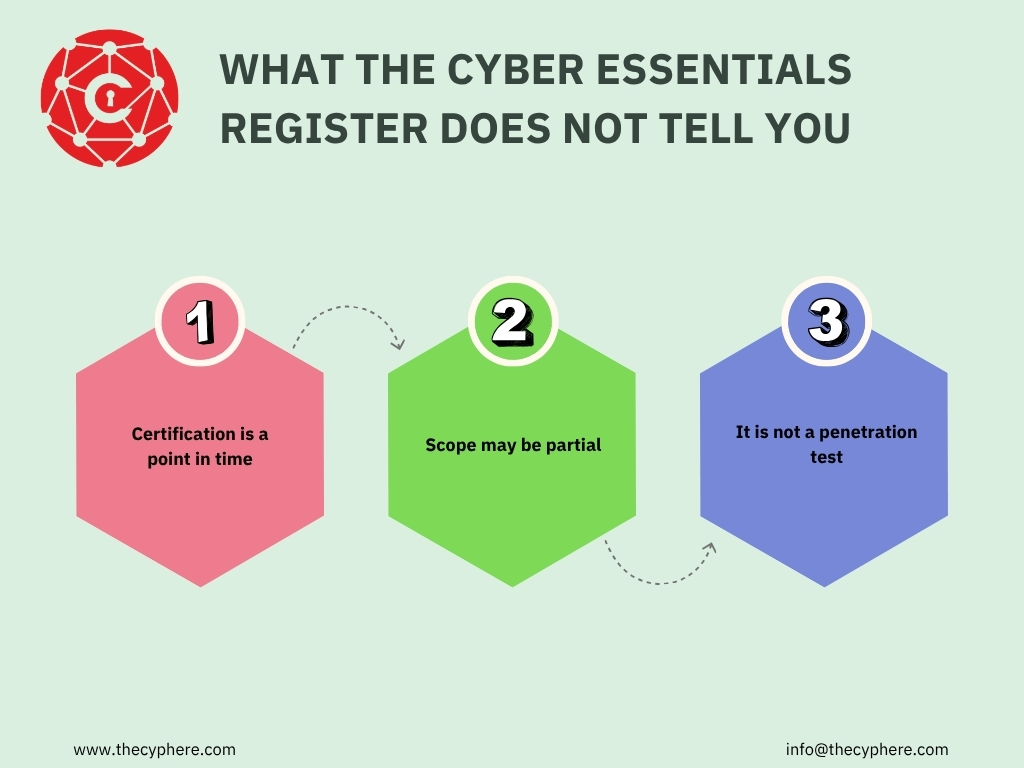
Certification is a point in time: It confirms that an organisation met the requirements when it was assessed. An organisation certified eleven months ago has had eleven months to add cloud services and fall behind on security updates.
Scope may be partial: The NCSC’s Requirements for IT Infrastructure allows certification to cover “a well-defined and separately managed sub-set” of the organisation. That is legitimate, and a partial scope is named on the certificate instead of “whole organisation”. The register does not show scope at all. If it matters, ask for the scope statement; our scope guide explains how sub-sets work.
It is not a penetration test: Even at Cyber Essentials Plus level, the independent audit tests the scheme’s controls on a sample of the supplier’s devices, and the sample is the minimum required number of assets, not its web application or its resistance to a targeted attacker. For a supplier that builds the product you rely on, a certificate is the floor of your due diligence, not the ceiling.
What if the supplier is not listed?
- Name mismatch: They are certified under a legal entity name that differs from the brand the business trades under, or the certificate is held by a parent company. Check Companies House for the registered name and search again. This check is often performed by the IASME application portal at the start of creating a Cyber Essentials certification application, so it’s important that you search by the correct legal entity name, not other names.
- Recently certified: A new certificate is updated and displayed straight away in the majority of cases. If it doesn’t, ask for the certificate and re-check later.
- Expired: A lapsed certificate drops out of the results. You should ask when they intend to renew.
- Not certified: Occasionally an organisation believes its IT provider’s certification covers it. It does not. Certification applies only to the organisation that was assessed.
If the register does not settle it, ask for the certificate PDF, the certificate number and the scope statement, then search again by that number. Any certified organisation can produce these in minutes. If that search also returns nothing, treat the supplier as not currently certified for the purposes of your risk assessment.
If the certificate names a CB you do not recognise, IASME’s directory lists licensed bodies by name, address and website; our certification body guide explains the role.
For certified organisations: your entry, your badge and what to send a buyer
Where your entry appears: Once your certification body issues the certificate, you are listed on the IASME certificate search under the name on your certificate until it expires. If a customer cannot find you, your CB can confirm your status and renewal date.
The badge: Your CB provides the Cyber Essentials badge for the level you hold. IASME issues certificates and badges through BlockMark Registry: the live badge is dynamically verified, links to the digital certificate, and stops showing once the certificate expires or is revoked. A copied image of the badge proves nothing; a live badge that opens the certificate does, and a buyer can still check the register.
What to send a buyer: The same three items a buyer asks for above (PDF, number, scope statement) settle almost every supplier query. If your certificate has lapsed, say so and give the renewal date; our renewal guide covers what expiry means.
How can Cyphere help you?
We are an IASME-licensed certification body (CB), so for the organisations we certify, we issue the certificate and the badge and logo pack, and the listing goes onto the IASME register. We track each client’s expiry date and contact them ahead of renewal, so certification does not lapse mid-contract. If you are a buyer and a supplier’s scope statement is unclear, we are happy to explain what it covers.
Need certification for a tender or customer questionnaire? Book your Cyber Essentials Plus Certification here
Cyber Essentials certificate check FAQs
Is there a list of all Cyber Essentials certified companies?
No. The IASME certificate search is the official source and is not a downloadable list; IASME states it may only be used to check certification, not for marketing or data research. Lists found elsewhere are copies of varying age and accuracy.
Does the portal show Cyber Essentials Plus separately?
Yes. The achieved level is part of each listing, and a Plus holder will normally show two entries, one for Cyber Essentials and one for Plus, each with its own reference and dates [HD CONFIRM: separate register rows]. These are the two certification levels, and Cyber Essentials Plus builds on the same controls by independently testing systems to confirm they work in practice. Use the Plus entry and its expiry date.
Can I download or use the Cyber Essentials logo?
Only if you are certified; your CB supplies the badge for your level. The live IASME badge verifies itself, so a pasted image that does not click through to a certificate should be checked on the register.
A certificate has expired. What does that mean?
The organisation is not currently certified, and its certificate drops off the register. In our experience, a short gap between certificates is usually administrative; a certificate that lapsed a year ago and was never renewed is a different signal.
Can I run a Cyber Essentials supplier check for multiple companies at once?
Yes. IASME runs a separate service, IASME Supplier Check, a tool for organisations verifying Cyber Essentials and Plus across their supply chain. Your organisation registers and is verified before access, and it may only be used to check certification. This is especially useful for larger UK organisations checking multiple suppliers.
Related Cyber Essentials guides
- Cyber Essentials scope: what a sub-set certificate covers
- Cyber Essentials vs Cyber Essentials Plus: the difference between the two levels
- Cyber Essentials renewal: expiry and re-certification
- Is Cyber Essentials mandatory?: who requires it and how buyers should write the requirement
- Choosing a certification body: what it does
- What is Cyber Essentials?: the scheme explained