This guide is for MOD suppliers, IT managers, and bid teams seeking to understand and achieve DCC Level 0 certification. It covers the requirements, process, and practical steps for meeting DCC Level 0, including Cyber Essentials, data protection, and business resilience. DCC Level 0 is now a baseline requirement for all defence suppliers by December 2026. Understanding and achieving this certification is essential for contract readiness and ongoing participation in the MOD supply chain.
Key Takeaways
DCC Level 0 is the entry level of the MOD’s Defence Cyber Certification scheme, and all defence suppliers are being asked to achieve it by 31 December 2026. DCC Level 0 requires a valid Cyber Essentials certificate, is for organisations with very low cyber risk, and must be achieved by all defence partners by December 2026. To meet Level 0, you must satisfy three controls: Cyber Essentials, UK GDPR and data protection, and evidence of business resilience.
It applies to owners, IT managers and bid teams at defence supply chain organisations of any size, including subcontractors several tiers removed from the MOD. For many suppliers, this is now a contract-readiness issue as much as a cyber one: the MOD is using DCC Level 0 to set a baseline for cyber security, data protection and resilience across its supply chain.
DCC certification levels range from 0 to 3 based on cyber risk. DCC has four levels: 0 to 3. This guide explains what DCC Level 0 requires, how certification works through a DCC certification body and the IASME portal, how Cyber Essentials fits into the requirement, how scope is defined, where Level 0 sits against the higher DCC levels, what the MOD deadline means in practice, and how Cyphere helps suppliers get ready. Level 0 is deliberately achievable: three controls, against 101 at Level 1, and one of them is a certificate many suppliers already hold.
This guide draws on IASME’s DCC Certification Process Guide and DCC Overview and quotes them where they state a rule.
What is Defence Cyber Certification (DCC), and who runs it?
Overview of DCC
Defence Cyber Certification is the MOD’s cyber security certification scheme for its supply chain, assessed against Def Stan 05-138 Issue 4 (IASME’s DCC FAQ [HD CONFIRM: IASME DCC FAQ URL]). IASME’s DCC Overview states that “IASME, the MOD’s official cyber certification partner, manages the implementation of the DCC through its extensive network of assured Certification Bodies.”
DCC Structure and Purpose
DCC replaces the MOD’s previous per-contract assessments with one organisation-level certificate. In the Overview’s words, “the DCC certification emphasises the overall security and resilience of the organisation”, which is why Level 0 looks at how the business runs, not only at its IT. Each defence project has a cyber risk assessment, and that risk level decides which DCC level the supplier needs.
IASME’s FAQ says DCC uses the same questions as the MOD’s Supplier Assurance Questionnaire, with small differences, so if you completed the SAQ under an earlier contract, they will be familiar.
Cyber Essentials and DCC
Cyber Essentials is a UK Government-backed certification scheme covering five key technical controls. Cyber Essentials uses a self-assessment reviewed by a certification body, while Cyber Essentials Plus adds independent technical testing. It is the Cyber Essentials requirement – not the whole DCC assessment – and must be considered alongside the DCC scope and the other Level 0 controls.
The Overview adds that the scheme “reinforces the requirement for appropriate adoption of Cyber Essentials at its core”, which is why the certificate is the first control at every level.
Transition: Now that you understand the structure and purpose of DCC, let’s explore the Cyber Essentials scheme in more detail.
Cyber Essentials Scheme
Certification Process
Cyber Essentials is a UK Government-backed certification scheme designed to help organisations protect themselves against common cyber threats. It assesses five key technical controls. Both Cyber Essentials and Cyber Essentials Plus assess the same five controls, but Cyber Essentials Plus adds independent technical testing to verify that the controls work in practice.
Cyber Essentials certification is completed through an online self-assessment questionnaire. The organisation defines its scope, answers questions about its systems and controls, and submits the assessment through an IASME-licensed certification body. The answers may be returned for clarification or resubmission before certification is awarded.
For an MOD supplier, the important distinction is:
Certification | How it is assessed | Relevance to DCC |
|---|---|---|
Cyber Essentials | Self-assessment reviewed by a qualified assessor | Required for DCC Levels 0 and 1, where applicable |
Cyber Essentials Plus | Cyber Essentials assessment plus independent technical testing | Required for DCC Levels 2 and 3, where applicable |
Cyber Essentials is not the same as DCC certification. It is one of the requirements within the DCC framework, whereas DCC Level 0 also requires evidence relating to data protection and business resilience.
Technical Controls
What does Cyber Essentials cover? The scheme assesses five technical areas:
- Firewalls and network security
- Secure configuration
- Security update management
- User access control
- Malware protection
The exact requirements can change when the Cyber Essentials scheme is updated, so suppliers should use the current assessment question set and technical requirements when preparing their submission.
Validity Period
How long is Cyber Essentials certification valid? Cyber Essentials certification is renewed annually. This means an organisation can hold a three-year DCC certificate but still needs to keep its Cyber Essentials certificate current throughout that period.
A supplier should therefore:
- Check the Cyber Essentials expiry date before applying for DCC Level 0;
- Ensure the Cyber Essentials scope covers the applicable DCC boundary;
- Renew Cyber Essentials before it expires;
- Reassess the scope after major changes to systems, sites, users or suppliers; and
- Retain the certificate and assessment evidence for procurement or audit purposes.
With an understanding of Cyber Essentials, let’s look at how these requirements fit into the broader DCC framework.
The four DCC levels
DCC Levels Overview
Each level is tied to the cyber risk of the contracted work, and the number of controls and scrutiny rises with the level. The first level remains pre-requisite to the next level; for instance, level 0 is pre-requisite for Level 1 and so on.
DCC certification levels range from 0 to 3 based on cyber risk. DCC has four levels: 0 to 3.
DCC level | Cyber risk profile | Controls | Cyber Essentials prerequisite |
|---|---|---|---|
Level 0 | Very low | 3 | Cyber Essentials |
Level 1 | Low to moderate | 101 | Cyber Essentials |
Level 2 | High | 139 | Cyber Essentials Plus |
Level 3 | Substantial | 144 | Cyber Essentials Plus |
Control counts: IASME, Defence Cyber Certification. Risk profiles: IASME’s DCC FAQ. The prerequisite column follows the DCC Overview: “All levels (0-3) start with Cyber Essentials certification, with Levels Two and Three requiring Cyber Essentials Plus.”
You can apply for any level without holding the lower ones first (IASME’s FAQ); equally, if a contract requires Level 1 or above, Level 0 alone will not meet it. For what separates the two Cyber Essentials levels, see Cyber Essentials vs Cyber Essentials Plus.
Transition: Now that you know the structure of DCC levels, let’s focus on the specific requirements and process for DCC Level 0.
What is DCC Level 0?
DCC Level 0 Summary
DCC Level 0 is for organisations with very low cyber risk. It requires a valid Cyber Essentials certificate, which is mandatory for DCC Level 0 and must be kept current throughout the three-year DCC certification period. All defence partners must achieve DCC Level 0 by December 2026.
DCC Level 0 Overview
DCC Level 0 is the entry level of the scheme. IASME’s FAQ describes it as normally assigned where the assessed cyber risk is very low, and it asks a supplier to show basic cyber security practice through three controls. DCC Level 0 requires a valid Cyber Essentials certificate, is for organisations with very low cyber risk, and must be achieved by all defence partners by December 2026. Level 0 requires basic cyber security practices. No DCC level is self-assessed: you answer the questions on the IASME portal and a DCC certification body marks the submission.
The three DCC Level 0 controls
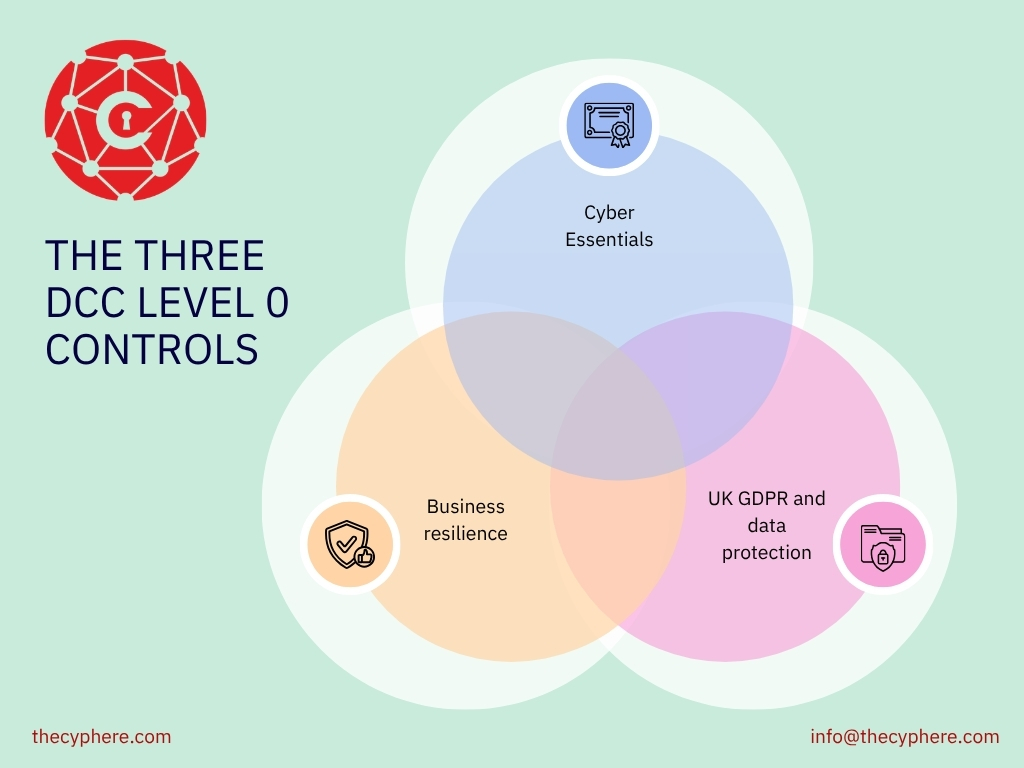
- Cyber Essentials: A valid Cyber Essentials certificate covering the applicable systems, devices, users, sites and networks within the agreed DCC scope. Confirm the precise boundary and any permitted exclusions with the certification body.
- UK GDPR and data protection: Evidence that you meet your obligations under UK GDPR and the Data Protection Act 2018: knowing what personal data you hold and why, processing it lawfully, and governing it, with supporting evidence such as records of what personal data is held and how responsibilities are communicated to staff.
- Business resilience: Evidence that the business can keep operating through a disruption, including a cyber incident: continuity arrangements that exist, are owned and are realistic, with supporting evidence such as continuity documentation or induction and training records for resilience responsibilities. Cyber Essentials does not assess backups or continuity, so your certificate gives no credit here.
The second and third controls deserve as much attention as the first. [REVIEWER: confirm the names of DCC Level 0 controls 2 and 3 from the IASME Level 0 supporting document]
Transition: With the requirements for DCC Level 0 clear, let’s examine what the MOD has asked for and how this impacts suppliers.
What has the MOD asked for?
MOD Statement and Deadlines
In a statement published on 8 May 2026 on the Defence Digital blog, the MOD’s Director of Cyber Defence and Risk said she had asked all industry partners to achieve DCC Level 0 by 31 December 2026, including Cyber Essentials for all applicable business-critical systems within scope.
The same post adds that “where higher levels of certification are required at lower tiers in the supply chain, these should be scheduled for delivery after 31 December 2026.” In practice, prime contractor requirements may flow these obligations down through subcontract agreements.
MoD Cyber Security Model (CSM)
The Ministry of Defence Cyber Security Model (CSM) was launched in 2017 to manage cyber risk across the defence supply chain, and Version 4 (CSMv4) was updated in March 2026. It is a risk-based approach designed to embed cyber resilience into the defence supply chain. Version 4 (CSMv4) shifts the focus from protecting specific MOD data to broader organisational security; it uses four updated risk profiles (Levels 0 to 3) and aligns with Defence Standard 05-138.
The process begins when the MOD issues a Cyber Risk Profile for a procurement activity. Suppliers use the online Supplier Cyber Protection Service to complete a Supplier Assurance Questionnaire (SAQ) to the required level; if they fall short of the required standards, they must submit a Cyber Improvement Plan (CIP) before contract award and maintain compliance through annual reviews. This required level remains mandatory for contractual risk assessment and procurement, and even with DCC certification, suppliers may still need to complete elements through the Supplier Cyber Protection Service. DEFCON 658 sets out the contractual terms for the Cyber Security Model.
IASME’s FAQ says DCC is currently not mandatory and that the MOD decides which contracts require it. The Overview is firmer about the standard beneath it: “Compliance (with this uplifted standard) is a requirement for all Defence procurement and contract activities”, so certification is the evidence route for an existing requirement, not an optional extra [HD CONFIRM: wording on mandatory vs certification].
If a prime asks you for a higher level before December, confirm the requirement with them.
Transition: Now that you know what the MOD expects, let’s walk through the DCC Level 0 certification process step by step.
How the DCC Level 0 certification process works?
Certification Steps
IASME’s DCC Certification Process Guide sets out five steps for Level 0:
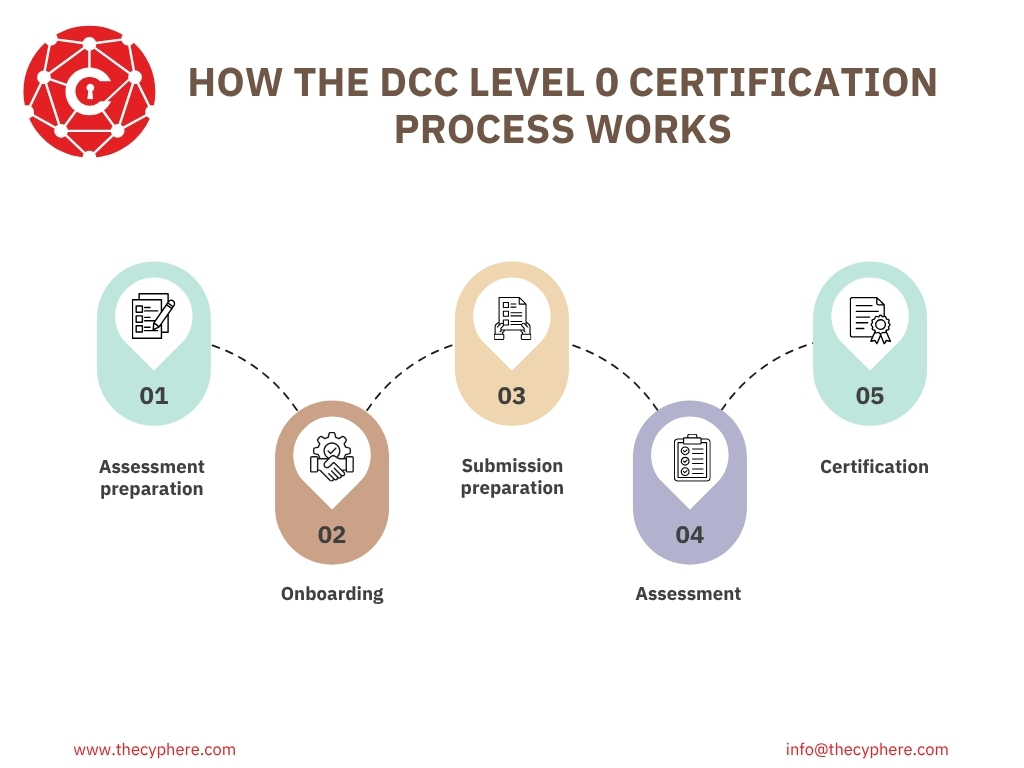
- Assessment preparation: You define your scope using IASME’s Scoping Guide (complex organisations “consult a Certification Body for additional support”); the scope section below sets out what it must cover. You then choose a certification body and give it your organisation size, scope, number of sites, complexity, security clearance requirements and level of preparedness. It may work closely with you to agree pricing based on size, scope, readiness, and complexity; IASME publishes no standard DCC price.
- Onboarding: The certification body enters your details on the IASME portal and selects the assessment level. You host all submission files, grant it access, and arrange any clearances needed for reviews of sensitive data.
- Submission preparation: The certification body confirms you have the latest guidance documents (including the Level 0 supporting document that sets out its controls and questions), have read them, and understand the requirements, including “any critical requirements that, if missing, could result in an automatic failure”. Preparation often includes identifying gaps against the DCC requirements before formal submission. A lapsed or missing Cyber Essentials certificate is the obvious one. You answer every question with an explanation and submit for marking.
- Assessment: This assessment process is the formal review stage. Each question is marked compliant, non-compliant, or more information needed, in which case you update and resubmit. The assessor can identify compliance gaps while remaining separate from implementing fixes. Once every question is compliant or non-compliant, the certification body submits the result.
- Certification: “If the Applicant passes, a certificate is automatically issued through the BlockMark system.”
Important Rules and Considerations
Two rules in the Process Guide matter here. First, the portal route is specific to Level 0: “The Level 0 path does not allow the Applicant to aim for a higher certification level.” Levels 1 to 3 follow a separate process, so decide the level before onboarding.
Second, if the step 1 discussions or the readiness check show you are not ready, you can “end the process and focus on implementation” and return later.
Transition: After understanding the certification process, it’s important to know how long DCC Level 0 lasts and how it aligns with Cyber Essentials renewal.
How long does DCC Level 0 take, and how long is it valid?
Timescales and Validity
IASME sets no fixed timescale; it depends on how ready you are, what needs fixing and certification body availability. In our experience, a supplier that already holds Cyber Essentials is looking at weeks rather than months. Without Cyber Essentials, add the time to certify first; see how long Cyber Essentials takes.
The Process Guide states the validity rule plainly: “Certification is valid for three years” and “Annual attestation is required at the end of years 1 and 2.” That attestation confirms the controls remain in place and that the scope has not significantly changed since certification. The certificate expires at the end of year three, when you reapply. Some contracts or tenders may require a supplier to maintain a valid DCC certificate throughout the contract term.
Cyber Essentials, by contrast, is renewed every year, so a lapsed Cyber Essentials certificate puts your DCC certificate at risk. Keep both cycles in the same calendar; see our Cyber Essentials renewal guide.
Transition: Next, let’s clarify how to define your DCC scope and ensure your Cyber Essentials certificate covers it.
The DCC scope, and what your Cyber Essentials certificate must cover
Defining the DCC Scope
The DCC scope is the organisation, not the network that touches the MOD contract. The Overview describes DCC as “a single, organisation-level assurance” in place of the old focus on protecting “MOD identifiable information”, so the broader scope covers the entire organisation, not just particular MOD information or a single connected environment, and your certification body reviews the scope you propose. See the scoping guide on the IASME website if you need help defining that scope. If operational technology or unusual environments are involved, the assessor can provide further guidance on scope and any compensating controls. Scoping it to the project LAN, as under the old per-contract model, leaves you under-prepared.
Cyber Essentials Scope Alignment
Your Cyber Essentials certificate must be valid when you apply and stay valid through the assessment. If it expires before your planned DCC date, renew first.
Its scope must cover your DCC scope. IASME’s rule is that any internet-connected devices and networks within your DCC scope must be covered by Cyber Essentials (or Cyber Essentials Plus at Levels 2 and 3). A certificate drawn for a narrower sub-set may need extending first. Our Cyber Essentials scope guide explains how a Cyber Essentials scope is defined.
Transition: Now that you know how to align your scope, let’s see how Cyphere can help you achieve DCC Level 0.
How Cyphere delivers DCC Level 0?
We run DCC Level 0 as a single engagement to help UK defence suppliers reach certification, from first conversation to certificate. As an IASME-licensed certification body, we certify the Cyber Essentials element in-house, with obtaining Cyber Essentials often the first practical step for suppliers seeking MOD work and stronger baseline protection. We then prepare you for Level 0: agreeing your DCC scope, aligning it with your Cyber Essentials scope, and building the data protection and business resilience evidence.
The Level 0 certification itself is carried out through our DCC certification partners as part of the same package, so you have one point of contact and one timeline, and we manage the handoffs.
Transition: For further clarity, let’s address some frequently asked questions about DCC Level 0 and Cyber Essentials.
DCC Level 0 FAQs
What is the difference between Cyber Essentials and Cyber Essentials Plus?
Both certifications assess the same five technical controls. Cyber Essentials is based on self-assessment, while Cyber Essentials Plus includes independent technical testing to check that the controls are working in practice.
Is Cyber Essentials certification the same as DCC Level 0?
No. Cyber Essentials is one component of DCC Level 0. A supplier must also demonstrate compliance with the other Level 0 controls, including data protection and business resilience.
How long does Cyber Essentials certification last?
Cyber Essentials certification is renewed annually. Check the current certificate expiry date before applying for DCC Level 0 and maintain certification during the DCC certification period.
Who assesses Cyber Essentials?
The assessment is completed through an IASME-licensed certification body. IASME states that a qualified assessor reviews submitted answers and may request clarification or a resubmission.
Do I need Cyber Essentials Plus for DCC Level 0?
No. Cyber Essentials is normally the relevant requirement for Level 0, while Cyber Essentials Plus applies to the higher DCC levels where required. Confirm the requirement against the applicable contract and current DCC guidance.
Is DCC Level 0 mandatory?
IASME’s FAQ says DCC certification is currently not mandatory and that the MOD decides which contracts require it. Defence Cyber Certification is the MOD’s assurance framework for the UK defence supply chain. In the defence sector, cyber attacks often target smaller suppliers in the MOD supply chain rather than the MOD directly, which is why baseline certification matters. The MOD has nonetheless asked all industry partners for Level 0 by 31 December 2026, so treat that as the working deadline.
Is Cyber Essentials enough for DCC Level 0?
No, Cyber Essentials is one of three Level 0 controls. You also need to evidence UK GDPR and data protection compliance and business resilience.
Do I need Cyber Essentials Plus for DCC Level 0?
No, Levels 0 and 1 require Cyber Essentials; Cyber Essentials Plus is the prerequisite for Levels 2 and 3.
Does my Cyber Essentials scope have to match my DCC scope?
It must cover it rather than match it exactly; the scope section above gives IASME’s rule. In our experience, a certificate drawn for a narrower sub-set is the usual reason Level 0 takes longer than planned.
Can we certify at Level 0 now and move to Level 1 later?
Yes, but as a separate assessment: IASME’s Process Guide says the Level 0 path “does not allow the Applicant to aim for a higher certification level”. If Level 1 is likely, plan both steps together.
Can we get Cyber Essentials and DCC Level 0 together?
Yes. Cyber Essentials is the first control and the prerequisite, so it is certified first or alongside the Level 0 submission, and the quickest route is to agree one scope that serves both certificates from the start.
Transition: For more information, explore our related guides on Cyber Essentials and DCC.
Related Cyber Essentials guides
- Is Cyber Essentials mandatory?: who requires it, including the defence supply chain
- Cyber Essentials scope: aligning scope with your DCC boundary
- How long does Cyber Essentials take?
- Cyber Essentials vs Cyber Essentials Plus: which level each DCC level needs
- Cyber Essentials renewal
- What is Cyber Essentials?