Key Takeaways
- A Cyber Essentials certificate is valid for 12 months from the day the application is assessed and marked as a pass. There is no automatic extension and no partial renewal.
- Renewal is a full reassessment against whichever question set is current at the time, and IASME requires every answer to be entered again.
- Start six to eight weeks before expiry. The work is not the questionnaire; it is whatever has drifted in your estate.
- Cyber Essentials Plus holders plan around two dates: the Plus certificate has its own expiry, and the Plus audit must again follow the renewed basic certificate inside 90 days.
Cyber Essentials renewal is a fresh assessment, repeated every year. You complete the current question set again, a director or board member signs the declaration again, and an assessor marks it again. Both levels work this way; there is no reduced check for having passed before.
Certification lapses quietly: nobody notices until a procurement team checks the register and finds it expired three weeks ago, and by then you are working to someone else’s deadline.
Does Cyber Essentials certification expire?
Yes. Cyber Essentials is a UK Government-backed cyber security certification scheme run through the National Cyber Security Centre and delivered by the IASME Consortium. Both Cyber Essentials and Cyber Essentials Plus certificates last 12 months from the day the application is assessed and marked as a pass. There is no rolling extension.
When the 12 months are up, your organisation drops out of the public IASME certificate search, which only lists certificates issued in the last 12 months, shows the expiry date on each, and is maintained by IASME so buyers can verify current status. That is the practical consequence, because the register is how buyers check. Our certificate check guide covers what procurement teams see when they look you up.
What happens if your cyber essentials certificate lapses?
Government contracts: Where a contract or framework requires current certification, a lapsed certificate is a compliance issue with the customer and can make you ineligible to bid for UK government contracts or continue some existing work. PPN 014 sets out when central government suppliers need it; our guide on whether Cyber Essentials is mandatory covers who else asks, including some UK businesses that rely on supplier portals for procurement or defence opportunities.
The defence supply chain: Cyber Essentials is the prerequisite for every level of Defence Cyber Certification, so a lapse takes the prerequisite away; see our DCC Level 0 guide.
Cyber insurance: The insurance included with eligible certificates ends with the certificate. IASME’s wording is that the policy “is connected to your Cyber Essentials Certification and cannot be renewed on its own”.
If you have already lapsed, reapply straight away: If you have a lapsed certificate, the process is the same as renewal, but you are uncertified until you pass again, so tell any buyer who needs to know before they find it on the register. IASME does not describe any grace period; the certificate stops on its expiry date.
What does the Cyber Essentials renewal process involve?
The assessment itself is the same assessment process used for first-time applications: the current question set, the same self-assessment questionnaire, a declaration signed by a director or board member, and marking by an assessor, with two working days to correct anything non-compliant. Our self-assessment guide walks through it. What is different at renewal is the work before you open the question set:
- Confirm scope: Check whether the boundary is still the one you certified last year, because a new office, an acquisition or a cloud migration changes it, and if you narrow it you will need to justify the reason for a partial scope to your assessor. This is also the point to review whether your IT estate still matches the certified boundary, including devices, cloud services, remote access, and network boundaries. Agree any new boundary with your certification body first; our scope guide covers what has to be included.
- Re-inventory: List the devices bought and retired, the staff who joined and left, and the cloud services added, including the phones and tablets, company-owned or personal, that access organisational data or services; our BYOD guide covers which of those are in scope. Make sure the renewal submission reflects changes such as new devices, cloud platforms, and remote working arrangements.
- Check the three automatic fails first: Is everything still supported by its vendor, is MFA on every cloud service, and have high and critical updates been applied within 14 days?
Your answers must reflect current scope changes, not last year’s wording copied across unchanged.
When the new certificate is issued: Send it to every customer, supplier portal and insurer holding the old one. For Cyber Essentials Plus, the technical audit then runs again; see renewing Cyber Essentials Plus below.
Do you have to re-enter everything? Yes. IASME’s Cyber Essentials FAQ is direct about it: “You do need to enter all the information each time you certify”, because the renewal is your annual review. Questions also change between versions, so keep last year’s answers to work from, not to copy.
Year one versus renewal
First certification | Renewal | |
|---|---|---|
Question set | Whatever is current | Whatever is current at renewal, which may be a newer version |
Scope | Agreed from scratch | Reconfirmed, and re-agreed if the organisation has changed |
Typical effort | Weeks, mostly remediation | Days to weeks, depending on drift |
Main work | Implementing controls | Finding what has changed since last year |
Cost | IASME assessment fee for your band, plus support | The same fee for your band, unless headcount moved you up |
Cyber Essentials Plus | Full technical audit | Full technical audit again |
The single biggest variable is drift. Most organisations find renewal faster than first certification only when they have controlled drift. An organisation that has tracked joiners and leavers, kept an asset register current and reviewed new cloud services as they arrived can renew in days. Many organisations assume little changes year to year, but gradual drift is what turns renewal into a near first-time exercise. One that has not is certifying from scratch, and discovers it six weeks before expiry.
At month eleven, the controls have rarely failed; the estate has moved. There are a few new joiners, a few end-of-life OS still on the network, and a SaaS tool someone signed up for in the spring. None of it is dramatic, but all of it has to be found before renewal. – Harman Singh, IASME-licensed Cyber Essentials assessor, Cyphere
How much does annual renewal for Cyber Essentials cost?
IASME sets the renewal fees by organisation size, so check the official IASME website before budgeting because IASME reviews pricing over time; our cost guide carries the current bands for both levels. Current Cyber Essentials certification prices start from £500-£700 for micro to medium organisations. In our assessments, the larger renewal cost is usually replacing devices and software that have fallen out of vendor support since last year, and that is the item that needs procurement lead time. Some Cyber Essentials and Cyber Essentials Plus certification renewal prices start from under £999 + VAT for both certifications, but confirm the latest fee before budgeting.
When should you start your Cyber Essentials renewal?
Start six to eight weeks before expiry, and earlier if you hold Cyber Essentials Plus or if your estate has changed materially. Annual renewal matters because the threat landscape shifts, new vulnerabilities emerge, and your controls need checking against the current technical requirements.
IASME emails a reminder roughly a month before expiry. Treat that as a final check, not your starting point, because a month leaves little room to replace unsupported devices or roll out MFA. That is especially true where cloud services require MFA across the whole organisation, not just isolated admin changes.
Phase | Timing before basic expiry | What you do |
|---|---|---|
Review | 8 to 6 weeks | Run a gap analysis across all five control areas, reconfirm scope, re-inventory devices (phones and tablets included), users and cloud services, check vendor support status and MFA coverage early enough to identify gaps before submission |
Remediate | 6 to 3 weeks | Replace unsupported software, enable missing MFA, tidy dormant accounts and admin rights |
Assess | 3 to 2 weeks | Complete the question set, board sign-off, submit |
Buffer | Final two weeks | For anything that comes back non-compliant |
Audit, Plus only | After the renewed basic certificate | Technical testing inside the 90-day window, booked to finish before your old Plus certificate expires |
Can you renew early? Yes, but the new certificate’s 12 months run from the day it is assessed and marked as a pass, not from your old expiry date, so renewing early gives away the overlap. IASME’s own advice is to “start early, but not too early” and to time the renewal so you keep the full validity period (IASME on renewing your certification). A few weeks before expiry keeps cover continuous and leaves time to fix anything that fails.
What changes when the question set changes?
The NCSC sets the scheme requirements, and IASME updates the question set and technical requirements to match. Your renewal is marked against whichever set is current, and annual renewal ensures organisations are assessed against current standards as new risks emerge. That is Danzell (v3.3), in use since 27 April 2026, so a certificate gained under Willow (v3.2) renews under Danzell, and the certificate you already hold is unaffected and runs to its own expiry date. After April 2026, multi-factor authentication (MFA) is mandated for cloud services where available.
If you still have an assessment open under Willow, the submission deadlines and the full list of changes are on our guide to the April 2026 Danzell changes; read it before you start answering.
The renewal checklist: What has drifted since last year?
These are the areas where we find the gaps at renewal, and this checklist is designed to identify them across the five core technical controls before renewal.
The five control areas are firewalls, secure configuration, user access control, malware protection, and patch management.
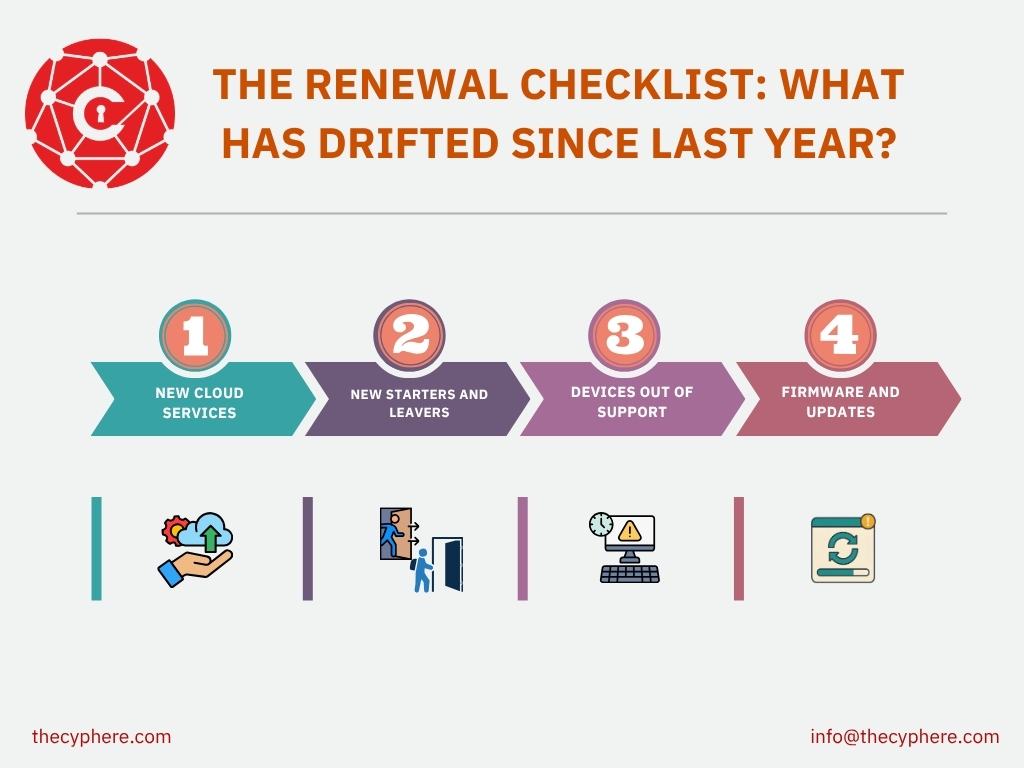
- New cloud services: Any SaaS tool adopted during the year is in scope and must have MFA for every user. Review each new service for MFA before it goes into use, not at month eleven.
- New starters and leavers: Dormant accounts and admin rights that outlived a role change are the commonest user access control findings. Remove accounts on every leaver, including supplier and contractor accounts, and special access privileges on every role change.
- Devices out of support: Check vendor support dates quarterly against the asset register, so end-of-life devices are replaced on your timetable, not the assessor’s. Our supported operating systems list tracks the dates that matter.
- Firmware and updates: Check monthly that high and critical updates, including router and firewall firmware, are going on within 14 days of release. This is part of security update management, the control theme covering timely patching and firmware updates.
Before renewal, run the Cyber Essentials checklist as a full pass to keep security practices on track.
Can you change certification body at renewal?
Yes. You are not tied to the body that certified you last year, and renewal is the easiest point to move: any IASME-licensed certification bodies can process renewals using the same questionnaire and assessor model as first-time applications, then agree scope and mark it as normal. The requirements and the IASME fee are the same wherever you go, though you can change service provider at renewal if you want different support; our guide on choosing a certification body covers what differs.
Renewing Cyber Essentials Plus certification, or moving up to it
Cyber Essentials Plus is renewed in full. The basic assessment is repeated first using the same self-assessment questionnaire as basic Cyber Essentials, then the technical audit runs again on a fresh sample of devices to independently check that the controls are correctly implemented, and it must again be completed within 90 days of the new basic certificate, with 30 days inside that window to fix and retest findings. Our Cyber Essentials Plus requirements guide covers the tests.
The sample typically covers around 10 per cent of user devices, and for a small organisation the audit may take half a day to a day if devices are available and correctly configured.
The Plus certificate carries its own date, set when the audit passed, so it can run up to 90 days past the basic one. Plan around both dates, and book the audit so it finishes before the old Plus certificate expires, not only before the basic one does.
If you hold basic Cyber Essentials, renewal is the cleanest point to change level; our comparison of the two levels covers who typically asks for which.
How Cyphere manages renewals?
We track every client’s expiry date, contact them ahead of renewal and handle the resubmission, so certification does not lapse mid-contract.
The renewal that goes wrong is almost always the one where the organisation changed shape during the year, and nobody told us until the question set was half done, so a two-minute email when changes to the IT estate and security controls happen should be reported early to keep the renewal accurate and save a fortnight at renewal. Talk to us about your renewal
Cyber Essentials renewal FAQs
What if we fail the renewal assessment?
You have two working days to correct non-compliant answers. IASME’s FAQ adds that “if you still fail after these two days you will have to reapply and pay the assessment fee again”. See our guide to failing Cyber Essentials.
How long do we have to complete the renewal once we have applied?
IASME’s FAQ gives you “6 months from the date of application to complete and submit your assessment”. Your current certificate still ends on its original date, so apply with that date in mind, not the six months.
Does the included cyber insurance renew with the certificate?
Only through the certificate. IASME states the policy “cannot be renewed on its own”, so to keep cover you renew your certification and still meet the eligibility criteria, or take a separate stand-alone policy.
What should we tell our certification body about during the year?
Anything that changes the boundary or the headcount: a new office, an acquisition or merger, a cloud migration, a new SaaS platform, growth that moves you into a larger IASME fee band, or changes across the whole organisation that affect the technology footprint, such as different remote access patterns or supplier changes.
Do we need to renew if no contract requires it?
Certification is voluntary unless a buyer or insurer asks for it, and the case for keeping it is on our guide to whether Cyber Essentials is worth it. Renewal also helps protect digital assets and maintain supplier and procurement eligibility even where certification is not strictly mandatory. Once you let it lapse, you start again as a new applicant.
Related Cyber Essentials guides
- Cyber Essentials cost: current fees for both levels
- Cyber Essentials vs Cyber Essentials Plus: which level to renew at
- Cyber Essentials checklist: the pre-renewal pass
- Cyber Essentials self-assessment: the question set and marking
- April 2026 Danzell changes: the current question set and Willow deadlines
- DCC Level 0 for defence suppliers
- Cyber Essentials scope: re-scoping after a year of change
- Cyber Essentials and BYOD: phones and tablets in the re-inventory
- Failed Cyber Essentials?: what happens next
- Supported operating systems
- Cyber Essentials certificate check
- Choosing a certification body