Key takeaways
- Cyber Essentials is delivered by IASME on behalf of the NCSC. Only IASME-licensed certification bodies can assess your submission and award certification.
- You can verify any body’s licence on the IASME directory before you buy.
- CREST does not accredit Cyber Essentials. Its role ended on 1 April 2020; today it accredits penetration testing and incident response providers.
- The basic assessment fee is set by IASME and is the same wherever you go, so what you are comparing is what surrounds it: what is included, who marks your submission, how quickly, and what happens if it comes back non-compliant.
Your Cyber Essentials certification body is the organisation that assesses your submission, runs your Cyber Essentials Plus audit if you take one, and issues the certificate. Every body marks against the same NCSC requirements using the same IASME question set, so the certificate you receive is identical whoever you use.
This guide is written for the buyer: the business owner or IT manager with a shortlist of providers and no obvious way to tell them apart.
What a Cyber Essentials certification body does?
Cyber Essentials is owned by the National Cyber Security Centre (NCSC) and delivered through IASME as the scheme’s delivery partner. IASME licenses certification bodies, publishes the question set and sets how assessments are run. If an organisation is not IASME-licensed, it cannot award Cyber Essentials certification, whatever else it holds.
Within that chain, the certification body is the licensed organisation and the Cyber Essentials assessor is the person who marks your submission or runs your Plus audit on the body’s behalf.
Stage | What the certification body does | What you do |
Scoping | Agrees the boundary of your assessment before it starts | Define the estate, sites, users and cloud services |
Question set | Provides portal access and answers queries about the requirements | Complete the answers and gather the evidence |
Marking | An assessor marks your submission against the requirements | Correct anything returned as non-compliant |
Cyber Essentials Plus | Tests a sample of your devices, users and cloud services, then compiles the report | Give written permission for the test, then make devices, users and cloud services available |
Certificate | Issues the certificate and your register entry | Diarise the expiry date |
Scoping is a shared job, not an optional extra: the NCSC’s Requirements for IT Infrastructure v3.3 states “You must agree the scope with the Certification Body before assessment begins.”
At Cyber Essentials Plus the body runs the tests, but IASME sets the test specification, the sample-size method, the approved scanning tools and the report format. The body must keep its scoping and sampling evidence “for at least the lifetime of the certificate”, and our Cyber Essentials Plus requirements guide covers what it must verify before testing starts.
Certification does not include implementing your controls. A consultant helps you prepare but cannot award certification. A Cyber Advisor, assured under the NCSC and IASME scheme, gives small organisations practical implementation advice (NCSC Cyber Advisor scheme) and likewise cannot certify you. [HD CONFIRM: Cyber Advisor scheme name and link]
Do you need to work with a certification body?
There are two ways to manage the Cyber Essentials certification process:
- Do It Yourself (DIY): Your organisation can do it yourself by reaching out to IASME directly, and IASME shall assign an independent assessor who will mark your application. You will be responsible for readiness and the application submission process without any expert guidance. This is often the go-to choice for Cyber Essentials standard certifications. You can use the IASME readiness tool and knowledge hub free tools to prepare for basic certification. This is also the cheapest way to get a basic Cyber Essentials certification, and where the aim is to get basic Cyber Essentials only (not CE+).
- Work with a Certification Body: Most of the organisations opting for Cyber Essentials Plus certification follow this option. Certification bodies have the expertise to support you with consultations around the entire process, expertise to support you with deciding on tricky situations such as scoping issues, gap analysis and readiness support, all the way to certification. This explains why organisations choose to work with certification bodies. You can also opt to get support from cyber advisors who are NCSC/IASME accredited to help organisations prepare for a Cyber Essentials certification audit.
Licensed, accredited or certified: the words you will see
Provider websites use these words loosely. In practice:
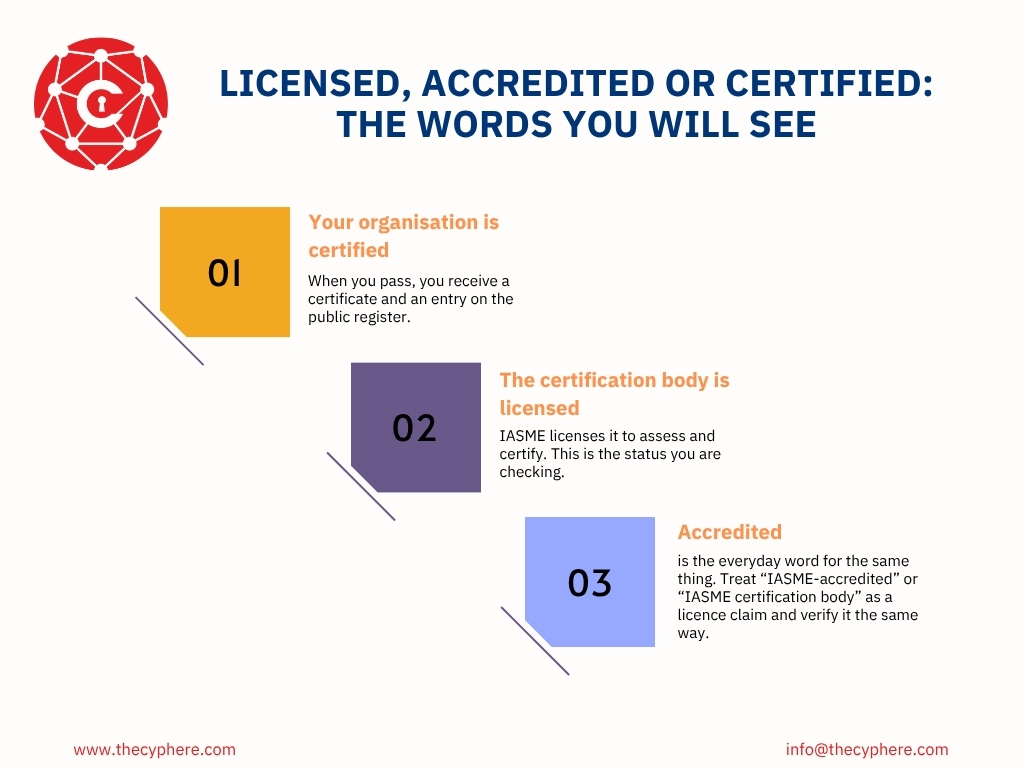
- Your organisation is certified. When you pass, you receive a certificate and an entry on the public register.
- The certification body is licensed. IASME licenses it to assess and certify. This is the status you are checking.
- “Accredited” is the everyday word for the same thing. Treat “IASME-accredited” or “IASME certification body” as a licence claim and verify it the same way.
Our pillar guide covers the accreditation versus certification wording in more detail.
What about CREST and Cyber Essentials?
CREST was one of several accreditation bodies for Cyber Essentials until 1 April 2020, when IASME became the scheme’s sole delivery partner; the search term has outlived the arrangement. Today CREST accredits penetration testing and incident response providers. A firm may hold both a CREST accreditation and an IASME licence; it is the IASME licence you are checking.
How to check a certification body is licensed?
- Open the IASME directory. IASME publishes a searchable list of licensed certification bodies. This is separate from the certificate register, which lists certified organisations.
- Search for the organisation by name. Use the registered company name if the trading name returns nothing.
- Confirm the listing. Ask the body to confirm in writing that its licence covers what you are buying, for example Cyber Essentials Plus. If the body does not appear, ask why before going further.
What to ask before you buy?
The basic Cyber Essentials fee is set by IASME and banded by size, so for basic certification you are comparing what surrounds the fee. Cyber Essentials Plus is priced by each body, so compare Plus quotes on the same scope. Our Cyber Essentials cost guide sets out the fee bands.
Ask for these in writing:
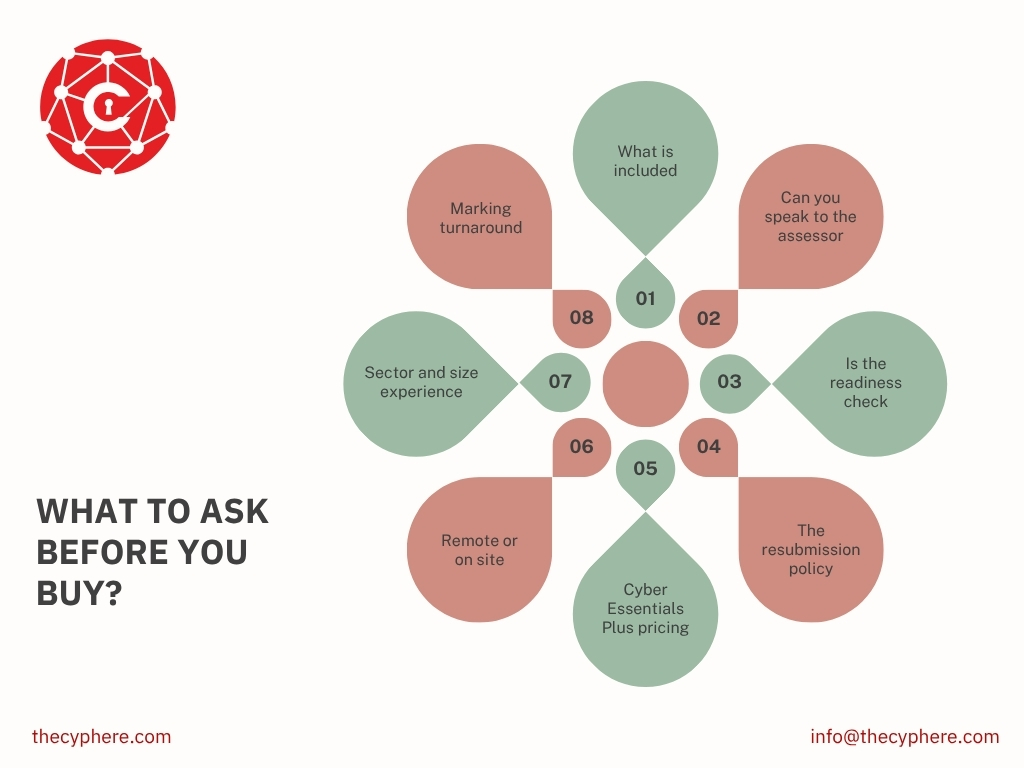
- What is included: scoping, question-set support and a readiness check.
- Can you speak to the assessor before you submit, or does support go through a sales desk?
- Is the readiness check a check against the three automatic-fail areas (unsupported software, cloud services without MFA, and high or critical security updates not applied within 14 days), or a generic questionnaire?
- The resubmission policy: how long you have to correct a non-compliant answer, and whether a further fee applies.
- Cyber Essentials Plus pricing, and whether it includes the basic assessment, the audit and a retest inside the scheme’s 30-day fix window.
- Remote or on site, and whether Plus audits are run by the body’s own assessors or passed on.
- Sector and size experience, which shortens scoping.
- Marking turnaround, which matters when a tender deadline is driving the work.
Also confirm which question set your submission will be marked against; our Danzell changes guide covers the current version and the deadline for assessments started under Willow.
Red flags
- “Guaranteed pass”: No certification body can guarantee a pass, because the assessor marks your estate against the requirements; a “guarantee” usually means free resubmission. See why organisations fail Cyber Essentials.
- Prices that do not state VAT: The IASME fee bands are quoted plus VAT, and a price with no VAT position flatters the cheapest quote.
- Not in the IASME directory: Some providers, often IT support firms offering to do your Cyber Essentials, are resellers who pass your submission to a licensed body. Ask who holds the licence and who will mark your work.
- Vague answers about who marks: If the body cannot name the assessor for the level you are buying, keep looking.
Using different bodies for Cyber Essentials and Plus
Yes, you can use one body for basic and another for Plus, because every certificate goes on the same IASME register, whichever licensed body assessed you. The NCSC’s Cyber Essentials Plus Test Specification v3.2 puts it plainly: “Applicants should be able to expect the same certification outcome, no matter which Certification Body they ultimately use.”
There are two constraints. The CE Plus audit must be completed within 90 days of your basic certificate, and the second body must verify that the Plus scope “matches the scope described by the valid Cyber Essentials self-assessment certificate”, so you cannot re-scope between bodies, and this may sometimes create two different versions of scope understanding, and often organisations find it easier to do both certifications with one certification body. Our Cyber Essentials vs Cyber Essentials Plus guide covers the choice of level.
How Cyphere works as a certification body?
Cyphere is an IASME-licensed certification body for Cyber Essentials, Cyber Essentials Plus, and IASME Cyber Assurance Level One and Level Two, with in-house assessors and Plus audits delivered remotely by our own team, on-site only where needed and agreed beforehand. We are also CREST-accredited for penetration testing, with a separate CREST relationship to offer detailed in-depth technical risk validation exercises.
Measured against the questions above: we aim to mark submissions within three working days, most within one. If something comes back non-compliant, you get a specific explanation and two working days to correct it, and you can speak to the assessor who marked it. If you passed basic Cyber Essentials elsewhere within the last three months, we quote the Plus audit alone. Talk to an IASME-licensed assessor
Cyber Essentials certification body FAQs
Does the certification body I choose affect my certificate?
No. The requirements, the certificate and your register entry are the same whoever assesses you; what differs is the support around the assessment.
Can I switch certification body at renewal?
Yes. Certificates last 12 months and every renewal is a fresh assessment against the requirements current at the time, so your new body simply agrees scope and runs it as normal. See our renewal guide for timing.
Can I do Cyber Essentials myself?
You can prepare yourself, and many small organisations do; the assessment itself is marked by a certification body, which issues the certificate. Our self-assessment guide explains what you submit and how it is marked.
Do I need a consultant as well as a certification body?
No, not usually. If your certification body includes scoping and question-set support, that covers most organisations. Separate consultancy makes sense where significant remediation is needed, and you want hands-on implementation help rather than advice.
How do organisations become certification bodies?
Through IASME’s application process. If that is your question rather than a buying one, IASME’s own guidance is the right place to start.
Related Cyber Essentials guides
- Cyber Essentials cost: what the scheme fee covers
- Why organisations fail Cyber Essentials: why the resubmission policy matters
- Cyber Essentials renewal
- Cyber Essentials certificate check: verifying a certificate on the register
- Cyber Essentials self-assessment: what you submit and how it is marked
- Cyber Essentials vs Cyber Essentials Plus: choosing the level before choosing the body