White box penetration testing, also known as clear-box or transparent box testing, is a security assessment approach where pen testers get full access to the application’s source code, configurations, architecture diagrams, APIs, databases and internal logic. The main features of white box penetration testing include detailed source code review, full architectural understanding, environment-level testing, logic flaw detection and the ability to assess security functions like authentication, authorisation and data validation with perfection. Organisations mainly prefer white box testing because it provides high coverage. faster testing cycles and fewer false negatives.
A white box penetration testing process follows a structured approach from source code acquisition and environment setup to code-level remediation documentation. White box testing tools conduct tests like static analysis, dependency scanning, code review and deeper dynamic testing. Some of the tools are Checkmarx, Fortify, Burp Suite, OWASP Dependency-Check, Nmap and Nessus.
Yunzhuang Lv et al state in their research, “A White-Box Intelligent Testing Platform for Rail Transit Equipment Software”, published on May 16, 2025, that test report compilation time can be reduced by 60% using a white box intelligent test platform and the code defect detection can be improved by 35 % through the intelligent defect location mechanism.
What is white box penetration Testing?
White box penetration testing is a cybersecurity technique that involves an ethical hacker simulating an attack on a system with full knowledge of the target system’s internal structure, such as source code, configurations, credentials and architecture diagrams, to identify security vulnerabilities from an insider’s perspective.

The white box penetration testing process is also known as Clear Box Testing, Glass Box Testing, or Transparent Box Testing. White box penetration testing involves a deep assessment of the system’s internal logic, code review, configuration analysis and security control evaluation. Penetration testers examine the source code/infrastructure to find development errors and configuration flaws to test the strength of the system against real attacks.
According to V. Kozel et al. in their research, “Research of Penetration Testing Methods,” published on November 26, 2024, the main goal of white-box penetration testing is to identify and fix vulnerabilities by thoroughly analysing a system with complete access to its internal structure and components.
How does White box penetration testing work?
White box penetration testing is a security assessment where ethical hackers have full knowledge of a system’s internal details to simulate an attack on the target system to uncover vulnerabilities. White box testing involves a structured approach that includes the scope and rules of engagement, threat modelling and planning, static code analysis, configuration and dependency review, dynamic analysis, exploitation and proof-of-concept, risk analysis and prioritisation, report and remediation guidance and retest and verification.
White box penetration testing is conducted by ethical hackers or professional penetration testers who are authorised by the organisation and have advanced knowledge of security, programming and system architecture. White box testing helps organisations identify vulnerabilities that may not be visible from an external perspective, including insecure code, logic flaws, misconfigurations, and strengthen their defences before an attacker can exploit weaknesses.
What are the unique features of White Box penetration testing?
White box penetration testing helps organisations find and fix security flaws with its unique features that include full internal visibility, source code review, comprehensive vulnerability coverage, integration with SDLC (Software Development Life Cycle) and verification of internal security controls.
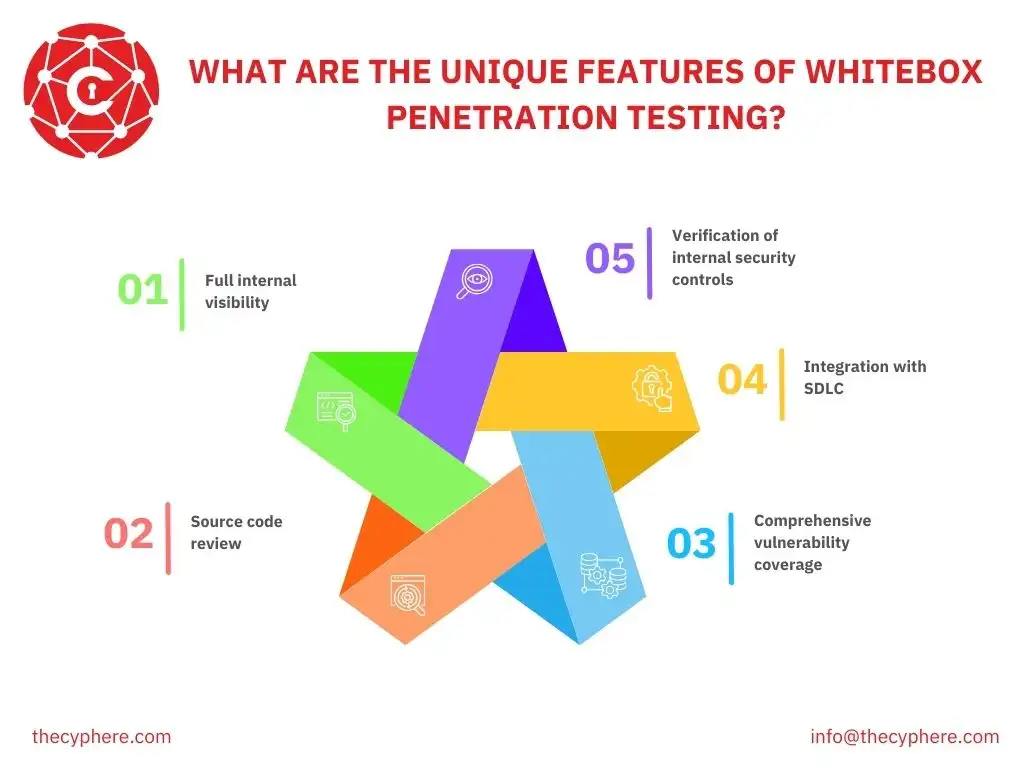
The 5 unique features of white box penetration testing are listed below.
- Full internal visibility: White box penetration testing provides penetration testers with complete access to the target system’s internal details, such as architecture diagrams, source code, database structures, network configurations, and credentials. This full internal visibility allows pen testers to conduct a thorough security assessment at every level, from code logic to backend configurations.
- Source code review: Pen testers manually and automatically review the application’s source code to find hidden vulnerabilities such as validation errors, hardcoded credentials, or insecure API calls during the source code analysis. Source code review ensures early detection of vulnerabilities, identifies the root cause of the security issues, and prevents insider threats and logic errors.
- Comprehensive vulnerability coverage: White box penetration testing provides broader and deeper vulnerability coverage because of its insider approach and complete access to all parts of the code. This comprehensive coverage identifies logic errors, insecure dependencies, privilege escalation flaws, and insecure communication channels. Pen testers use both static and dynamic analysis tools to ensure that every part of the application, from backend logic to data storage, is completely secured.
- Integration with SDLC: White box penetration testing is highly effective when integrated into the software development lifecycle (SDLC). This integration helps developers and security teams find and fix vulnerabilities during early development stages, reducing the cost and risk associated with post-release patches.
- Verification of internal security controls: White box penetration testing assesses the effectiveness of internal security measures such as authentication systems, encryption processes, access control lists, and logging mechanisms. Pen testers ensure that these security controls are implemented correctly and are working properly. This ensures that even if a malicious attacker gains internal access, additional layers of protection still prevent data breaches or privilege misuse.
What are the benefits of White box penetration testing?
The 12 main benefits of white box penetration testing are described below.

- White Box penetration testing provides faster execution: White box testing provides faster execution because pen testers already have access to internal system information, such as code, architecture, and credentials. This saves time on reconnaissance and information gathering and helps the organisation focus directly on vulnerability detection and remediation.
- Deep code analysis reveals hidden vulnerabilities: Pen testers perform a deep review of the source code that helps them find hidden or logic-based vulnerabilities that are often missed in black box penetration testing. This deep analysis of the source code helps organisations find weaknesses early and improve code security, and prevent exploitation in the production environment.
- White Box testing achieves comprehensive system evaluation: White box testing provides complete visibility into the system’s architecture to achieve a complete assessment of both internal and external components. It helps to understand how different parts interact and helps security teams identify weaknesses across applications, servers and configurations.
- Early vulnerability detection addresses security issues: White box testing allows early detection of vulnerabilities during the software development cycle by identifying issues before deployment. The companies can fix security flaws faster and reduce the cost and risk of security breaches after the product goes live.
- White Box environments enhance automation capabilities: White box testing enables integration of automated tools (SonarQube, Semgrep, Checkmarx, Fortify Static Code Analyser) for static code analysis and configuration scanning. Automation improves consistency and speed that help pen testers identify coding flaws and insecure dependencies quickly while saving manual effort.
- Data breach prevention through critical component focus: White box testing focuses on critical system components (Authentication and login modules, Access control and authorisation logic) and internal controls to help prevent potential data breaches. Data breach prevention ensures sensitive data handling, access control mechanisms and encryption are secure, which helps organisations avoid financial loss and reputational damage.
- White Box testing offers clear transparency and efficiency: A Transparent environment of White Box testing provides pen testers with all visible system details, ensuring testing is efficient, and communication between developers and security teams is clear.
- Simplified error detection with direct architecture access: White box testing offers direct access to the system architecture that simplifies the identification of vulnerabilities and misconfigurations. Pen testers can directly trace issues to their source in the code or setup that helps developers implement accurate and permanent fixes instead of temporary patches.
- Accurate threat simulations through complete knowledge: Pen testers simulate real-world attacks more accurately and assess how internal defences respond with complete system knowledge. Accurate threat simulations help organisations strengthen their security posture by understanding the impact of advanced attacks or potential insider threats.
- White Box testing enables extensive coverage: White box testing provides broad coverage of applications, configurations and infrastructure, which ensures every component, including front-end, back-end and database, is thoroughly tested. This reduces the chances of major vulnerabilities being overlooked.
- Shortened reconnaissance phases allow focused assessment: Pen testers save time on discovery and reconnaissance, since they already know the internal structure. This allows pen testers to focus on actual exploitation and remediation, which results in a more focused and effective testing process.
- Technical vulnerabilities exposed more efficiently: White box testing enables faster and more accurate detection of technical vulnerabilities, such as weak encryption, insecure APIs or logic flaws. Efficient exposure of technical vulnerabilities helps penetration testers give actionable insights, and organisations can prioritise and fix high-risk issues quickly.
What are the 7 Steps to perform White Box penetration testing?
Listed below are the 7 steps to perform White Box penetration testing.

1. Source Code Acquisition and Environment Setup
Source code acquisition and environment setup involve obtaining the complete source code, building artefacts, docs and creating an isolated test environment that reproduces production. Source code acquisition and environment setup includes collecting git repos/branches, building scripts, CI/CD manifests, container images, IaC (Terraform/CloudFormation), deployment scripts, DB schemes and architecture/design docs. Pen testers get sanitised test credentials, provision a VM/cloud sandbox matching the runtime and run the build/deploy. This ensures pen testers can safely analyse and interact with the system without affecting production. Pentesters find inventory of repos/artefacts, working test environment, environment setup guide, access/credentials list, signed scope/RoE.
2. Code Architecture and Flow Analysis
Code architecture and flow analysis involves analysing the system’s architecture and logic flow using flowcharts, diagrams or flowgraphs. In code architecture and flow analysis, a pen tester extracts or draws architecture and sequence/data flow diagrams, enumerates entry points(endpoints, jobs, APIs), generates call graphs, traces auth paths and DB interactions by reading code and artefacts. This process uncovers high-impact surfaces and logical weaknesses (where sensitive data or privileges cross boundaries). Pen testers get dataflow diagrams, sensitive modules, a list of entry points and a prioritised target list for review.
3. Static Source Code Review
Static source code review involves performing a detailed static code analysis to identify potential security flaws, logic errors and risky coding practices before the code is executed. In static source code review, a pen tester runs language-appropriate SAST tools, assesses results and manually inspects critical modules (auth, crypto, input handling). They also search for hardcoded keys, poor sanitisation, bad error handling and session/token issues. This process finds root-cause coding errors that are not always visible at runtime and reduces false positives later. Pen tester finds static findings with file paths/line numbers, severity, and prepares remediation suggestions and SAST reports.
4. Dependency and Component Analysis
Dependency and component analysis involves examining third-party libraries, frameworks and other dependencies for known vulnerabilities or insecure configurations that can be exploited. In dependency and component analysis, pen testers produce dependency inventory/SBOM from lockfiles and images, review internal modules and integration points, run SCA/CVE scanners, and check for deprecated APIs. This process helps reduce supply chain risk that includes breaches caused by vulnerable or misconfigured dependencies. Dependency and component analysis output includes dependency inventory/SBOM, CVE list with remediation (upgrade/patch/mitigate), and integration risk notes.
5. Code-Informed Dynamic Testing
Code-informed dynamic testing involves conducting dynamic testing, such as basis path, control flow, or mutation testing, guided by insights from the code review, which target high-risk areas and validating findings in a running environment. In code-informed dynamic testing, pen testers create test cases targeting identified code paths, perform authenticated testing, attempt business-logic abuse scenarios, fuzz inputs at vulnerable locations and use runtime instrumentation (logs/debuggers) to analyse behaviour. It helps validate which static issues are exploitable in the running environment and finds environment-dependent faults.
6. Vulnerability Correlation and Proof of Concept
Vulnerability correlation and proof-of-concept involves correlating static and dynamic findings, prioritising vulnerabilities and developing proof-of-concept exploits to demonstrate real-world impact. In vulnerability correlation and proof of concept, a pen tester cross-references code findings with runtime evidence, creates minimal non-destructive PoCs (scripts, curl commands, screenshots), documents exact steps/privileges required, and assesses impact using CVSS or business-impact scoring. This process helps remove false positives, demonstrates real risk and provides reproducible evidence for stakeholders and developers.
7. Code-Level Remediation Documentation
Code-level remediation documentation involves documenting all findings, providing remediation guidance and supporting developers in fixing code-level vulnerabilities. Pen tester provides file path, line numbers, function, offending snippet and a secure replacement or patch example for each confirmed issue and recommends architectural changes if needed. They also include unit/integration test snippets and retest instructions. Code-level remediation documentation gives clear, actionable guidance that speeds fixes, avoids ambiguity and allows CL-level regression prevention.
What are the examples of white box penetration testing?
The top 5 examples of white box penetration testing are described below.
- Web Application Vulnerabilities: White box testing is used in web applications because pen testers get complete access to the source code, configuration files, backend logic and framework structure. White box testing enables a pen tester to inspect how requests are handled, how input is validated and how authentication or session management is implemented. A pen tester can identify hidden issues such as SQL injection, CSRF, XSS or insecure session tokens by understanding the internal code paths.
- Network Infrastructure Vulnerabilities: White box testing in network infrastructure vulnerabilities involves reviewing router configurations, firewall rules, VLAN setups, device management settings and routing tables. White box testing enables full access to internal documentation and configuration files so that pen testers can identify misconfigurations, exposed administrative services, weak access controls and insecure protocols. This insider-level view of white box testing helps find vulnerabilities that an external attacker may never detect, but an insider or misconfigured system can easily exploit.
- Source Code Vulnerabilities: White box testing in source code vulnerabilities involves a pen tester analysing the full codebase thoroughly, running static analysis tools and examining authentication logic, input validation, error handling, exception management and cryptographic implementations. White box testing method helps identify hardcoded secrets, race conditions, insecure functions, business logic flaws and unsafe data handling, including issues that are impossible to detect without direct code visibility.
- API and Microservices Vulnerabilities: White box testing in API and microservices vulnerabilities provides access to internal API documentation, authentication logic, routing configurations, and inter-service communication details. Pen testers analyse how tokens are validated, how object-level authorisation is performed and how data flows across services. Pen testers detect vulnerabilities like BOLA (Broken Object Level Authorisation), weak JWT signing, insecure API keys and internal endpoint exposure, which require a complete understanding of how APIs are built and connected.
- Mobile Application Vulnerabilities (Android and iOS): White box testers for mobile apps include access to configuration files, source code, API endpoints, manifest files and backend logic. Pen testers can analyse how the app stores data logically, how the app communicates with its server and how encryption is implemented. Pen testers detect issues like insecure storage (such as SharedPreferences, SQLite), hardcoded keys, weak root/jailbreak detection, unsafe SSL handling and API misuse, vulnerabilities that are not visible through UI-only testing.
What tools are used for white box penetration Testing?
The top 10 white box penetration testing tools are described below.
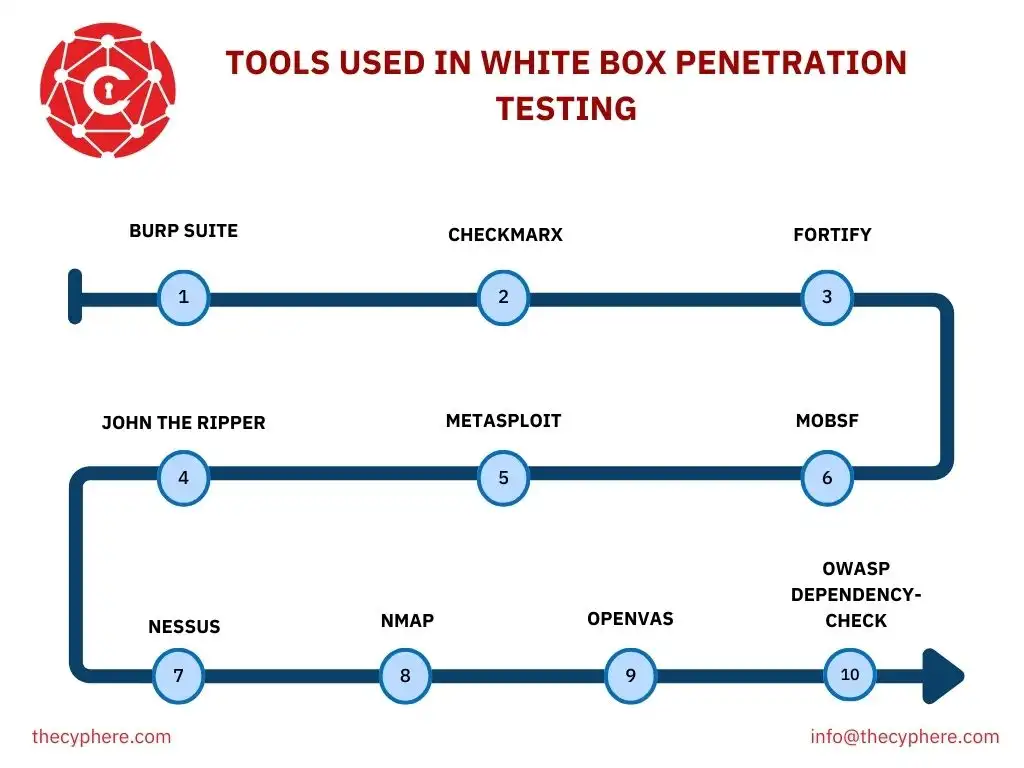
- Burp Suite: The Burp Suite tool is widely used for analysing and testing web applications by intercepting and modifying HTTP/S requests. Pen testers use Burp Suite to assess backend logic, hidden endpoints and authentication flows based on known implementation details. Burp Suite has repeater, truder and scanner functions that allow exploitation of vulnerabilities discovered during code review.
- Checkmarx: Checkmarx is a static application security testing (SAST) tool that scans source code for security vulnerabilities. Pen testers use Checkmarx to analyse the entire codebase to find insecure coding patterns, hardcoded secrets, vulnerable functions and data flow flaws. Checkmarx provide code-level insights with exact file and line numbers that help developers quickly fix issues.
- Fortify: Fortify is a Static Application Security Testing (SAST) tool that performs deep static code analysis on applications to identify vulnerabilities before deployment. Pen testers use Fortify to scan full system source code to identify injection points, authorisation flaws, insecure cryptography or misconfigured error-handling routines. Fortify is mainly used in large enterprises with complex codebases.
- John the Ripper: John the Ripper is a fast password-cracking and credential auditing tool. Pen testers already have access to internal password hashes or configuration files, so they use the John the Ripper tool to identify weak passwords, mismanaged credential systems or poor hashing algorithms. This tool efficiently exposes weak authentication practices and helps organisations strengthen password policies.
- Metasploit: Metasploit is an exploitation framework that develops, modifies and executes exploits. Pen testers use internal information such as patch levels, versions and code insights to exploit exactly target known vulnerable components.
- MobSF: MobSF or Mobile Security Framework is an automated mobile application testing framework for Android, iOS and Windows apps. MobSF analyses mobile app source code, configuration files, decompiled binaries, API calls and local storage logic. MobSF’s hybrid static-dynamic approach helps identify hardcoded secrets, flawed authentication in mobile codebases and insecure storage, which makes this tool ideal for white box mobile security testing.
- Nessus: Nessus is a vulnerability scanner that performs network, system and configuration security checks. Nessus becomes a white box tool when used with automated scans to analyse patch levels, file permissions, system configuration and privilege settings with full internal access.
- Nmap: Nmap is a network discovery and security auditing tool used to scan ports, network structures and services. White box pen testing gives access to network diagrams, service lists and internal architecture details; thus, pen testers use Nmap to target scanning of specific components based on known configurations. Nmap’s scripting engine (NSE) allows a pen tester to check service logic and configuration weaknesses.
- OpenVAS: OpenVAS (Greenbone Vulnerability Manager) is an open-source vulnerability scanning suite. OpenVAS conducts authenticated scans using internal credentials and configuration access provided during white-box assessments.
- OWASP Dependency-Check: OWASP dependency check is a software composition analysis (SCA) tool used to identify vulnerable libraries and components in codebases. Pen tester scans application dependencies to detect outdated, unpatched or high-risk third-party components within the project source. This dependency check integrates with CI/CD pipelines and maps dependencies to CVE databases, helping the team fix risks arising from third-party packages.
How much time does it take to perform white box penetration testing?
The time duration to perform white box pen testing for a small application takes 5 to 10 days, and for a medium-sized application, it takes 2 to 4 weeks. For a large and enterprise-level system, white box penetration testing takes 6 to 12 weeks. The time duration for white box penetration testing depends on the system and code complexity, manual review and classification, tester experience and automation and tool efficiency.
A longer time is taken to analyse, generate and classify tests if there is a more complex system or codebase. Large or poorly documented systems require more time to understand and coverage. More time is taken to manually review and classify generated tests to ensure they reflect correct behaviour, and additional time is needed to understand the code under test.
A less experienced tester may require more time to accurately classify and understand test cases. The use of an intelligent or automated testing platform can reduce time. For example, tools providing automated test case generation and reporting can improve efficiency by 40-60% compared to traditional methods.
According to Yunzhuang Lv et al in their research ‘A White-Box Intelligent Testing Platform for Rail Transit Equipment Software’ published on 16 May 2025, the use of an intelligent white box testing platform can increase the efficiency of unit test case design by more than 40% compared to traditional tools.
How much does it cost to perform white box penetration testing?
The cost of performing white box penetration testing ranges from £5,000 to £50,000+ per engagement in the UK. The cost of performing white box testing depends on factors such as system size, number of applications, depth of testing and required reporting detail. Larger and more complex systems require more time and resources to test thoroughly, increasing costs.
Highly skilled white box testers charge higher rates but provide effective testing and accurate defect identification. Manual review and classification of test cases are time-consuming and costly. White automation tools can reduce some costs, but significant manual effort is still required to validate test results and understand code behaviour.
When to use White Box penetration testing?
White box testing is most appropriate in cases where a pen tester is provided with complete information about the target system, including network architecture, source code, and configuration details. The scenarios where the white box testing approach is particularly valuable are listed below.
The 5 common scenarios when white box testing should be used are explained below.
When reviewing custom-developed applications: Use white box pen testing when you need to analyse source code, logic flows, and backend processes to identify insecure implementations and deep coding flaws.
- When assessing high-risk or highly sensitive systems: White box testing is ideal for the systems handling financial data, authentication processes or healthcare information because this testing allows full internal review to eliminate any hidden weaknesses.
- When verifying security after a major code change: White box testing is ideal for checking whether new updates, architectural changes or patches introduced new vulnerabilities in the internal codebase.
- When compliance standards require code-level testing: Regulations such as SOC 2, ISO 27001, and PCI DSS often recommend secure code review and thorough internal testing.
White box penetration testing is considered best among different penetration testing types, including grey box testing, black box testing and blinded approaches. White box penetration testing provides pen testers with complete access to the system’s internal structure, source code and configurations. This internal visibility enables testers to identify sophisticated vulnerabilities, reduce false positives more accurately and faster. White box testing allows thorough coverage of potential attack vectors that may be missed by black box or grey box penetration testing methods, which provide limited or no internal knowledge.
How is White Box penetration testing more efficient than Black Box penetration testing?
White Box penetration testing is more efficient than Black Box testing due to complete code coverage, faster vulnerability detection and reduced false positives.
White box pen testing provides full access to source code and system internals that allow pen testers to systematically explore more execution paths and reach deeper program logic. Methods like symbolic execution and constraint solving allow White Box fuzzers to generate targeted test cases that exercise rare or complex code branches, which black box penetration testing often misses because of random or uninformed input generation.
White Box pen testing provides complete system visibility, thus pen testers identify vulnerabilities more quickly and with higher accuracy. For example, the white box method has been shown to find critical bugs (such as MS07-017 ANI vulnerability) that were missed by extensive Black Box fuzzing and static analysis tools.
White Box testing provides transparency, which allows precise identification of actual vulnerabilities, reducing the number of false alarms compared to Black Box testing, which often depends on external behaviour and may misinterpret benign anomalies as threats.
The white box method can use knowledge of input formats when testing programs that process complex or highly structured inputs to bypass trivial errors and focus on meaningful vulnerabilities and uncover more issues in less time than Black Box fuzzers.
What companies prefer using White Box penetration testing?
The top 5 categories of companies that prefer using white box penetration testing are listed below.
- Software development companies (product-based and SaaS providers): Software development companies mainly rely on secure, high-quality code, which makes white box testing essential for identifying deep logic flaws, API vulnerabilities and insecure coding practices.
- Financial Institution (Banks, Fintech, Insurance firms): Financial systems handle sensitive transactions and store high-value customer data, so they need code-level inspection. White box testing helps financial institutions by uncovering hidden vulnerabilities in core banking systems, transaction workflows and authentication modules that black box testing might miss.
- Healthcare Organisations (Hospitals, HealthTech, EMR providers): White box testing allows security teams to verify secure data handling, access control enforcement, encryption and interoperability between systems that help meet regulations like HIPAA and protect patient data.
- Technology and Cloud infrastructure providers (IaaS, PaaS, Middleware Vendors): White box testing helps assess internal configurations, APIs, cloud orchestration and containerised services to ensure they can stand against privilege escalation, configuration drift and zero-day threats.
- Government and defence organisations: White box testing helps agencies handling national security or classified systems by enabling in-depth scrutiny of system internals, identification of vulnerabilities and secure-by-design verification that could be exploited by advanced persistent threats (APTs).
How can Cyphere help with White Box Penetration Testing?
Cyphere can help with white box penetration testing by offering a detailed, internally focused assessment that examines your systems with full visibility of source code, architecture, and configuration.
As a part of our CREST-accredited penetration testing services, our cybersecurity experts at Cyphere identified vulnerabilities that external-only testing often overlooks, such as insecure coding practices, hard-coded secrets, authentication weaknesses, flawed logic paths and misconfigurations across applications and infrastructure.
We combine automated code and application scanning with detailed manual analysis to ensure every critical component is reviewed thoroughly. Throughout the engagement,
Cyphere works collaboratively with development teams, offering clear technical explanations, risk-based prioritisation, and remediation steps for the identified issues. This approach not only identifies hidden issues early in the lifecycle but also improves the overall security posture of your environment.