Web application penetration testing is a structured approach combining information gathering, vulnerability detection through automated and manual methods, exploitation to validate impact, and reporting with detailed remediation guidance.
The main process of a web app penetration test begins with reconnaissance to gather technical and behavioural information. It then moves into scanning and vulnerability assessment through security tools and manual analysis. After this, testers attempt controlled exploitation of logic flaws and authentication weaknesses. The process concludes with post‑exploitation review, remediation guidance, and retesting.
Automation speeds up the web application pentesting process, especially in the scanning and initial discovery phases, to identify potential vulnerabilities quickly. Human intervention is still required to uncover business-logic issues, context-specific vulnerabilities, and unusual authentication flows.
Main advanced tools used in web application penetration tests include Burp Suite, OWASP ZAP, Nmap, SQLMap and lots of scripts and utilities for discovering critical vulnerabilities. The cost of web application penetration is within the range of £5,000–£20,000 for a single web-app test with a moderate complexity level. Manual web application pentesters quote £1,000–£1,500 per day.
You should choose CREST-accredited web application penetration testing service providers, as certified providers follow industry rules and compliance requirements. Businesses must select a service provider well-versed in both manual web app pen test techniques and automation if their application has complex user flows and unique business logic. This approach is highly recommended for applications handling sensitive information.
The service scope of a web app pen test must align with the client’s specific application environment, including APIs, behind-login workflows requiring user credentials, and web UIs.
What is web application Penetration testing?
Web application Penetration Testing, or web app pen test, is a controlled and ethical web application assessment during which skilled cybersecurity professionals simulate cyber attacks on a target system to identify weaknesses, misconfigurations and vulnerabilities.
A web app pen test is not the same as website penetration testing based on primary focus, objective, and vulnerabilities found.

The primary focus of a web app pen test is on the security of the application’s code, data handling, and business logic. Website penetration testing focuses on protecting the underlying infrastructure, including networks, servers, and configuration.
The objective of web application penetration testing is to find flaws in user authentication, data processing, and app functionality, whereas Website penetration testing aims to find weaknesses in server-side components and network perimeter. Web application penetration testing detects application-specific vulnerabilities like XSS and SQL injection, whereas testing web-facing infrastructure identifies server and network-related issues such as outdated software, misconfigurations, and weak passwords.
What is the history of Web Application Penetration Testing?
Web Application Penetration Testing history began with the discovery of SQL injection (a common vulnerability) by a prolific hacker and security consultant named Rain Forest Puppy (RFP) in the late 90s. At that time, dynamic websites and e-commerce platforms were growing exponentially and facing attacks from malicious attackers.
The evolution of web security testing came to the surface with a recorded mention of a web application attack (a file inclusion vulnerability via a URL parameter) on the Bugtraq mailing list in February 1996, titled “CGI Security: Escape Newlines”. This demonstrated how a malicious attacker could exploit web systems. In 1997, the first formal book related to web security was titled “Web Security, Privacy & Commerce” by Gene Spafford and Simson Garfinkel.
In the 1990s, the concept of penetration testing was not well-known yet, and the need to secure web applications was quite clear. A group of cybersecurity professionals created the Open Web Application Security Project (OWASP) in 2004 to help organisations identify potential vulnerabilities.
OWASP released a list of the top 10 vulnerabilities in web applications. Quickly, OWASP became a reference point for pentesters and developers as the lists help them identify security risks and weaknesses in the web apps. In 2004, PortSwigger created Burp Suite- a series of manual and automated testing tools for web applications for security professionals. Pentesters relied on this suite as it combines all the required tools to perform comprehensive penetration testing on applications and sites. In 2007-2008, Web application security practices shifted from theory to practice with the publication of Web Application Hacker’s Handbook (2007) and Web Security Testing Cookbook (2008).
In 2010, A web application and audit framework, W3AF, was launched as an open-source all-in-one penetration testing tool. Later, OWASP ZAP (Zed Attack Proxy) was introduced as a free and open-source platform designed for security professionals for security assessment. In 2012, a bug bounty program named HackerOne came to the surface. It is crowdsourced security testing that allows independent hackers to contribute to the overall security ecosystem.
From 2017 to 2021, web app pen test training evolved into interactive labs and cloud-based platforms like Hack The Box (2017) and TryHackMe (2018). For further information, these platforms let testers practise gaining access to target systems in controlled environments.
Web app pen test programs have been somewhat automated since 2020, making testing more cost-effective. The most popular web application tools for automated penetration testing are Burp Suite, Invicti (formerly Netsparker) and OWASP ZAP. In 2025, the latest draft version of OWASP Web Security Testing Guide (WSTG) version 5 has introduced many improvements in web application penetration testing, like broader coverage (APIs, microservices), better tools, repeatable test sets, community collaboration (open-source), and faster update cycles.
Web Application penetration testing is popular in the UK, with a market valued at approximately. £3.4 billion (USD 4.5 billion) in 2025 and projected to reach approximately. £10.6 billion (USD 14.0 billion) by 2033, according to Verified Market Reports.
How does web application penetration testing work?
A web app pen test involves planning, reconnaissance, scanning, exploiting, and reporting with various tools and techniques used at each stage. The process begins with planning that involves defining objectives, scope, compliance requirements and rules of engagement. This ensures clear boundaries are set, and legal authorisation is obtained.
Information gathering (Reconnaissance) is the next stage during which pentesters collect essential data on the target system, including techniques used, URLs, open ports and potential entry points. Web application pentesters start the third stage of vulnerability detection and analysis by using automated tools like OWASP ZAP and Metasploit. They also use manual techniques such as SQL injection, authentication flaws, and XSS to find potential vulnerabilities on the target site.
The exploitation stage is the fourth stage during which pentesters attempt to gain access by exploiting discovered vulnerabilities to evaluate real-world impacts such as privilege escalation or unauthorised data access. Web application pentesters document all the findings, such as vulnerabilities, exploitation steps, risk levels, and recommendations. Remediation and the retest are the last steps of the web app pen test.
Pentesters retest a web application after vulnerabilities are fixed to ensure all issues are addressed. For additional information, this verification step is critical to confirm the end goal of secure deployment. Web application retesting is an essential step across different penetration testing types, ensuring vulnerabilities are properly resolved before deployment.
The primary goal of a web app pen test is to identify critical vulnerabilities in web-based applications, evaluate their ability to withstand unexpected threats, and assess the risk of a system breach, according to a 2024 Study by Rohith Vallabhaneni, titled “Understanding Penetration Testing for Evaluating Vulnerabilities and Enhancing Cyber Security”.
Businesses should use web app pen test services to keep their brand trustworthy in the eyes of consumers and stakeholders. A cyberattack costs companies approximately £3.7 million per incident, as per an IBM report in 2025. Businesses can easily prevent these million-pound losses through early detection of app vulnerabilities via web app pen test services. This cost-effective approach acts as an insurance policy to save downtime, legal expenses, and money.
Regular (business as usual, BAU) web app pen test work allows businesses to meet compliance requirements and stay aligned with data protection legal standards such as PCI DSS, UK GDPR (United Kingdom General Data Protection Regulation), and ISO/IEC 27001 (Information Security Management Standard). Businesses must use web app pen test services to stay proactive and build long-term resilience against malicious attackers.
What are the examples of web application penetration testing?
Examples of web application penetration testing simply mean common types of attacks used by a web application penetration tester. Examples of web application penetration testing refer to controlled attack scenarios used to identify and validate security weaknesses and assess their impact on web application security.

Six common examples of web application penetration testing are listed below.
- SQL Injection: SQL Injection is a web security vulnerability that lets an attacker inject malicious SQL code into an application’s SQL databases with the intention to manipulate or gain control of the application database. A web application pentester uses tools like SQLMap, OWASP ZAP, or Burp suites to inject malicious SQL code into input fields (search bars, login forms to determine whether the application has user-supplied input.
- Cross-Site Scripting (XSS): Cross-Site Scripting (XSS) Testing is a web security vulnerability that lets attackers inject malicious client-side scripts into legitimate web pages/websites and execute them in users’ browsers, leading to serious security breaches. Pentesters use tools like Burp Suite and XSSER to insert JavaScript code into input fields and URLs to determine whether this script is executed in the user’s browser.
- Cross-Site Request Forgery (CSRF): Cross-Site Request Forgery is a web security vulnerability that lets attackers trick authenticated users into making unwanted HTTP requests to applications. A pentester uses tools like Postman and OWASP ZAP to send a manufactured malicious request to a logged-in user and determine whether the application validates the request’s authenticity.
- Broken Access Control: Broken access control is a security vulnerability that lets unauthorised users access restricted resources, data, and functionalities because an application fails to enforce authorisation and authentication mechanisms. A pentester uses tools like OWASP ZAP or Burp Suite to determine URL manipulation and role-based access control vulnerabilities of a web application.
- Sensitive Data Exposure: Sensitive Data Exposure Testing is a web security vulnerability that occurs when sensitive data of an application is not securely encrypted, transmitted, and guarded against unauthorised access. A pentester checks the management of encryption keys, data leak issues, and the transmission of sensitive data over HTTPS using penetration testing tools such as Wireshark or Burp Suite.
- Denial of Service (DoS): A Denial of Service is a cyber attack attempting to crash a web application by flooding it with synthetically generated traffic. A pentester simulates a traffic spike for a web application by using tools like LOIC and HOIC to evaluate its resilience and recovery against such an attack.
What are the 10 steps to perform web application penetration testing?
Web application penetration testing process includes a series of controlled, ethical steps of testing a web application to identify security vulnerabilities that an attacker could exploit.

Listed below are the 10 steps to perform web application penetration testing.
1. Define Web App Pen Test Scope and Objectives
A pentester defines scope and objectives during the web app penetration testing process by establishing the test boundaries, rules of engagement, success criteria, and legal approvals that govern the pentest.
Scope and objectives are defined by collecting asset lists (IPs, subdomains, APIs, domains), establishing test windows and throttling, and deciding test type (grey/black/white box). Pentesters also finalise legal sign-offs, communicate with stakeholders, and clarify how user credentials and sensitive information will be handled.
A clearly defined objective is important because it guides the reporting process and ensures findings are relevant, understandable, and actionable for stakeholders (i.e. developers, security teams). This supports timely remediation and improved security posture aligned with the risk appetite of the organisation.
The tools used for scope and objective definition include stakeholder interviews, a contract for rules of engagement, Google Sheets or a ticketing document, and asset inventories ( cloud hosts, DNS/subdomain lists). Pentesters get an approved and signed scope and rules of engagement document alongside a test schedule, an authorised target list during the scope and objective definition process and use them as an input for reconnaissance Intelligence.
Security professionals move toward gathering web application reconnaissance intelligence after defining the scope and objective of a web application penetration test.
2. Gather Web App Reconnaissance Intelligence
A pentester gathers public intelligence and internal information about the target system, business logic, infrastructure and technologies in use (server software, frameworks, DNS servers, databases) to build an attacker’s context and identify potential vulnerabilities.
There are two types of web application reconnaissance intelligence methods: active reconnaissance and passive reconnaissance. Active reconnaissance is the process of gathering information by directly examining web applications. Active reconnaissance techniques include port scanning, service enumeration, file brute forcing, vulnerability scanning, and API fuzzing. Passive reconnaissance is a process of gathering information available on the internet without direct interaction with web applications. Passive reconnaissance techniques include search engine/Google dorking, source HTML analysis, repo search, DNS history/passive DNS, and fingerprinting.
Reconnaissance intelligence reveals hidden assets, legacy subdomains, API endpoints, and tech stacks for the web app pen test. For further information, this phase often uncovers attack vectors that would otherwise remain hidden.
Common tools and methods used for reconnaissance intelligence are public cert transparency, Burp Spider, Shodan, Censys, GitHub search, Nmap, Amass, Subfinder, Aquatone, browser devtools, Collect site maps, and robots.txt. Reconnaissance intelligence provides security professionals and businesses with a complete reconnaissance report highlighting tech stack list, authentication mechanisms, asset inventory, exposed endpoints, and prioritised targets (high/medium/low).
A security professional uses reconnaissance intelligence to create attack surface topology.
3. Map Application Attack Surface Topology
Pentesters utilise reconnaissance reports’ data to create a visual and logical map (attack surface topology) highlighting trust boundaries, data flows, and all vulnerable entry points.
Web application attack surface topology is created by listing all endpoints (web pages, third-party integrations, APIs, and services), mapping user flows (password, login, payments, admin, tasks), adding data flow with clear marketing of trust boundaries, and sensitive assets.
Mapping web app attack surface topology reveals all potential entry points, data flows, and interconnected components. This allows testers to uncover critical vulnerabilities that may be missed with a less structured approach, according to a 2024 study by Santanam Kasturi, titled “Prioritisation of Application Security Vulnerability Remediation Using Metrics, Correlation Analysis, and Threat Model”.
Tools and methods used for thread modelling include manual modelling (Diagrams.net/Visio), automated crawling (Burp spider, OWASP ZAP), API mapping (Postman/Swagger/OpenAPI), and code-review artefacts if white-box. Threat modelling provides a pentester with a complete attack surface diagram alongside a prioritised attack surface register and a list of high-risk flows for manual focus.
Complete attack-surface topology is an input for systematically testing each endpoint and data flow against OWASP vulnerability patterns.
4. Identify OWASP Vulnerability Patterns Systematically
A pentester tests web applications against OWASP’s Top 10 vulnerabilities (cross-site scripting, SQL injection, and insecure authentication) to identify common, high-impact flaws and refine the attack surface topology before further testing.
The OWASP vulnerability patterns are determined by using a checklist based on the OWASP Top 10 for each endpoint and user/data flow, as well as common tests for injection, access control, XSS, CSRF, and misconfigurations. Identification of web app vulnerabilities through OWASP Top 10 helps pentesters prioritise high-risk classes that cause serious security breaches. Testing against OWASP top 10 defensible coverage and repeatable results.
Tools used for OWASP Vulnerability Patterns identification include OWASP Web Security Testing Guide (WSTG) checklist, automated templates (Nuclei templates), Burp Suite manual checks (Intruder/Repeater), manual logic tests for access control (IDOR/Insecure Direct Object Reference, Client-side role/flag manipulation), fuzzers (FFuf, wfuzz) and custom payload lists (FuzzDB, SecLists). Pentesters get an OWASP-mapped vulnerability register highlighting confirmed issues based on category, affected endpoints, proof steps, and severity.
Web app pen testers move forward with automated penetration scans across the same endpoints confirmed by OWASP vulnerability patterns.
5. Perform Automated Scanning
A pentester uses automated web application penetration testing tools (Burp Suite, OWASP ZAP, or Acunetix) to scan a web application and identify vulnerabilities that may be opportunities for exploitation.
By using automated scanning tools, we are not conducting an automated web app pen test. Automated scanning is part of the vulnerability analysis phase to identify areas that could be further investigated for exploitation or report issues to the customer.
Automated web application penetration testing with multiple vulnerability scanners improves detection rates and overall security by combining results from multiple scanners into a consolidated vulnerability report, according to a 2023 study by Khaled Abdulghaffar, titled “Enhancing Web Application Security through Automated Penetration Testing with Multiple Vulnerability Scanners”.
Tools and methods used for this phase include dependency checkers (OWASP Dependency-Check, Snyk), Nuclei, Burp Scanner, SAST tools, Nessus, and Nikto. Automated security scanning assessments provide a consolidated automated scan report alongside a complete list of filtered false-positive and input evidence.
Evidence from automated scan reports is used to execute manual web application penetration testing techniques.
6. Execute Manual Penetration Testing Techniques
Pentesters execute manual penetration testing techniques (parameter manipulation, business logic testing, brute-force attacks) to validate complex, context-sensitive vulnerabilities. This helps customers (organisations asking for web app pen test) to identify the extent of exploitation for the identified vulnerabilities, meaning how far a threat actor can go in case a vulnerability is identified.
Manual web app penetration involves analysis of the target system, targeting OWASP top 10 vulnerabilities (injection flaws, broken authentications) by analysing application logic, business processes, and user roles requiring user credentials for deeper investigation.
Manual web app penetration testing matters because pentesters achieve accuracy in vulnerability detection, which helps decrease the attack surface of an application, according to a 2013 study titled “Detecting Vulnerabilities in Web Applications Using Automated Black Box and Manual Penetration Testing”.
Tools used for manual web application penetration testing include SQLmap, Postman, Browser devtools, Burp Suite (Repeater/Intruder/Extender modules), proxy logs, and manual code review. Pentesters get a prioritised list of confirmed issues for exploitation, validated proof-of-concept (PoC) steps, reproducible exploit scripts or sequences, and request/response captures from manual penetration testing.
Security professionals now move toward the exploitation of web application vulnerabilities discovered through manual and automated penetration testing.
7. Exploit Discovered Web Application Vulnerabilities
Pentesters attempt controlled exploitation of discovered vulnerabilities to determine impact and scope while following the rules of engagement.
Web application vulnerabilities are exploited by selecting high-priority weaknesses and establishing access, privilege escalation, and data exposure. Multiple flaws (SQLi, RCE, data exfiltration) are chained based on relevancy after establishing access and exploitation stops when business impact is proven to prevent downtime and data loss. The exploitation of discovered web application vulnerabilities demonstrates the real-world business impact of a security flaw.
Tools used for web app vulnerability exploitation include SQL ( SQL injection proof), Burp Suite (payload delivery), Metasploit, and reverse shells in lab environments. Pentesters get screenshots, affected asset list, impact statement (data exposure, privilege exposure, artefacts demonstrating exploit chain, and logged command output.
Security professionals continue with post-exploitation after getting access to endpoints for enumerating possible pivots and privilege escalation.
8. Assess Post-Exploitation Lateral Movement Potential
Pentesters begin the post-exploitation phase by leveraging successful compromise to perform actions like moving laterally to other systems, escalating privileges, accessing additional sensitive systems, and using persistence mechanisms.
Post exploitation involves analysing credentials, internal endpoints, misconfigured IAM roles, and cloud metadata services. Security professionals pivot in scoped testing environments, like abuse of SSO tokens and API abuse, to reach internal services. Post-exploitation demonstrates systemic risk; a single web application weakness enables broad risks across cloud resources, Continuous Integration and Continuous Delivery(CI/CD), and data stores.
Tools used for post-exploitation include cloud tools (AWS CLI with scoped creds), Bloodhound (for AD environments), token analysis, and API explorers (Postman, Swagger UI). Pentesters get a lateral movement map, privilege escalation paths, a list of additional at-risk assessments, post-exploit blast radius estimation, and recommendation priorities.
Security professionals consolidate all confirmed issues and evidence into a formal report for developers and stakeholders, after mapping lateral risks with security finding documentation, after getting the required evidence, screenshots, and Proof of Concept (PoC).
9. Document Security Findings with Evidence
Pentesters produce clear, comprehensive, and reproducible documentation of each confirmed vulnerability alongside its impact, supporting evidence, and reproducible steps for the cybersecurity team, developers, and stakeholders.
Security professionals organise findings in a vulnerability register, add title and severity of discovered vulnerability, affected assets, PoC artefacts (logs, screenshots, exploit code), detailed reproduction steps (requests, responses), risk level, recommendation strategies alongside an executive summary. Documentation of security findings matters because developers reproduce and fix vulnerabilities, stakeholders understand the business impact of web app security issues, and the report serves as an audit trail for governance and compliance.
Tools used for security finding documentation include issue trackers (GitHub, Jira), report generators (Nessus, Burp exports), evidence captures (PCAP, logs), and reporting templates (Word/PDF). Security professionals produce an actionable security report including an executive summary for leadership, a prioritised remediation list, a comprehensive vulnerability register, and a full technical appendix.
Pentesters continue with remediation reports after documentation of security findings.
10. Deliver Remediation Recommendations Report
Pentesters provide an actionable and comprehensive remote with practical remediation plans consisting of verification steps, timelines, mitigation, and vulnerability fixes.
Security professionals turn technical findings into developer-friendly remediation steps (configuration update, patching, code fixes), verification tests (penetration testing, vulnerability scans), and compensating controls (rate limits, Web Application Firewall/ WAF rules, Multi-factor Authentication/MFA). Remediation recommendation report matters because it provides the security team with actionable remediation plans and verifiable tests to prevent and reduce exposure quickly. This report provides a complete roadmap combining short-term mitigations with permanent fixes.
Tools used for the report include code snippets, CI/CD scan integration for verification remediation templates, Jira/GitHub issue creation with reproduction steps, configuration diffs, and test cases for QA (Quality Assurance). Security professionals provide a report highlighting a verification checklist, a recommended retesting plan, assigned tickets, and a prioritised remediation roadmap to stakeholders and developers.
This effective report lets organisations take necessary actions to improve the overall security posture of a web application.
Is the web application Penetration testing process manual or automated?
The web application penetration testing process is usually a hybrid approach where both manual and automated methods are used, according to the 2025 study by Fawaz A. Mereani, titled “Evaluating the Efficacy of Automated Penetration Testing Tools in Identifying Vulnerabilities in Modern Web Applications”.
Manual web app penetration testing is a human-driven approach and relies on ethical security hackers who simulate real-world attacks through advanced techniques. Ethical security hackers analyse logic workflow and integration of a web application to unwrap vulnerabilities such as complex chained issues, business logic flaws, real-world exploitation paths, and authentication bypasses.
Automated penetration testing utilises software frameworks (OWASP Top 10, NIST Cybersecurity Framework, ISO/IEC 27001) and security scanning tools (OWASP ZAP, Burp Suite, Nessus) to uncover common vulnerabilities and misconfigurations ( listed in OWASP Top 10 Standards) of web applications, APIs, and servers without human intervention. Automated tools detect vulnerabilities such as SQL injection, Outdated libraries, Weak passwords, misconfigured headers, and session flaws.
Automated web application penetration testing is important for every business as it provides continuous security monitoring alongside instant identification of vulnerabilities at a lower cost than manual web application penetration testing. Businesses deploy code changes and new integrations regularly, running 24/7 automation with tools to ensure consistent checks across releases and updates to identify and mitigate risks without delay.
What are some online platforms for web application penetration testing?
Web application penetration platforms are cloud-based services and online tools used to uncover, mitigate, and analyse vulnerabilities in web applications, APIs, and servers.
Listed below are some online platforms for web application penetration testing.
OWASP ZAP
Metasploit
Acunetix
BurpSuite
SQLmap
PEntest-tools
Hack The Box
What tools are used for web application Penetration testing?
Web application penetration testing tools are specialised applications used by business and ethical security hackers to simulate real-world cyber attacks on web applications to uncover misconfigurations, security loopholes, and issues.
Listed below are 10 tools used for web application penetration testing.
- Burp Suite: Burp Suite is an integrated web-security testing platform used in penetration testing to detect vulnerabilities such as Server-Side Request Forgery (SSRF) and Cross-Site Request Forgery (CSRF). Distinctive features of Burp Suite included Intruder, Repeater, Extensibility, Scanner and Intercepting proxy. Different kinds of testing provided by Burp Suite include XSS/SQLi scanning, Fuzzing, parameter tampering, session testing, and business-logic testing. Use professional mode to unlock deep scans, chain repeater/intruder for exploit chaining, and passive reconnaissance (Nmap), to get the most out of Burpsuit.
- OWASP ZAP: OWASP ZAP is a free and open source tool used in web application penetration testing to scan web applications and identify vulnerabilities like Cross-Site Scripting XSS, Broken authentication, and Insecure Direct Object Reference (IDOR). Software developers and security experts use OWASP Zap to intercept, display, modify and forward web requests between browsers and web apps. Distinctive features of OWASP ZAP include Active &Passive scans, desktop or API scans, and REST API. Different kinds of tests performed by OWASP ZAP include discovery, session/cookie testing, scripted custom tests, and automated OWASP Top 10 checks. Users run ZAP in Docker for continuous scanning and write a ZAP script for app-specific flows to get the most out of OWASP ZAP.
- Nmap: Nmap is a free and open source network/host discovery and port scanner used in web application penetration testing for network and service checks. Nmap is mainly used during the Reconnaissance step as it helps security experts to identify open HTTP/HTTPS ports, live hosts and web services and versions. Experts run NSE HTTP scripts to collect information about simple network vulnerabilities and web server info. Distinctive features of Nmap are Port/service detection and the Nmap Scripting Engine (NSE) with HTTP/SSL scripts. Different types of penetration testing performed by Nmap include detection of exposed management interfaces, basic info on SSL/TLS and server versions. Users combine results and reports with web scanners, document exposed endpoints for more detailed web application testing later, to get the most out of Nmap.
- SQLMap: SQLMap is an automated tool used in web application penetration testing to detect and exploit SQL injection flaws while taking over database servers. SQLMap is used to test input parameters and endpoints for SQLi, to enumerate the Database structure, and to extract sample data as PoC, finally. Distinctive features of SQLmap include DB fingerprinting, tamper scripts for WAF evasion, multiple SQLi techniques, and support for various DB engines. Different types of penetration testing performed by SQLmap include Automated SQL injection discovery and exploitation, WAF evasion testing for SQLi and parameter testing. Users run with correct session tokens, limit destructive payloads in production, and confirm finding manuals before preparing any report, to get the most out of SQLmap.
- Metasploit: Metasploit is a free and open source modular exploitation framework used in web application penetration testing to develop and un-exploit, validate vulnerabilities (Command Injection, Buffer overflow, and Remote Code Execution/RCE) and explain post-exploit impact. Metasploit is used to validate and exploit server-side issues discovered during remote code execution in a web app server, to showcase business impact in a controlled test environment, and to run auxiliary modules for web service enumeration. Distinctive features of Metasploit include post-exploit tools, scanner integration, payloads, exploit modules, and auxiliary scanners. Different types of penetration testing performed by Metasploit are payload delivery after discovery, post-exploit action chain, and vulnerable web servers and components. Security experts use the Metasploit framework only with proper authorisation in a controlled lab environment, document the impact to justify remediation, and prefer safe payloads in production to get the most out of Metasploit.
- Nikto: Nikto is a free and open source web server scanner used in web application penetration testing to check outdated software, basic server configurations, and dangerous files and scripts. Nikito is used to identify and address web application issues such as obsolete server versions, unsafe server options, directory indexing, dangerous CGI (Common Gateway Interface)scripts, and default files. The distinctive features of Nikto include large signature databases for known issues, plugin checks, a basic level of SSL/TLS tests, default/backup file checks, and header checks. Different types of web application penetration testing performed by Nikto include server misconfigurations, leftover files, and basic SSL/TLS-related tests. Users utilise Nikto during the initial reconnaissance step and then combine the results with Nmap enumeration to get the most out of Nikto.
- Gobuster: Gobuster is a fast, reliable, and easy-to-run CLI directory file and DNS brute-forcing GO programming language tool used in web application penetration testing for identifying hidden endpoints through wordlists. Gobuster is used for the discovery of virtual hostnames, brute-force directories or files that are kept hidden in the API endpoints, and backup files. Distinctive features of Gobuster include instant concurrent requests, custom extensions, resume, and compatibility with large wordlists. Different types of web app penetration testing performed by Gobuster include the discovery of unlinked endpoints such as admin, staging, and backups, and identification of virtual hosts or subdomains. Users input curated wordlists, combine status codes with response length filters to reduce noise, and feed discovered endpoints to ZAP and Burp, to get the most out of Gobuster.
- Nuclei: Nuclei is an open-source, high-performing vulnerability scanning engine used in web application penetration tests to identify vulnerabilities (SQL Injection, XSS), exposed services, and misconfigurations. Nuclei is used to run simple YAML-based custom templates to detect specific issues such as SQL Injection, broken sessions, and broken access control at scale. Nuclei is used to run targeted templates to discover common misconfigurations and vulnerabilities. Distinctive features of Nuclei include a community-maintained template library and CI/CD integration support. Different types of web app penetration testing performed by Nuclei include testing for insecure headliners, known plugin issues, SSRF/RCS checks, and default logins. A pentester writes a custom template to check specific logic to get the most out of Nuclei. Nuclei has a free and open source license.
- Wireshark: Wireshark is a GUI network protocol analyser used in web application penetration testing for capturing and inspecting packets at the network layer, like Ethernet, IP, TCP, and HTTP. Wireshark is used to perform analysis on insecure plaintext traffic, to inspect TCP behaviour, to verify session tokens and cookies, and to troubleshoot requests or responses by capturing HTTP/HTTPS traffic. Distinctive features of Wireshark include deep packet inspection, expert analysis, TLS description support, solid display and capture filters, and statistical views. Different types of web app penetration testing performed by Wireshark include identification of network-level issues like weak ciphers at the packet level, and detection of plaintext-sensitive data in transit. Users utilise server keys and TLS session key logs to decrypt traffic for HTTPS, to get the most out of Wireshark.
- Hydra: Hydra is a fast, multi-protocol login brute-force tool used in web application penetration testing for authentication strength tests against various web forms and services. Hydra is used to perform basic/digest authentication, password-guessing attacks against HTTP forms, and other protocols like FTP, SMB, and SSH to identify default accounts, weak credentials, and rate-limiting protections. Distinctive features of Hydra include parallelised attempts for speed, support for different protocols such as HTTP-proxy, FTP, SSH, and HTTP-form. Web application tests performed by Hydra include identification of default or weak credentials on the admin interface, validation of MFA presence and account lookout, and detection of credential stuffing. Users utilise rate-limiting and throttling, analyse results for enforcement of password policies, and get the most out of Hydra.
What is the cost of a web application penetration test?
The cost of a web application penetration test is between £2,000 and £50,000+, depending on project size and complexity. The minimum cost of a web application penetration test for a small and low complexity application is £2,000 – £3,500. The average cost of a web application penetration test for a single small to medium-scale application is £5,000 – £12,000. The maximum cost of a web application penetration test for a large enterprise, APIs, and multiple roles is £20,000 – £50,000+.
The hourly cost of an ad-hoc web app penetration testing or retesting service provider is £125–£375 per hour. The daily cost of a web app penetration testing service provider is £1,000 – £1,500.
The starting salary of a junior penetration tester is between £25,000 and £40,000. The salary of an experienced penetration tester is between £40,000 and £65,000. The salary of a senior and team leader is between £60,000 and £80,000+.
Factors affecting the cost of web application penetrating include scope and size like number of endpoints, APIs, pages and users roles; complexity of a web application like single-page apps, custom business logic and third-party integration; test type and type like automated scan or deep manual scan; compliance or accreditation requirement like ISO, PCI, and UK GDPR; deliverables and retesting like remediation guidance, detailed insight, and retest days; and vendor reputation like fresh consultants with a few years of experience, and well-recognized organization. According to the 2019 study by A. Al-Ahmad et al, titled “Systematic Literature Review on Penetration Testing for Mobile Cloud Computing Applications”, manual testing by high-expertise external testers is generally more expensive than automated or internal testing due to the depth and skill involved.
The best ROI for hiring to perform web application penetration comes from preventing the cost of a breach. A single data breach costs over £3.29 million in recovery, fines, and lost trust, while on average, a professional pentester costs £5,000–£15,000. Investment in hiring an expert (£5,000–£15,000) provides a return by reducing exposure risk, preventing business downtime, ensuring compliance, and saving the money (over £3.29 million) that the business otherwise spends during a breach. One prevented breach provides 300% to 700% ROI or more.
Who can provide you with web application penetration testing services?
Specialist cybersecurity firms, in-house security teams, managed security service providers MSSPS, freelance pentesters, independent cybersecurity consultants, and bug bounty/crowdsourced platforms can provide you with web application penetration testing services.
Professional web application penetration testing service contains application scope& rules of engagement, Reconnaissance & attack surface discovery, business-logic and authenticated testing, source-code review, exploit proofs-of-concept, retests or verifications, API/Mobile-backed testing, and a full technical report. Web application penetration testing benefits your business by reducing financial risks and breach costs, protecting customer trust, ensuring regulatory and contractual compliance, lowering insurance premiums, speeding up safe product delivery, and prioritising engineering efforts.
Cyphere is a UK-based cybersecurity company that provides web application penetration testing services. Cyphere runs CREST-accredited web application penetration tests, including API reviews, manual exploitation, and automated scanning, while offering actionable remediation guidance and retesting services.
What are the benefits of web application penetration testing?
Below are the 7 benefits of web application penetration testing.
- Identify Vulnerability: Web application penetration testing identifies vulnerabilities through manual and automated scans, so malicious actors don’t exploit these vulnerabilities for their financial and personal gain.
- Helps reduce data breach risk: Web application penetration testing reduces risk of data breach by finding vulnerabilities that lead to significant financial and reputation damage, if exploited by cybersecurity criminals, according to a 2023 study by R. Al-Khannak et al., titled “Penetration Testing for the Cloud-Based Web Application.
- Maintain regulatory compliance: Web application penetration testing maintains regulatory compliance by performing consistent and regular tests on web applications, according to a 2023 study by Vippalapalli Vikas et al., titled “Web Security Audit and Penetration Testing: Identifying Vulnerabilities and Strengthening Website Security”.
- Improve security posture: Web application penetration testing improves the security of a web application by letting organisations understand security loopholes and implement better security policies.
- Protect brand reputation: Web application penetration testing protects brand reputation by preventing cybersecurity incidents and offering customers a web application they can trust.
- Strengthens In-House Teams: Web application penetration testing strengthens in-house teams by providing actionable insights that developers and IT staff use to understand, prevent, contain and respond to real-world exploit methods.
- Delivers Measurable ROI: Web application penetration testing delivers measurable ROI (Return on Investment) by reducing vulnerabilities, enhancing incident response, improving client retention and building customer trust.
What are the web application penetration testing best practices to follow?
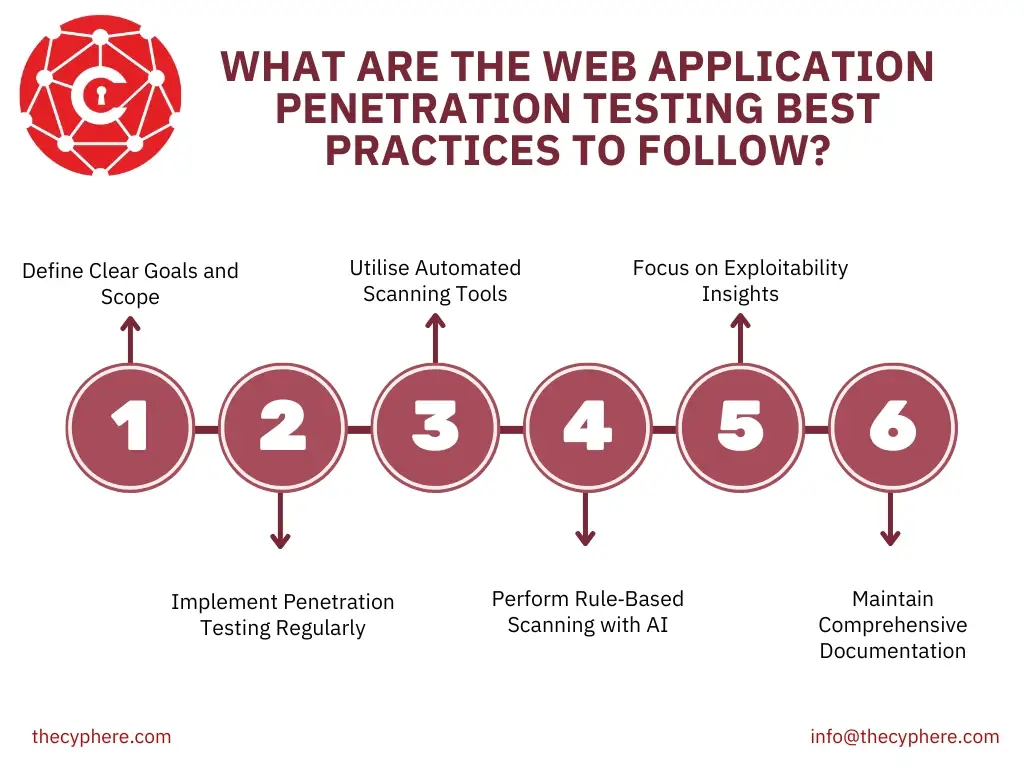
The 6 best practices for effective penetration testing are listed below.
- Define Clear Goals and Scope: Define clear goals and scope for the web application penetration testing process by identifying in‑scope applications, business‑critical functions, authentication flows, and data‑handling components. This ensures that testing efforts, resources, and time are directed toward the areas that present the highest security risk.
- Implement Penetration Testing Regularly: Implement web application penetration testing on a regular schedule, as one‑off or infrequent testing fails to capture newly introduced vulnerabilities. Continuous development, infrastructure changes, and third‑party integrations require frequent assessments to maintain ongoing application security.
- Utilise Automated Scanning Tools: Utilise automated scanning tools to identify exposure points, detect common web vulnerabilities, and analyse code dependencies, API behaviour, and configuration weaknesses. These tools help reduce false positives, improve test coverage, and provide a reliable baseline before deeper manual testing begins.
- Perform Rule‑Based Scanning with AI: Perform rule‑based scanning using AI‑integrated testing tools that mimic human-like decision‑making when analysing web traffic, business logic, and unusual patterns in application behaviour. This enhances detection accuracy and reveals complex vulnerabilities that traditional scanners or manual testing may not uncover.
- Focus on Exploitability Insights: Focus on exploitability insights by evaluating each vulnerability in terms of real‑world attack vectors, application context, and potential business impact. This helps prioritise remediation efforts, address the most critical weaknesses first, and minimise wasted effort caused by lower‑risk or false‑positive findings.
- Maintain Comprehensive Documentation: Maintain detailed documentation of every step in the web application penetration testing process, including tools used, test cases executed, deviations from the original scope, and confirmed findings. Proper documentation supports regulatory compliance, enhances future testing accuracy, and provides a structured record for remediation and audit reviews.
What are the best books to learn web application penetration testing?
The top 10 best books to learn web application penetration testing are listed below.
- The Penetration Tester’s Guide to Web App Security by Ryan Burnham: The Penetration Tester’s Guide is a go-to book for professionals and beginners, as it creates a perfect balance between theory and practice while making complex vulnerabilities easy to understand and test.
- Real-World Bug Hunting: A Field Guide to Web Hacking by Peter Yaworsk: Real-world bug hunting is a great resource because it unlocks real-world bug bounty case studies with comprehensive lessons on web app exploitation. According to a user, real-world bug hunting provides a great introduction and learning of web hacking to anyone who has some experience in web development.
- Practical Web Penetration Testing by Daniel P. Jones: Practical Web Penetration Testing is an in-depth manual because it uncovers real-world labs and modern attack simulations while explaining penetration testing techniques step-by-step.
- Gray Hat Hacking: The Ethical Hacker’s Handbook by Daniel Kurtz: Gray Hat Hacking is the best book because it is a complete knowledge panel for ethical hacking resources, while providing detailed info about both offensive and defensive hacking strategies. According to a user, Gray Hat Hacking offers excellent reference for a variety of offensive security topics.
- Black Hat Python- Python Programming for Hackers and Pentesters by Justin Seitz: Black Hat Python is a must-read book because it turns complex Python knowledge into practical hacking tools and payloads, allowing coders to weaponise Python ethically. According to a user, Black Hat Python is not for beginners and requires a lot of background knowledge and is certainly the best resource to learn every row of code.
- Penetration Testing with Python: A Practical Guide by Dinesh S. Shenai: Penetration Testing with Python is a practical handbook because it perfectly blends coding with cyber defence methods while letting pentesters build their own tools through real-world scripting.
- The Tangled Web (A Guide to Securing Modern Web Applications by Michal Zalewski): The Tangled Web: A Guide to Securing Modern Web Applications is the most insightful book because it explains why vulnerabilities exist in the first place instead of giving practical knowledge about their exploitation. According to a user, The Tangled Web is a useful defensive book, and quite actionable.
- The Web Application Hacker’s Handbook: Finding and Exploiting Security Flaws by Dafydd Stuttard and Marcus Pinto: The Web Application Hacker’s Handbook is known as the “bible” for security of web applications, as it provides a systematic methodology and detailed info about exploitation techniques and vulnerability classes regardless of experience level. According to a user, half of the exploits listed in this handbook are unknown even for a professional software engineer.
- The Web Application Security Handbook: Finding and Exploiting Security Flaws by Matthew Rice: The Web Application Security Handbook is an authoritative reference because it unlocks practical, penetrating testing workflow and defensive coding techniques for modern developers.
- Professional Pen Testing for Web Applications by Andres Andreu: Professional Pen Testing for Web Applications is a top-rated book because readers learn surveillance techniques of attackers, issues found in the modern-day web app, web services auditing tutorial and detailed result analysis. According to a user, Professional Pen Testing for Web Applications is the most comprehensive guide to date, as it provides in-depth and practical security knowledge.
What is the difference between web application penetration testing and ethical hacking?
The difference between web application penetration testing and ethical hacking lies in their scopes and outcomes. Web application penetration testing is defined as a focused type of penetration testing that targets the vulnerabilities of a single web application, while ethical hacking is defined as a broader practice and comprehensive security evaluation of networks, systems and applications.
The scope of web app penetration testing is specifically on web applications, while the ethical hacking scope is wider and broader, including apps, systems and networks, according to a 2023 study by Ms Pooja et al., titled “Ethical Hacking and Penetration Testing: Securing Digital Assets and Networks. The outcome of web application penetration testing is a detailed report on vulnerabilities of a web app and their potential impact, while the result of ethical hacking is a comprehensive report on the overall security posture.