Penetration Testing, or ethical hacking, is a high-demand, high-paying, and growth-opportunity career. Penetration Testing is a hard-to-learn yet satisfying profession that demands patience for lifelong learning and the acquisition of practical skills.
To become a penetration tester or ethical hacker, develop the basics of IT, study offensive security (OWASP, Nmap/Burp Suite), and gain certifications (OSCP, CEH, and CRTE). Practice your skills in real-life scenarios through CTFs and learn networking, including OSes (Linux/Windows). Practical experience gained through laboratories and simulated environments is critical for developing the skills necessary to become a penetration tester. Learn standard security tools, such as Nmap, Burp Suite, and Metasploit, to understand how attacks operate. Seek more advanced topics, including web, mobile, and cloud security, and develop practical skills in the process of labs and CTFs. To become a penetration tester, individuals should build IT fundamentals, learn networking and programming (Python), gain hands-on experience with tools like Metasploit and Wireshark, and earn key certifications such as OSCP and CEH.
The average base pay of a penetration tester in the UK ranges from £49,000 to £90,000 yearly. The salary of a penetration tester with five years of experience ranges from £55,000 to £60,000 yearly. A penetration tester with a higher level of experience and skills will have a £90,000 salary per year in 2026. The average annual salary of penetration testers is approximately $100,708, according to Payscale.
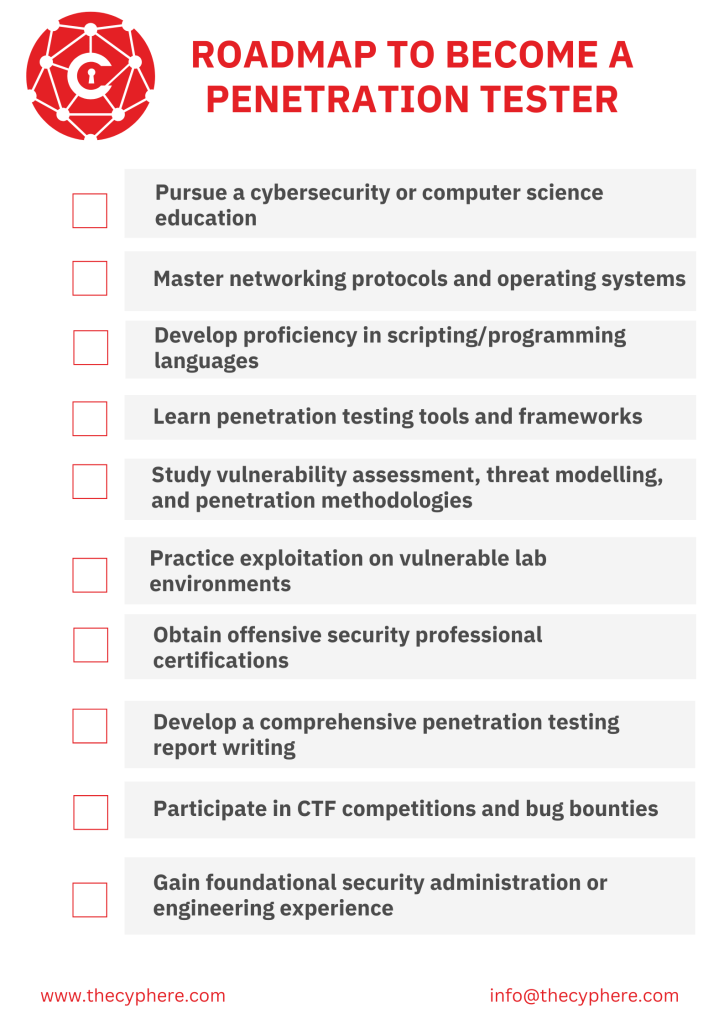
1. Pursue a cybersecurity or computer science education
Computer science or cybersecurity education provides knowledge of IT work (system or network administrator), bug bounty winnings, or capture the flag (CTF) competition scores. Cybersecurity and computer education help an ethical hacker to deal with operating systems, programming, networking, and exploit vulnerabilities (mobile apps, web, hardware, and cryptographic) in the system. Many penetration testers start out in more entry-level IT and cybersecurity roles before advancing into pen testing.
It is possible to achieve the role of a penetration tester without a formal degree. A bachelor’s degree in computer science or cybersecurity provides background information on pen testing, as described by Anatoli Kovalev et al, titled “Skill-Driven Certification Pathways: Measuring Industry Training Impact on Graduate Employability”, published in 2025.
2. Master networking protocols and operating systems
Networking protocols (TCP, HTTP, and SMTP) and operating systems (Linux and Windows) help to deal with cyberattacks on the communication and operation of the systems. Networking protocols (TCP and IP Suite) are used to manage web traffic, email, and remote access in system applications. It is crucial to understand firewalls, routers, switches, VPNs, and Wi-Fi security because most of the vulnerabilities are due to poor configuration. The Linux operating system is necessary to learn because hacking tools and servers use Linux to hack into the system. The simplest understanding of macOS, Android, and iOS increases your possibilities of testing applications and mobile platforms. Knowledge of networking protocols and operating systems facilitates easier identification of vulnerabilities and effective and precise penetration testing, as described by V. Kozel et al, titled “RESEARCH OF PENETRATION TESTING METHODS”, published in 2024·
3. Develop proficiency in scripting/programming languages
Proficiency in scripting and programming helps to deal with real-world attacks that need tailored automation, exploit alteration, and data examination. The pentester or an ethical hacker has to learn the programming language Python for automating scans and scripting languages like Bash for Linux systems, and PowerShell for exploiting Windows systems and Active Directory. Studying JavaScript assists in testing web applications, including XSS, CSRF, and API vulnerability testing. The use of HTML and SQL is significant in assisting web exploitation. Advanced knowledge of C or C++ is helpful in the analysis of binaries and binary overflow exploits. Penetration testing also requires exceptional problem-solving skills, a dogged determination to uncover weaknesses in computer systems, dedication to detail, and a desire to remain continually educated on the latest trends in the field.
Learning scripting and programming languages provides penetration testers or ethical hackers with the flexibility to develop custom tools, the ability to learn how applications operate, and the ability to identify more in-depth security defects, as stated by Ruksit Rojpaisarnkit et al, titled “Towards Identifying Code Proficiency Through the Analysis of Python Textbooks”, published in 2024.
4. Learn penetration testing tools and frameworks
Penetration testing tools (Burp Suite and Nmap) and frameworks ( Hydra and Medusa) help the penetration tester or ethical hacker to gain practical experience in finding system vulnerabilities and coping with cyber attacks.
The penetration testing tools like Nmap are used to scan the network and detect available services; Wireshark is used to analyse the flow of data over a network; and Burp Suite is required for testing web applications. The Metasploit Framework helps to find vulnerabilities, execute exploits, and develop payloads. Hydra and Medusa frameworks are used in password-cracking and brute-force testing, and John the Ripper is used in complex password and hash cracking. In wireless penetration testing, Aircrack-ng, Kismet, and OpenVAS penetration testing tools are used to scan for vulnerabilities (cracked WPA and weak Wi-Fi encryption). Learning the use of penetration testing tools and frameworks enables the pentester to perform professional-level penetration testing, as described by Helmi et al, titled “A Review of Penetration Testing Frameworks, Tools, and Application Areas”, published in 2023.
5. Study vulnerability assessment, threat modelling, and penetration methodologies
Studying vulnerability assessment, threat modelling, and penetration testing methodologies provides the knowledge of identifying, analysing, and exploiting web security system vulnerabilities. Vulnerability assessment teaches you to scan systems, examine dangers, and rank security defects with the help of Nessus, OpenVAS, and Nmap. Threat modelling enables you to learn attacker thinking by diagramming assets, potential entry points, and actual attack paths. Penetration testing methodologies like OWASP Testing Guide, PTES, and NIST help in step-by-step reconnaissance, exploitation, post-exploitation, and reporting methodologies. Studying vulnerability assessment, threat modelling, and penetration testing standards and methodologies is a key factor in internationally accepted standards of penetration testing, as described by V. Kozel et al, in the title “RESEARCH OF PENETRATION TESTING METHODS” published in 2024·
6. Practice exploitation on vulnerable lab environments
Practice exploitation in a vulnerable lab environment to build real-world penetration testing skills to become an ethical hacker. Hack The Box, Metasploitable, OWASP, and VulnHub have platforms with vulnerable machines on which testers practice scanning, web hacking, and exploit development. These platforms assist testers in practising the use of Nmap, Burp Suite, and Metasploit on a vulnerable website for penetration testing. Through daily practical experience, pentesters learn how systems break, how vulnerabilities act, and how attackers navigate within networks, as described by Jun-Ming Su in the title “WebHOLE: Developing a web-based hands-on learning environment to assist beginners in learning web application security”, published in 2023.
7. Obtain offensive security professional certifications
Obtain offensive security professional certificates (OSCP, C, EH, and CRTE) to become a professional pentester or a certified ethical hacker, because certification is proof of your skills. The CEH (Certified Ethical Hacker) penetration testing certificate covers basic knowledge of hacking tools. The eJPT (eLearnSecurity Junior Penetration Tester) penetration testing certificate is for practical hands-on skills. The OSCP (Offensive Security Certified Professional) penetration testing certificate is for coping with real-world challenges in exploit and penetration testing. The CREST, GIAC Penetration Tester (GPEN), and CISSP penetration certificates are required for authentication in mobile penetration testing. Obtaining these ethical hacking certifications also reflects a level of technical capability as well as opens more job prospects, career development, and employer and customer trust.
8. Develop a comprehensive penetration testing report writing
Develop a comprehensive penetration testing report to analyse the security weaknesses in the system and how to address them. A quality penetration testing report clearly outlines every vulnerability and the tools and techniques used to explore the vulnerability. Penetration testing reports also describe the magnitude of the risk posed by the vulnerability and step-by-step instructions for remediation. Penetration testing reports must have screenshots, evidence, and POCs in simple and professional language comprehensible to both technical and non-technical managers. Use formal structures and make sure that your results are structured, correct, and practical. Learning to write a penetration testing report not only makes your communication better but also increases your credibility.
9. Participate in CTF competitions and bug bounties
Participation in CTF competitions (Capture the Flag) and bug bounty programs improves penetration testing skills through demonstrations and presentations on penetration testing. Participation in CTF competitions provides a real-world application of testers’ skills and knowledge to practice. CTFs are an opportunity to train web exploitation, cryptography, reverse engineering, digital forensics, privilege escalation, and network attacks in a real-world, gamified setting. Hack-the-box, TryHackMe, PicoC, TF, and CyberTalents contribute to testers’ problem-solving skills. On sites like HackerOne, Bugcrowd, and Synack, Bug bounty programs allow testers to discover real vulnerabilities in an operational app and get rewarded or recognised for legitimate reports. These activities instil confidence and develop testers’ technical depth. Participating in bug bounty programs is another way to gain experience and make your resume stand out.
10. Gain foundational security administration or engineering experience
Gain foundational security administration or engineering experience to become a penetration tester or ethical hacker, because it provides the information to deal with LAN, TCP, and Wireless networks. Working as a network security administrator, system administrator, or security engineer allows testers to understand the practical details of how firewalls, intrusion detection systems, VPNs, Active Directory, endpoint security, and patch management are functioning. The experience teaches the tester how to detect misconfiguration, access control, and common defender-oriented vulnerabilities. The knowledge of how systems are constructed and guarded provides visibility of the realistic attack paths and enhances testers’ capability to conduct effective, professional penetration tests.
Can a single person learn all penetration testing disciplines?
No, a single person can not learn all penetration-testing disciplines because the penetration testing disciplines are extremely large and constantly evolving. Penetration testing covers web, network, cloud, mobile, wireless, malware analysis, and exploit development disciplines, all of which involve deep specialised knowledge. It is impossible to master the fundamentals of all types of penetration testing, but at the same time, becoming an expert in all fields is impractical. The majority of professionals specialise in a single or a variety of pentesting disciplines (web application and cloud security) with a general overview of all pentesting fields, as described by D. Garg and N. Bansal, titled “A systematic review on penetration testing,” published in 2021.
Is penetration testing a good career in 2026?
Yes, penetration testing is a good career in 2026 because it offers remote working opportunities, lifelong learning, and career advancement in one or more specialised fields such as cloud security, web applications, and red teaming. Cybersecurity risks are escalating at an alarming rate in all cybersecurity sectors, so the need for competent ethical hackers will rise by 29%. Penetration testers are in demand because organisations require professionals to detect vulnerabilities and eliminate them before attackers use them.
How long does it take to learn penetration testing?
Penetration testing takes 3 to 5 years to reach an expert level. The time taken to achieve a penetration testing job is 1 to 3 years of focused study and practice. Penetration testing takes between 4 and 6 months to gain basic penetration testing knowledge. Learning the TryHackMe and HTBT paths takes 5-6 months. The process of penetration testing learning depends on the background testing knowledge, the ability and dedication of an individual, and the availability of practical penetration testing labs.
What are the challenges to learning penetration testing?
Challenges to learning penetration testing are technical, cognitive, and practical difficulties faced by penetration testers to find, exploit, and report vulnerabilities in systems, networks, and applications in relation to security.
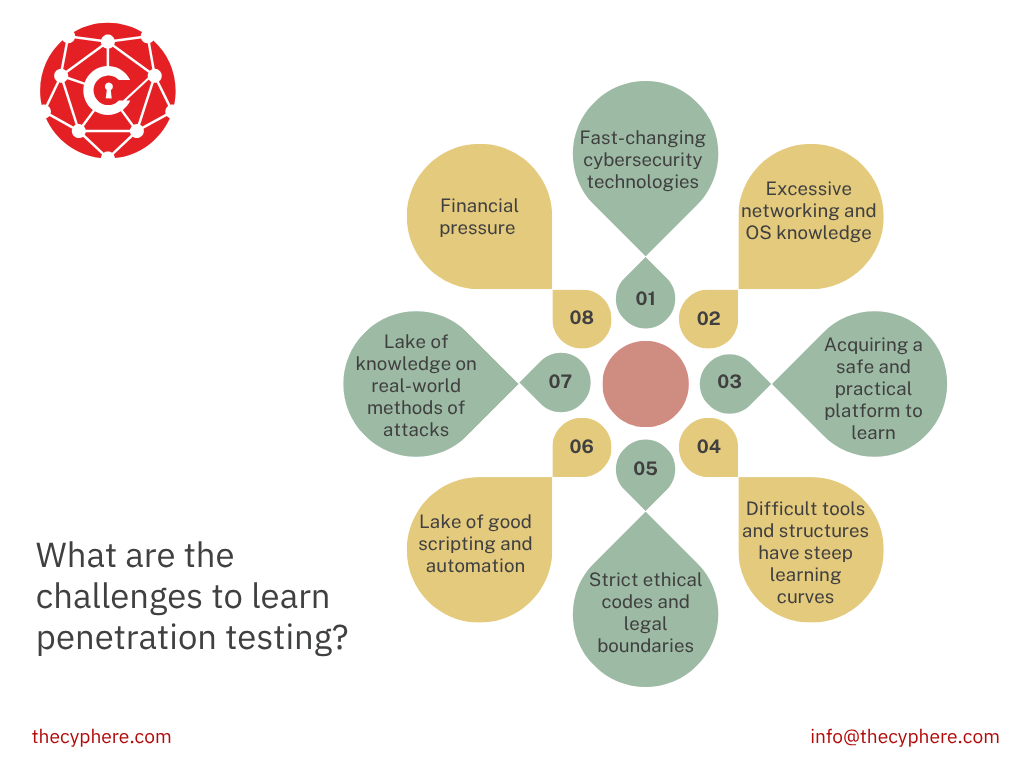
Challenges to learning penetration testing are listed below.
- Fast-changing cybersecurity technologies
- Excessive networking and operating systems prerequisite knowledge
- Problem with acquiring a safe, legal, practical platform to learn
- Difficult tools and structures have steep learning curves
- Strict ethical codes and legal boundaries
- Lack of good scripting and automation
- Lack of knowledge on real-world methods of attacks
- Financial pressure
What job roles can you get after becoming a penetration tester?
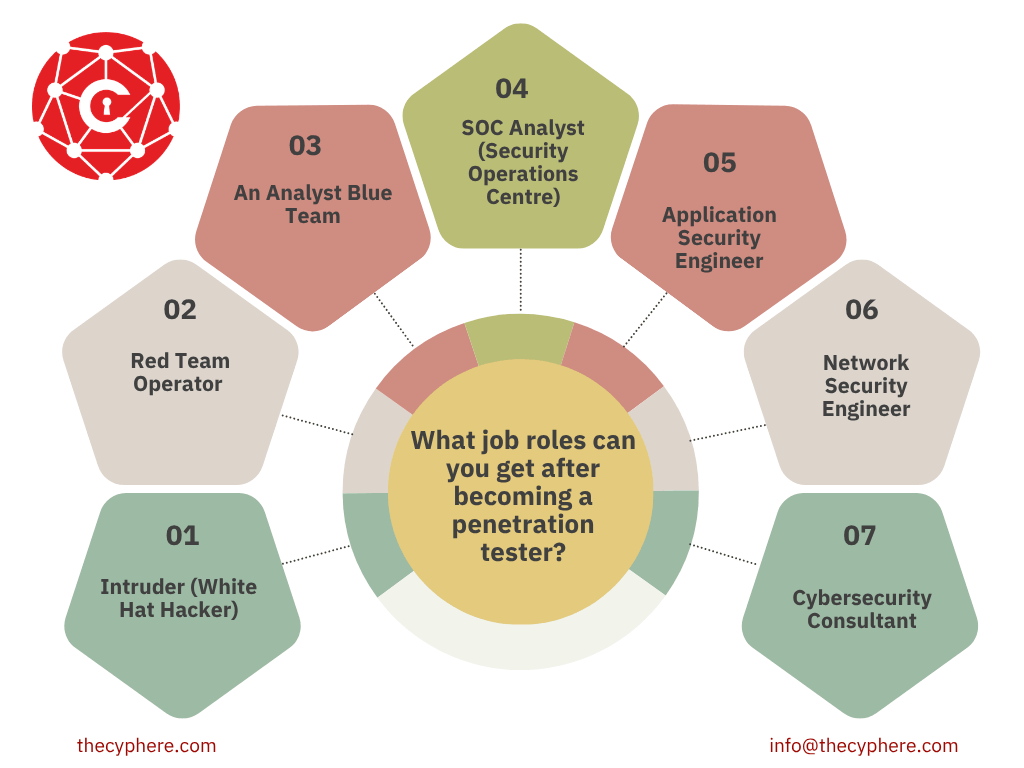
Jobs for a person after becoming a penetration tester or ethical hacker are listed below.
- Intruder (White Hat Hacker)
- Red Team Operator
- An Analyst Blue Team
- SOC Analyst (Security Operations Centre)
- Application Security Engineer
- Network Security Engineer
- Cybersecurity Consultant
Can you start a penetration testing company after learning penetration testing?
Yes, you can start a penetration testing company after learning penetration testing. Register your business legally, learn about the cybersecurity laws, and develop a set of clear contracts with clients before starting your penetration testing company. To open a penetration testing company, you must gain mastery of network, web, mobile, and cloud pentesting. You have to gain professional certification (OSCP or CEH), secure a testing lab, have the correct tools, and have good reporting and communication skills. Ensure that your company provides vulnerability assessment, red team simulation, and application security testing services without compromising ethical and legal protection. The demand for penetration testing companies has risen 50% because of the growing cyberattacks (30%/year), the potential to earn a lot of money, and the flexibility of work.
What responsibilities will be assigned to you as a penetration tester?
The responsibilities assigned to you as a pentester are listed below.
- Vulnerability Assessment
- Network Penetration Testing
- Web Application Testing
- Mobile Application Testing
- Cloud Security Testing
- Social Engineering Tests
- Exploit Development and Proof of Concept
- Privilege Escalation and After Exploitation
- Security Reporting and Documentation
- Risk Analysis and Remediation Recommendations
- Compliance and Regulatory Testing
- IT and Development Teams Cooperation
A pentester provides penetration testing services to small and medium-sized enterprises (SMEs), Large Corporations, Government organisations, Banks, FinTechs, Financial Institutions, Healthcare organisations, SaaS Firms, e-commerce, Educational Institutions, Providers of Critical Infrastructure (Energy, Transportation), Tech Companies and Managed Services providers (MSPs).
What is the salary of a penetration tester?
Senior and team leader penetration testers have a salary range between £60,000 and £80,000 yearly. Skilled penetration testers have a £40,000-£65,000 yearly salary. The salary of Junior penetration testers ranges between £25,000 and 40,000 yearly, depending on their experience. The salary of a penetration tester depends on skills, experience, and expertise. Ad hoc testing pentesters cost between £60-£120 per hour and £600-£3000 per day. The pentesters deal with API vulnerabilities that cost £20,000–£50,000 per application.
What is the job market for penetration testing in the United Kingdom?
The demographic of penetration testers in the UK is underserved, with a highly developed and expanding demand due to the 43% rise in cyber-attacks. UK NCSP (National Cyber Security Programme) announced 2,698 penetration jobs in 2025. In the UK, 26% of penetration testing jobs are remote, according to the Cyber Security Skills in the UK labour market 2025.
The scope of penetration testing rose 50% in the UK after AI, because AI is the cause of software bugs, Insecure system APIs, and leaks of confidential user information.
In the UK, 6,000 students leave university with cybersecurity skills every year. In the UK, 143,000 cybersecurity professionals were recorded in 2024. The total number of cyber positions was 61,163, and 2% of these jobs are occupied by penetration testers.
What is the future of Penetration testing?
The future of penetration testing is growing due to the 53%-56% increase in cyber threats. The demand for penetration testing increases 12%-18% every year due to AI-driven cyber attacks. The demand for pentesters in the BFSI sector increased 29% in 2025. AI, machine learning, and automation are starting to take over repetitive tasks such as scanning, reconnaissance, and reporting. Human testers are still required in challenging situations and for business logic vulnerabilities, according to Mariam Alhamed and M. M. Hafizur Rahman, titled “A Systematic Literature Review on Penetration Testing in Networks: Future Research Directions”, published in 2023.