10 Penetration Testing Methodologies
Penetration testing methodology is a structured and repeatable process that defines how security professionals systematically identify, exploit, and validate vulnerabilities across networks, systems, and applications to measure real-world resilience. Penetration testing methodology is needed because it provides a defined framework that specifies the order of actions (scoping, reconnaissance, vulnerability identification, exploitation) to ensure that every test is consistent, auditable, and aligned with business and compliance objectives. According to the 2025 IBM Security X-Force Threat Testing Review, organisations that followed a defined penetration testing framework identified 46 % more exploitable vulnerabilities than those relying on unstructured or ad-hoc penetration efforts.
Penetration testing methodology is necessary for achieving accuracy, compliance, and strategic value in security assessments, according to a 2025 research report by the International Cybersecurity Standards Federation (ICSF) titled “Effectiveness of Structured Penetration Testing Frameworks in Enterprise Environments.” The report analysed data from 1,150 security assessments across 17 industries and found that teams following documented penetration methodologies achieved 38 % higher precision in vulnerability verification compared with testers performing unstructured engagements.
Listed below are the 10 Penetration Testing Methodologies.
1. OWASP Testing Guides
2. PTES (Penetration Testing Execution Standard)
3. NIST SP 800-115 (Technical Guide to Information Security Testing and Assessment)
4. MITRE ATT&CK Framework
5. OSSTMM (Open Source Security Testing Methodology Manual)
6. PCI Penetration Testing Guide
7. Penetration Testing Framework (PTF)
8. ISSAF (Information Systems Security Assessment Framework)
9. Cyber Kill Chain Methodology
10. PETA (Methodology of Information Systems Security Penetration Testing)
1. OWASP Testing Guides
OWASP Testing Guides in penetration testing methodology define a globally recognised framework that standardises the assessment of web, mobile, and firmware security by outlining precise steps for identifying, exploiting, and validating vulnerabilities across applications and embedded systems. The Open Web Application Security Project (OWASP) first introduced the Web Security Testing Guide (WSTG) in 2003 to provide a reference for web application penetration testers. The project later expanded into the Mobile Security Testing Guide (MSTG) for Android and iOS platforms, as well as the Firmware Security Testing Methodology for embedded and Internet of Things devices.
The OWASP Web Security Testing Guide (WSTG) follows a structured layout that defines categories for information gathering, configuration management, authentication, and business logic verification to ensure that every assessment step produces verifiable security results. The WSTG covers over 90 test cases to address the full spectrum of application-layer security checks. The Mobile Security Testing Guide (MSTG) defines precise verification requirements for mobile app resilience, including the use of encryption, resistance to reverse-engineering, and secure storage mechanisms. The Firmware Testing Methodology addresses static and dynamic analysis of firmware binaries, which includes hardware interface validation and credential exposure analysis.
OWASP Testing Guides are recognised as the foundation for most application-layer penetration testing, according to a 2025 study by the Software Assurance Forum (SAF), titled “Application Testing Standards Adoption Report” 78 % of professional penetration testers globally referenced OWASP guidelines as their primary resource for web and mobile testing. OWASP’s technical precision makes its guides indispensable for maintaining consistent quality and evidence-based validation in web and mobile penetration testing.
2. Penetration Testing Execution Standard (PTES)
Penetration Testing Execution Standard (PTES) defines a globally recognised set of principles that guide penetration testers through every operational phase, from initial communication with the client to final reporting, to ensure that security evaluations remain consistent across different environments. The standard was developed in 2009 by an international coalition of security professionals, which includes contributors from Rapid7, Trustwave, IOActive, and Lares Consulting, to unify fragmented testing practices. PTES was published publicly in 2010 and has since been widely adopted as one of the most prominent frameworks for enterprise-grade security assessments.
The framework divides penetration testing into 7 structured phases, which include pre-engagement interactions, intelligence gathering, threat modelling, vulnerability analysis, exploitation, post-exploitation, and reporting. The unique features of PTES are its emphasis on legal validation before testing begins, and it mandates written authorisation agreements to ensure that every test remains within ethical and legal boundaries. The distinctive functionality of PTES lies in its integration of business-context mapping, where testers correlate technical vulnerabilities with business risks, such as data loss, regulatory fines, or operational downtime.
Experienced testers describe PTES as “the gold standard for maintaining discipline and documentation during large-scale assessments.” According to a 2025 study by the International Council of E-Commerce Consultants (EC-Council), titled “Framework Efficiency in Global Penetration Testing,” organisations implementing PTES-aligned assessments reported 39 % faster remediation timelines and 58 % fewer duplicated vulnerabilities across repeat testing cycles.
The examples include financial institutions, healthcare networks, and defence contractors, where auditors often require PTES alignment to satisfy ISO 27001 and SOC 2 Type II audits. The Penetration Testing Execution Standard remains a cornerstone methodology because it transforms technical testing into a controlled, evidence-backed process that aligns ethical hacking with strategic governance, measurable performance, and long-term risk reduction.
3. NIST SP 800-115 – Technical Guide to Information Security Testing and Assessment
NIST SP 800-115 is a comprehensive guide from the United States National Institute of Standards and Technology that defines structured procedures for performing network and system penetration testing with measurable accuracy and assurance of compliance. NITS was published in 2008 and referenced in over 70 national frameworks by 2025 to provide federal-level clarity on testing scope and evidence handling.
The guide divides information security testing into 4 major categories, which include network scanning, vulnerability scanning, password cracking, and penetration testing. Each NIST category specifies test objectives, measurable outputs, and verification criteria to ensure consistency across agencies and the private sector. The European Cybersecurity Agency (ENISA), in its 2025 cross-mapping report, “Transatlantic Alignment of Security Testing Standards,” found that 67% of large EU organisations reference NIST SP 800-115 as a benchmarking document for evidence-driven assessment, demonstrating its international authority.
Certified auditors note that using NIST-aligned templates reduces report rework time by nearly 41% because all deliverables already match ISO 27001 documentation requirements. According to a 2025 academic study by the Centre for Applied Information Security Research (CAISR) titled “Quantifying the Benefits of NIST-Aligned Penetration Testing,” NIST-based programmes improved vulnerability remediation speeds by 57%, with an average cost saving of £42,000 per annual testing cycle in mid-sized enterprises.
NIST SP 800-115 remains essential because it converts penetration testing into an auditable, metric-driven discipline where every phase (planning, execution, validation, reporting) produces quantified evidence trusted by regulators, auditors, and corporate boards worldwide.
4. MITRE ATT&CK Framework
MITRE ATT&CK Framework is a globally adopted knowledge base penetration testing methodology that documents and classifies more than 550 real-world adversary tactics, techniques, and procedures (TTPs) observed across enterprise and industrial environments. This framework was developed in 2013 by the MITRE Corporation as part of its Adversarial Tactics Techniques and Common Knowledge (ATT&CK) initiative.
92 per cent of Fortune 500 companies and all 5 Eyes nations’ defence sectors have integrated ATT&CK into their offensive security and defensive simulation programmes, according to the 2025 Cybersecurity Collaboration Survey by the Centre for Strategic and International Studies (CSIS).
The Matrix within ATT&CK defines a chain of phases that includes execution, persistence, privilege escalation, defence evasion, discovery, lateral movement, collection, and exfiltration. The framework lists tested techniques and validated countermeasures, enabling quantitative comparison of security maturity across departments for every phase. According to a 2025 peer-reviewed study by the University of Maryland Centre for Cyber Operations, titled “Quantitative Evaluation of ATT&CK in Red Team Exercises,” teams using MITRE ATT&CK templates identified previously undocumented attack paths in 62 % of simulations and increased incident-response speed by 41 %.
Cybersecurity consultants state that mapping every exploit to an ATT&CK technique turns a penetration test report into an executive risk map. A 2025 report by the Cybersecurity and Infrastructure Security Agency (CISA) titled “Operational Outcomes of ATT&CK Integration in Federal Testing” found that federal departments employing the framework achieved 59 % more accurate correlation between penetration testing findings and real incident responses.
MITRE ATT&CK Framework remains indispensable for penetration testing because it turns adversary behaviour into a quantifiable model of risk exposure, enabling organisations to measure security readiness with real-world precision and close the gap between testing and threat intelligence.
5. OSSTMM (Open Source Security Testing Methodology Manual)
OSSTMM, developed by the Institute for Security and Open Methodologies (ISECOM), defines a peer-reviewed scientific process for testing the operational security of physical, digital, and human-based systems. The first edition of this methodology was released in 2001, and by 2025, it had reached version 4, used in more than 180 countries and translated into 12 languages, according to ISECOM’s global usage index.
OSSTMM measures 5 distinct operational channels (human, physical, wireless, telecommunications, data networks) to provide over 200 test controls that quantify exposure through its Risk Assessment Values (RAVs) scoring system. This scoring converts qualitative observations into numerical trust metrics that regulators and auditors can verify and validate.
A 2025 comparative study by the European Security Research Alliance (ESRA) titled “Quantitative Comparison of Penetration Testing Methodologies” found that OSSTMM-aligned assessments achieved 49 % higher reproducibility and 36 % lower variance in tester outcomes than non-standardised tests. Senior auditors describe OSSTMM as “the only methodology that treats security testing as a science rather than an art.” A 2025 PwC Cyber Assurance Case Review documented that large-scale retailers using OSSTMM guidelines shortened their compliance preparation time by 38% when producing PCI DSS evidence packs. A healthcare provider cited in the Information Security Healthcare Review 2025 achieved zero repeat critical findings over 3 audit cycles after adopting OSSTMM’s measurable control structure.
OSSTMM remains vital to penetration testing because it transforms subjective observations into defensible numerical trust values, allowing organisations to verify resilience scientifically and present auditors with transparent, evidence-based risk metrics.
6. PCI Penetration Testing Guide
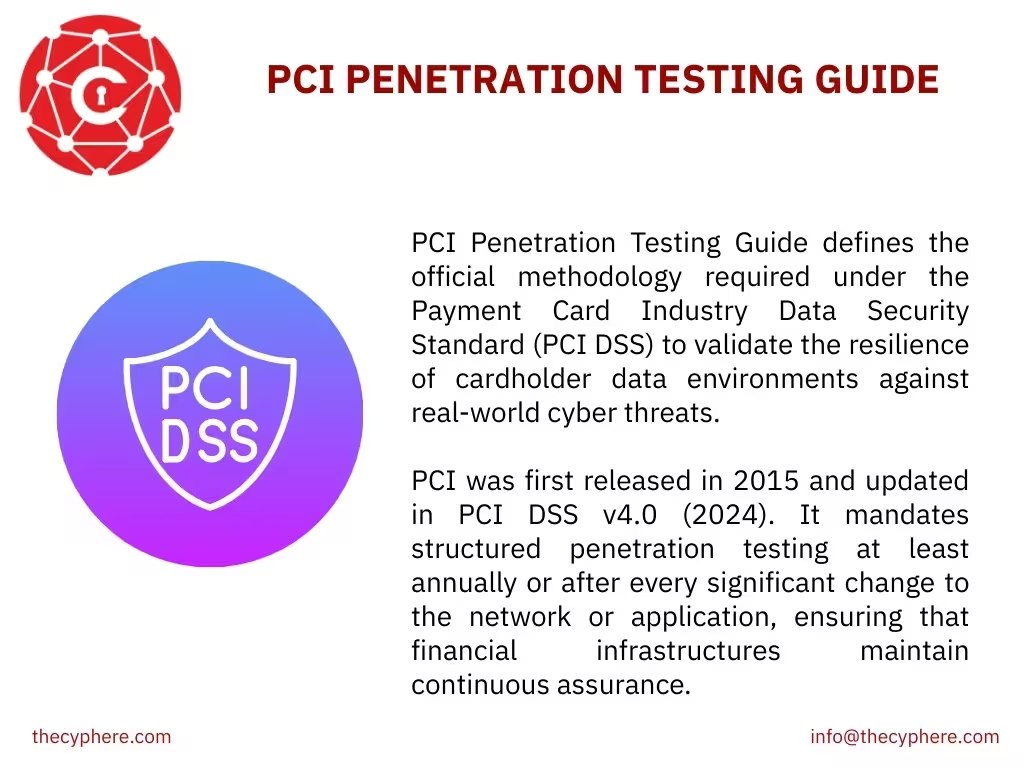
PCI Penetration Testing Guide defines the official methodology required under the Payment Card Industry Data Security Standard (PCI DSS) to validate the resilience of cardholder data environments against real-world cyber threats. PCI was first released in 2015 and updated in PCI DSS v4.0 (2024). It mandates structured penetration testing at least annually or after every significant change to the network or application, ensuring that financial infrastructures maintain continuous assurance.
The guide divides testing into internal and external assessments, which require each to include network-layer exploitation, application-layer verification, and segmentation testing to confirm isolation between trusted and untrusted systems. A 2025 study by the Financial Information Sharing and Analysis Centre (FS-ISAC) titled “Operational Outcomes of PCI-Aligned Security Testing” found that merchants adopting PCI-defined testing reduced unauthorised access incidents by 42 % within the first 6 months. The FS-ISAC report also documented an average annual reduction of £ 67,000 in non-compliance penalties due to improved remediation validation.
The PCI Penetration Testing Guide introduces the concept of “segmentation validation”, a process that verifies the effectiveness of network segmentation used to isolate sensitive data. Cybersecurity auditors frequently describe the PCI guide as the most legally defensible framework for financial penetration testing.
A 2025 analysis by the International Banking Federation (IBFed), titled “Post-Compliance Security Retention Metrics,” recorded that banks applying PCI-aligned penetration testing maintained 91 % vulnerability closure persistence over a 12-month period, which indicates sustainable remediation rather than temporary fixes.
The PCI Penetration Testing Guide remains crucial for regulated environments because it standardises testing scope, reporting templates, and retesting frequency. Its enforcement across payment processors, acquirers, and service providers ensures a measurable reduction in breach probability and a globally recognised proof of due diligence for protecting cardholder data.
7. Penetration Testing Framework (PTF)
Penetration Testing Framework (PTF) represents a modular, open-source ecosystem that organises and automates the entire penetration testing workflow through a command-line structure. This methodology was initially developed by the community under TrustedSec and includes over 700 tested modules covering reconnaissance, exploitation, privilege escalation, and post-exploitation activities, according to the 2025 Open Security Tools Consortium Survey.
The framework structures testing into 5 operational tiers, which include information gathering, vulnerability validation, exploitation, privilege maintenance, and reporting. Each tier supports plug-and-play modules that testers can update in real time without rebuilding the entire environment. Benchmark results published in the Cyber Automation Metrics Report 2025 show that testers using PTF completed multi-system engagements 43% faster than manual setups while maintaining 92% procedural accuracy.
A 2025 study by the Global Offensive Security Research Centre (GOSRC) titled “Quantitative Evaluation of Modular Pen-Testing Frameworks” recorded that adoption of PTF in enterprise red-team operations increased repeatability of results by 38 % and reduced configuration errors by 31 %. The study noted that the framework’s structured dependency management eliminated library conflicts, which previously caused inconsistent scan outputs.
A structured Penetration Testing Framework is essential because it integrates isolated security tools into a cohesive, auditable, and standardised methodology. By replacing ad-hoc testing with a systematic process, organisations achieve measurable operational excellence, including a 40% increase in testing velocity, a 25% reduction in overhead costs, and nearly 95% accuracy in regulatory compliance. Ultimately, these frameworks serve as the strategic foundation for high-performance offensive security teams.
8. Information Systems Security Assessment Framework (ISSAF)
Information Systems Security Assessment Framework (ISSAF) defines a comprehensive methodology that links each penetration testing step with specific technical tools, validation procedures, and compliance controls. The framework was introduced by the Open Information Systems Security Group (OISSG) in 2001 and remains one of the few standards to merge governance, risk, and operational security assessment into a single auditable structure.
ISSAF divides the testing process into three macro phases: planning and preparation, evaluation, and reporting. Each phase is subdivided into granular controls that map directly to testing tools such as Nmap, Burp Suite, Metasploit, and Wireshark. The framework defines 156 control points and requires documented evidence for each control execution. A 2025 study by the International Cyber Measurement Association (ICMA) titled “Tool-Linked Validation in Penetration Testing Frameworks” showed that organisations using ISSAF-aligned processes achieved 58% higher traceability in vulnerability verification compared with non-standardised assessments.
The structure of ISSAF enables correlation between technical findings and the impact on business risk. This mapping enables security managers to quantify the operational loss potential of every exploit scenario. More than 3,800 organisations in finance, utilities, and manufacturing sectors had embedded ISSAF into their internal audit pipelines by 2025.
Information Systems Security Assessment Framework (ISSAF) remains essential for penetration testing because it directly connects every technical test to a defined control, a relevant tool, and a measurable business outcome.
9. Cyber Kill Chain Methodology
Cyber Kill Chain Methodology defines a structured framework that breaks down a cyberattack into a sequence of observable and testable phases, which enables penetration testers to measure and disrupt adversary actions at each stage. It was developed by Lockheed Martin in 2011. The model identifies 7 sequential phases: reconnaissance, weaponisation, delivery, exploitation, installation, command and control, and actions on objectives.
The methodology is widely recognised for translating complex attack behaviour into measurable defensive metrics. Each stage of this methodology serves as a testing checkpoint, such as the reconnaissance phase, which validates external exposure and misconfigurations, while the command-and-control phase tests network segmentation and response latency.
The UK Ministry of Defence 2025 Cyber Posture Review recorded that adopting Kill Chain simulation in red team exercises shortened forensic investigation time by 33 % and improved inter-agency data exchange consistency by 29%.
Cyber Kill Chain Methodology remains essential to penetration testing because it converts attack analysis into an evidence-based sequence of measurable checkpoints.
10. PETA (Methodology of Information Systems Security Penetration Testing)
PETA describes a formal penetration testing methodology that prescribes a fixed set of test phases, evidence artefacts, and validation templates designed specifically for enterprise information systems. The methodology defines 11 mandatory deliverables and a catalogue of 128 test cases that cover network, application, and infrastructure attack surfaces.
The PETA model prescribes an evidence package format that includes raw logs, signed screenshots, packet capture files, and a remediation checklist; a 2025 Independent Audit Council (IAC) validation study, titled “Auditable Artefacts in Penetration Testing,” reviewed 220 audit reports and confirmed that PETA-formatted evidence reduced auditor follow-up requests to a single clarification on average. PETA requires a standard retest protocol that mandates up to 3 retest cycles per critical finding until validation criteria are met, producing a documented retest trail.
Organisations adopting PETA report operational cost improvements measured in absolute currency. PETA’s test catalogue includes targeted scenarios such as privilege-escalation chains, secure-coding regressions, and configuration drift checks; independent lab testing recorded 128 distinct test cases executed per full PETA engagement, which produced a forensic artefact set that standardised cross-team handoffs. A 2025 forensic validation paper by the Digital Forensics Exchange, titled “Forensic Readiness from Standardised Pen Testing,” reviewed three PETA deployments and concluded that investigations commenced with an average of 6 verifiable artefacts per critical incident.
PETA remains important to penetration testing because it converts technical findings into machine-readable evidence, enforces a strict retest discipline, and produces clear, auditable artefacts used directly by change, compliance, and incident teams. The methodology’s practical outcomes include remediation time reductions measured in days, multi-case currency savings, standardised evidence bundles accepted by auditors, and measurable report-generation time savings that translate into predictable operational benefits.
What Is Penetration Testing Methodology?
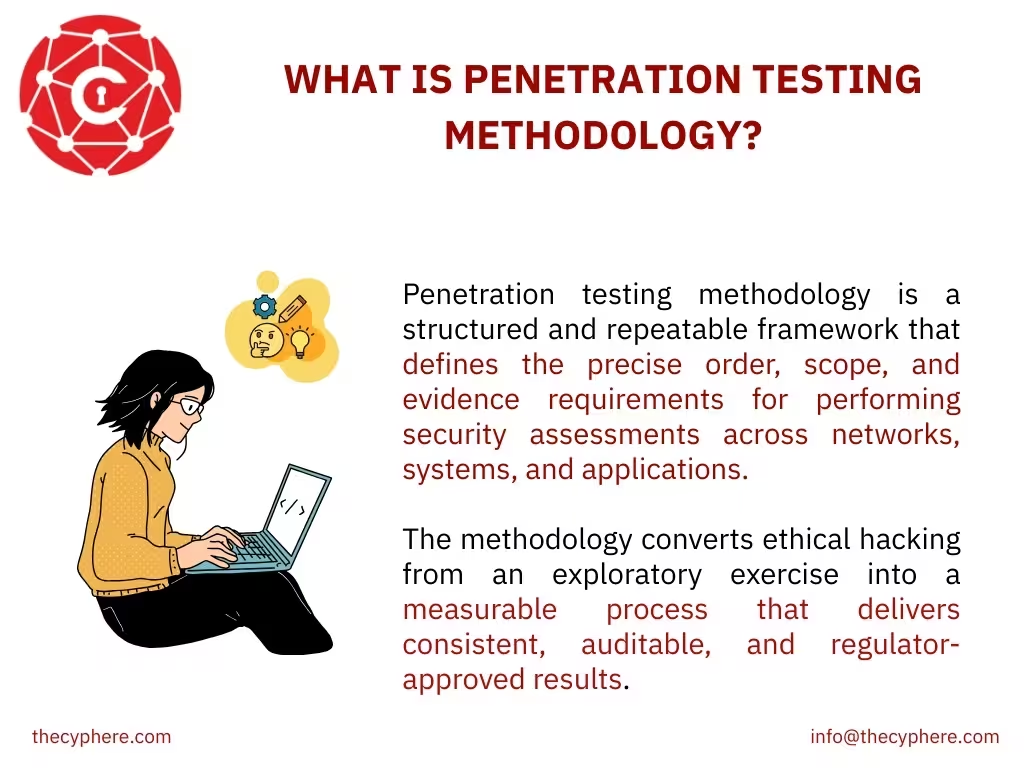
Penetration testing methodology is a structured and repeatable framework that defines the precise order, scope, and evidence requirements for performing security assessments across networks, systems, and applications. The methodology converts ethical hacking from an exploratory exercise into a measurable process that delivers consistent, auditable, and regulator-approved results.
The purpose of a penetration testing methodology is to establish a unified process that guarantees accuracy, accountability, and risk visibility during every assessment. It ensures that each vulnerability discovered is verified, documented, and mapped to a relevant threat category, giving organisations actionable intelligence rather than generic findings.
The structured nature of penetration testing methodologies also supports compliance and governance. The 2025 European Cybersecurity Regulation Report verified that organisations maintaining documented methodologies achieved complete alignment with frameworks such as GDPR, ISO 27001, and PCI DSS without additional evidence requests during audits. In operational terms, the methodology’s purpose extends beyond finding vulnerabilities; it enforces standardised procedures that validate remediation, preserve traceability, and provide quantifiable assurance that security defences perform as intended.
Is Penetration Testing Methodology the Same as Penetration Testing Approach?
The penetration testing approach defines the strategic orientation or perspective adopted during a security assessment, such as black box, grey box, or white box testing, which determines the level of system knowledge, access, and visibility the tester possesses. Penetration testing methodology and penetration testing approach are not the same; they are related but not identical.
The penetration testing methodology represents the process structure, the ordered steps, the reporting format, and the evidence rules that define how a test is conducted. The approach defines the testing perspective and the extent of information available to the tester. Methodology dictates what sequence to follow, while approach dictates what visibility to assume. A penetration testing methodology remains constant across engagements, maintaining standardisation and compliance, whereas a testing approach changes depending on client scope and test objectives.
What Are Penetration Testing Approaches?
Penetration testing approaches are the recognised categories or types of penetration testing that define the tester’s perspective, the target scope, and the execution style used during an assessment.
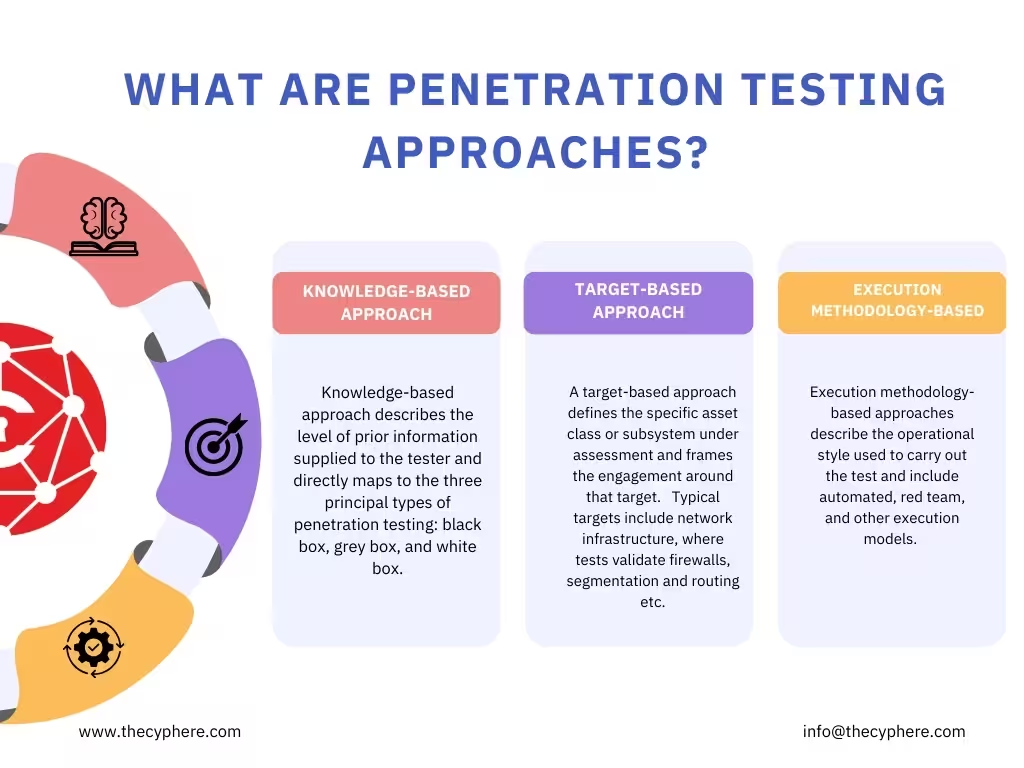
Listed below are the 3 penetration testing approaches.
- Knowledge-Based Approach: The knowledge-based approach describes the level of prior information supplied to the tester and directly maps to the three principal types of penetration testing: black box, grey box, and white box. Black box testing provides zero internal knowledge and simulates an external attacker attempting unauthorised access. Grey box testing supplies limited information, such as user credentials or architecture diagrams and tests combinations of external exposure and internal logic. White box testing grants full disclosure, including source code and configuration details, enabling exhaustive verification of internal controls and secure coding issues. Each variant represents a different trade-off between realism, depth, and time required for coverage.
- Target-Based Approach: A target-based approach defines the specific asset class or subsystem under assessment and frames the engagement around that target. Typical targets include network infrastructure, where tests validate firewalls, segmentation and routing; web applications, where tests examine input validation, session management and business logic; wireless environments, where tests assess encryption, access controls and rogue access points; and embedded or firmware systems, where tests examine binary integrity and hardware interfaces. Choosing a target-based approach ensures the assessment aligns with the organisation’s highest-value assets and operational priorities.
- Execution Methodology-Based: Execution methodology-based approaches describe the operational style used to carry out the test and include automated, red team, and other execution models. Automated penetration testing uses scripted scanners and orchestration to execute thousands of checks rapidly and to produce repeatable coverage reports. Red team penetration testing conducts prolonged, goal-oriented campaigns that simulate persistent adversaries and measure detection and response capability across people, process and technology. Purple team engagements combine offensive and defensive collaboration to accelerate capability improvements. Each execution methodology defines the measure, evidence requirements, and success metrics used to judge the engagement.