The NIS 2 directive aims to improve the cybersecurity posture of essential entities across the European Union, particularly critical infrastructure.
Every day, we hear about security threats and attacks on organisations. These threats range from data breaches and ransomware to cloud storage buckets leaking PII and sensitive data. There is no denying that cyber threats have been on the rise, and many organisations have fallen victim to these attacks, leading to financial and reputational losses. Hence, it is crucial to implement policies and processes that can help respond to simulates ahem.
What is NIS 2 Penetration Testing?
NIS 2 penetration testing simulates a cyber attack against an organisation’s assets to identify vulnerabilities an attacker can exploit. This helps organisations assess their security posture thoroughly, a requirement of NIS 2.
A penetration test under NIS 2 involves inspecting your network and information systems security measures. It will show you what attacks against the identified vulnerabilities your systems and networks are prone to. Organisations can achieve the required standards by taking corrective actions against the identified vulnerabilities.
NIS2 directive has the following direct links with penetration testing:
Aligned with recital 49 from the NIS2 directive, penetration tests help to identify missing updates and inadequate password controls.
A critical element of risk management, the quick detection and mitigation of exploitable vulnerabilities in information systems and networks, is aligned with Recital 58.
10 Key Requirements For Network and Information Systems Compliance
Apart from conducting NIS 2 penetration tests, organisations must also fulfil some requirements for NIS 2 compliance. Businesses must implement these measures at the concept level to effectively manage network and information systems risks while minimising the impact of security incidents on service recipients.
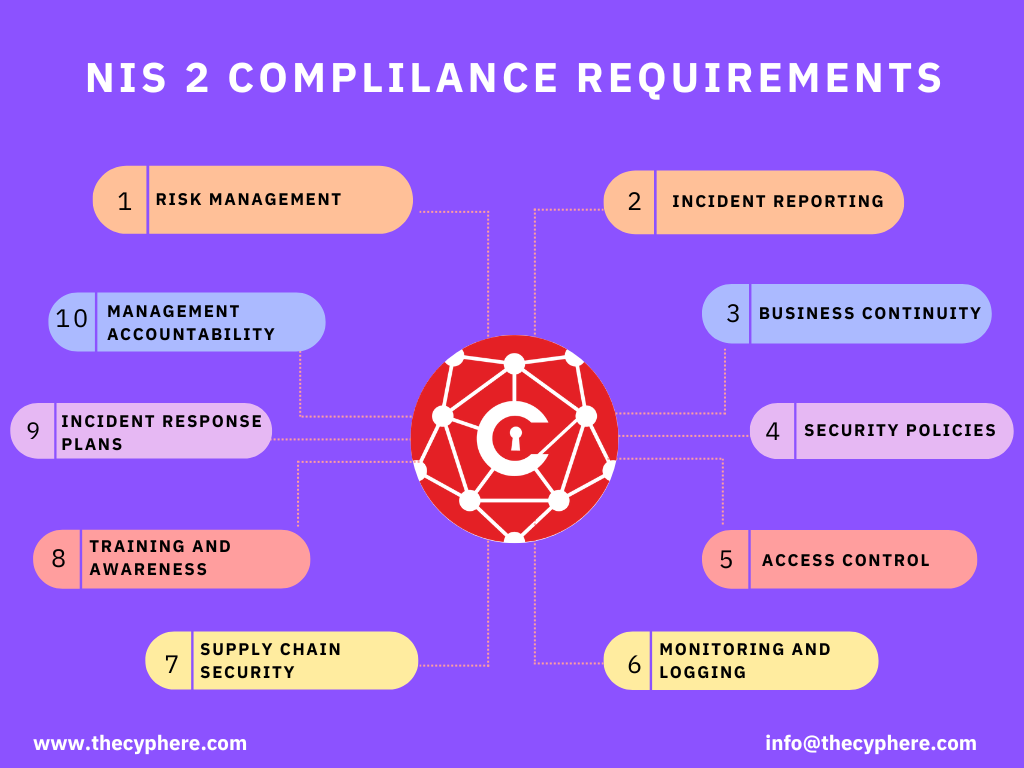
1. Risk Management
Risk management is the single most critical component from where everything starts. This is the spine of your cyber security program addressing your overall security posture and regulatory and compliance landscape. Therefore, risk identification and risk remediation aligned with standards or frameworks is a go-to approach for organisations ensuring proactive risk management.
It’s essential to take a a risk-based approach to securing data. Good risk management has multiple business benefits, such as improved decision-making and a foundation for adapting and being prepared against security threats.
2. Incident Reporting
Under the NIS 2 directive, companies must report high-impact cyber incidents to the relevant authorities within 24 hours. The affected organisations must also share a detailed report on the incident within 72 hours.
3. Business Continuity
As the name suggests, organisations should develop business continuity plans to ensure their essential services and functions face as little downtime as possible after a cyber attack.
4. Security Policies
Cybersecurity policies are guidelines that help an organisation protect its data. The most crucial guideline is an IT security policy. Additionally, high-level cyber security policies are centred around access control, passwords, backup, email security, and BYOD, and they also define the roles and responsibilities of the employees.
5. Access Control
Organisations must implement rules on who can access certain apps, data, and resources and when.
6. Monitoring and Logging
Network activities and traffic should be continuously monitored and logged regularly. It will help detect potential cyber security threats and create an incident response plan.

7. Supply Chain Security
Organisations must access third-party vendors’ cybersecurity posture and security measures and ensure they meet cybersecurity standards. It will protect your organisation from supply chain attacks from malicious actors.
NIS2 takes into account critical suppliers whose failure can disrupt your organisations operations or compromise security, therefore, they must comply to minimum cybersecurity standards.
8. Training and Awareness
Organisations must conduct regular cybersecurity training sessions for staff so that they understand their role in maintaining the security posture and best practices.
9. Incident Response Plans
Organisations must develop incident response plans so that the security teams have a playbook to prevent security incidents from causing more damage. These plans should be tested regularly to ensure they are up-to-date with the evolving threat landscape.
10. Management Accountability
Your organisation’s senior management must oversee the implementation of security measures and access controls. It ensures management is held accountable for compliance with NIS 2 requirements.
Does NIS 2 Compliance Require Penetration Testing?
Yes! Penetration testing is an integral part of risk management that is the core element of achieving NIS 2 compliance. It emphasises the need for organisations to assess their security measures regularly, which includes conducting penetration tests to identify and mitigate vulnerabilities.
Penetration tests help validate existing security controls’ effectiveness and provide recommendations based on the findings.
Importance of NIS 2 Penetration Testing
NIS 2 is an upgrade of its predecessor in more ways than one. It focuses on risk management, incident reporting, and corporate accountability. Organisations are classified as essential, particularly those in critical sectors such as utilities, healthcare, and transportation. Each must implement security measures that are designed to protect against cyber threats.
As we have above, penetration testing is the most crucial part of NIS 2 compliance because:
Identify Vulnerabilities
NIS 2 pen testing allows you to identify risks impacting the target infrastructure and ensure good analysis to help mitigation teams assess the impact and likelihood of identified issues to be exploited.
Incident Response
Pen testing identifies weaknesses in the current setup of an organisation from incident response preparedness. For instance, logging and monitoring mechanisms and any backups or misconfigurations identified in the associated services help teams mitigate such risks.
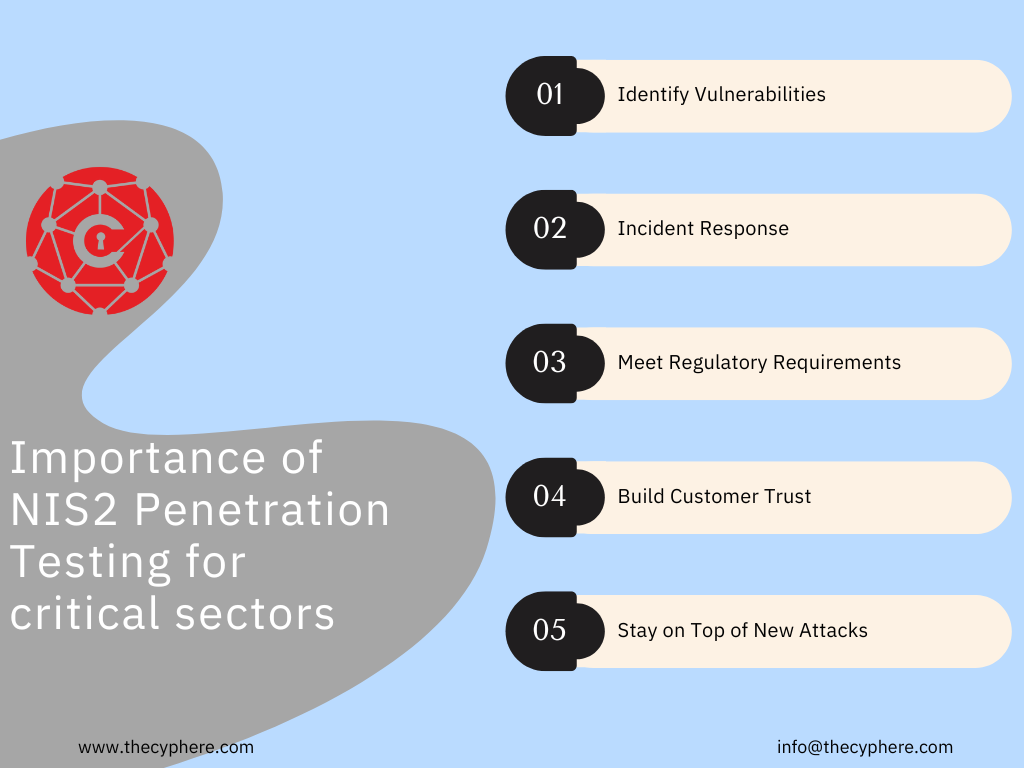
Meet Regulatory Requirements
As part of NIS 2 compliance, organisations must show that they have taken appropriate measures to manage risks effectively, and penetration tests are a way of proving that.
Build Customer Trust
Due to increasing cyber threats, customers are concerned about how their data is protected online. By performing penetration tests regularly and being NIS 2 compliant, you can reassure clients that you take their security seriously.
Stay on Top of New Attacks
Cyber threats constantly evolve, so organisations must stay one step ahead of attackers. Regular penetration tests allow organisations to adapt their security measures in response to emerging threats.
Who Needs NIS 2 Penetration Testing?
NIS 2 applies primarily to “essential” and “important” entities within various sectors across the EU, including digital infrastructure.
Essential Entities
These include organisations that provide critical services, such as energy suppliers, healthcare providers, banks, etc. Since these entities are essential in maintaining public safety and economic stability, they must prioritise penetration testing as part of their compliance efforts.
Important Entities
This category contains organisations whose services may not be critical but still play a significant economic role. Think of businesses such as postal services, food supply chains, or manufacturing companies. These entities might not face as strict rules as essential entities, but they benefit greatly from regular penetration testing.
Non-EU Companies Operating in the EU
These companies are not based in the EU but still provide services within the EU market, such as cloud service providers or online platforms. They also need to comply with NIS 2 regulations.
When Should You Perform NIS 2 Penetration Testing?
Performing NIS 2 pen testing once a year or upon significant changes is recommended.
A penetration test can also be conducted when your IT infrastructure undergoes significant changes. It will help you identify gaps and vulnerabilities in your new systems and suggest appropriate remediation steps.
Even if your IT systems have not undergone significant changes, it is still recommended that you conduct regular pen tests, either annually or bi-annually. If your organisation has recently experienced a cyber-attack, you should also perform a pentest. This will help you better prepare for future attacks and deploy a defensive strategy.
How Much Does NIS 2 Penetration Testing Cost?
Similar to a standard penetration test, the cost of a NIS 2 penetration test varies and is dependent on several factors:
Scope of Testing
The scope includes all the company’s assets, such as systems, networks, and applications, that will be assessed during a penetration test. Some penetration tests are limited to only the internal network, while others are more comprehensive and may include web applications and mobile apps.
Remember, we are discussing penetration testing here, not automated vulnerability assessments, which are a fraction of the price of a pentest.
Complexity of Systems
Organisations with complex IT infrastructure may take more time to assess due to the intricacies of determining various components.
Experience of the Testers
Another important factor determining the cost of your penetration test is the experience level of the penetration testers and the security vendor you choose to conduct. The vendor charges differently depending on their business operations and the number of people working on your project.
Frequency of Testing
An organisation may perform security assessments regularly after a specific interval. Different organisations carry out penetration tests differently. Some perform a pentest annually, while others perform it bi-annually or quarterly. The frequency of the penetration tests depends on the organisation’s goals and objectives.
How does Cyphere perform penetration testing for NIS compliance?
Our team of experts at Cyphere will guide you through the entire process. We start with a pre-consultation session to discuss your business needs and tailor our approach to your business goals. Then, our team develops a detailed plan for performing the assessment.
After completing the penetration test, we will submit a detailed report that includes the findings and remediation steps to improve your organisation’s security. We also offer ongoing support throughout remediation efforts, ensuring successful implementation before re-testing if necessary!
Summary
NIS 2 penetration testing is a central component to achieving NIS 2 compliance. Without risk identification, an organisation will be unaware of which risks to manage. Risk management is always risk identification and mitigation. A thorough penetration test is a long-term investment that helps you be aware of vulnerabilities and inform your IT investments.
Contact the Cyphere team to discuss your concerns or schedule a penetration test.