Internal network penetration testing is a security assessment performed from inside an organisation’s network to identify vulnerabilities, misconfigurations and internal attack paths that a malicious attacker could exploit. The process of internal pentesting typically includes scoping the internal environment, enumerating hosts and services, identifying vulnerabilities, exploiting weaknesses, escalating privileges, moving laterally and documenting findings with remediation steps.
The main tools used in internal network pentesting include Nmap, Nessus, Metasploit, Kali Linux, Cobalt Strike and BloodHound. Each of these tools supports scanning, exploitation, lateral movement and analysis. The cost of internal network penetration testing in the UK typically ranges from £4,000 to £20,000, depending on size, complexity, scope and testing duration.
Using internal network penetration testing services is worth it because it provides a deeper insight into internal threats. Internal threats are one of the main causes of modern breaches, and professional testers provide structured methodologies and a verified view of real organisational risk. A main checklist of internal pentesting includes defining scope, obtaining written authorisation, mapping assets, validating access levels, performing non-disruptive testing, detecting vulnerabilities, verifying lateral movement paths and documenting remediation steps.
What is Internal network penetration testing?
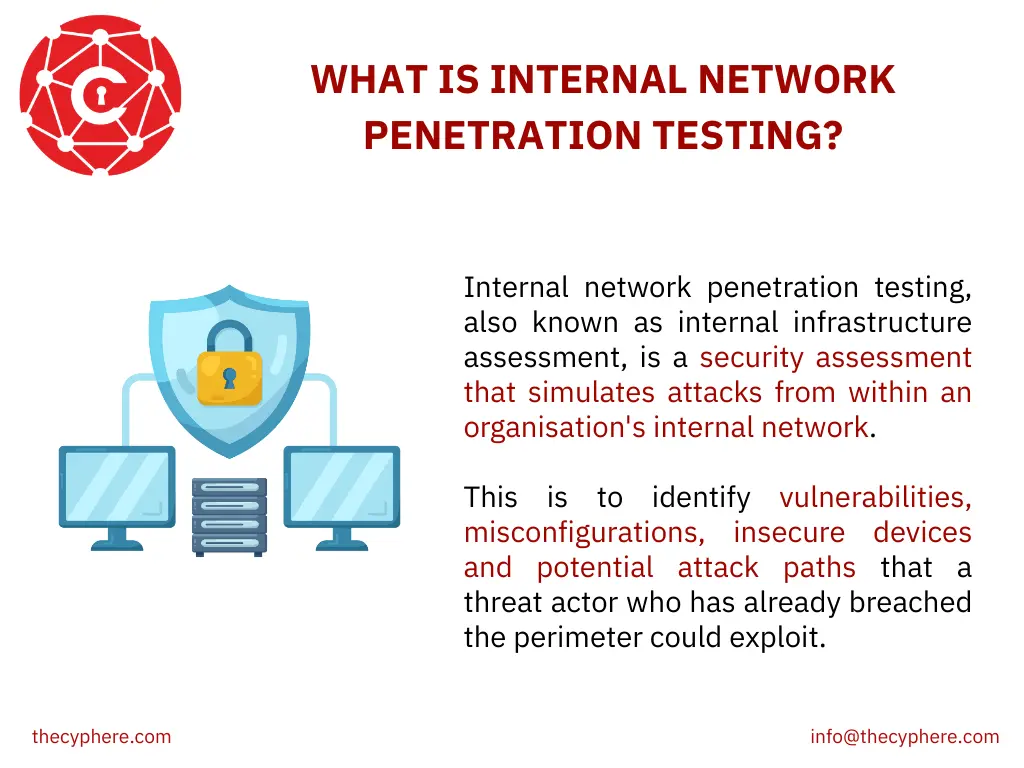
Internal network penetration testing, also known as internal infrastructure assessment, is a security assessment that simulates attacks from within an organisation’s internal network. This is to identify vulnerabilities, misconfigurations, insecure devices and potential attack paths that a threat actor who has already breached the perimeter could exploit. Internal network penetration testing simulates the techniques of a malicious internal user (a compromised employee device, malware or rogue insider) to assess how easily an attacker can move laterally, escalate privileges and gain access to sensitive systems once inside the network.
Internal network penetration testing can be performed by certified penetration testers, in-house security teams, third-party CREST, OSCP, CEH or similar qualified professionals and red teams during more advanced internal attack simulations. Internal network penetration testing reveals how much damage an attacker can cause after bypassing the firewall or through insider threats, identifies lateral movement paths, weak segmentation and privilege escalation opportunities. Internal network pentest also finds vulnerabilities that are unknown to the organisation, especially in internal servers, AD, endpoints and network protocols.
Internal network penetration testing is conducted under all three models: Black-box internal testing, White-box internal testing and Grey-box internal testing. According to Mohamed Jasem Alhammadi in his research, “Continuous Internal Penetration Testing (CIPT),” published on August 30, 2023, Continuous Internal Penetration Testing (CIPT) effectively improves an organisation’s security posture and reduces the risk of cyberattacks by integrating testing activities into daily operations.
How does internal network penetration work?
Internal network penetration testing allows pen testers to access the network as an internal entity, often using a virtual machine, standard workstation or a pre-connected test device. Pen testers then perform reconnaissance, enumeration, vulnerability scanning, exploitation and privilege escalation inside the network. Pen testers attempt to map the entire environment, discover hosts, and identify weaknesses such as weak passwords, outdated systems, open network shares, and insecure protocols. Later, they exploit them to demonstrate the real impact (such as accessing domain admin privileges or sensitive data).
Issues or challenges that arise from internal network penetration testing include scope & realism limitations, a false sense of security, detection & monitoring gaps, potential operational disruptions, dependence on the tester’s skill, and coverage & resources. All the blind spots of internal network penetration testing are covered by broader security measures such as monitoring, policies, user training, access governance, DLP (Data Loss Prevention) and detection.
When organisations operate cloud-hybrid environments (which is a popular use case in the UK), internal network penetration testing extends beyond traditional on-premises infrastructure. Testers assess connectivity between on-premises Active Directory and Azure AD (Entra ID), evaluate trust relationships between cloud and local resources, test VPN and ExpressRoute configurations, and examine identity synchronisation weaknesses. Cloud-hybrid testing also evaluates whether attackers can pivot from compromised on-premises systems to cloud resources or vice versa. Organisations must ensure cloud provider testing policies are followed and that appropriate authorisation covers both environments.
Internal network penetration testing is an effective and highly valuable security assessment when used correctly and as part of a broader security programme. Organisations achieve the best results when they combine internal testing with external assessments, vulnerability management, security monitoring, user awareness training and incident response planning.
Initially, penetration testing was a manual, expert-led process, developed as organisations recognised the need to proactively assess their own network defences by simulating real-world attacks from within their internal infrastructure. Over time (2000-2010s), penetration testing methodologies became more formalised, including multi-stage processes such as planning, information gathering, vulnerability detection, exploitation, and reporting. Since the 2010s till the present, automation and artificial intelligence have become central to modern internal network penetration testing because of the increasing complexity of networks and the shortage of skilled security professionals. Machine learning and reinforcement learning are used to automate attack planning and vulnerability discovery, which makes testing faster, more reliable and less resource-intensive.
What are the nine steps for performing internal network penetration Testing?
Internal network penetration testing methodology is a structured, step-by-step method used to assess the security of an organisation’s internal IT infrastructure by simulating an attacker who already has insider access.

The 9 steps to perform internal network penetration testing are described below.
1. Define internal network scope boundaries
Defining internal network scope boundaries in an internal pen test includes identifying which internal systems, network segments, devices and environments are included in the penetration test. The purpose of defining scope is to ensure the test remains safe, legal, non-disruptive and aligned with business requirements. Pen testers first identify internal IP ranges, VLANs, subnets, AD domains, servers and critical systems. Then they define what is in-scope (e.g., internal LAN, Wi-Fi, VPN network) and what is out-of-scope (e.g., production databases that must not be touched) and agree to test constraints (time window, risk limits, exploitation rules).
2. Enumerate internal hosts and services
Enumerating internal hosts and services involves mapping all internal devices, systems and exposed services running inside the organisation’s network. The purpose of enumerating internal hosts and services is to give an attacker the visibility required to identify potential attack targets. Tester uses a test laptop connected to the internal network and discovers hosts through ping sweeps, ARP scans, SNMP enumeration, NetBIOS scans or network scanners. Further, he/she enumerates open services like SSH, SMB, RDP, LDAP, SQL, VNC, RPC, FTP, etc. Tester uses tools like Nmap, Masscan, Netdiscover, Angry IP Scanner, CrackMapExec (CME) and rpcclient in enumerating internal hosts and services.
3. Identify exploitable system vulnerabilities
Identifying exploitable system vulnerabilities in internal pen testing includes finding internal weaknesses (outdated services being used, an Anonymous LDAP connection enabled, misconfigurations) that an attacker can exploit. The purpose is to highlight vulnerable systems that could lead to compromise or privilege escalation. Pen testers scan discovered hosts with authenticated/unauthenticated scanners and identify weak passwords, outdated software, insecure services, missing patches and misconfigurations. They check internal domain policies and SMB/LDAP vulnerabilities and commonly use tools like Nessus/OpenVAS, Qualys, Nmap NSE scripts, BloodHound for AD misconfigurations and Lynis for Linux audits.
4. Exploit weaknesses for initial access
Exploiting weaknesses for initial access in internal pentesting involves using identified vulnerabilities to gain initial access to internal systems. The purpose of internal network penetration testing is to simulate a real attacker attempting to enter the network from an insider position. Pen testers exploit vulnerable services (SMB, RDP, FTP) and attempt password spraying or brute-force attacks. Pen testers use Metasploit modules or manual exploit scripts and exploit known CVEs based on scanned results. Other tools like CrackMapExec, Impacket tools (psexec.py, smbexec.py), Hydra, Medusa and custom exploit code are used to exploit the weakness found during the internal network assessment.
5. Establish persistent backdoor mechanisms
Establishing persistent backdoor mechanisms is about maintaining continuous access to exploited systems. The purpose of maintaining continuous access is to show how long an attacker could remain undetected. To establish a persistent backdoor, deploy reverse shells, startup scripts, scheduled tasks or registry run keys. Pentesters can create rogue admin accounts (with permissions) and use built-in tools to remain stealthy (LOLBins). LOLBins standards for Living Off the Land Binaries that are utilised for persistence to evade detection and blend in with normal system activity. Pen testers can also use tools like Metasploit persistence modules, Empire/convent/Silver C2 (Command and Control), PowerShell scripts and Nishang/Evil-WinRM to discover weak endpoint controls, lack of monitoring, ineffective EDR (Endpoint Detection and Response)/ antivirus and missing integrity protection.
6. Perform lateral network movement
Performing lateral network movement involves moving from one compromised machine to another in the network. The purpose of lateral movement is to simulate a real attacker’s progression through internal systems. Pen testers use captured credentials to access other hosts. It includes pivoting through SMB, WMI (Windows Management Instrumentation), PsExec, RDP, SSH or LDAP protocols. Pen testers also use BloodHound to map attack paths. Pen testers commonly use tools like Impacket suite, CrackMapExec, BloodHound/Sharphound, RDP, and SSH clients to discover network segmentation weaknesses. These techniques align with MITRE ATT&CK Lateral Movement (TA0008) tactics.
7. Escalate to administrative privilege levels
Escalating to administrative privileges levels includes gaining higher-level permissions(local admin, domain admin). The purpose of escalating the privileges is to demonstrate the business impact if an attacker reaches critical privileges. Pen testers run local escalation checks (token impersonation, UAC (User Account Control) bypass, DLL hijacking) and use Active Directory attack techniques such as Pass-the-Hash, Kerberoasting and abuse of delegation or ACL weaknesses. Testers use captured credentials or hashes and attempt to elevate access to local admin and eventually Domain Admin privileges. They use tools like Mimikatz, WinPEAS/LinPEAS, PowerView, BloodHound and Impacket for escalating the privileges.
8. Extract credentials and sensitive data
Extracting credentials and demonstrating data access includes obtaining stored passwords, tokens, hashes and credential material to prove exploitation impact. Pen testers dump credentials from LSASS (Local Security Authority Subsystem Service) and demonstrate access to shared folders, file structures and document locations. Testers document proof of access using directory listings, file metadata or sanitised screenshots rather than extracting actual confidential documents containing personal or financial data. Only pre-approved test data or credential hashes are retained for reporting purposes.
9. Document vulnerabilities with remediation steps
Documenting vulnerabilities with remediation steps involves creating a professional report including findings, evidence, risks and fixes. The purpose of documenting the vulnerabilities with remediation is to enable the organisation to understand weaknesses and fix them. Pen testers record exploited vulnerabilities and attack paths, including screenshots, logs, code, commands and proof-of-compromise. They provide business impact analysis and remediation guidance and give findings to technical and management teams.
How long does internal network penetration testing take?
Internal penetration testing takes 3 to 10 business days, depending on the size and complexity of the environment. Small networks may be completed in 2-3 days, while large corporate environments can take 1-2 weeks or more.
Factors that affect the timeframe of internal penetration testing include the size of the internal network, Active Directory complexity, in-scope systems & segments, depth of testing required, exploitation restrictions and reporting requirements.
More hosts, domains, servers, and VLANs (Virtual Local Area Network) require more time for enumeration, scanning, and exploitation. Active directory complexity, like multi-domain forests, nested groups and complex GPOs (Group Policy Object), increases analysis time. Privilege escalation and lateral movement testing take longer in larger AD structures. Testing multiple VLANs, Wi-Fi networks, cloud-connected systems, VPN networks and OT/SCADA requires extra time. Grey-box or white-box testing can be more thorough because more systems can be reviewed at a deeper level, whereas black-box internal testing takes longer because testers spend more time on reconnaissance and enumeration without pre-provided information. Black-box internal testing may have limited exploitation depth but often requires extended reconnaissance time to map the environment without prior information.
How often should you conduct internal network penetration testing?
Organisations should conduct internal network penetration testing regularly or at least once every 12 months and every 6 months if they operate in high-risk industries (finance, healthcare, SaaS, e-commerce or organisations with high employee turnover).
Conducting internal network penetration testing regularly or annually is recommended because the internal network changes frequently, and new devices, servers, software updates, and policy changes create new vulnerabilities over time. Regular internal testing helps detect weaknesses early because most breaches involve stolen credentials, phishing or internal misuse. Yearly testing may miss critical issues introduced during patch cycles or system upgrades. Standards like PCI DSS, ISO 27001, SOC 2, HIPAA, and GDPR recommend or require regular penetration testing. Internal penetration testing should also be performed any time the organisation adds new systems, deploys cloud/hybrid, merges networks, or reconfigures Active Directory.
What is the scope of internal network penetration testing?
The scope of internal network penetration testing defines which systems, network segments, Active Directory domains and infrastructure components are authorised for testing. A typical internal network penetration testing scope includes internal IP ranges and subnets, Active Directory domains and domain controllers, internal servers (file servers, database servers, application servers), workstations and endpoints, network devices (switches, routers, internal firewalls), wireless networks accessible from inside the organisation, VPN concentrators and remote access infrastructure, and cloud-connected resources where authorised.
The scope document also specifies testing limitations, excluded systems (such as production databases or critical operational technology), testing windows, rules of engagement, credential access levels (for grey-box or white-box testing), and escalation contacts. Clear scope definition prevents misunderstandings, protects critical systems, and ensures the test aligns with business risk priorities.
What tools are used to perform internal network penetration testing?
Internal network penetration testing tools are specialised network security frameworks developed to identify vulnerabilities, misconfigurations, weak credentials and exploitable paths inside an organisation’s internal environment.
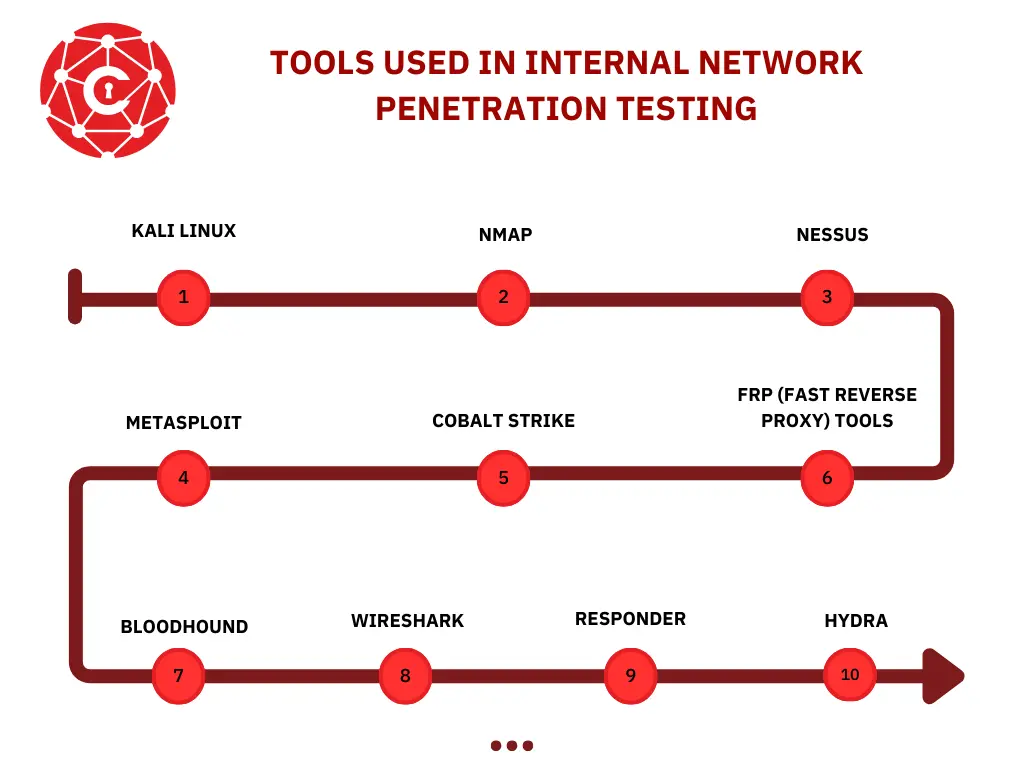
The top 10 internal network penetration testing tools are explained below.
- Kali Linux: Kali Linux is one of the most comprehensive penetration testing operating systems used for internal network assessments. Kali Linux contains hundreds of built-in security tools for scanning, exploitation, privilege escalation, password attacks and post-exploitation. In internal pentesting, Kali Linux helps pen testers enumerate internal hosts, exploit vulnerabilities, capture traffic, perform credential attacks and automate various offensive tasks. Kali is an operating system which includes a pre-configured, security-focused environment with all essential tools like Hydra, Nmap, Metasploit, BloodHound, Responder and Wireshark in one place.
- Nmap: Nmap is a famous network discovery and port scanning tool used to identify live hosts, open ports, running services and OS details within internal networks. Pen testers use Nmap in the initial phase to map the internal network infrastructure, fingerprint services, discover weak configurations and detect outdated services. Nmap includes fast scanning capability, support for NSE (Nmap Scripting Engine) and deep insights into internal network attack surfaces. Nmap includes custom scripts for vulnerability detection, service enumeration, firewall bypass checks and brute-force attempts. According to a broad literature review of network pen-testing research published by Mariam Ali Alhamed et al, the tool Nmap was highlighted as the most commonly used scanner for network discovery and enumeration.
- Nessus: Nessus is a vulnerability scanning tool widely used to identify security weaknesses in internal systems, servers, devices and applications. Pen testers use Nessus in internal pentesting to automate large-scale vulnerability discovery and report vulnerabilities with severity ratings. Nessus include a massive vulnerability plugin database, detailed remediation steps and accurate internal network scan results with minimal false positives.
- Metasploit: Metasploit is a powerful exploitation and post-exploitation framework used to attack vulnerable systems inside internal networks. Pen testers use Metasploit to launch exploits, gain initial access, escalate privileges and pivot laterally across the network. Metasploit provides payloads, auxiliary modules and post-exploitation scripts that help simulate real attacker behaviour. Metasploit has a huge exploit library combined with automated exploitation capabilities, making it essential for assessing internal security controls and validating vulnerabilities.
- Cobalt Strike: Cobalt Strike is a commercial adversary simulation tool used for advanced internal network exploitation, command and control (C2) and red-team operations. During internal pentesting, Cobalt Strike allow pen testers to deploy beacons, maintain persistence, perform lateral movement, keystroke logging and privilege escalation. Cobalt Strike includes realistic attack simulations, team collaboration functions, stealthy post-exploitation techniques and integration with payloads that mimic real-world APT behaviour.
- FRP (Fast Reverse Proxy) tools: FRP is a general-purpose tunnelling tool that pen testers use to create secure reverse proxy channels during internal assessments. FRP enables testers to bypass NAT devices, firewalls and network restrictions to maintain remote access to compromised internal systems. In internal pentesting, FRP helps establish command and control connections when direct connectivity is blocked. Alternative tunnelling tools include Chisel, ligolo-ng and SSH tunnelling, but FRP is valued for its speed, configuration flexibility and support for multiple protocols.
- BloodHound: BloodHound is an Active Directory attack path visualisation tool widely used in internal pentesting. BloodHound collects data from AD environments to identify privilege escalation paths, domain misconfigurations and hidden attack routes. In internal pentesting, BloodHound is used to map complex AD relationships and identify routes to Domain Admins. BloodHound provide graph-based analysis that reveals attack paths impossible to identify using manual methods.
- Wireshark: Wireshark is a network protocol analyser used to capture and examine network traffic. Pen testers use Wireshark to identify insecure protocols, plaintext credentials, ARP spoofing opportunities and misconfigured services. Wireshark is mainly used in internal LAN environments for analysing traffic and detecting sensitive data leakage.
- Responder: Responder is a powerful internal network tool used to capture credentials and exploit misconfigurations like NBT-NS (NetBIOS Name Service Name Spoofing), LLMNR (Link-Local Multicast Name Resolution) and MDNS poisoning. Responder allow pentesters to trick internal systems into sending authentication requests, which expose NTLM hashes and sensitive user details. Responder includes poisoning protocols of network name resolution, which make it effective for internal credential harvesting.
- Hydra: Hydra is a fast online brute-force tool used to test weak internal login credentials on SSH, RDP, FTP, SMB, database services and other network protocols. Hydra is used in internal pentesting to identify accounts with weak or reused passwords. The main features of Hydra are its speed, multi-threading capability and broad protocol support, which make it highly effective for internal password attack scenarios.
How much does it cost to perform internal network penetration testing?
Performing a standard internal network penetration test can cost between £4,000 and £20,000, covering small to medium-sized environments. The cost can rise to £25,000–£40,000 or more for larger enterprises with multiple segments, complex Active Directory structures, cloud-hybrid networks or deeper exploitation requirements.
Service providers in the UK generally charge using daily rates or fixed project pricing rather than hourly billing. A common day rate for a skilled penetration tester in 2025 is roughly £7,50–£1,500 per day for manual internal network testing. When multiplied by a typical 5-10 day engagement (depending on scope), the cost ranges £4,000–£12,000 for small-to-medium tests.
What factors affect the cost of internal network penetration testing?
The factors that affect the cost of an internal pen test include size and complexity of the internal network, depth and scope of testing required, provider expertise and certifications, reporting, retesting and follow-up requirements.
Organisations with a small number of endpoints or a single network segment may only require a few days of testing, which costs roughly £4,000–£6,000. Whereas a large enterprise with hundreds of hosts, multiple VLANs, cloud-hybrid infrastructure or complex Active Directory environments often needs deeper analysis that costs above £10,000–£20,000.
Another major factor in the cost of internal network penetration testing is the depth of testing required. A basic internal vulnerability assessment costs far less than a full manual penetration test, where the tester attempts lateral movement, privilege escalation, AD misconfiguration exploitation and data exfiltration. Deeper manual testing requires skilled consultants who typically charge £1,000–£1,500 per day in the UK. The cost is further increased by the test that includes advanced red-team-style techniques, social engineering or persistent access simulation because they require specialist skills and additional time.
Provider’s expertise and certifications also influence internal pentesting cost in the UK. CREST-accredited or CHECK-approved penetration testers often charge higher fees because they meet government-recognised standards and provide higher-quality reporting. Organisations aiming for ISO 27001, PCI DSS, Cyber Essentials Plus or SOC 2 often choose certified testers, which increases overall expenditure but ensures audit-grade results.
The reporting quality, retesting and additional deliverables also affect cost. Comprehensive internal test reports with executive summaries, technical breakdowns, exploitation evidence and prioritised remediation advice take more time to produce. Many UK providers charge extra for retesting to verify fixes.
How does Cyphere perform internal network penetration testing for businesses?
Cyphere provides internal network penetration services for businesses through a structured, expert-driven approach designed to replicate the actions of an insider threat or an already-compromised internal user or asset.
The process starts with the discovery and mapping of all internal assets, followed by a thorough enumeration of hosts, services and trust relationships to get a picture of the network’s behaviour. Experts use various techniques and tools to assess authentication weaknesses, configuration flaws, outdated systems, insecure protocols and lateral-movement pathways. Throughout the engagement,
Cyphere simulates realistic attacker behaviour such as credential harvesting, privilege escalation, pivoting and access abuse, while ensuring all actions remain safe and controlled within the agreed scope. Every finding is validated, risk-rated, and supported by clear remediation guidance, helping organisations improve their internal defences, reduce attack paths, and enhance resilience against real-world threats.
What techniques do we use to perform internal network penetration testing?
Below are the 6 core techniques that we use while performing internal network penetration testing services.

- Credential Attacks (Password Spraying, Brute Force, Kerberoasting, AS-REP Roasting) – Credential attacks are techniques we use to identify weak, reused, or exposed passwords that attackers could exploit to gain initial access or move laterally within the internal network.
This includes password spraying, brute force, Kerberoasting, and AS-REP Roasting, all aimed at evaluating the strength of authentication controls and detecting accounts vulnerable to credential-based compromise. - Privilege Escalation Techniques – A Privilege escalation technique is a method we use to determine how an attacker could elevate low-level access by abusing misconfigurations, insecure permissions, or vulnerable software within the environment.
This helps uncover excessive privileges, weak ACLs (Access Control List), and unprotected administrative pathways that enable a compromised user to gain higher-level access. - Man-in-the-Middle (MITM) Attacks – A man-in-the-middle attack is a technique we use to intercept, manipulate, or analyse internal network traffic to uncover insecure protocols, plaintext credentials, and sensitive data exposure.
By leveraging ARP spoofing or rogue DHCP setups, we evaluate whether the internal network is resilient against traffic manipulation and credential interception. - Pass-the-Hash / Pass-the-Ticket Attacks – Pass-the-hash and pass-the-ticket attacks are techniques we use to authenticate to systems without knowing the actual passwords, relying instead on captured NTLM hashes or Kerberos tickets.
This allows us to test whether identity and access controls can prevent impersonation or lateral movement once an attacker has access to credential material. - Social Engineering – Social engineering is a technique we use to evaluate employee awareness and the organisation’s ability to detect manipulation or unauthorised internal access attempts.
This often includes phishing, pretexting, or physical access challenges to assess human-layer security. - Exploitation of Insecure Network Protocols – Exploitation of insecure network protocols is a technique we use to target outdated or misconfigured services such as SMBv1, LLMNR, mDNS, or NetBIOS that allow device impersonation or credential capture.
By abusing these weaknesses, we assess whether attackers can pivot through the network or harvest authentication details.
What internal network penetration testing checklist does Cyphere recommend for pentesters?
To perform internal penetration testing, we at Cyphere recommend the following checklist.
Reconnaissance
- Network traffic (Wireshark)
- Network range scan
- Fingerprinting (whois, ASN, DNS, DNS Lookup, Google dorks)
- Live host scan
- Port scanning (service, version, OS, UDP, TCP)
- SNMP enumeration (snmpcheck, snmpwalk)
- NetBIOS enumeration (nbtscan, nbtlookup)
- Network mindmap
- IPv6 enumeration and dual-stack testing
- Certificate enumeration (internal PKI, ADCS certificates)
Scanning
- ḶLMNR/Net-BIOS poisoning (responder)
- DNS/ARP spoofing/poisoning (ettercap, bettercap)
- FTP enumeration (default/guessable creds, anonymous login)
- STMP enumeration (telnet connection, user enumeration)
- DNS (reverse lookup, brute force, service discovery)
Active Directory Enumeration
- User enumeration
- Machine/service accounts enumeration
- Domain admin account enumeration
- Domain controller enumeration
- Access domain shares
- ADCS (Active Directory Certificate Services) enumeration
- Azure AD/Entra ID synchronisation assessment (for hybrid environments)
- Privileged Access Workstation (PAW) identification
Lateral Movement
- Password spray
- Internal spearphishing
- Kerberoastable users (PowerShell, Powerview, Bloodhound, Mimikatz, Impacket)
- AS-REP roastable users
- Constrained/Unconstrained delegation attacks
- Pass the hash (crackmapexec, metasploit, impacket)
- NTLM relay attacks
- PrintNightmare and related print spooler attacks
- SCCM/MECM abuse (if applicable)
Domain
- GPO/ACL abuses (GenericAll, GenericWrite)
- Abusing shadow copies
- Abusing DNS admins
- Abusing Backup operators group (PowerShell, SeBackupPrivilege)
- Token Impersonation
- Abusing AD Certificate Services
Domain Persistence
- Golden Ticket
- Silver Ticket
- DCSync/DCShadow attack
- Skeleton Key attack
- DSRM abuse
To go through the complete Internal penetration testing checklist, click here for Internal penetration testing checklist.
What common vulnerability do we find in our internal penetration testing?
According to Cyphere’s experience based on real internal penetration testing projects, the following are the six common vulnerabilities that we commonly identify:
- Weak or Reused Passwords: It is observed that users often share or reuse simple passwords, which allow attackers to escalate access quickly.
- Excessive Privileges & Misconfigured Group Memberships: Based on the assessments carried out by Cyphere, it is often found that organisations use over-permissioned accounts, shadow admins and unnecessary domain privileges to normal accounts.
- Poor Network Segmentation: Poor Network segmentation is also one of the most common issues that we identify in our network penetration testing. It makes the network flat and allows attackers to move freely between sensitive systems.
- Misconfigured Active Directory Settings: Misconfigured AD settings like weak group policies, open SMB (Server Message Block) shares, and outdated domain controllers create multiple attack paths in the AD environment. These misconfigurations can help attackers to escalate privileges and compromise the domain controller.
- Default or Hard-coded Credentials: Organisations often use the manufacturer’s default passwords for devices like printers, switches, IoT devices and legacy systems. Attackers often exploit these to gain easy access and unauthorised entry into internal networks.
- Unsecured File Shares: Any poorly configured shared folders may expose confidential data to any internal user. This increases the risk of data leakage, privilege escalation and abuse of sensitive information.
What are the examples of internal network penetration testing
Internal network penetration testing examples include a range of simulated attack scenarios that assess the security of systems, users and network components inside an organisation.
The 6 common examples of internal network penetration testing are described below.
- Active Directory penetration testing: Active Directory(AD) pentesting focuses on identifying weaknesses in domain configurations, user privileges, authentication mechanisms and group policies. Pen testers attempt to exploit misconfigurations such as weak Kerberos protections, excessive privileges, outdated domain controllers or poor password policies.
- Internal network vulnerability assessment & exploitation: Internal vulnerability assessment & exploitation identifies vulnerabilities within internal servers, workstations, routers, switches, and network services. After scanning for weaknesses, pen testers exploit outdated software, weak configurations, exposed services and mismanaged patching.
- Credential harvesting & password attacks: Credential harvesting & password attacks involve capturing internal user credentials through techniques like LLMNR/NBT-NS poisoning, SMB relay, packet sniffing and weak password attacks. Pen testers assess how easily internal users’ passwords can be cracked, reused or abused to access critical systems.
- Lateral movement testing: Lateral movement simulation focuses on how attackers spread from one compromised machine to other internal systems. Pen testers identify segmentation weaknesses, unrestricted network paths and poor administrative credential controls.
- Privilege escalation testing: Privilege escalation testing checks how attackers can elevate access from a low-level internal user to administrator or system-level privileges. Pen testers exploit misconfigurations, missing patches, vulnerable services, or improper permission settings to gain higher access.
- Insider threat simulation: Insider threat testing simulates the actions of a malicious insider or contractor with legitimate internal access. Pen testers assess how easily an insider could steal data, access restricted systems, bypass monitoring, or disable security controls.
What are the ethical considerations in internal network penetration testing?
Key ethical considerations in internal network penetration testing are described below.
- Obtain written authorisation before commencing any testing: Internal network penetration testing must only begin once formal written approval has been granted by the relevant stakeholders, such as senior management, the IT director, or the information security officer. This authorisation should clearly outline the scope, dates, testing methods, and the names of approved testers. Without this documentation, any testing activity, regardless of intent, constitutes unauthorised access and may carry serious legal consequences under the Computer Misuse Act 1990.
- Strictly respect the agreed scope and boundaries: Pen testers must operate exclusively within the systems, networks, IP ranges, and applications defined in the authorisation agreement. Any discovery of in-scope vulnerabilities that could lead to out-of-scope systems must be flagged immediately rather than pursued. Scope creep, even unintentional, can compromise untested systems, create legal liability, and undermine trust with the client or internal team.
- Protect data confidentiality and employee privacy throughout: All findings, credentials, exploit paths, and vulnerabilities uncovered during testing must be handled securely and shared only with authorised stakeholders. Sensitive personal data, HR records, or private employee information encountered incidentally must not be accessed beyond what is necessary and must never be stored, copied, or disclosed. Final reports should be encrypted and delivered through secure channels, with physical or digital copies restricted to named recipients only.
- Minimise operational disruption and use non-destructive techniques: All testing activities should be carried out in a manner that avoids downtime, service interruptions, or damage to production systems. Aggressive exploitation techniques, denial-of-service attempts, or actions that could corrupt data or destabilise live environments must be avoided unless explicitly authorised and conducted in a controlled window. Where possible, testing should be scheduled during low-traffic periods, and roll-back or recovery plans should be in place before any high-risk activity is attempted.
- Maintain transparent and ongoing communication with management: Pen testers must keep relevant stakeholders regularly informed throughout the engagement, covering test progress, any unexpected findings, elevated risks, and any deviations from the original plan. If a critical vulnerability is discovered that poses an immediate threat, it must be escalated without delay rather than held until the final report. Clear communication ensures that business decisions can be made promptly and that all parties remain aligned on risk exposure.
Cyphere, a CREST-accredited provider, follow all the standards and codes of conduct for every type of penetration testing.
How is the internal network penetration testing process different from external penetration testing?
The main differences between internal and external penetration testing are visibility, attack perspective and depth of access. Internal network penetration testing focuses on lateral movement, privilege escalation, and internal misconfigurations, since it mimics an attacker who has already gained network access, while external testing does not evaluate these aspects. In contrast to internal testing, which looks at insider threats and internal trust relationships, external network penetration testing assesses internet-facing systems and perimeter defences. While external testing specifically identifies vulnerabilities exposed to the outside world, internal testing does not target infrastructure that is visible to the public and focuses on the internal corporate environment.
What are the benefits of performing internal network penetration testing?
The benefits of internal network penetration testing are listed below.
- Identifies internal security gaps: Internal network penetration testing helps uncover weaknesses within the corporate network, such as weak passwords, insecure configurations, outdated systems, exposed services, or overly permissive access. Testers simulate real internal threats to determine exactly how an attacker could exploit these gaps. Organisations use these findings to prioritise remediation, strengthen internal defences, and prevent attackers or compromised insiders from abusing overlooked vulnerabilities.
- Tests the effectiveness of internal controls: Internal testing evaluates whether core security controls, including access controls, monitoring tools, logging, endpoint security, and segmentation policies, actually work as intended when facing a real attack scenario. By simulating internal exploitation paths, testers validate whether alerts are triggered, whether access checks function correctly, and whether monitoring detects suspicious activity. Organisations rely on this insight to fix gaps in detection, improve alert tuning, and reinforce control effectiveness.
- Strengthens insider threat protection: Internal network penetration testing acts as a safe simulation of what a malicious insider or compromised employee account could achieve. It demonstrates how far an attacker could move within the network, what data they could steal, and which systems they could compromise. This helps organisations design stronger insider threat programs, enforce least-privilege access, and implement better behavioural monitoring to reduce the risk posed by internal misuse.
- Validates patch and configuration management: Internal tests highlight unpatched operating systems, outdated applications, unsupported devices, insecure legacy protocols, and misconfigurations across servers, workstations, and network infrastructure. These issues create internal attack surfaces that attackers commonly exploit. Organisations use the test results to refine patch cycles, standardise secure configurations, retire legacy systems, and ensure continuous hygiene across the internal environment.
- Improves incident detection and response: By simulating real-world internal attacks, the test measures how quickly a security team can detect, triage, and contain malicious activity. It reveals gaps such as missing alerts, delayed responses, insufficient log visibility, or weak escalation processes. Organisations use this information to enhance SOC capabilities, fine-tune alerts, improve playbooks, and strengthen response readiness in the event of an actual internal breach.
- Supports compliance requirements– Many regulations and standards, such as ISO 27001, PCI DSS, GDPR, and various industry frameworks, require regular assessment of internal controls and technical security measures. Internal network penetration testing provides documented evidence that an organisation is proactively identifying and addressing internal risks. This helps maintain compliance, reduce regulatory exposure, and demonstrate due diligence during audits.
- Improve overall network visibility: Internal network penetration testing maps the internal network structure, hidden assets, trust relationships, and lateral movement paths that are often unknown to IT teams. Testers reveal how attackers could navigate through the environment, pivot between systems, and escalate privileges. Organisations use this visibility to enhance asset inventory, improve network segmentation, remove unnecessary privileges, and build a clearer picture of internal risk.
What are the best practices to follow when performing internal network penetration testing?
The best practices to follow when performing internal network penetration testing are listed below.
- Obtain formal written authorisation and clearly define scope and objectives: All internal network penetration testing must begin with documented approval from senior management, the IT director, or the designated information security authority within the organisation. This written authorisation should specify which internal systems, servers, endpoints, and network segments are in scope, along with the testing objectives, approved methodologies, agreed timeframes, and the identities of all internal or contracted testers involved. Defining clear objectives at the outset ensures the engagement remains legally protected and aligned with the organisation’s internal security goals. Without this documentation, testing activities may constitute unauthorised access under the Computer Misuse Act 1990, even when conducted by internal staff.
- Conduct thorough internal network mapping and asset identification: Before active testing begins, pen testers should carry out comprehensive reconnaissance of the internal network environment, cataloguing all in-scope assets, including internal IP ranges, subnetworks, active hosts, domain controllers, shared drives, open ports, and running services. A clear picture of the internal attack surface helps prioritise testing efforts, reduces the risk of overlooking critical internal systems, and prevents accidental interaction with out-of-scope infrastructure such as third-party or partner-connected systems.
- Follow a structured, repeatable methodology using both automated and manual techniques: Internal testing should be conducted in accordance with an established framework such as PTES, OWASP, or NIST, ensuring consistency and thoroughness across all internal engagements. Automated tools are useful for broad internal vulnerability scanning and efficiency, but manual testing is essential for uncovering internal logic flaws, Active Directory misconfigurations, privilege escalation paths, and lateral movement opportunities that automated scanners routinely miss. Combining both approaches produces the most accurate and comprehensive view of the internal security posture.
- Use least-disruptive testing methods: All internal testing activities should be performed in a controlled manner that avoids causing downtime, service interruptions, or damage to internal production systems and business-critical applications. Aggressive exploitation techniques or denial-of-service-style attacks against internal infrastructure should only be carried out if explicitly authorised and scheduled during agreed maintenance windows. A recovery or rollback plan should be in place before any high-risk technique is attempted against live internal systems.
- Maintain strict data privacy, confidentiality, and secure handling of credentials: Any sensitive internal data, employee personal records, HR information, financial data, or internal credentials encountered during testing must not be accessed beyond what is strictly necessary to demonstrate a vulnerability. All findings, captured credentials, and vulnerability details must be stored securely, shared only with named authorised stakeholders, and transmitted via encrypted channels. Testers must never retain, copy, or misuse any sensitive internal information discovered incidentally during the engagement.
- Document evidence responsibly and accurately: All internal findings must be recorded thoroughly and objectively, with supporting screenshots, network logs, and proof-of-concept evidence captured at the time of discovery. Documentation should be factual and reproducible, enabling internal stakeholders to understand both the nature of each vulnerability and the exact steps taken to identify it within the internal environment. Thorough documentation also provides a clear audit trail protecting the testing team and the organisation in the event of any dispute or regulatory review.
- Communicate regularly with internal stakeholders: Pen testers must keep management and relevant internal technical teams informed throughout the engagement, providing updates on progress, emerging risks, and any unexpected findings within the internal network. If a critical internal vulnerability is discovered that presents an immediate threat, such as an exploitable path to a domain controller or sensitive data store, it must be escalated promptly rather than held until the final report. Consistent communication ensures the business can respond in a timely manner and that all internal parties remain aligned on risk exposure.
- Perform post-testing cleanup and artefact removal: Once internal testing is complete, all tools, scripts, backdoors, temporary test accounts, and any other artefacts created within the internal environment must be fully removed. Failure to clean up can leave internal systems in a weakened state, introduce unintended security gaps, or cause confusion during future internal audits or incident response activities. A documented cleanup checklist should be completed and signed off by both the testing team and the internal IT or security team before the engagement is formally closed.
- Provide clear remediation guidance and conduct retesting after fixes are implemented: The final report should include actionable, prioritised remediation recommendations for every identified internal vulnerability, written in a way that is accessible to both the internal technical team and senior management. Once the organisation has applied the necessary fixes internally, a structured retest should be conducted to verify that vulnerabilities have been fully resolved and that no new issues have been introduced in the process. Retesting closes the loop on the internal engagement and provides the organisation with measurable, documented evidence of security improvement.