There are two types of penetration testing based on execution methodology: manual penetration testing and automated penetration testing.
Manual penetration testing is a human-driven approach used by ethical hackers to manually probe networks, applications, and systems, uncovering complex vulnerabilities, business logic flaws, and chained exploits.
Automated penetration testing is a tool-based approach that uses scripts and scanning software to automatically identify known vulnerabilities, weaknesses, and misconfigurations in digital assets.
The main differences between manual and automated penetration testing are accuracy, speed, and cost. Manual penetration testing provides deep human insight and highly accurate results, while automated testing offers faster scanning but may generate more false positives. Manual testing is resource-intensive and expensive, whereas automated penetration testing is cost-effective and requires fewer resources (time, manpower, investment).
What is manual penetration testing?
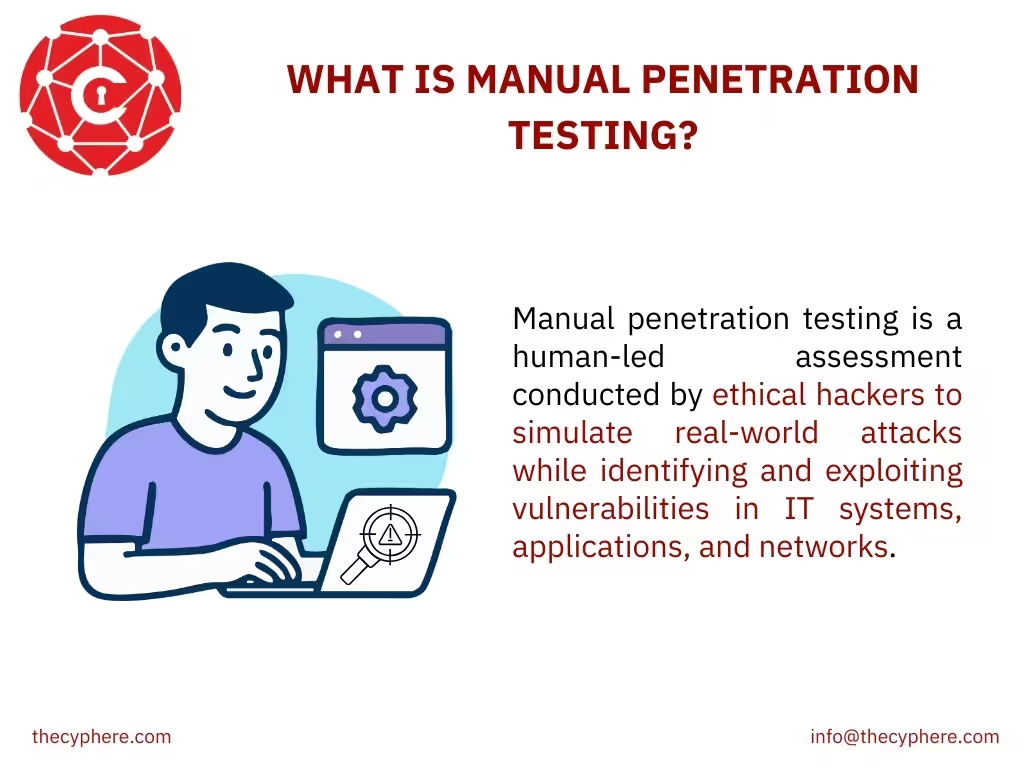
Manual penetration testing is a human-led assessment performed by ethical hackers to simulate real-world attacks while identifying and exploiting vulnerabilities in IT systems, applications, and networks. Manual penetration testing works by gathering information about the target system, conducting vulnerability analysis with manual techniques and specialised tools (Metasploit, Burp Suite), exploiting discovered vulnerabilities to assess their real-world impact, and finally submitting a detailed findings report.
Almost 37% of organisations hire third-party manual penetration testing service providers, while 17% rely on their in-house security teams to conduct manual pentests, according to The State of Pentesting Survey 2025.
How to perform manual penetration testing?
Ethical hackers perform Manual penetration testing by simulating the tactics of real attackers to identify security weaknesses in networks, applications, and systems.
Listed below are five short steps for performing manual penetration testing.
- Reconnaissance: Reconnaissance is used in manual penetration testing to gather all the information about the target system (vulnerable entry points, network structure, technologies).
- Vulnerability analysis: Vulnerability analysis is performed by a manual penetration tester using both manual techniques (input manipulation, logic flaw exploitation) and specialised tools (Burp Suite, Metasploit). Manual pentesters review code, system behaviour, and configuration to identify weaknesses.
- Exploitation: In manual penetration testing, exploitation is used to assess the real-world impact of discovered vulnerabilities (SQL Injection, Cross-Site Scripting/XSS). Manual pentesting experts may write custom exploits or utilise public tools to exploit a vulnerability, just like attackers would breach the system.
- Post-Exploitation: Post-exploitation is performed in manual penetration testing to assess the extent of potential damage. A manual pentester escalates privileges and moves laterally within the system after gaining initial access to the system.
- Reporting: Reporting involves documenting all findings, including discovered vulnerabilities, exploited vulnerabilities (XSS, SQLi), attack paths, and remediation recommendations.
What tools are used to perform manual penetration testing?
Manual penetration testing tools are software applications used by security professionals to identify, exploit, and assess vulnerabilities in systems, networks, or applications through hands-on, targeted testing.
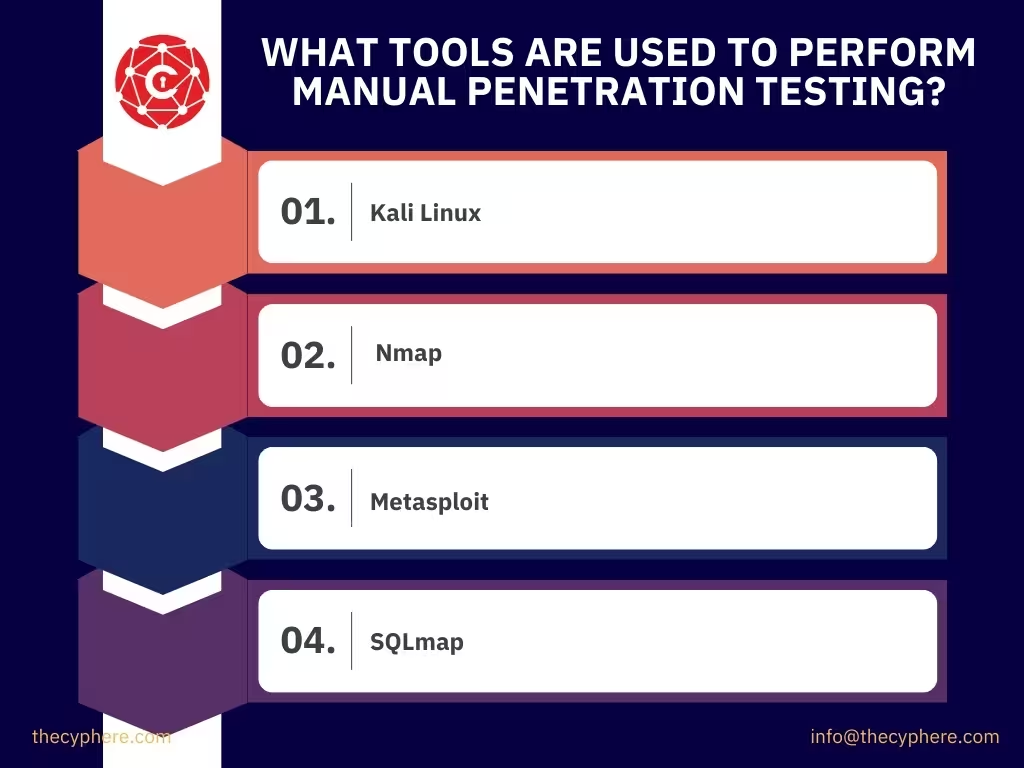
Listed below are 4 tools commonly used for manual penetration testing.
- Kali Linux: Kali Linux provides all the tools required for various stages of penetration testing (reconnaissance, exploitation, vulnerability analysis). A manual penetration tester uses Kali Linux as the primary operating system, which supports multiple network services, forensic tools, and exploitation frameworks (Metasploit, Nmap). Unique features of Kali Linux include password cracking, live boot, web application testing, and wireless attacks.
- Nmap: Manual pentesters use Nmap to map out a network by discovering vulnerabilities, services, and hosts during the first stage of penetration testing. Nmap helps manual pentesters to identify active devices, running services, and open ports of the network for potential vulnerability assessment. Nmap’s unique features include port scanning, service version detection, operating system detection, and the Nmap scripting engine.
- Metasploit: A manual penetration tester uses Metasploit to discover and exploit vulnerabilities. Pentesters simulate attacks using known exploits and gain insight into how an attacker would breach systems. Unique features of Metasploit include Meterpreter, custom payload creation, extensibility, and the exploit database.
- SQLmap: A manual penetration tester uses SQLmap to find and exploit SQL injection vulnerabilities by performing different tasks (taking control of the database server, accessing user credentials, and extracting database information). Manual penetration testers require SQLmap to test web applications that interact with databases. Unique features of SQLmap include support for advanced injection techniques (second-order, time-based blind), database fingerprinting, and post-exploitation.
How much does it cost to perform manual penetration testing?
The cost of manual penetration testing ranges from approximately £5,000 to over £100,000+ on average. Factors affecting the price of manual penetration include system complexity, the scope of the test (network, web, or mobile), duration, test types (black box, white box, or grey box), the expertise of the manual penetration service provider, and the level of reporting required.
What is automated penetration testing?
Automated penetration testing is a process of using software to identify and exploit security vulnerabilities in IT systems, applications, and networks. Computerised tools (Burp Suite, Nmap) execute penetration tests by running scripts and commands that mimic real-world attack scenarios.
Over 50% organisations rely on automated penetration testing to support their in-house team, according to The State of Pentesting Survey 2025.
How to perform automated penetration testing?
Pentesters perform automated penetration testing by using tools (Burp Suite, ZAP) to gather information, conduct vulnerability scans, exploit discovered vulnerabilities, and generate a high-level report of findings.
Listed below are five short steps to perform automated penetration testing.
- Target scope and definition: Pentesters define the objective and scope of automated penetration testing by identifying systems, networks, and applications to be tested.
- Automated Information Gathering: Pentesters use Shodan and OSINT techniques initially to map the target environment. Data collection is streamlined through scripts or automated scanners (Nmap) for gathering data on open ports, system configurations, and services.
- Vulnerability Analysis: Pentesters run automated scanners (ZAP, Nessus) to detect known security vulnerabilities (injection flaws, broken authentication, missing patches). Machine learning models classify and prioritise security flaws based on exploitability and risk factors.
- Exploitation: Penteter uses AI-driven frameworks (AttackIQ, Deep Exploit)to generate an attack path and simulate real-world attack behaviour. Tools like Metasploit are used during automated penetration testing to exploit discovered vulnerabilities.
- Reporting and Remediation: Pentesters generate detailed reports of all the findings of automated penetration testing. Tools with large language models are used to add remediation advice in the report.
What tools are used to perform automated penetration testing?
Tools are used in automated penetration testing to scan systems, detect vulnerabilities, and simulate attacks much faster than manual testers, according to a 2025 study by Dhananjai Sharma Shria Verm, titled Automated Penetration Testing using Large Language Models”.
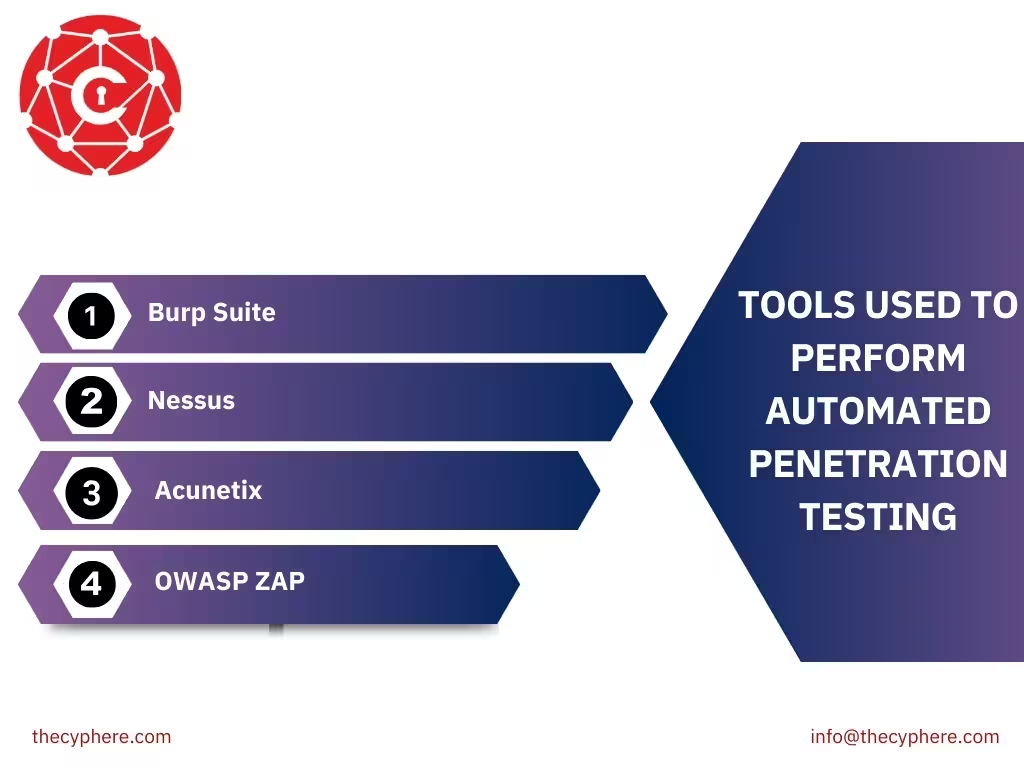
Listed below are 4 tools used for performing automated penetration testing.
- Burp Suite: Burp Suite run automated active scans on web applications to detect common flaws (file inclusion, SQLi). Burp Suite reduces the time required by a security analyst to identify reproducible issues that can be validated manually. Unique features include a built-in active scanner, an extensible scanner, a smart crawler/capture system, and vulnerability evidence (response traces, PoC).
- Nessus: Nessus run automated scans across IP ranges to identify vulnerable services and configuration weaknesses at scale. Security professionals rely on Nessus to generate a risk-rank report, which enables them to proceed with follow-up exploitation and remediation. Unique features of Nessus include compliance and policy templates (PCI, CSI), clear remediation steps, and credentials scan.
- Acunetic: Acunextix crawls and scans web applications (SPs and APIs) to detect broken authentication and SQL injection flaws. Security professionals rely on Acunextix for generating actionable vulnerability reports and running automated pre-release scans and guardrails against regression in DevSecOps. Unique features of Acunextix include we hook, issue-tracker integration, JSON/REST scanning capabilities, and Proof-of-exploit attachment.
- OWASP ZAP: OWASP ZAP schedules and runs passive/active scans on web applications through its Powerful REST API and CLI. Security professionals rely on OWASP ZAP to automate fuzzing, backline checks for quick feedback during the development process. Unique features include a headless model, automation hooks, passive scanning, and scripting (JavaScript/Groovy/Python).
What is the cost of performing automated penetration testing?
The cost of automated penetration testing ranges from £500 to £1,000 for a single scan by a self-service platform to one automated single app scan by a pentester, respectively. Factors affecting the cost of penetration testing include the number of assets (domains, apps), frequency (one-time, continuous), complexity (single-page app, microservices), and reporting and false-positive triage (analyst review, remediation).
Manual Vs Automated Penetration Testing: Which one is better for me?
There is no single better approach for penetration testing. Manual Penetration Testing excels when pentesters deal with logic-based vulnerabilities, complex applications, and situations requiring human intuition and creativity. Human pentesters detect security flaws, business logic errors, and chained exploits that automated scans often miss. Manual penetration testing is a more effective approach for assessing critical systems and conducting high-stakes compliance audits, as it requires creative problem-solving skills to identify complex attack vectors.
Automated penetration testing is considered the best approach when priorities are scalability, continuous testing, and efficiency. Organisations detect common vulnerabilities (outdated software, misconfigurations) quickly with automated tools. Automated penetration testing is a cost-effective approach for routine and consistent security coverage in a fast-paced development environment.
According to a user, an automated penetration testing tool runs a predefined list of scripts looking for vulnerabilities that a human pen tester should be able to find. Its pros are continuous scanning and the speed at which it’ll find a lot more in a shorter period of time. Users look for features such as a low false-positive rate, integration into development workflows (CI/CD), developer-friendly reporting, and the ability to customise rules and testing when selecting an automated penetration testing tool.
The comparison of manual penetration testing with automated penetration testing is described in the table below.
| Feature | Manual Penetration Testing | Automated Penetration Testing |
| Accuracy | High, produce low to zero false positives | Low, high false positives |
| Vulnerabilities | Suitable for detecting complex and contextual vulnerabilities | Ideal for detecting basic vulnerabilities |
| Speed | Low, due to in-depth human analysis | High, scan multiple assets simultaneously |
| Scalability | Low, depends on the pentester’s availability | High, ideal for large networks and frequent scans |
| Cost | Average £5,000 to over £100,000+; more expensive due to human expertise and time | £300 to £1,200 per month; cost-effective, suitable for one-time scans and continuous monitoring |
| Social Engineering Simulation | Applicable; include phishing, physical testing, and vishing | Not applicable; automated tools can’t simulate human deception |
| Business logic testing | Excellent; pentesters understand business logics and workflows | Poor; tools can’t understand complex logic or business rules |
| Vulnerability coverage | Identifies chained exploits, custom vulnerabilities, and deep logic issues | Identifies surface-level, known vulnerabilities and misconfigurations |
| Creativity | High; pentesters adapt testing strategy based on asset behaviour | Limited tools follow pre-defined rules and scripts |
| Human Insight | Yes | No |
| Adaptability | High; pentesters adjust to a unique environment and unexpected results | Limited; tools require manual configuration for new systems |
| Best Use Cases | Bespoke apps, complex and high-risk systems, compliance audits | Routine vulnerability scans, continuous monitoring |
| Customisation | High, based on threat model and environment | Limited, based on the tool feature and configuration |
| Integration with CI/CD | Manual testing is done periodically and post-deployment. (No integration) | Easy integration with CI/CD pipelines for continuous testing |
| Compliance Support | Excellent for PCI DSS, ISO/IEC 27001, NIS Directive | Supports compliance scan, but lacks depth for audits |
| Learning and Skill Requirement | Require skilled ethical hackers | Minimal, IT staff manage automated tools with basic training |
| Reporting Quality | High, based on human experience, creativity, and intuition | Low, generic report with limited explanation |
What are the advantages of manual penetration testing when compared to automated penetration testing?
Seven advantages of manual testing when compared to automated penetration testing are listed below.
- Human Expertise: Manual testing relies heavily on human expertise and creativity to detect complex, logic-based issues (payment or workflow bypasses), or new vulnerabilities that are usually missed by automated penetration testing.
- Reduce false positives: Manual penetration testing is more effective in uncovering vulnerabilities than automated testing, as manual testers can focus on security weaknesses and avoid false positive results, according to a 2024 study by Nikhil Rane, titled “Comparative Analysis of Automated Scanning and Manual Penetration Testing for Enhanced Cybersecurity.”
- Advanced social-engineering: A manual pentester simulates realistic social engineering tests (phishing, vishing, physical entry) based on the organisation’s role and culture to expose human attack vectors that automation cannot detect.
- Creative and contextual attack: Creative manual testers invent novel exploits tailored to specific scenarios based on domain knowledge by turning small misconfigurations into high-impact risks. Automation tools can’t invent such a novel attack.
- Exploration of chained vulnerabilities: Human pentesters discover multi-step exploit chains in the system by linking low-severity issues into critical attack paths. Automated penetration testing tools don’t produce exploit chains.
- Human Intuition for adoptability: Human pentester improvises and probes smartly when an app behaves oddly or undocumented features exist. Fixed rule-based scanners are not adaptable to new or evolving threats, zero-day attacks, or novel attack techniques.
- Tailored testing for unique environments: Manual pentesters tailor penetration tests for unique environments (legacy systems, bespoke APIs) by using a custom scope, threat models to produce relevant findings, and remediation guidance. Customisation is limited in automation.
What are the advantages of automated penetration testing when compared to manual penetration testing?
Eight advantages of automated penetration testing when compared to manual penetration testing are listed below.
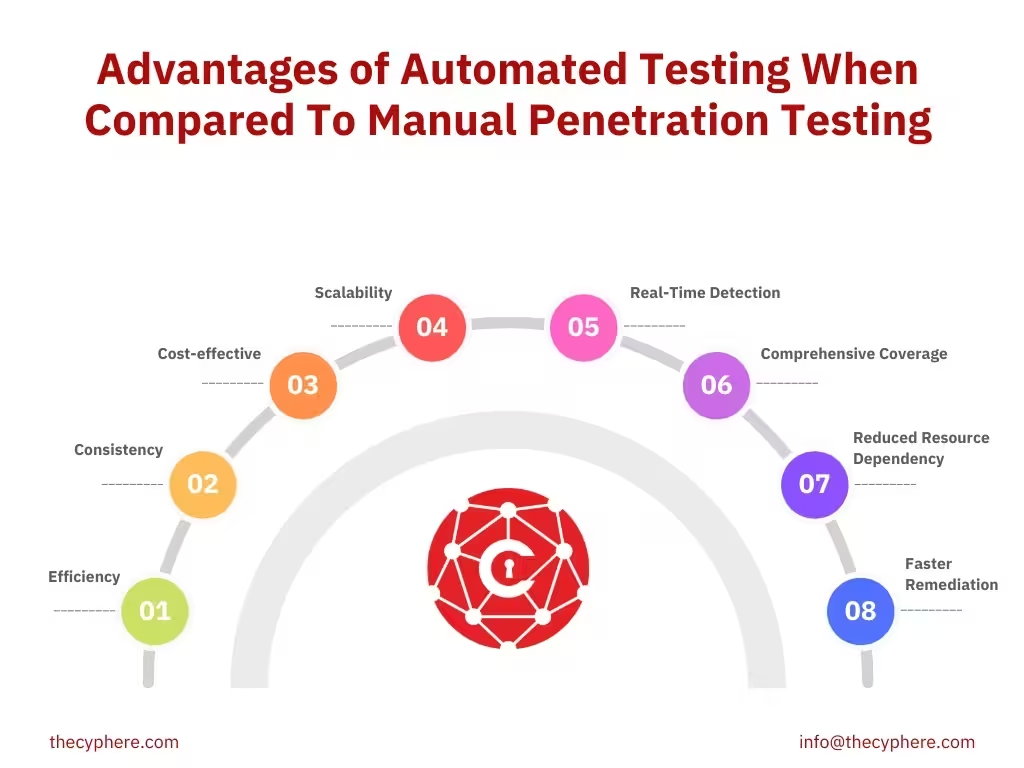
- Efficiency: Automated tools quickly scan large networks and identify common vulnerabilities, saving significant time compared to manual methods, according to a 2023 study by M. Alhamed, titled “A Systematic Literature Review on Penetration Testing in Networks: Future Research Directions”.
- Consistency: Automated penetration testing tools use predefined testing scripts and algorithms to perform scans in a consistent and repeatable manner, while minimising human errors.
- Cost-effective: Automated penetration testing is more cost-effective than manual testing when an organisation needs recurring, routine scans or large-scale vulnerability assessments.
- Scalability: Automated frameworks outperform traditional methods and even human testers as network size increases, according to a 2023 study by M. Alhamed, titled “A Systematic Literature Review on Penetration Testing in Networks: Future Research Directions”.
- Real-Time Detection: Automated penetration tools are integrated with DevSecOps pipelines, offering real-time security testing through continuous integration and continuous deployment (CI/CD) processes.
- Comprehensive Coverage: Automated penetration testing is useful for comprehensive scanning of multiple attack vectors (open ports, outdated software). Manual testing of numerous attack vectors would be time-consuming and challenging.
- Reduced Resource Dependency: Automated penetration testing is performed using vulnerability scanners, thereby eliminating the dependency on highly skilled human pentesters.
- Faster Remediation: Automated penetration testing tools deliver instant remediation to help organisations respond to threats (XSS, open ports) in a more timely manner than manual penetration testing
What is the future of manual and automated penetration testing?
The future of manual penetration testing is hybrid, with automation and AI taking over routine tasks. Human expertise remains crucial for navigating complex environments (large IoT systems, legacy systems), addressing business logic flaws (discount manipulation, order/workflow bypass), mitigating advanced social engineering, and resolving chained vulnerabilities (SQL Injection → write web shell to disk → remote code execution → lateral movement). Manual penetration testing is likely to remain important in the future, especially for discovering severe and unique vulnerabilities that automated tools may overlook, according to a 2022 study by Sarah Elder, titled “Do I really need all this work to find vulnerabilities?”
Some trends shaping the future of automated penetration testing tools are AI and Machine learning integration, efficiency boost, context-aware testing, and scalability. The future of penetration testing is expected to focus on automated tools powered by machine learning and deep reinforcement learning, especially for wireless networks (WLAN). Automated tools aim to detect a wider range of vulnerabilities more quickly and efficiently than manual methods, according to a 2023 study by M. Alhamed, titled “A Systematic Literature Review on Penetration Testing in Networks: Future Research Directions”.