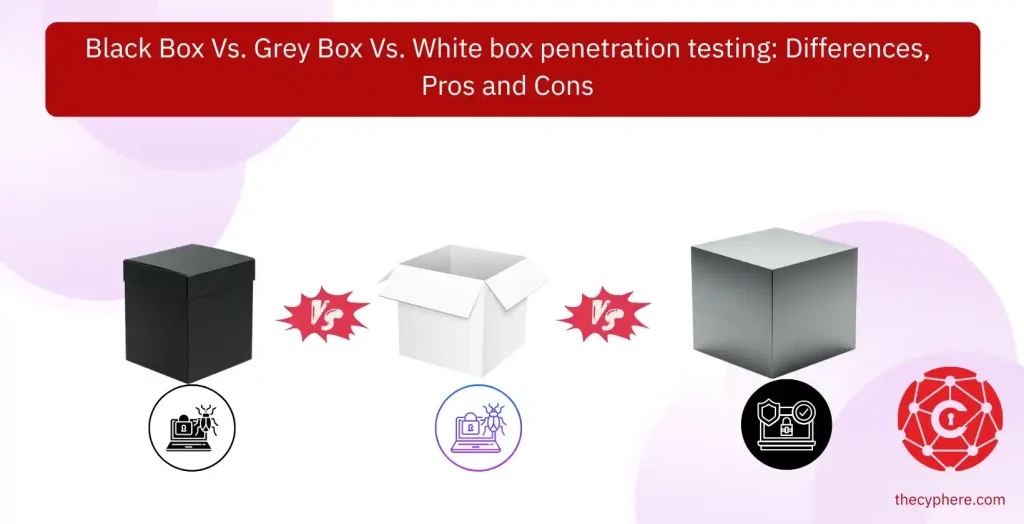
Black box, grey box, and white box testing methodologies all fall under the knowledge level types of penetration testing, which is a part of the broader field of ethical hacking and cybersecurity assessment.
Black box penetration testing simulates an unauthenticated external attacker and is performed with the tester having no prior knowledge of the target system’s infrastructure.
Grey box penetration testing simulates an insider threat or compromised user and is performed with the tester having limited knowledge of the target (authenticated user credentials or network diagrams).
White box penetration testing simulates an internal developer or auditor and is executed with the tester having complete knowledge of the target (source code access, internal IP addresses, and configuration information).
The main differences between black box, grey box, and white box penetration testing are the level of initial knowledge, access to system internals, realism of attack simulation, vulnerability coverage depth, time required for reconnaissance, required tester skills, cost and time efficiency, and root cause analysis.
Grey box penetration testing is considered the most practical type of penetration testing because it provides a realistic simulation of a malicious hacker who has successfully gained an initial foothold.
Choose black box testing to check perimeter defences and the team’s incident response capability against an attacker with no internal knowledge.
Choose grey box testing for a cost-effective and time-saving test that simulates an insider threat or an attacker who has compromised a standard user account.
Choose white box testing to perform a security review during the development process or after a major code change to catch flaws before deployment.
What is black box penetration testing?
Black box penetration testing is a security assessment methodology with no prior knowledge of the target system’s internal structure, network architecture, or source code for the pentester.
Black box penetration testing is also called external testing.
Black box penetration testing offers maximum realism and unbiased assessment, focusing on reconnaissance. Black box penetration testing is used to validate external security, meet compliance, and get an unbiased view. Black box penetration testing is the hardest approach for a penetration tester because of a lack of knowledge, time-consuming reconnaissance, and difficulty in achieving high coverage. This difficulty increases the pentester’s manual skill, experience, and creativity to find weaknesses that automated tools might miss. Black box penetration testing is done frequently for simulating external threats (external perimeter and security layers) and meeting compliance requirements (WAF bypasses, network segmentation and patch management effectiveness).
What is grey box penetration testing?
Grey box penetration testing is a balanced security assessment methodology that combines the lack of knowledge in black box testing and the full disclosure of white box testing.
Grey box pentesting is referred to as ‘translucent box testing’.
Grey box penetration testing features are insider threat simulation, efficiency and focus, and test access controls. Grey box penetration testing identifies authenticated vulnerabilities, such as broken access controls and business logic flaws. Grey box pentesting determines the extent of damage an attacker with limited internal access could inflict.
Grey box penetration testing is used to test web applications, internal networks, APIs, cloud environments, balance cost and depth and meet compliance. Grey box penetration testing is of moderate difficulty for the penetration tester. The challenge lies in exploiting the partial information to find subtle logic flaws and access control bypasses.
Grey box testing is one of the most commonly requested and performed types of penetration testing in the industry (for web applications, complex systems, API testing, and internal networks).
What is white box penetration testing?
White box penetration testing is a security assessment methodology where the pentester is granted full knowledge of the target system, such as access to source code, architecture diagrams, and internal IP address spaces. White box pentesting is also called crystal box testing.
White box penetration testing has maximum depth and focuses on internal flaws and efficiency in discovery to ensure that the underlying architecture and source code are free from complexity.
White box penetration testing is used to secure high-value assets, perform security code reviews, and audit complex logic. White box penetration testing requires advanced skills in programming, code analysis (Static and Dynamic Application Security Testing – SAST/DAST), and application architecture.
White box pentesting is a widely used approach in penetration testing for insecure coding patterns, hardcoded secrets, and subtle business logic flaws.
What are the differences between black box, grey box and white box penetration testing?
The differences between black box, grey box and white box penetration testing are in knowledge level, tester access, focus area, realism, coverage, skills required, cost and time.
Black box penetration testing is ideal for simulating real-world external attacks. White box penetration testing offers the most comprehensive coverage and can uncover deep, code-level issues.
Grey box penetration testing combines the advantages of both and is preferred for its efficiency and broader coverage in complex systems.
Many cybersecurity experts suggest a combination of these methods to maximise security, as each uncovers different types of vulnerabilities, according to 2024 research by Kozel et al., titled “Research of Penetration Testing Methods”.
We at Cyphere advocate Grey Box testing for most scenarios. Black Box simulates an attacker with zero knowledge. This approach works well for external perimeters but consumes significant time. White Box provides full system knowledge, including source code, enabling deep-dive auditing. Grey Box offers the optimal balance between output and investment. Grey Box testing mimics a compromised insider or standard user role. We receive credentials to test internal controls.
This makes assessments efficient and relevant to real-world threats. The methodology combines the threat realism of Black Box with the thorough auditing of White Box. This balanced approach delivers comprehensive security insights without excessive time or cost investment. You gain a complete picture of your security posture aligned with actual business risks.
Listed below is the table of differences between black box, grey box and white box penetration testing.
| Feature | Black Box Penetration Testing | Grey Box Penetration Testing | White Box Penetration Testing |
| Knowledge Level | No | Partial | Full |
| Access to Source Code | No | No | Yes |
| Access to System Architecture | No | Partial | Yes |
| Credentials Provided | No | Yes | Yes |
| Tools and Techniques | external scanners, fuzzers, social engineering, and network mapping. | Standard user access tools, API testing tools, and authenticated scanners. | Static Analysis (SAST) tools, debuggers, and manual code review. |
| What Does It Cover | external attack surface, perimeter defences, and network-level flaws. | Authorisation, authenticated application logic, and privilege escalation. | Internal logic, coding errors, data flow, and deep system misconfigurations. |
| Vulnerability Detection Rate | Low | Medium | High |
| Attack Realism | High | High | Low |
| Penetration Testing Approach | External | targeted, hybrid, and efficiency-focused. | Internal and code-centric. |
| Report Comprehensiveness | Medium | High | High |
| Root Cause Analysis | No | Limited | Yes |
| Remediation Depth | Surface-level depth | Logic and control fixes | Code and architectural fixes |
| Code-Level Insights | No | No | Yes |
| Time to First Vulnerability | Long | Short | Short |
| Advantages | Has the highest realism and the highest realistic simulation. | Highest efficiency and best ROI. | Has the highest coverage, finds the deepest flaws, and enables “shift-left” security. |
| Disadvantages | Lowest coverage, time-consuming, and misses internal flaws. | Limited code insights | highest cost, lowest realism, and potential for information overload/bias. |
| Automation Support | High | Moderate | High |
When to choose black box penetration testing?
Black box penetration testing should be chosen when the organisation’s primary objective is to simulate the initial stages of an attack by an external and unauthorised adversary. It evaluates the effectiveness of the external network perimeter, including firewalls, IDS/IPS, and public-facing services. Black box pentesting is mandated by compliance standards requiring a test from a completely untrusted perspective.
When to choose grey box penetration testing?
Grey box penetration testing is the best option when the goal is to achieve an optimal balance between realism and testing efficiency. It focuses on the most common real-world threats, such as a compromised user or an insider. Grey box pentesting is important for testing complex authorisation flaws, such as vertical and horizontal privilege escalation within authenticated applications. It is a highly cost-effective method for deeply assessing API endpoints and business logic accessible only after login.
When to choose white box penetration testing?
White box penetration testing is chosen when the highest possible depth of coverage and code-level certainty is required for securing complex or high-risk systems. White box pentesting allows for comprehensive source code analysis to discover subtle logic flaws and insecure cryptographic practices. White box penetration testing is widely used for high-risk industries, but its execution is a formal audit of the application’s security.
Black box vs. grey box vs. white box penetration testing: Testing Duration
Black box pentesting results in a longer execution time than white box and grey box penetration testing. Black box pentesting takes the longest time (2 to 6weeks), as a pentester dedicates significant hours to the initial, arduous reconnaissance and asset discovery phase. Grey box pentesting takes 3 to 7 days, as the provision of partial information eliminates extensive initial mapping. White box pentesting takes 2 to 3 weeks, as the large codebases and extensive documentation require substantial time for the highly specialised pentester.
Black box vs. grey box vs. white box penetration testing: Pentesting Cost
White box pentesting costs more than black box and grey box penetration testing. Black box pentesting costs between £3,500 and £50,000+ because the tester must spend significant time and effort on the initial, complex reconnaissance and asset discovery phases. White box penetration testing costs between £4,500 and £50,000+ due to the need for highly specialised security experts who can perform meticulous code review and deep internal logic analysis. Grey box penetration testing costs between £3,000 and £25,000+, as it is the most cost-effective balance to provide partial information.
Black Box vs. Grey Box Vs White Box penetration testing: Skills Required
The skills required for black box, grey box, and white box penetration testing are different. Black box pentesting requires expertise in reconnaissance, open-source intelligence (OSINT), and network-level exploitation, as the tester must possess exceptional skill. Grey box pentesting demands a balanced combination of black box external testing skills and internal application knowledge, with a strong focus on business logic flaws, authorisation testing, and privilege escalation. White box pentesting requires the most specialised level of technical skill, demanding expertise equivalent to an experienced software developer or security architect.
Black box vs. grey box vs. white box penetration testing: Communication Level
The communication level for Black Box pentesting is lower than for Grey Box and White Box pentesting. In Black Box pentesting, the communication level is the lowest and most restricted during the active testing phase. Grey box pentesting requires a moderate and focused level of communication, centred on securely exchanging the necessary partial knowledge (test credentials, limited documentation) to commence testing. White box pentesting demands the highest and most continuous level of communication, as the tester requires frequent dialogue with developers, architects, and system owners.
Black box vs. grey box vs. white box penetration testing: bias/accuracy
Black box pentesting offers higher realism than grey box and white box pentesting. Black box pentesting offers the lowest bias and highest realism because the tester operates with zero internal knowledge. White box pentesting provides the highest coverage accuracy and comprehension by granting full access to source code and documentation. Grey box pentesting achieves the optimal balance and minimises reconnaissance, which leads to higher coverage accuracy in authenticated areas than black box pentesting.
Black Box vs. Grey Box Vs White box penetration testing: Test Scenario Complexity
Black Box pentesting scenarios have lower internal logic complexity than grey box and white box pentesting. Black box pentesting scenarios have the lowest internal logic complexity, which focuses on the difficulty of initial discovery, reconnaissance, and perimeter evasion. Grey box pentesting scenarios strike a balance and achieve medium technical complexity to focus on attacks against authenticated workflows, authorisation flaws (privilege escalation), and targeted business logic manipulation. White box pentesting scenarios possess the highest technical complexity and depth, centred on source code integrity, data flow tracing, and path coverage.
Black Box vs. Grey Box Vs White box penetration testing: Application Domain Suitability
The application domain suitability is different for black box, grey box, and white box pentesting. Black box pentesting is best suited for assessing the security of the external network perimeter and publicly facing web applications. Black box pentesting provides the most realistic simulation of an external attacker with zero prior knowledge. Grey box pentesting excels when evaluating authenticated web applications, internal network segments, and APIs. White box pentesting secures custom-built applications, high-risk systems in regulated industries, and embedded devices.
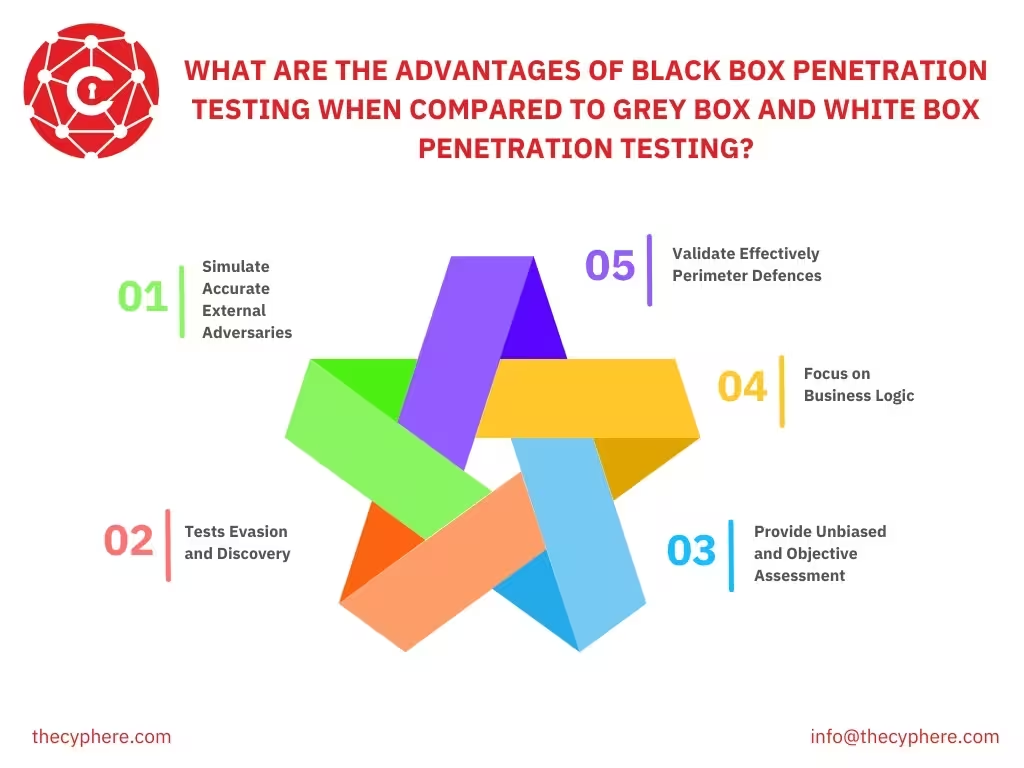
What are the advantages of black box penetration testing when compared to grey box and white box penetration testing?
Listed below are the advantages of black box penetration testing when compared to grey box and white box penetration testing.
- Simulate Accurate External Adversaries: Black box penetration accurately simulates the perspective of an external and real-world attacker. Black box pentesting is unlike grey box and white box pentesting, as the pentester performs the time-consuming reconnaissance to find an initial entry point. Black-box testing is the fastest type of penetration test due to the limited information available to testers.
- Tests Evasion and Discovery: Black box penetration testing forces the tester to use the same techniques to gather information and bypass perimeter defences (firewalls, WAFs, and intrusion detection systems). The defences are bypassed when internal knowledge is provided (grey or white box).
- Provide Unbiased and Objective Assessment: Black box pentesting is completely unbiased by the organisation’s or development team’s assumptions about how the system works. The black box pen tester receives no internal documentation or source code. White box pentesting is focused on technical vulnerabilities, and black box pentesting offers an objective view of what is exploitable from the internet.
- Focus on Business Logic: The black box pen tester often leads to the discovery of business logic flaws (bypassing price checks, exploiting an ordering workflow) that are overlooked in a code review. White box pentesting is excellent for finding technical vulnerabilities, but business logic flaws are apparent with black box pentesting.
- Validate Effectively Perimeter Defences: Black box penetration testing is the most effective way to test the effectiveness of an organisation’s external security controls and monitoring systems (firewalls, DDoS protection, and IDS/IPS).
What are the advantages of grey box penetration testing compared to black box and white box penetration testing?
Listed below are the advantages of grey box penetration testing when compared to black box and white box penetration testing.
- Simulate realistically the most common threat: Grey box pentesting begins with limited access (user credentials and a partial network map). Grey box pentesting is the only model that directly simulates an insider threat (malicious attacker) who has successfully phished credentials and gained initial access.
- Achieve Optimal Balance of Efficiency and Depth: Grey box pentesting provides limited documentation and credentials. Grey box pentesting skips the weeks of time and resources required for a black box pentester to perform initial reconnaissance (footprinting, port scanning, and service enumeration). This significantly reduces the overall engagement time and cost.
- Focus Testing on Internal Logic and Privilege Escalation: Grey box pentesting allows the pentester to immediately focus on business logic flaws, authorisation issues, and privilege escalation within the application. These vulnerabilities only appear after a user is logged in.
What are the advantages of white box penetration testing compared to black box and grey box penetration testing?
Listed below are the advantages of white box penetration testing when compared to black box and grey box penetration testing.
- Perform Deep Source Code Vulnerability Analysis: White box penetration testing enables formal Static Application Security Testing (SAST) and secure code review.
- Achieve Complete Coverage: White box pentesting gives the ability to achieve full code coverage to ensure every line of code is scrutinised. Black and grey-box pentests are limited to the functionality that can be reached and observed externally.
- Optimise Time and Cost Efficiency for Deeper Flaws: white box pentesting is provided with network maps, IP schemas, and architecture diagrams. This skips the time-consuming reconnaissance and mapping phases required in black box pentesting and significantly shortens them compared to grey box pentesting.
- Target Testing on High-risk Components: The white box pentester immediately focuses on the high-risk components and functions (payment processing modules, authentication logic). It leads to a more efficient use of testing time.
- Uncover Code and System Integrity Issues: White box pentesting uncovers vulnerabilities that cannot be found without access to the internal findings. Finding flaws in complex business logic or data validation requires understanding the internal flow, rather than just observing the output (which is the limit of Black Box).
What are the similarities between white box penetration, black box and grey box penetration testing?
Listed below are the similarities between white box penetration, black box and grey box penetration testing.
- Identify Vulnerability Discovery: White box, black box, and grey box penetration testing identify security flaws (weaknesses, misconfigurations, and design flaws) in a system, application, or network.
- Execute Exploitation and Validation: White box, black box, and grey box penetration testing move beyond a simple scan by attempting to exploit the identified flaws. This proves the vulnerability is real and provides a Proof-of-Concept (PoC).
- Determine Risk & Impact Assessment: White box, black box, and grey box penetration testing aim to determine the business impact and risk of the successful exploitation, allowing the organisation to prioritise remediation based on actual exposure.
- Simulate Real Attackers: White box, black box, and grey box penetration testing involve an authorised and simulated attack using the different tools, techniques, and methodologies that malicious hackers employ.