The advantages of penetration testing refer to the positive effects on an organisation’s security posture achieved through the systematic and controlled evaluation of systems, networks, or applications.
The main advantages of penetration testing are vulnerability identification, security control validation, and compliance assurance. Pentesters identify exploitable vulnerabilities (weak passwords, misconfigurations) by simulating a real-world attack scenario before attackers can exploit these vulnerabilities. They validate security controls to ensure that the organisation’s defence systems are working as intended. Pentesting helps organisations meet regulatory compliance requirements by maintaining a strong security posture.
The disadvantages of the penetration testing process refer to the limitations and challenges that an organisation encounters during the systematic and controlled evaluation of its security controls.
The main disadvantages of penetration testing are heavy dependence on expertise, extensive resource requirements, and business operation disruption. Pentesting heavily relies on third-party testers’ expertise, especially for results interpretation and vulnerability discovery. Pentesting is a resource-intensive and time-consuming process that overwhelms security teams with frequent security alerts. It leads to system disruptions during active testing, temporarily affecting business operations while reducing employee productivity.
What are the advantages of penetration testing?
Penetration testing helps organisations by identifying exploitable vulnerabilities, validating security controls, meeting compliance requirements, and preventing financial losses from cyber incidents, while accurately simulating real-world attack scenarios.
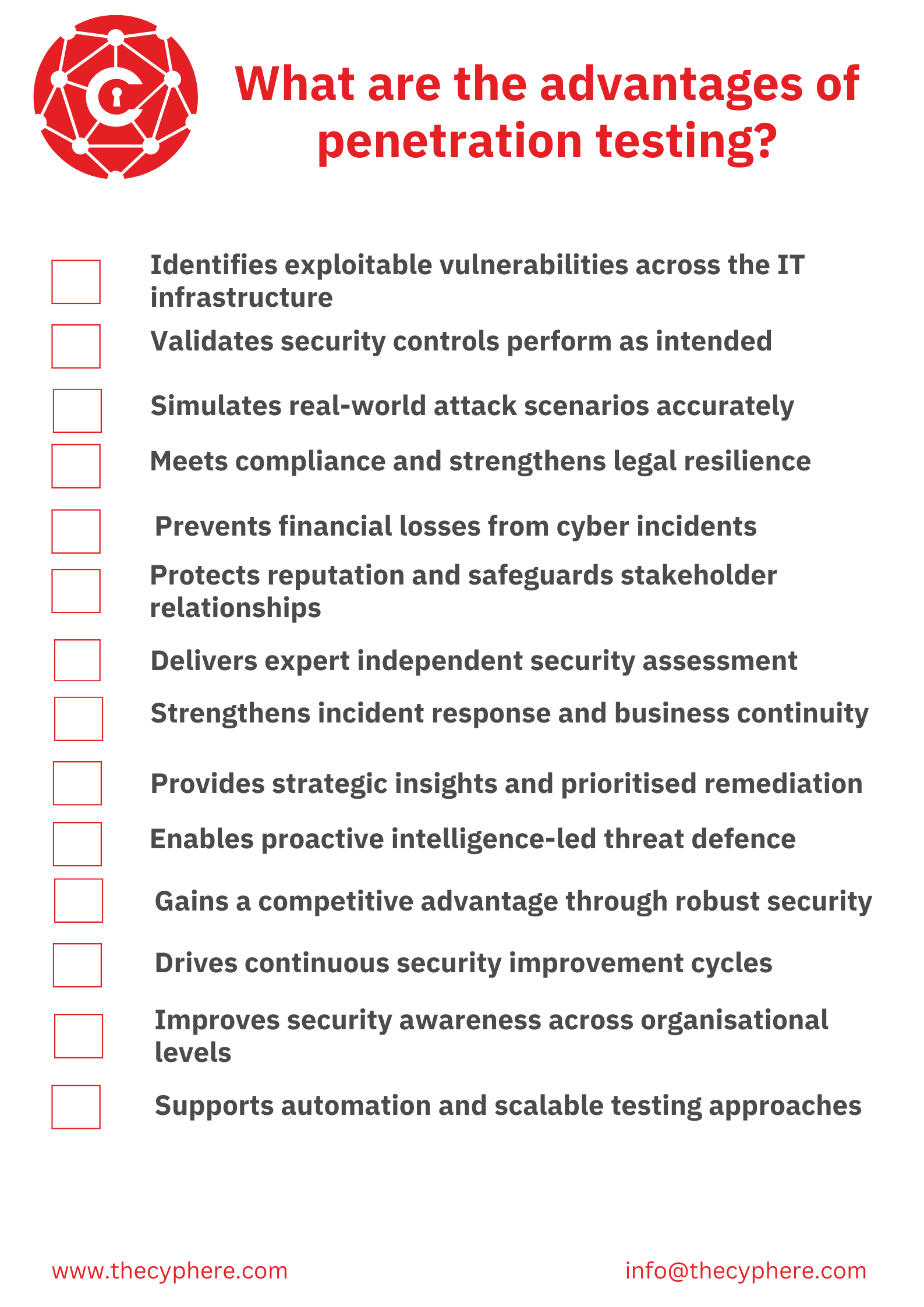
Listed below are 14 advantages of penetration testing.
- Identifies exploitable vulnerabilities across the IT infrastructure
- Validates security controls perform as intended
- Simulates real-world attack scenarios accurately
- Meets compliance and strengthens legal resilience
- Prevents financial losses from cyber incidents
- Protects reputation and safeguards stakeholder relationships
- Delivers expert independent security assessment
- Strengthens incident response and business continuity
- Provides strategic insights and prioritised remediation
- Enables proactive intelligence-led threat defence
- Gains a competitive advantage through robust security
- Drives continuous security improvement cycles
- Improves security awareness across organisational levels
- Supports automation and scalable testing approaches
1. Identifies exploitable vulnerabilities across the IT infrastructure
Penetration testing targets vulnerabilities such as unsafe user behaviour, software flaws, weak authentication, and misconfiguration across servers, endpoints, web apps, wireless, and network devices, according to a 2022 study by Petar Lachkov, titled “Vulnerability Assessment for Application Security Through Penetration Simulation and Testing.”
Pentesters go beyond scanning as they validate exploitability, chain weaknesses (e.g., privilege escalation, lateral movement), and show potential business impact on confidentiality, integrity, and availability (CIA) of assets, according to a 2023 study by A. Fatima, titled “Impact and Research Challenges of Penetrating Testing and Vulnerability Assessment on Network Threat.
Pentesting demonstrates how different vulnerabilities can be chained together, leading to severe security compromises. It allows organisations to fix security gaps and loopholes before attackers can exploit them and thereby improve their overall security posture.
2. Validates security controls perform as intended
Penetration testing validates security controls such as intrusion detection systems (IDS), Firewalls, multi-factor authentication (MFA), and encryption mechanisms within an organisation to ensure that these controls are functioning as intended. Simple implementation of security controls isn’t enough; there is a need to regularly test these controls to prevent or mitigate cyber attacks.
Penetration testing simulates real attacks to see whether existing controls (technical, configuration, and policy) actually prevent or limit compromise in practice, according to a 2018 study by Hessa Mohammed Zaher Al Shebli, titled “A study on penetration testing process and tools. In industrial control systems, pen testing verifies the “effectiveness of security measures” by attacking from an adversary’s viewpoint, according to a 2021 study by Yueliang Zhang, titled “Research and application of penetration testing method in industrial control system”.
Security control validation assures that the organisation’s defence is reliable and capable of stopping actual cyber threats. Organisations take corrective actions (patching vulnerabilities, fixing misconfigurations) if security controls don’t protect the system against potential threats. They prioritise remediation efforts and reduce risks of successful attacks while having the confidence that the security framework is functioning properly.
3. Simulates real-world attack scenarios accurately
Penetration simulates real-world attack scenarios accurately by replicating the tactics, techniques, and procedures (TTPs) used by actual cybercriminals to identify vulnerabilities and weaknesses within an organisation’s IT infrastructure. This simulation demonstrates how a real attacker might exploit the system.
Studies on web apps and networks show that realistic testbeds and step‑by‑step attack chains can reveal subtle bugs (SQL injection, XSS, misconfigurations) that map closely to real attacker behaviour, according to a 2022 study by Petar Lachkov, titled “ Vulnerability Assessment for Application Security Through Penetration Simulation and Testing.”
Case‑study‑based work demonstrates pentests conducted in replicated production environments or isolated testbeds, emphasising realistic topologies and attack paths, while avoiding risk to live systems, according to a 2025 study by Wei Zhang, titled “Penetration Testing for System Security: Methods and Practical Approaches.”
These real-world attack simulations provide organisations with a realistic assessment of their security posture and help them understand the potential severity of an attack. Organisations look into security gaps that lead to further compromises (lateral movement or privilege escalation). They prioritise remediation efforts to prevent a chain reaction of security breaches and minimise the potential damage to their assets and reputation. Phishing simulation services strengthen this approach by testing human susceptibility to social engineering, ensuring both technical and user-level attack vectors are addressed together.
4. Meets compliance and strengthens legal resilience
Penetration testing meets compliance by simulating real-world attacks to identify and fix vulnerabilities, and thereby providing documented proof that security controls work within organisations, as required by standards PCI DSS and GDPR. Pentesters go beyond automated vulnerability scans as they validate security defences against specific regulatory requirements and provide evidence for audits. Organisations ensure continuous improvement in their security postures to avoid fines and build customer trust. Penetration testing alongside cybersecurity compliance services helps companies achieve compliance with ISO 27001 and GDPR.
In sectoral contexts (financial institutions, crypto exchanges, academia, healthcare), pentesting is framed as necessary to meet rising regulatory expectations and protect sensitive data, according to a 2025 study by Areeza Shahirah Mohamad Safari, titled “A Case Study of Penetration Testing Implementation in a Financial Institution: Lessons Learned and Best Practices.”
Regular, documented pentests are required or strongly encouraged in many regimes (PCI DSS, ISO 27001, SOC 2, HIPAA, GDPR). Pentests are treated as evidence of proactive risk management and reasonable security controls, according to a 2023 study by Kamal Uddin Sarker titled “Penetration Taxonomy: A Systematic Review on the Penetration Process, Framework, Standards, Tools, and Scoring Methods”
Penetration testing strengthens legal resilience by reducing an organisation’s exposure to regulatory penalties. Pentesters obtain a clear scope, written authorisation and rules of engagement before starting any test to avoid breaching computer misuse laws. Output from penetration testing is a standard report used in audits, risk registers, and broad-level decisions. This report and its findings strengthen the organisation’s position in case of any contract dispute, investigation and insurance claims. Thorough contracts and purpose statements mitigate legal and reputational risk in red‑team and pentest exercises, according to a 2024 study by Tarandeep Singh, titled “Ethical Hacking and Penetration Testing.”
5. Prevents financial losses from cyber incidents
Penetration testing prevents financial losses from cyber incidents. Cyberattacks such as ransomware, data breaches, and system compromises lead to significant financial damage, including the cost of regulatory fines, recovery efforts, and legal actions. According to the IBM Cost of a Data Breach Report, the average cost of a data breach globally is £4.14 million. Penetration testing minimises the possibility of these costly incidents and safeguards organisations from substantial costs associated with cyberattacks.
Penetration testing saves the company much more funds, effort, and time to remediate from a successful attack. Pentesting protects a company’s reputation and finances. It does this by finding security flaws—like those leading to data theft or service outages- before they can be exploited, according to a 2021 study by Bandar Abdulrhman Bin Arfaj, titled “Efficacy of Unconventional Penetration Testing Practices”
Pentesting uncovers weaknesses in an organisation’s security posture that could lead to financial harm if left unaddressed by simulating realistic attack scenarios. For example, a successful data breach could lead to customer data theft, which may trigger lawsuits, fines, and loss of customer trust. Similarly, a ransomware attack could disrupt operations and demand costly ransoms.
A successful data breach leads to customer data theft that triggers lawsuits, fines, and loss of customer trust. A ransomware attack could disrupt business operations until businesses meet the costly ransom demand of attackers. Penetration testing reduces revenue/capital losses from malicious attacks by minimising service downtime and helping avoid or decrease fines and lawsuits for security breaches, according to a 2024 study by Yazeed Alkhurayyif, titled “Adopting Automated Penetration Testing Tools.”
The financial impact of a cyberattack goes beyond direct cost as it also includes loss of business opportunities, an increase in insurance premiums, and a decline in the market value of a business. Penetration testing protects organisations from these financial consequences while ensuring that businesses remain secure, compliant, and financially stable.
6. Protects reputation and safeguards stakeholder relationships
Penetration testing protects reputations and safeguards stakeholders’ relationships by identifying and fixing vulnerabilities that could lead to serious security breaches. A security breach led to serious damage to the organisation’s public image, which can take years to rebuild.
Public perception of an organisation is directly related to customer trust, brand loyalty and overall business success. A high-profile breach reduces customers’ confidence in the company’s ability to safeguard customers’ personal/financial information, leading to reduced sales, cancelled contracts, and even losing clients.
Customers and other stakeholders (employees, investors, partners) don’t like to interact or engage with a company with weak security or a history of data breaches. Cybersecurity incidents cause investors to question an organisation’s management and financial stability, leading to a decrease in stock value and a decline in investment. Employees don’t like to work in an organisation where they have security concerns. Partners hesitate to continue business relations with an organisation with security weaknesses that are considered potential financial risks. Penetration testing enhances the trust of customers and business partners in the company, demonstrating a commitment to protecting their sensitive data.
Regular testing is now expected or mandated under standards like ISO 27001, SOC 2, PCI DSS, HIPAA, and GDPR, helping signal responsible cyber risk management to regulators and partners, according to a 2025 study by Yu.M. Lisetskyi, titled “Penetration testing as a means of increasing the level of information systems cyber protection.”
In software startups, proactive pentesting best practices entail upfront cost but clearly reduce expected financial and reputational losses, and help win and retain clients, according to a 2024 study by Ahmed Ali Gaafar, titled “Penetration Testing: A Cost-Benefit Analysis of Best Practices Implementation for Software Startups.
7. Delivers expert independent security assessment
Penetration testing delivers an expert, independent security assessment of an organisation’s cybersecurity posture. This independent evaluation presents an objective perspective free from internal biases and assumptions regarding organisational security. Pentesters are a team of ethical hackers who uncover risks that otherwise go unnoticed by an organisation’s internal team. They have specialised knowledge of vulnerability analysis, networking protocols, attack methodologies, evasion techniques and social engineering to test security defences against sophisticated or novel attack techniques. Ethical hackers of the pentesting team think like attackers and uncover security weaknesses (misconfiguration, weak passwords) that might not be obvious to internal teams. Automated tools help internal teams to scan systems for known vulnerabilities, but pentesters perform manual testing, simulate complex attack strategies, and chain vulnerabilities together to assess how one weakness could lead to lateral movement or further compromises. This comprehensive pentesting ensures a detailed and accurate security assessment.
Pentesting is an authorised, ethical, third‑party style review used to measure “security posture” and validate controls independently of internal development teams, according to a 2023 study by Kamal Uddin Sarker, titled “Penetration Taxonomy: A Systematic Review on the Penetration Process, Framework, Standards, Tools, and Scoring Methods.”
Pentesters deliver a standardised report linking findings to business impact, risk level, and remediation priorities, often for executives and governance bodies, according to a 2025 study by Yu.M. Lisetskyi, titled “Penetration testing as a means of increasing the level of information systems cyber protection.
8. Strengthens incident response and business continuity
Penetration testing strengthens an organisation’s incident response capabilities by simulating real-world attack scenarios. Simulated attacks reveal how well monitoring, alerting, and escalating work in practice, highlighting detection gaps and a slow response path, according to a 2023 study by Mohamed Jasem Alhammmadi, titled “Continuous Internal Penetration Testing (CIPT)”. Social-engineering pentests expose human-driven entry points and prompt improvements in reporting mechanisms, training, and incident drills. This testing directly supports faster and more accurate response to phishing and fraud attempts, according to a 2024 study by Mrs Jamuna K M, titled “Social Engineering and Human Factors in Penetration Testing.
Pentesters mimic the tactics of cybercriminals to identify potential flaws in their incident response strategy. This real-world attack simulation practice helps businesses to fine-tune their contingency plans, such as data restoration after a ransomware attack or ensuring critical service continuation during a denial-of-service attack. Effective incident response and business continuity plans are essential to meet compliance requirements of data protection regulations like the GDPR or industry standards. Pentesting lets organisations meet these compliance requirements by demonstrating that the business has a solid plan in place to mitigate and recover from cyber threats.
Pentesting helps reduce the likelihood of successful cyberattacks by identifying weaknesses and prioritising remediation. Therefore, it prevents the financial, reputational, and legal damage that would threaten continuity, according to a 2023 study by Mohamed Jasem Alhammmadi, titled “Continuous Internal Penetration Testing (CIPT)”.
9. Provides strategic insights and prioritised remediation
Penetration testing provides strategic insights into risk, defences, and security investment priorities. Pentesting helps organisations prioritise remediation based on the severity level of security risk.
Pentesters simulate real attacks to reveal how likely breaches are and what business impact they would have, supporting risk-based prioritisation of fixes and budgets, according to a 2024 study by Rohith Vallabhaneni, titled “Understanding Penetration Testing for Evaluating Vulnerabilities and Enhancing Cyber Security.”
Pentesting helps organisations to understand which vulnerabilities are the most critical based on the potential business impact. Organisations spend resources on high-risk issues rather than on low-risk issues to prevent costly data breaches, reputational damage and financial losses. This prioritisation lets organisations optimise their security budget and resources. Pentesters provide an actionable insight highlighting weaknesses in the current security controls and areas that need improvement. Organisations make informed, long-term decisions about their security infrastructure based on such insights. The pentesting team provides a clear remediation roadmap that IT and security teams must execute to patch vulnerabilities systematically and thoroughly.
Many pentest frameworks explicitly map discovered vulnerabilities to scoring systems (CVSS, EPSS) to order fixes by risk, ensuring the most exploitable or impactful issues are addressed first, according to a 2025 study by Yaroslav Stefinko, titled “Penetration Testing Method Improvements Using Modern Vulnerability Metrics.”
10. Enables proactive intelligence-led threat defence
Penetration testing enables proactive intelligence-led threat defence by providing the security team with a clear idea of how an attacker might exploit vulnerabilities, gain unauthorised access, and escalate their attack. Security teams develop timely and more effective defence mechanisms based on this actionable intelligence on weaknesses that lie in their systems, applications, and network. Pentesting helps organisations to stay ahead of dynamic and evolving cyber threats and to combat these latest threats by continuously adapting their security strategies and defences. Security teams improve threat detection and response time by fine-tuning their security controls (firewalls, monitoring software). Pentesting provides early warning signals of potential vulnerabilities that attackers could exploit. The security team implements mitigation strategies to minimise the window of opportunity for attackers to exploit vulnerabilities. Pentesting provides real-world data that the security team uses to tailor their defence strategies based on the unique risks their business faces.
Pentesting provides threat-informed controls by mapping attacker behaviours/TTPs to gaps in controls and policies, improving hardening and detection rules, according to a 2021 study by Abdul Basit Ajmal, titled “Offensive Security: Towards Proactive Threat Hunting via Adversary Emulation.”
Machine learning and reinforcement learning are used to plan optimal attack paths, expand coverage, and reduce time and human effort, according to a 2025 study by A. Moreno, Aldo Hernandez-Suarez, titled “Analysis of Autonomous Penetration Testing Through Reinforcement Learning and Recommender Systems.”
11. Gains a competitive advantage through robust security
Penetration testing helps businesses gain a competitive advantage through robust security measures. It lets organisations build trust with customers by demonstrating a commitment to proactive security measures. Customers are more likely to choose a business that safeguards their personal information and prevents cyber threats. Regular testing signals responsibility in cybersecurity, helping maintain credibility and customer confidence in digital services, according to a 2025 study by Yu.M. Lisetskyi, titled “Penetration testing as a means of increasing the level of information systems cyber protection.”
Organisations with robust security controls always attract high-value partnerships. Business partners tend to choose secure, trustworthy partners that don’t become liabilities in the long run. Businesses investing in regular pentests find a competitive edge in the market against other businesses with weak security defences. This competitive advantage leads to increased market share, greater customer retention, and high sales. Organisations with a robust security posture remain competitive in the face of evolving threats by quickly adapting to and recovering from modern attacks.
A cost–benefit case study on a software startup found that investing in pentesting best practices helped secure and retain key clients; the avoided breach costs and increased revenue outweighed testing expenses, according to a 2024 study by Ahmed Ali Gaafar, titled “Penetration Testing: A Cost-Benefit Analysis of Best Practices Implementation for Software Startups.
Organisations that embed continuous or regular pentesting or Continuous Internal Penetration Testing detect issues faster, improve incident response, and position themselves as more reliable partners in high‑risk sectors like finance and healthcare, according to a 2023 study by Mohamed Jasem Alhammmadi, titled “Continuous Internal Penetration Testing (CIPT)”.
12. Drives continuous security improvement cycles
Penetration testing drives continuous improvement cycles within an organisation with a regular, structured approach to identify vulnerabilities, test security measures, and implement better security measures over time. Regular pentests ensure that new weaknesses are discovered and addressed promptly. Organisations need to improve their defences nonstop to stay one step ahead as cybercriminals adapt their techniques and tactics continuously. Pentesting provides an organisation with insight to anticipate and counter new threats by continuous adjustment of security measures.
Continuous or frequent pentesting is emphasised as necessary because IT infrastructures and threats change rapidly, so static results lose value quickly, according to a 2025 study by Yaroslav Stefinko, titled “Penetration Testing Method Improvements Using Modern Vulnerability Metrics.”
Regular penetration tests foster a culture of security within the organisation by encouraging employees, managers and leaders to prioritise and engage in security improvements. Each pentest provides the organisation with an opportunity to assess the progress of its cybersecurity strategies. Organisations understand what has worked by comparing results from previous tests with new tests. This data-driven approach lets organisations track the complete progress of their security practices over time.
Penetration testing integration into CI/CD pipelines enables automated security checks on every change, shrinking exposure windows and enabling iterative hardening, according to a 2023 study by Mohamed Jasem Alhammmadi, titled “Continuous Internal Penetration Testing (CIPT).”
13. Improves security awareness across organisational levels
Penetration testing improves security awareness across organisational levels. Keeping the organisation secure isn’t just the responsibility of IT teams, but it’s a shared responsibility that everyone must embrace, from executive to entry-level staff. Pentesting provides practical insight into how security vulnerabilities can be exploited. Employees witness actual tactics and techniques (social engineering, phishing) that attackers use. It allows employees to better recognise risks and respond to threats properly. Pentest offers a practical demonstration of potential consequences of security breaches that helps non-technical employees (employees in Sales, HR, and marketing departments) to learn how weak passwords or an insecure email attachment might compromise the entire organisation’s data. Pentesting could be a part of cybersecurity awareness training that prepares employees for real-world threats by involving them in social engineering exercises that offer hands-on learning. Regular pentests demonstrate an organisation’s commitment to security and send a clear message to people across all organisational levels that protecting data and systems is a priority. It promotes a security-conscious culture throughout the organisation.
A large case study found employees knew correct responses on surveys but behaved insecurely in real social‑engineering scenarios, highlighting a need for awareness and behavioural training, according to a 2020 study by Miika Sillanpää, titled “Social Engineering Intrusion: A Case Study.”
Qualitative interviews with pentesters and social engineers report that social engineering tests “open eyes” of staff and management to human vulnerabilities and are often integrated into security awareness programs, according to a 2021 study by Kevin F. Steinmetz, titled “Executing Effective Social Engineering Penetration Tests: A Qualitative Analysis.”
Pentest reports link vulnerabilities to business impact and compliance, increasing leadership awareness of strategic and reputational risk, according to a 2025 study by Yu.M. Lisetskyi, titled “Penetration testing as a means of increasing the level of information systems cyber protection.”
A one‑year field study in an agile software team found that penetration tests were an “eye‑opener”: developers realised security needed much more attention, and security awareness measurably increased after the test, according to a 2016 study by Sven Türpe, titled “Penetration Tests a Turning Point in Security Practices? Organisational Challenges and Implications in a Software Development Team”.
14. Supports automation and scalable testing approaches
Penetration testing supports automation and scalable testing approaches, making it easier for organisations to maintain robust security at scale. IT infrastructure becomes more complex as organisations grow, and manual penetration alone becomes a time-consuming and inefficient security practice. Automation in penetration testing lets expert pentesters provide more comprehensive testing across a wide range of systems, applications and networks. Pentesters speed up the testing process by covering more attack targets (web apps, cloud systems) on a smaller scale.
Automating pentesting ensures broader coverage for large-scale environments and lets experts uncover security gaps that could otherwise be missed with manual penetration testing. Organisations with a large and dynamic IT infrastructure require regular penetration and automation of vulnerability scanning and data collection, making testing more cost-effective than before. Automated tools improve speed, coverage, and repeatability, often reducing testing time by ~50% and increasing detection rates, especially for known vulnerability classes, according to a 2025 study by S.Mishra, titled “Autopen Test: Leveraging Automation for Real-Time Web Vulnerability Scanning.”
Automated penetration testing tools are scalable for a growing environment. Penetration testing remains a consistent and manageable process for a company expanding its cloud services and adding new applications. Automating repetitive and time-consuming tasks reduces human errors and generates fast responses to new threats while allowing the organisation to monitor security controls continuously. Automation and AI integration with penetration testing enable a fast-track remediation process for discovered vulnerabilities. AI‑driven and RL‑based frameworks (IAPTF, EPPTA, DynPen, GAIL‑PT, HER‑PT) learn multi‑step attack strategies. They outperform humans in coverage and efficiency in simulated networks, improving realism of attack paths and decision‑making, according to a 2022 study by Mohamed Chahine Ghanem, titled “Hierarchical reinforcement learning for efficient and effective automated penetration testing of large networks.”
What are the disadvantages of penetration testing?
Penetration testing is a resource-intensive and time-consuming security assessment that causes alert fatigue and inflates operational costs while disrupting business operations and temporarily reducing employee productivity.
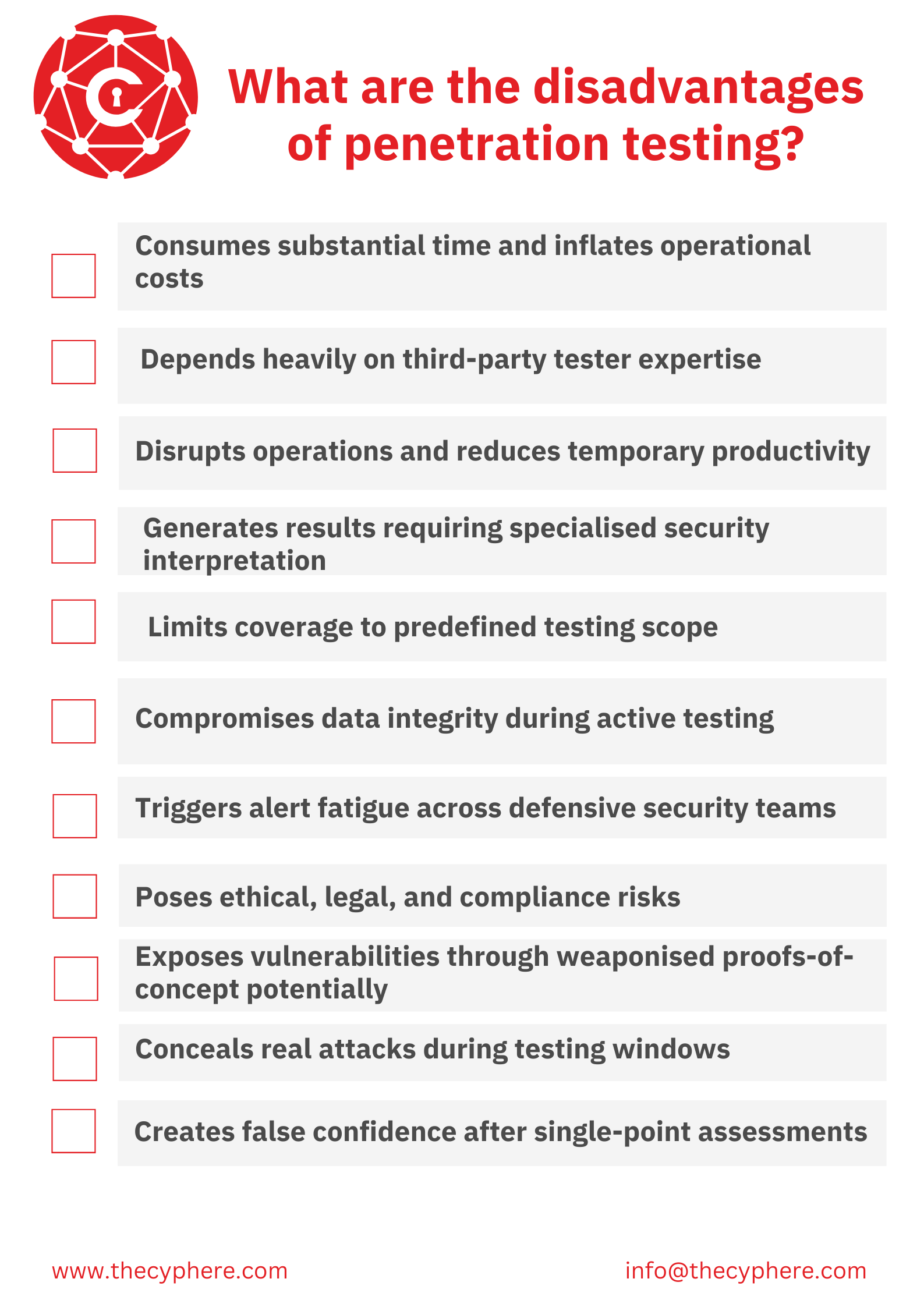
Listed below are 11 disadvantages of penetration testing.
- Consumes substantial time and inflates operational costs
- Depends heavily on third-party tester expertise
- Disrupts operations and reduces temporary productivity
- Generates results requiring specialised security interpretation
- Limits coverage to predefined testing scope
- Compromises data integrity during active testing
- Triggers alert fatigue across defensive security teams
- Poses ethical, legal, and compliance risks
- Exposes vulnerabilities through weaponised proofs-of-concept potentially
- Conceals real attacks during testing windows
- Creates false confidence after single-point assessments
1. Consumes substantial time and inflates operational costs
Penetration testing consumes substantial time and inflates operational costs because it involves testing various components across the entire network. This comprehensive testing for large-scale organisations with complex infrastructures takes considerable time. The operational cost of penetration testing increases as it requires the involvement of experienced testers who need specialised tools and related resources to perform tests on the complete IT infrastructure. Large businesses can afford the high operational cost associated with in-depth pentesting, but small businesses with limited budgets can’t afford this cost.
Traditional penetration testing relies heavily on manual expert work, making it slow and resource‑intensive, especially for medium and large networks, according to a 2019 study by Mohamed Chahine Ghanem, titled “Reinforcement Learning for Efficient Network Penetration Testing.
Red teams and pentest services are described as monetarily expensive, with additional overhead from managing tools, scope, and reporting, according to a 2023 study by Daniel Dalalana Bertoglio, titled “Towards new challenges of modern Pentest.
2. Depends heavily on third-party tester expertise
Penetration testing depends heavily on third-party tester expertise. Businesses hire a third-party pentesting team to analyse their IT infrastructure. These external pentesters or ethical hackers have specialised knowledge, but their ability to identify and address vulnerabilities is limited based on their tools, experience, and testing methodologies. External pentesters may miss critical vulnerabilities and fail to fully simulate complex attack scenarios if they lack expertise in certain aspects or are unfamiliar with the specific infrastructure of an organisation. This reliance on third-party expertise results in incomplete results, as some vulnerabilities may not be tested thoroughly.
Interviews with 38 vulnerability management professionals identified knowledge and skills in penetration testing principles and tools, attack stages, and network protocols as critical KSAs (Knowledge, Skills, and Abilities) for the role. It highlights the centrality of human expertise, according to a 2018 study by Miriam E. Armstrong, titled “The Knowledge, Skills, and Abilities Used by Penetration Testers: Results of Interviews with Cybersecurity Professionals in Vulnerability Assessment and Management”.
In competitions and practical studies, testers’ skills and experience strongly influence which vulnerabilities are found and how quickly they are exploited, according to a 2022 study by Benjamin S. Meyers, titled “Examining Penetration Tester Behaviour in the Collegiate Penetration Testing Competition.”
Qualitative interviews with professional pentesters show they rely heavily on improvisation, intuition, and serendipity beyond scripted methodologies, using creative reasoning to discover overlooked or legacy vulnerabilities, according to a 2021 study by Francesco Caturano, titled “Discovering reflected cross-site scripting vulnerabilities using a multiobjective reinforcement learning environment.”
The effectiveness of penetration testing depends heavily on the skills and expertise of the testers. Unprofessional penetration tests can create serious problems, including server crashes and exposure of sensitive data.
3. Disrupts operations and reduces temporary productivity
Pentesting disrupts operations and reduces temporary productivity if the test is conducted on live systems. External testers and internal security teams test various components of IT infrastructures such as cloud services, web apps, and networks. This live testing leads to downtime or performance degradation.
Pentesting of routine IT systems causes a slowdown in network traffic, service interruptions, and false alarms in the security monitoring system. These issues impact employee productivity and degrade customer-facing services. It adversely affects daily business operations, causing delays in services and potential loss of business. The internal team allocates their regular work hours to assist the pentesting team. Internal teams spend more time coordinating with external pentesters, like providing them with system access and fixing issues discovered during tests. This diversity of staff time and resources leads to a temporary reduction in productivity.
In operational technology (OT)/industrial control systems, active tests (floods, malformed packets, some vulnerability scripts) have directly caused device crashes, total loss of availability, and the need for manual resets, clearly disrupting operations, according to a 2023 study by Alex Staves, titled “An Analysis of Adversary-Centric Security Testing within Information and Operational Technology Environments”.
Enterprise security mechanisms (access control, DRM) introduce Non‑Productive Time (NPT). Staff cannot work on core tasks, leading to productivity loss. Penetration testing adds to low productivity by consuming staff time for coordination, monitoring, and remediation, according to a 2019 study by W.Zeng, titled “Modelling and analysis of corporate efficiency and productivity loss associated with enterprise information security technologies”
4. Generates results requiring specialised security interpretation
Penetration testing generates results requiring specialised security interpretation by experienced security professionals. The data produced during penetration testing is highly technical as it requires a complete understanding of vulnerabilities, their potential impact and proper remediation measures. Professional ethical hackers have specialised expertise in threat modelling, reverse engineering, exploitation techniques, and vulnerability analysis to interpret results generated from penetration testing. Organisations struggle to fully comprehend the findings of penetration testing or implement the correct fixes without the right knowledge. Some vulnerabilities (zero days, business logic flaws) are difficult to address, especially when the internal team doesn’t understand them, and they expose the organisation to risk. Results from pentesting must be interpreted in the context of a unique organisation’s environment. An ethical hacker with a deep understanding of the broader security landscape and technical aspects can perform this job well. Organisations need dedicated in-house cybersecurity teams or external pentesters to implement the right fixes for vulnerabilities in their IT infrastructure.
Pentests reveal issues from legacy systems, poor maintenance, and organisational practices, not just technical bugs; interpreting these requires understanding socio-organisational security factors, according to a 2023 study by S. Paoli titled “A qualitative study of penetration testers and what they can tell us about information security in organisations”.
Organisations struggle to understand, prioritise, and act on findings; common gaps include unclear scope/methodology, vague descriptions, and generic mitigations. Reports must be tailored differently for technical staff vs managers/boards, according to a 2025 study by Katarína Galanská, titled “From Reports to Actions: Bridging the Customer Usability Gap in Penetration Testing.
5. Limits coverage to predefined testing scope
Penetration testing limits coverage to a predefined testing scope, and it usually causes an incomplete security coverage of the complete organisation system. Every organisation defines the scope of a pentest by specifying systems, network components, or applications to be tested. This scope definition ensures that ethical hackers focus testing on critical areas that need immediate attention. However, this limited coverage leaves other parts of the infrastructure unexamined, so potential vulnerabilities in these areas go undetected. This limited pentesting scope doesn’t provide a complete security snapshot for a dynamic organisation where systems and technologies are frequently updated or expanded.
Pentesters conduct testing based on a static scope, and findings from this testing do not reflect the latest changes that have happened in the IT infrastructure, which causes gaps in testing. Pentester doesn’t offer a comprehensive security assessment across the entire organisation. There is a need to perform additional tests and have ongoing testing to cover overlooked spots in the IT infrastructure of an organisation.
Penetration testing often has a limited scope, which may not encompass every aspect of a company’s IT environment. Methodology and scope are critical because narrow or poorly defined scopes can miss critical attack paths and under‑represent real threats, according to a 2024 study by Sakthi Kandaswamy, titled “Analysing Scope Risk in Vulnerability Assessment and Penetration Testing Methodology.”
6. Compromises data integrity during active testing
Penetration testing compromises data Integrity during active testing, as a pentester may intentionally manipulate, delete or modify data to simulate an attacker’s behaviour. All such actions are required to understand potential threats, but they lead to severe consequences such as system function disruptions, partial data loss, and data corruption.
Penetration testers interact with live systems. They cause system instability or downtime if they aren’t careful, and thereby affect the integrity of business-critical data. Risks of data integrity compromise are usually addressed by pentesting in a controlled environment to ensure that proper backups are in place to mitigate any negative impact on data integrity during active testing.
Some vulnerabilities demonstrated in pentests (SQL injection, broken access control, weak encryption) inherently allow testers to manipulate or delete data if not bound by rules of engagement, according to a 2024 study by Ferzha Putra Utama, titled “Uncovering the Risk of Academic Information System Vulnerability through PTES and OWASP Method.”
7. Triggers alert fatigue across defensive security teams
Penetration testing triggers alert fatigue across defensive security teams. These teams receive a high volume of alerts for vulnerability findings, simulated attack attempts and potential exploit paths. Security personnel are overwhelmed by all these alerts. Pentesting produces continuous alerts, leading to security teams becoming desensitised to notifications. There is a possibility that the team may miss or ignore critical alerts.
Pentesters mimic real-world cyberattacks, triggering a flood of alerts from threat detection and monitoring systems. The security team spends valuable time addressing false positives or low-priority issues and will be unable to address more pressing security issues with full energy. Continuous addressing of nonstop alerts leads to burnout and significant delay in addressing actual security concerns.
8. Poses ethical, legal, and compliance risks
Penetration testing poses ethical, legal, and compliance risks. Penetration testers intentionally attempt to bypass security controls and access sensitive systems to exploit vulnerabilities. This testing may unintentionally violate privacy laws, data protection regulations, or contractual regulations if the rules of engagement, testing scope, and authorisation are unclear. Poorly governed pentests raise serious ethical concerns related to data exposure, consent, and the potential misuse of discovered information, even when conducted with good intent.
Organisations must invest time and effort in compliance reviews, stakeholder coordination, and legal approvals before conducting penetration testing. Any misalignment between testing vendors, legal teams, and security teams increases legal and compliance risks, leading to reputational damage and regulatory penalties. The depth and effectiveness of penetration testing are often limited in highly regulated environments because the scope is restricted to mitigate compliance risks and breaches.
Standards-based audits (ISO 27001, NIST CSF, COBIT, SOX) treat pentesting as part of broader cybersecurity auditing and risk assessment, alongside policy review and control testing, according to a 2023 study by Semi Yulianto, titled “Strengthening IT Governance in the Crypto Marketplace: Leveraging Penetration Testing and Standards Alignment.”
9. Exposes vulnerabilities through weaponised proofs-of-concept, potentially
Penetration testing can expose vulnerabilities through weaponised proofs-of-concept (PoCs). Penetration testers create PoCs, simulated attack techniques or scripts designed to exploit weaknesses by demonstrating how specific vulnerabilities could be exploited. These PoCs help organisations understand the potential impact of vulnerabilities. But these PoCs become a weapon in the hands of malicious actors, especially if the testing results are not handled securely. Cybercriminals weaponise PoCs by launching real attacks on these potential vulnerabilities. Organisations with weak security controls make PoCs accessible to unauthorised individuals, thereby making the second more vulnerable to exploitation. There is a need to manage and protect PoCs created during penetration testing to avoid security liabilities in future.
According to the 2024 Application Security Report by Cloudflare, “hackers can weaponise a newly published proof-of-concept exploit in as little as 22 minutes.”
10. Conceals real attacks during testing windows
Penetration testing masks real attacks during testing windows as simulated attackers generate noise that masks actual malicious attempts. Pentesters expose the target system to a high volume of simulated attacks that trigger numerous alerts and defensive measures. Legitimate security threats are overlooked by the security team due to this influx of alerts. This real attack concealment is highly problematic in dynamic environments that are exposed to real attacks simultaneously.
Security teams find it difficult to distinguish between real and simulated attack attempts, so organisations fail to detect or respond to real threats in a timely fashion. This mask on a real attack leads to potential data compromise and breaches that go unnoticed.
11. Creates false confidence after single-point assessments
Penetration testing creates false confidence after single-point assessments, especially when organisations rely on single-point security analysis to gauge their overall security posture. A pentest offers a point-in-time security snapshot that reflects the security state of systems and networks at a moment when the pentest was conducted. Pentest doesn’t uncover vulnerabilities that arise after the test, and if there are some issues outside the scope of testing. Businesses may assume that their security posture is robust and get a false sense of confidence, leading to overlooking ongoing security issues and emerging risk factors. This false confidence about overall security is dangerous, as attackers keep developing new techniques and tactics to bypass security measures. Organisations’ defences may become outdated if they are not adapted to deal with evolving threats. Organisations leave gaps in security by relying only on one-time pentest and simply overlooking continuous monitoring or repeated assessments.
Organisations can stay ahead of emerging threats, ensure compliance with security standards, and maintain a strong security posture by continuously monitoring and testing their internal environment, according to a 2023 study by Jamshid Ali, titled “Continuous Internal Penetration Testing (CIPT).”
How to gain maximum benefits and minimum risks from penetration testing?
To gain maximum benefits and minimum risks from penetration testing, organisations must ensure clear scope definition, early coordination with internal teams, identification of fragile critical systems, and strong upfront communication.
Penetration testing is a powerful security assessment, but it causes risks like business disruption, providing a false sense of security due to a lack of correct scope, methodology, or pentester skill, if poorly managed. Our approach at Cyphere ensures risk minimisation while maximising the benefits that actually feed into your risk management program to improve your long-term security posture.
Upfront communication and coordination are our priority. We don’t just work with your security team; we take the lead in arranging our meetings with all internal departments involved. This practice ensures minimal disruption risk with maximum benefit.
Minimal disruption risk: Our expert pentesters identify fragile assets and note down any specific concerns from stakeholders in Infrastructure, Change Management, and Projects. This clear communication prevents unexpected crashes of critical production systems during pentesting.
Maximum Benefit: Our highly trained pentesters ensure the business is fully aware of the assessment initiative by holding calls with various teams. This awareness turns pentesting from a technical exercise into a business-aligned risk treatment action.
Clear Scope: We gain complete oversight of the environment by defining a clear scope so the test covers what actually matters, not just what’s easy to test.
Cyphere penetration testing services are built on this methodology of involving internal teams early to turn potential risks (operational downtime or team misalignment) into collaboration, allowing you to get a true, actionable picture of your risk environment. We ensure the report leads to effective security improvements, not just sitting on findings, by following this methodology of communication, collaboration, and coordination.