Penetration Testing as a Service (PTaaS) is a modern, platform-based approach to penetration testing that provides continuous, on-demand security assessments instead of one-time security testing.
According to Yu.M. Lisetskyi et al, in their research, Penetration Testing as a Means of Increasing the level of Information Systems Cyber Protection, published on January 1, 2025, the demand for penetration testing is continuously expanding and developing both methodologically and instrumentally. PTaaS aligns with modern automation, including the use of cloud-based tools, artificial intelligence in vulnerability analysis, and the growing role of tests that incorporate social engineering techniques.
The three main features of PTaaS include continuous testing, real-time vulnerability insight through a central dashboard and integrated expert communication. The PTaaS process includes scoping, automated and manual testing, vulnerability validation, remediation support, and ongoing monitoring with scheduled or on-demand retesting.
Implementing PTaaS can also introduce some challenges, such as incomplete scoping, false positives from automated testing, rapidly evolving environments, and remediation delays. PTaaS also provide benefits such as faster vulnerability resolution, improved compliance alignment, reduced attack surface exposure, and greater operational efficiency. Traditional penetration testing is valuable for compliance requirements, but PTaaS provides ongoing assurance that keeps pace with modern digital transformation, cloud deployments, and the speed of emerging threats.
What is Penetration Testing as a Service?
Penetration Testing as a Service (PTaaS) is a modern, cloud-based service model that allows organisations to perform penetration testing, including continuous, on-demand security testing, real-time reporting, and faster remediation support through a dedicated online platform.
Penetration Testing as a Service is also known as Continuous Penetration Testing, On-Demand Penetration Testing, Subscription-based Penetration Testing and Cloud-Hosted Pen Testing Services.
Penetration Testing as a Service (PTaaS) involves automated and manual security testing of networks, applications, cloud, and other digital assets. PTaaS also includes continuous vulnerability scanning with regular testing, direct collaboration with security experts, real-time access to critical vulnerabilities, risk ratings and remediation guidance. PTaaS platforms provide compliance support for standards like ISO 27001, PCI DSS, HIPAA, GDPR, etc and a scalable testing model that adapts to growing infrastructure and changing threats.
How does Penetration Testing as a Service work?
PTaaS operates through a cloud-based platform that manages the entire penetration testing process, including planning, testing, reporting and remediation all in one place. Once an organisation subscribes, the service starts by mapping assets and defining the scope. First, automated scanners are used to detect common vulnerabilities, followed by deeper manual testing performed by security experts to uncover complex, logic-based weaknesses.
All findings are delivered in real-time through an online dashboard rather than waiting for a final report. The PTaaS platforms enable teams to interact directly with pen testers, request clarification, prioritise risks and track remediation progress. Organisations can request retesting instantly to confirm closure without delays once the patches are implemented. In case new assets are added or configurations change, testing can be repeated on demand or continuously to ensure security remains up to date.
The unique features of PTaaS involve continuous or on-demand testing live dashboard for results, real-time collaboration with security experts, automated testing and a manual approach. PTaaS platforms also provide instant retesting after fixes, a scalable subscription model and compliance mapping features for frameworks like PCI DSS, ISO 27001, SOC 2 and GDPR.
According to A. Podzolkov et al, in their research, Method and Means for Choice of Penetration Testing Services, published on April 10, 2024, note that some PTaaS services may be fully automated, which can be performed without human intervention, while other services may be semi-automated or fully manual.
Traditional penetration testing is typically performed once or twice a year and reflects the security posture of the exact moment, whereas PTaaS provides continuous security management rather than a single, fixed assessment. The purpose of PTaaS is to proactively identify and remediate security vulnerabilities before malicious attackers exploit them, improve security maturity, meet compliance requirements, and save time between vulnerability discovery and resolution.
How to perform Penetration Testing as a Service?
The main 10 steps to perform penetration testing as a service are explained below.
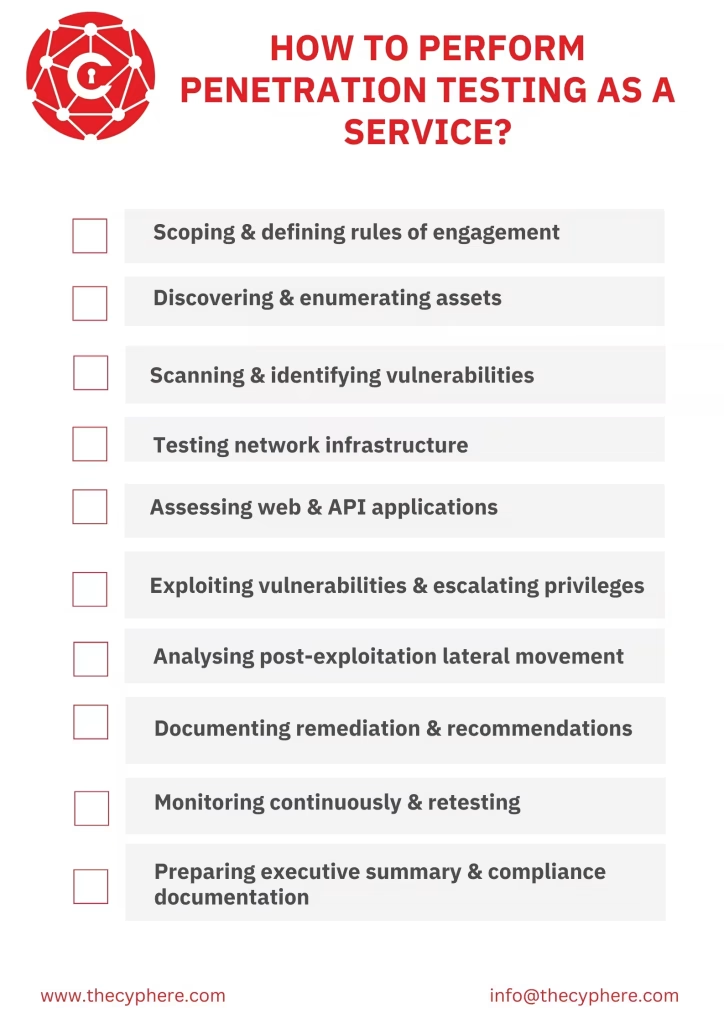
- Scoping & defining rules of engagement: Scoping & defining rules of engagement in penetration test service involves defining the scope, ensuring all systems, networks, cloud environments, APIs, and applications to be tested are clearly identified. Scoping & defining rules of engagement ensures testing meets compliance requirements and organisational risk priorities. Considerations include whether internal or external testing is needed, the depth of testing (black box, grey box or white box), and critical business systems that require minimal disruption. Relevant system details, credentials (if required) and documentation are shared through platforms such as PTaaS dashboards or secure portals. By the end of this stage, both parties have a signed testing agreement and a clear methodology aligned to business risk and operational limitations.
- Discovering & enumerating assets: Discovering & enumerating assets in penetration test services involves identifying all live assets and mapping the environment. Automated discovery tools and cloud integration capabilities help locate IP ranges, hosts, domains, applications and exposed services. Discovery & enumeration also detect new or orphaned assets for dynamic environments such as cloud or SaaS platforms that may not be documented. The purpose is to create a complete inventory of the attack surface. The PTaaS platform provides a visual representation of discovered systems, service banners, DNS entries, open ports, and trust relationships.
- Scanning & identifying vulnerabilities: Scanning & identifying vulnerabilities in PTaaS includes automated vulnerability scanners that are deployed to quickly identify common security weaknesses such as misconfigurations, outdated software versions, weak encryption, insecure services, and known CVEs. Tools like Nessus, Qualys, OpenVAS, or the PTaaS provider’s proprietary scanning engine are used to conduct scanning. The identified vulnerabilities are classified based on severity, exploitability, and potential business impact. The scanning process acts as the foundation for later manual testing that allows pen testers to prioritise high-risk assets and validate scanner findings.
- Testing network infrastructure: Testing network infrastructure involves identifying weaknesses across internal and external networks, including routers, firewalls, wireless networks, VPNs, and cloud network segments. Manual testing methods, such as port manipulation, firewall rule validation, credential brute forcing, and configuration checks, are performed to assess the security of system communication and authentication. This testing process also includes validating segmentation controls to ensure networks are isolated effectively and cannot be easily traversed by an attacker. Testing network infrastructure process includes tools like Nmap, Burp Suite, Hydra, and packet analysis utilities. This process provides a detailed understanding of how resilient the network is against unauthorised access attempts and infrastructure-level exploitation.
- Assessing web & API applications: Assessing web & API applications involves pen testers evaluating the security of web applications, mobile back-end APIs, and cloud services. Manual testing is combined with automated vulnerability detection to identify vulnerabilities such as SQL injection, insecure direct object references (IDOR), broken authentication, API logic flaws, and improper access control. Depending on the access and testing methodology, Dynamic Application Security Testing (DAST), Static Application Security Testing (SAST), and interactive testing methods are often used. This process includes simulating real-world attack patterns by chaining vulnerabilities where possible. The assessment complies with standards like OWASP Top 10 and API Security Top 10.
- Exploiting vulnerabilities & escalating privileges: Exploiting vulnerabilities & escalating privileges includes security researchers attempting to exploit validated vulnerabilities with controlled intent to understand the true business risk. Exploiting vulnerabilities includes leveraging weak credentials, misconfigurations, logic flaws, or unpatched vulnerabilities to gain deeper access. Escalation techniques are then applied to determine whether unauthorised privilege levels, such as domain control or admin access, can be achieved. Tools such as custom scripts, Metasploit or manual payload crafting are used in the exploitation and escalation process.
- Analysing post-exploitation lateral movement: Analysing post-exploitation lateral movement in PTaaS involves analysing what actions an attacker could perform once they succeed in exploitation. This process may include pivoting to other hosts, harvesting credentials, accessing sensitive data, or bypassing monitoring systems. The analysis helps determine how effectively internal controls prevent lateral movement and whether detection systems identify malicious activity. The PTaaS platform records the attack chain, providing visual mapping of the exploitation pathway and documenting real-world attack potential. This process helps organisations understand the blast radius of a breach rather than only the initial vulnerability.
- Documenting remediation & recommendations: Documenting remediation & recommendations in PTaaS involves compiling the results of vulnerabilities and exploitation into prioritised remediation guidance. PTaaS platforms allow real-time remediation collaboration between internal teams and pen testers instead of static reports. Recommendations include patching, configuration hardening, identity security improvements, network segmentation, and governance improvements. Each finding includes severity ratings, exploitation evidence, business impact analysis, and step-by-step guidance to fix the issues effectively.
- Monitoring continuously & retesting: PTaaS continues after the initial engagement, unlike traditional penetration testing. Continuous monitoring detects new vulnerabilities as systems evolve, while retesting checks whether fixes are implemented correctly. Without waiting for a new contract or scheduling cycle, teams can request retesting instantly through the platform. This process closes the vulnerability loop faster, reduces exposure time, and ensures long-term security validation.
- Preparing executive summary & compliance documentation: Preparing an executive summary involves generating an executive-level summary that translates technical findings into business language. The summary includes risk, posture, attack paths, key remediation progress, compliance alignment, and improvement areas. The PTaaS platform also generates compliance-ready reports for standards like PCI DSS, ISO 27001, SOC 2, HIPAA, GDPR, and financial sector regulations. The purpose is to improve not only technical resilience but also support regulatory audit readiness.
What are the challenges during penetration testing as a service?
The top 7 challenges during penetration testing as a service are listed below.
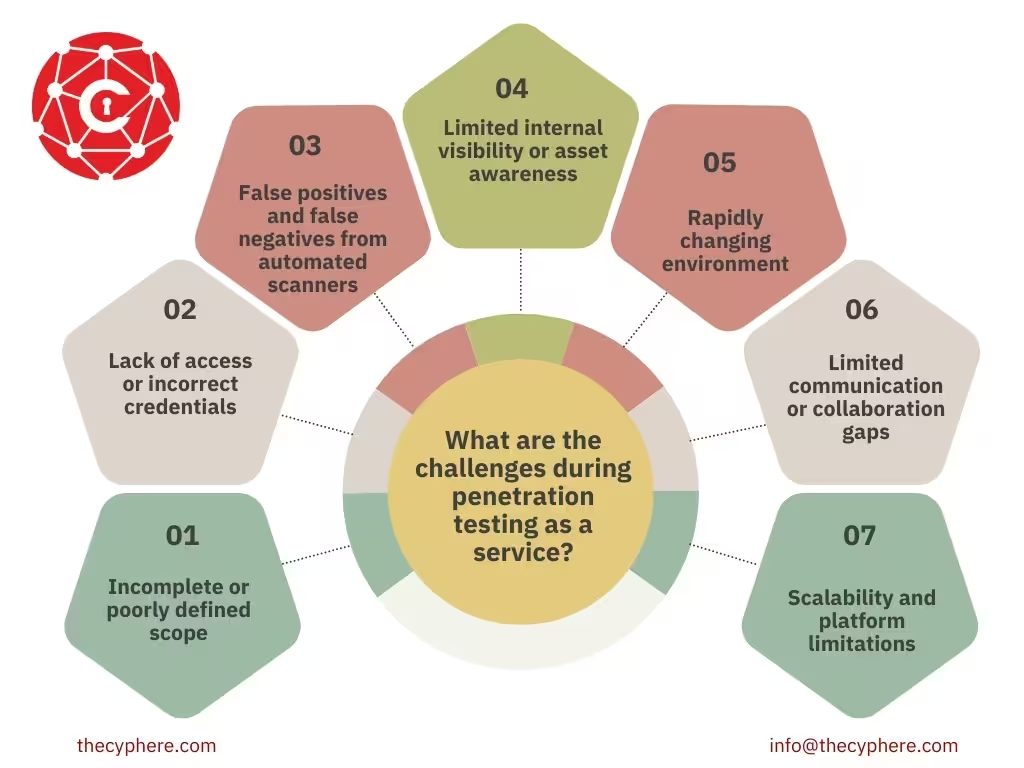
- Incomplete or poorly defined scope: An Incomplete or poorly defined scope makes it difficult to determine what should be tested, which leads to missed assets or unnecessary focus on low-priority systems. This affects both the tester and the process because unclear boundaries increase testing time, risk legal conflicts, and may leave critical systems unassessed.
- Lack of access or incorrect credentials: PTaaS depends on proper credentials, sometimes for authenticated scanning or deeper manual testing. Missing or incorrect access delays force testers to rely on limited unauthenticated assessments. It impacts the process by slowing down testing and may reduce the depth and accuracy of findings.
- False positives and false negatives from automated scanners: Automated tools can misidentify vulnerabilities or fail to detect complex ones, especially logic-based flaws. These challenges are common during large automated scans. It affects pentesters because they must spend extra time validating results manually to ensure accuracy. If unchecked, it may cause prioritising the wrong fixes.
- Limited internal visibility or asset awareness: Organisations often lack a complete understanding of their assets, especially in hybrid or cloud-native environments. These challenges are common in fast-scaling businesses or those undergoing digital transformation. It affects the process by increasing blind spots and widening the attack surface that remains untested.
- Rapidly changing environments: Modern digital environments, especially CI/CD pipelines and microservices, change frequently, which makes earlier test results quickly outdated. These challenges are common in agile and DevOps organisations. It affects the process by requiring continuous retesting, automation, and effective change tracking to remain accurate.
- Limited communication or collaboration gaps: PTaaS often depends on ongoing interaction between the provider and the organisation. Remediation is delayed. It mostly affects remediation efficiency and slows the vulnerability lifecycle when the communication is slow.
- Scalability and platform limitations: Some PTaaS platforms struggle to scale enterprise environments or highly disturbed cloud infrastructures. It affects performance, automation reliability, and sometimes delays reporting or asset discovery.
What are the benefits of Penetration Testing as a Service for organisations?
The 7 main benefits of penetration testing as a service for organisations are explained below.
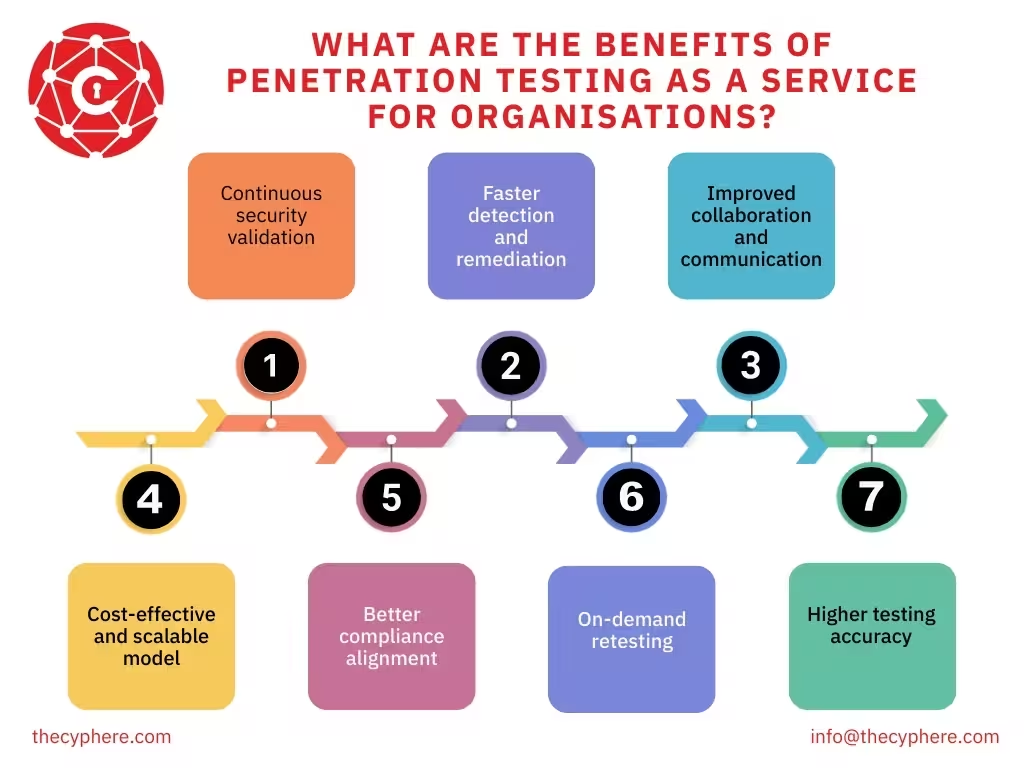
- Continuous security validation: PTaaS validates continuous security by providing ongoing assessments that adapt to new deployments, updates, or emerging threats. Continuous security assessment helps organisations maintain an up-to-date security posture at all times.
- Faster detection and remediation: PTaaS detects vulnerabilities in real time and provides immediate visibility through a centralised platform. This reduces the delay between vulnerability discovery and remediation, enabling teams to act before issues are exploited.
- Improved collaboration and communication: PTaaS improves collaboration by allowing security teams, developers, and testers to communicate directly through integrated dashboards. This streamlines remediation discussions, reduces misunderstandings, and accelerates vulnerability resolution.
- Cost-effective and scalable model: PTaaS reduces costs by offering a subscription-based or pay-as-you-go model that scales with organisational growth. This eliminates the need for repeated one-off engagements as new assets, applications, or cloud services are added.
- Better compliance alignment: PTaaS simplifies compliance by mapping vulnerabilities to standards such as ISO 27001, PCI DSS, SOC 2, and HIPAA. This helps organisations prepare for audits more efficiently while reducing manual reporting effort.
- On-demand retesting: PTaaS enables immediate retesting after remediation to confirm vulnerability closure. This reduces long-term exposure and removes the need for separate contracts or extended waiting periods.
- Higher testing accuracy: PTaaS increases testing accuracy by combining automated scanning with expert-led manual validation. This approach identifies both common vulnerabilities and complex issues, such as logic flaws and privilege escalation, that automated tools often miss.
What are the differences between Penetration Testing as a Service and traditional penetration testing?
The difference between penetration testing as a service and traditional penetration testing is explained below in a table.
| Aspect | Penetration Testing as a Service (PTaaS) | Traditional Penetration Testing |
|---|---|---|
| Delivery Model | Platform-driven, subscription-based, on-demand testing | One-time engagement performed periodically (often annually) |
| Testing Frequency | Continuous or recurring testing as environments evolve | Fixed schedule; typically yearly or half-yearly |
| Results Access | Real-time vulnerability visibility through the dashboard | PDF or static report delivered after testing completion |
| Communication Method | Ongoing collaboration with testers through integrated messaging portals | Limited communication during the engagement, often formal and scheduled |
| Retesting | Instant retesting is included within the platform | Need a separate agreement or additional cost |
| Reporting Style | Dynamic, interactive reporting with live remediation tracking | Static, often technical report with no live updates |
| Scalability | Easily scales with new assets, cloud environments, and digital growth | Requires formal scoping changes and new contracts for expanded testing |
| Speed of Detection & Remediation | Faster, as vulnerabilities are shared and tracked immediately | Slower, since findings are delivered after the testing phase concludes |
| Compliance Support | Built-in templates and live progress tracking for standards like ISO 27001, PCI DSS, SOC 2, HIPAA | Compliance mapping often requires manual interpretation or additional documentation |
| Resource Efficiency | Reduces operational burden through automation and integrated workflows | Higher manual overhead and administrative effort for planning, reporting, and retesting |
| Threat Adaptation | Adjusts as new vulnerabilities emerge or systems change | Shows a snapshot in time and may become outdated quickly |
| Access to Experts | On-demand, continuous access to security experts | Limited and bound to the contract duration |
| Cost Structure | Subscription or pay-as-you-go model | Fixed project-based cost |
In contrast to traditional penetration testing, Penetration Testing as a Service (PTaaS) provides continuous, on-demand security testing via a platform as opposed to a single, planned evaluation. While traditional testing produces a static report at the conclusion of the engagement with little interaction, PTaaS offers real-time vulnerability visibility, instant retesting, and continuous communication with testers. While traditional testing necessitates new scoping, contracts, and separate costs for retesting, PTaaS uses a subscription model, scales easily with expanding infrastructure, and quickly responds to emerging threats. Traditional penetration testing provides a point-in-time assessment, whereas PTaaS is generally more dynamic, collaborative, and responsive.
Who can provide you with penetration testing as a service?
Penetration Testing as a Service can be provided by specialised cybersecurity companies, managed security service providers (MSSPs), or dedicated penetration testing firms that provide a cloud-enabled platform for continuous security testing.
A PTaaS provider is an organisation that provides penetration testing through a platform-driven model that allows clients to request testing, view results, collaborate with testers, and verify remediation in real time. The PTaaS provider integrates technology, automation, and human expertise to continuously assess and improve the security posture of an organisation. These providers work with defined methodologies that comply with industry standards such as OWASP, OSSTMM, NIST, and CREST, to ensure testing is repeatable, measurable and aligned with global cybersecurity standards.
A PTaaS provider is responsible for planning, conducting, and managing penetration testing services throughout the engagement lifecycle. The role of PTaaS providers includes defining scope, performing automated vulnerability scans, executing manual penetration testing techniques, validating findings, and delivering ongoing insights through a dashboard or reporting portal. They also provide remediation guidance, risk prioritisation, and compliance-ready documentation to support audits and regulatory obligations. Additional responsibilities may include threat modelling, restesting fixes, asset discovery, and monitoring new vulnerabilities that may emerge over time.
PTaaS providers employ highly qualified penetration testers, security analysts, and platform engineers with extensive practical experience in offensive security to provide PTaaS effectively. PTaaS professionals typically hold certifications such as OSCP, OSWE, CEH, CREST CRT/CPT, GPEN or CISSP, which show validated proof of experience in ethical hacking and assessment methodologies.
What key qualities define a reliable penetration testing service provider?
The 7 key qualities of a reliable penetration testing service provider are listed below.
- Strong technical expertise and proven skillset: A reliable PTaaS provider employs skilled penetration testers with certifications such as OSCP, CREST, CEH, GPEN, or OSWE. Penetration testers have experience across modern infrastructure such as cloud, API, web apps, mobile and internal networks that ensure accurate testing beyond automated scanning.
- Combination of manual and human testing: A trustworthy penetration testing provider uses automation for efficiency and experienced ethical hackers for logic vulnerabilities, chaining attacks, privilege escalation, and real-world exploit simulation.
- Continuous and real-time vulnerability visibility: A reliable penetration testing provider offers a live dashboard with real-time updates rather than waiting for final reports. This real-time visibility increases remediation, prioritisation, and collaboration throughout the security lifecycle.
- Retesting and validation included: Reliable PTaaS includes unlimited or flexible retesting to assess fixes without requiring a separate contract. This ensures remediation is verified and vulnerabilities are fully closed.
- Clear communication and support access: PTaaS provider uses Strong communication channels, such as built-in chat, ticketing, pr direct analyst access, enabling users to ask questions, request clarification, and receive guidance instantly rather than waiting for scheduled sessions or email responses.
- Compliance mapping and reporting capability: A reliable PTaaS provider supports compliance frameworks like ISO 27001, PCI DSS, SOC2, HIPAA, NIST, or GDPR. They should provide compliance-aligned reporting, executive summaries, and audit-ready evidence.
- Remediation guidance and prioritisation support: A reliable penetration testing provider doesn’t stop at identifying vulnerabilities; they also help prioritise risks based on business impact, provide actionable remediation instructions, and reduce effort for internal teams.
How does Cyphere deal with penetration testing as a service?
Cyphere provides Penetration Testing as a Service through a continuous, subscription-based model that combines automated assessment, expert-led testing, and real-time remediation guidance. Their method starts with continuous vulnerability discovery using reliable scanning tools, and then skilled security consultants carry out in-depth manual exploitation. All findings, proofs-of-concept, and remediation steps are accessible through a centralised portal, giving organisations clear visibility into risks, progress, and security posture. In addition, Cyphere’s PTaaS offers attack surface monitoring, on-demand retesting, and direct access to security experts for assistance or clarification. This guarantees that security testing is an ongoing cycle of detection, validation, and improvement in line with changing threats rather than a one-time occurrence.