Database penetration testing, also known as Database Security Testing (DST), is a systematic process of evaluating the security of the Database Management System (DBMS) and supporting infrastructure.
The UK Government’s Cyber Security Breaches Survey 2025 shows the scale of the problem: 43% of businesses suffered a breach in the last year, rising to 74% for large organisations. Despite 73% of companies having password policies, adoption of advanced controls remains dismal: just 31% use VPNs for remote access, and 30% have user monitoring.
The number of DoS attacks in 2025 Q2 was still 44% higher than in 2024 Q2. Critical infrastructure continues to face sustained pressure, with the Telecommunications, Service Providers, and Carriers sector jumping again to the top as the most targeted industry, according to the 22nd edition of the Cloudflare DDoS Threat Report.
A 63% increase in publicly disclosed ransomware attacks occurred, with a total of 276 incidents compared to Q2 2024 (169 incidents). Across the board, the use of data exfiltration remained consistently high, with 95% of publicly disclosed attacks involving the theft of sensitive information, according to BlackFrog’s The State of Ransomware Report Q2 2025.
Main steps to perform database penetration testing include database reconnaissance, scanning and vulnerability analysis, exploitation, impact assessment, and reporting. Main tools used during database penetration testing are SQLMap, SQLNinja, NoSQLMap, ODAT (Oracle Database Attacking Tool), and PowerUpSQL.
Database penetration testing improves security posture by identifying and remediating vulnerabilities, ensuring data compliance, and checking database resilience against real-world threats (SQLi, DoS).
What is Database Penetration Testing?
Database penetration testing is a process of simulating real-world attacks on databases to find, exploit, and mitigate known and unknown vulnerabilities (SQL injection, code errors) without disrupting business continuity. Other names of database penetration testing are Database Security Testing (DST) and database vulnerability assessment.
Database penetration testing involves checking the database for vulnerabilities (SQL injection, code errors), assessing user privileges, and testing the effectiveness of authorisation/authentication. It is a proactive security measure that helps organisations prevent unauthorised access and data breaches while finding weaknesses in privilege levels, access controls, and configuration errors.
Database security testing (DST) ensures that backups are not publicly accessible and that encryption policies are enforced fully on backups. Other features of database vulnerability assessment include mapping sensitive data files (Personally Identifiable Information/PII, Protected Health Information/PHI), assessing log monitoring, verifying authorisation and access control, evaluating database authentication, and identifying unpatched database engines (Jet Database Engine, SQL Server).
How does database penetration testing work?
Database penetration works by gathering information about the database, running a vulnerability scan to detect known weaknesses (SQL injection, privilege escalation), exploiting and post-exploiting security flaws, and concluding with a report and recommendation for remediation. The process identifies known vulnerabilities such as misconfigured permissions, SQL injection risks, sensitive data exposure, weak authentication, outdated software, unpatched software, and privilege escalation. This assessment uncovers security gaps (improper encryption, insecure configuration) that lead to data breaches.
The main goal of database penetration testing is to proactively identify and address security weaknesses. This testing helps organisations to prevent data breaches and improve their overall security. This goal is achieved through systematic vulnerability assessment, risk ranking, and the use of advanced detection technologies, according to a 2024 study by Xiaolu Zhang, titled “Data Security Assessment Method Based on Penetration Testing”.
How to perform database penetration testing?
Database penetration testing is performed by gathering database reconnaissance, vulnerability assessment, exploitation, post-exploitation, and reporting.
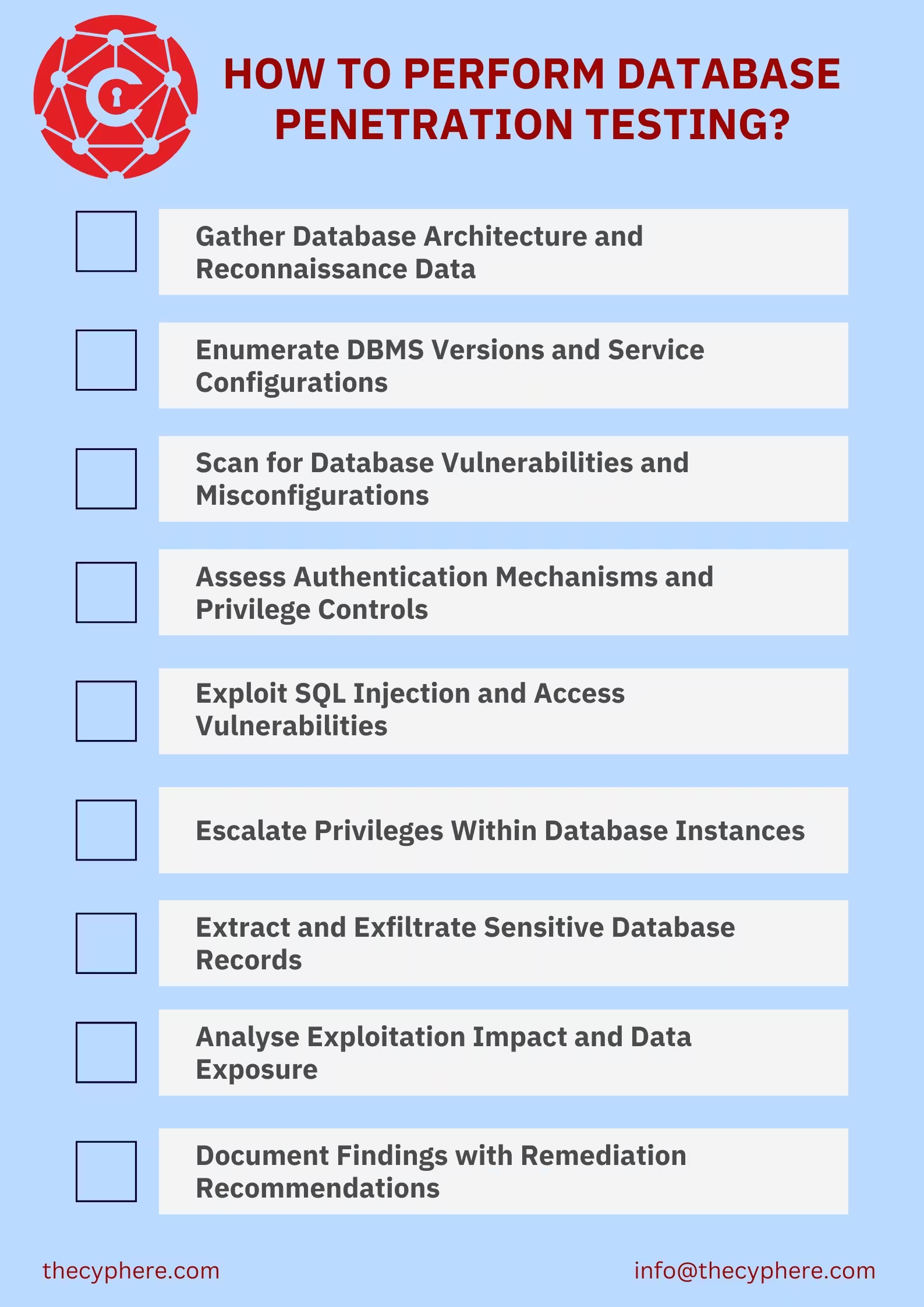
Listed below are 9 steps for performing database penetration testing.
1. Gather Database Architecture and Reconnaissance Data
Pentesters gather data about database architecture, including the type of database management system (DBMS) in use, the database environment, host system (IP address, operating system), and network configurations. Reconnaissance helps pentesters to identify potential attack vectors (open ports, vulnerable services) that lie in the structure and components of the database.
Security professionals use tools like Nmap or Netcat to run scans on open ports and services running in DBM. The output of scanning is a detailed database map that highlights potential weak points and services in operation requiring further investigation. Database reconnaissance lets the pentester maintain testing focus completely on vulnerable areas while avoiding unnecessary testing on secure ports or irrelevant services.
The database penetration testing team enumerates DBMS versions and service configurations after database data reconnaissance.
2. Enumerate DBMS Versions and Service Configurations
Pentesters start enumerating DBMS versions (MySQL, SQL Server, Oracle) as each DBMS version has its own set of vulnerabilities (unpatched software, insecure access control). For example, an outdated version of PostgreSQL is vulnerable to an SQL injection attack due to improper validation of user input. Knowledge of DBMS versions (MySQL, SQL Server, Oracle) (MySQL, SQL Server, Oracle) allows pentesters to focus on database version-specific vulnerabilities. Tools like Banner Grabbing or SQLmap are used for enumerating DBMS versions by capturing service banners and response headers.
Database security professionals also review configurations of services running on the system by using tools like Nikto or Net to identify configuration flaws. Assessment of specific service configuration allows security experts to highlight sensitive data exposure and a foothold for attacks (XSS, SQLi). Pentesters focus on particular vulnerabilities after identifying complete details about the DBMS version and service configurations (overly permissive user roles, weak passwords).
The database penetration testing team scans the database for vulnerabilities and misconfiguration after collecting information about the DBMS version and service configuration.
3. Scan for Database Vulnerabilities and Misconfigurations
Pentesters start scanning the database for vulnerabilities and misconfiguration through a hybrid approach, including manual and automated penetration testing. Manual testing helps security professionals identify weaknesses like default account setup and weak passwords, while automated database penetration solely focuses on finding known vulnerabilities (overly permissive user roles, outdated software).
Vulnerability scanning tools such as Nessus and OpenVAS are commonly used to automate database vulnerability scanning. Pentester performs manual testing for poorly configured databases, as it leads to sensitive data exposure (database backups, unencrypted passwords). The output of automated and manual penetration testing is a list of vulnerabilities and misconfigurations that an attacker could exploit.
The database penetration testing team moves forward with the assessment of authentication and access control, once valuable information about potential attack vectors of the database is available.
4. Assess Authentication Mechanisms and Privilege Controls
Pentesters perform a thorough assessment of the database’s authentication mechanisms and user privilege management by accessing data as unauthorised users and executing Brute Force Attacks. Security professionals check the configuration for users, roles, and privileges. Professional assessment ensures that only authorised users get access to the database, and privilege controls limit user access only to the data they need. Pentesters probe into the database and evaluate how users authenticate to the system and what access rights users have.
Tools like Hydra and Burp Suites are effective for automating brute-force attempts on login pages to check the authentication mechanism of the database. Manual pentesters first try to access data as a low-privilege user and escalate by gaining administrative access after changing user roles. The output of the assessment is a report highlighting how secure the authentication system is and whether privilege escalation could lead to unauthorised access to confidential data.
Database penetration testing exploits vulnerabilities after evaluating the database’s access privileges and authentication mechanism.
5. Exploit SQL Injection and Access Vulnerabilities
Pentesters attempt to exploit SQL Injection flaws in the database queries by targeting poorly sanitised inputs while bypassing access controls by leveraging discovered vulnerabilities in database services. Tools like SQLmap are used to automate the process of SQL injection testing. Security professionals manually test the database by crafting custom queries and checking how the database responds to SQL injection. Pentester tests the extent of damage on the database by reviewing how an attacker would access sensitive data and execute arbitrary commands on the database server.
The output of the exploitation phase is understanding the impact of the exploit, checking the severity of the threat, and moving toward the privilege escalation stage.
6. Escalate Privileges Within Database Instances
Pentester starts privilege escalation within the database instance by attempting to obtain a higher level of access than originally granted. Security experts move from a user account to an administrator or root-level account to assess how an attacker would escalate privilege after gaining initial access.
Tools like Metasploit or custom scripts are used to exploit a vulnerability (poorly configured role) and analyse how an attacker escalates privilege and tries to access restricted data and accounts. Security professionals try to modify user roles or permissions through SQL queries and exploit flaws in authentication mechanisms. Pentester inputs the initial user credentials and access level to get an output of complete access to sensitive parts of the database with elevated privileges.
The database penetration testing team plans to exfiltrate sensitive database records after a successful privilege escalation phase.
7. Extract and Exfiltrate Sensitive Database Records
The exfiltration of sensitive data records refers to exporting records to external systems using covert methods like tunnelling through encrypted channels, using low-traffic data streams to avoid detection. Pentesters try to extract and exfiltrate sensitive database records (financial records, personally identifiable information (PII), or intellectual property) after escalating privileges. Tools like SQLMap and Burp Suite are used to exfiltrate confidential data through SQL queries or database bumps. Security professionals attempt to extract and exfiltrate as much sensitive data as possible while avoiding database system defences (logging mechanisms, encryption). The output of the sensitive database exfiltration record is a list of stolen and exfiltrated data.
The database penetration testing team continues with exploitation impact analysis after data extraction and the exploitation phase.
8. Analyse Exploitation Impact and Data Exposure
Pentesters analyse exploitation impact and data exposure to understand how compromised data could be used or abused by an attacker while determining the extent of damage (identity theft, intellectual property theft) as a result of sensitive data exfiltration. Security professionals analyse database roles in the broader infrastructure and determine whether compromised data could lead to lateral movement within the organisation. Tools like Wireshark are used to monitor the data exfiltration route.
Penetration testers assess the impact of property theft after extracting sensitive data, depending on the type of information extracted. Testers will assess how exposed sensitive data is and whether it can be used for further attacks, such as phishing or social engineering. This analysis involves looking at the database’s role in the broader network infrastructure and determining if compromised data could lead to lateral movement within the organisation. Tools like Wireshark can be used to monitor data exfiltration routes. Data loss prevention (DLP) tools (Symantec DLP, Forcepoint DLP, Trellix) help the security team to identify and prevent sensitive data leaks. Pentesters get an insight into data exfiltration risks, potential consequences of exploitation, and the level of sensitive data exposure.
The database penetration testing team documents findings after understanding the urgency of remediation and the scale of the potential data breach.
9. Document Findings with Remediation Recommendations
Pentesters document all the findings in a detailed report and provide actionable remediation recommendations to address discovered vulnerabilities, exploited weaknesses, and misconfigurations. Security professionals translate technical findings from database penetration testing into clear and easy-to-understand language for stakeholders, business leaders, the IT team, and compliance officers. A detailed report, including a step-by-step description of each discovered vulnerability, the method used to exploit the vulnerability, and the impact of the exploitation.
Pentesters add recommendations for remediation, such as improvement in logging and monitoring, Implementation of stronger authentication methods, permission reconfiguration, and vulnerability patching. Pentesters use tools like Metasploit or Burp Suite to create exploitation logs to illustrate findings. Organisation gets a comprehensive report highlighting security gaps alongside a roadmap for securing the database environment. Database penetration testing ensures that recommendations help organisations secure their security posture to prevent database attacks (SQLi, XSS).
How much does it cost to perform database penetration testing?
The data about the exact cost of database penetration testing is not available, but the cost of simple penetration testing is around £7,590 to £75,900. Factors affecting the cost of database penetration include project complexity (Single database, multiple systems); testing methodology (manual, automated); pentester experience, testing type (cloud, compliance); remediation/retesting, and duration of test.
How much time does it take to perform database penetration testing?
The exact timeframe for database penetration testing is not available, but simple penetration testing typically takes 2 to 4 weeks. Factors affecting the duration of database penetration include project complexity (Single database, multiple systems); testing methodology (manual, automated); pentester experience and team size, availability of test data; testing type (cloud, compliance); and remediation and retesting.
What tools are used to perform database penetration testing?
Database penetration testing tools are specialised software designed to detect, exploit, and remediate database vulnerabilities (unpatched software, misconfigurations) by simulating real-world attacks.
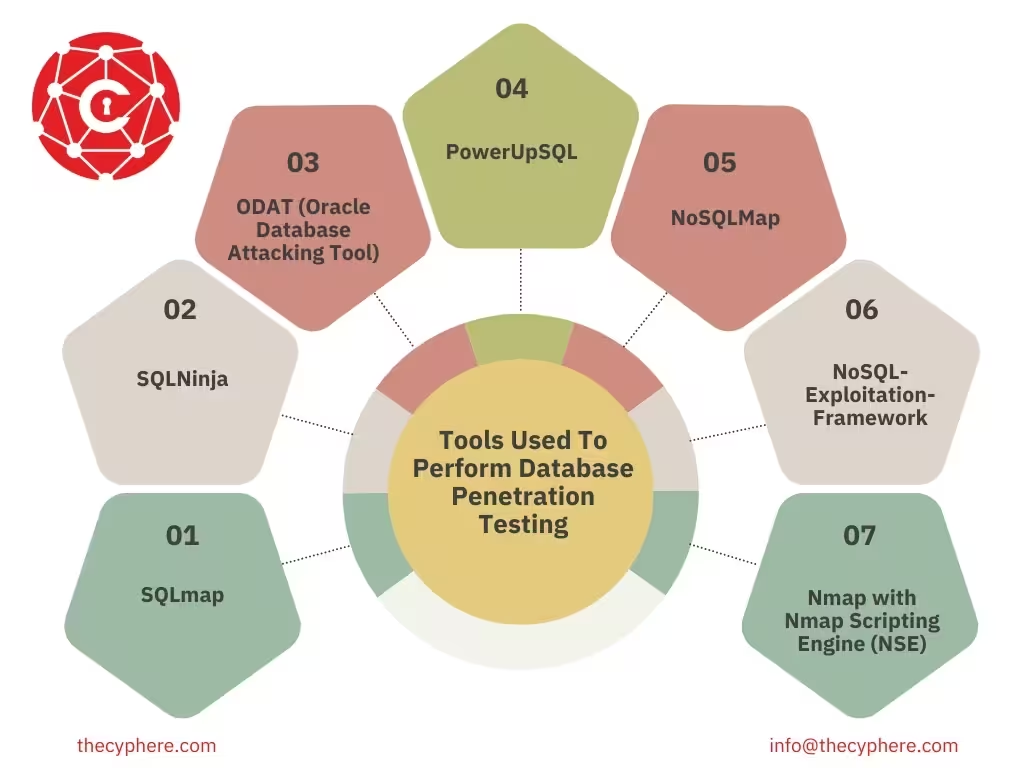
Listed below are seven tools used for database penetration testing.
- SQLmap: SQLmap is an open-source tool used in database penetration testing for detecting and exploiting SQL injection (SQLi) vulnerabilities. Tools like SQLmap are specifically designed to detect SQL injection vulnerabilities, including Boolean, stack, union, and error-based injection methods. These flaws allow attackers to manipulate database queries and potentially access or alter sensitive data, according to a 2023 study by Kamal Uddin Sarker, titled “Penetration Taxonomy: A Systematic Review on the Penetration Process, Framework, Standards, Tools, and Scoring Methods”. This tool includes support for multiple database systems (MySQL, PostgreSQL, Oracle, and Microsoft SQL Server) and complete automated testing for SQL injection. It targets databases with improper input validation or insufficient query sanitisation. Pentesters identified SQL injection through database penetration testing by employing various injection techniques, including error-based and union-based methods.
- SQLNinja: SQLNinja is used in cloud penetration testing to exploit SQL injection vulnerabilities in Microsoft SQL Server databases. This tool is a free and open source tool with post-exploitation capabilities (remote shell access, Metasploit integration) and exploitation capabilities (command execution, file access system). It targets Microsoft SQL Server databases with SQL injection vulnerabilities and servers running unpatched versions of SQL Server. This identifies vulnerabilities (SQL Injection, weak passwords, broken access controls, insecure configurations) by injecting malicious SQL code. Attackers gain remote access and take over the database server.
- ODAT (Oracle Database Attacking Tool): ODAT is a specialised tool used in database penetration testing for uncovering vulnerabilities (privilege escalation, and authentication bypass). It includes vulnerability detection, especially in the Oracle database, while providing a series of automated attacks (password cracking, Brute Force). It specifically targets the Oracle database with default configurations, known security flaws, and weak authentication. This tool identifies vulnerabilities, such as authentication bypass or privilege escalation, by targeting the database with weak passwords or brute force attacks.
- PowerUpSQL: PowerUpSQL is a PowerShell-based penetration testing tool specifically designed for exploiting SQL Server vulnerabilities. Pentesters use PowerUpSQL to analyse privilege escalation and lateral movement within SQL Server environments. It is a free and open source tool with the capability to execute post-exploitation tasks (dumping credentials, executing arbitrary commands on SQL Server). This database pentesting tool targets misconfigured permissions and insecure setups in the Microsoft SQL Server environment to assess how an attacker would escalate privilege and move laterally within SQL Server systems. Vulnerabilities found by PowerUpSQL include command execution, weak access control, and improper permissions. It leverages PowerShell’s automation to scan for vulnerable configurations while escalating privileges and performing post-exploitation actions (remote command execution).
- NoSQLMap: NoSQLMap is an open-source Python tool used in database penetration testing to evaluate NoSQL databases (MongoDB, CouchDB) for misconfiguration and injection vulnerabilities. Pentesters use different injection payloads and techniques (PHP application parameter injection, Timing-based blind injection) to retrieve all database records and validate vulnerabilities. It includes database enumeration, cloning, and Password Hash extraction. This tool is especially designed to target injection vulnerabilities and misconfigured settings. Vulnerabilities found by NoSQLMap are authentication bypass, arbitrary code execution, NoSQLi, and Denial of Service DoS attacks. Pentesters automate the detection of injection flaws in NoSQL queries by utilising a NoSQL map while exploiting weak access controls.
- NoSQL-Exploitation-Framework: NoSQL-Exploitation-Framework is an advanced database penetration testing tool used to automate the exploitation of vulnerabilities in NoSQL databases (MongoDB, CouchDB, Redis). It includes multi-database support (MongoDB, CouchDB, Redis, H-Base, and Cassandra), comprehensive exploitation modules (enumeration, dumping, copying, dictionary attacks), and a multi-threaded IP list scanner. NoSQL-Exploitation-Framework is used to identify unpatched vulnerabilities and insecure configurations in NoSQL databases (MongoDB, CouchDB). Vulnerabilities found by NoSQL-Exploitation-Framework include NoSQL injection and authorisation flaws(improper input validation, data tampering, and privilege escalation). This framework automates the discovery and exploitation of NoSQL injection flaws and misconfigured access controls (data leak, authentication bypass)
- Nmap with Nmap Scripting Engine (NSE): Nmap is a network scanning and testing tool used for database penetration testing, leveraging the Nmap Scripting Engine (NSE), to identify vulnerabilities specific to database systems. Pentesters use this tool to target Networked database services (MySQL, PostgreSQL, MongoDB) to expose vulnerabilities (unpatched systems, weak database services). It provides custom scripts that enable security professionals to identify vulnerabilities and conduct database-specific reconnaissance. This tool includes automated, sophisticated scans, flexible script execution control, and specific task automation (performing Network protocol queries, detecting specific vulnerabilities or backdoors). Vulnerabilities identified by Nmap include outdated software/services, Cross-Site Request Forgery (CSRF), insecure cookie handling, and Remote Method Invocation (RMI) Vulnerabilities. The pentester runs specialised scripts against a target database using Nmap with BESE and scans the database for vulnerabilities.
What vulnerabilities are found in database penetration testing?
Five common vulnerabilities found through database penetration testing are listed below.
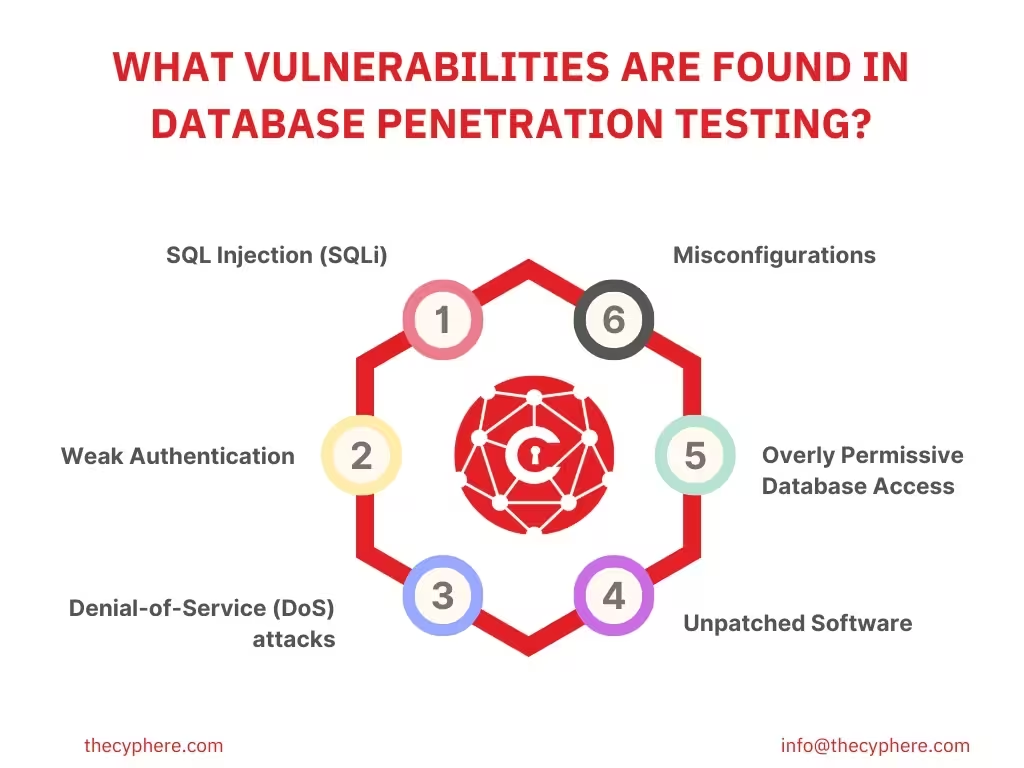
- SQL Injection (SQLi): SQLi is a web application vulnerability introduced by an attacker into a database by injecting SQL code into user input fields (search boxes, forms). SQLi allows attackers to access, steal, exfiltrate, modify, and delete data from the database. Attackers can execute system-level commands to gain full control of the database server. Pentesters identify SQLi by injecting malicious payloads into user input fields and observing the database response. Automated scanning tools, such as SQLmap, are also useful in detecting SQLi (High risk level). Prepared statements, parameterised queries, and proper input validation are used to prevent and mitigate SQL injection attacks.
- Weak Authentication: Weak authentication happens due to a lack of multi-factor authentication (MFA), default account settings, and weak passwords. Attackers exploit weak authentication to gain unauthorised access to the database. They escalate privileges, compromise the whole system, and steal data after gaining access. Pentesters find weak authentication (high-level risk) through brute force attacks, default credential scan, and improper authentication checks during database penetration testing. Security professionals implement strong password policies, multi-factor authentication (MFA), and regularly update default credentials to resolve weak authentication.
- Denial-of-Service (DoS) attacks: Denial-of-Service attacks are initiated by a malicious actor to overload the database server with a flood of requests, making it unavailable to legitimate users. DoS disrupts the normal operation of the database by making the service unavailable to users and causes downtime. These attacks lead to financial and reputational damage if not fixed quickly. Pentester identifies Denial-of-Service Attacks (medium to high risk level) during penetration testing by simulating high traffic load or resource exhaustion techniques (SQL Query Bombing, Connection Flooding). Security professionals implement strategies such as data load balancing, traffic filtering, and rate limiting, alongside regular system performance monitoring, to mitigate DoS attacks.
- Unpatched Software: Unpatched software refers to a database system that has not been updated with the latest security patches. Patches are used to address known vulnerabilities and bugs in the system. Unpatched software exposes the database to known exploits (privilege escalation, remote code execution attacks). It allows attackers to gain unauthorised access to the system, steal data, and disrupt complete business operations. Pentesters identify unpatched software by manually scanning the database version or by using automated tools (Nessus, OpenVAS). A regular patch management process is implemented to fix unpatched software.
- Overly Permissive Database Access: Overly permissive database access to existing and former employees is excessive privileges that employees may exploit intentionally and unintentionally for personal and financial gain. This vulnerability leads to data theft, modification, and leaks. Pentesters find overly permissive database access (medium risk level) by reviewing user roles and permissions during database penetration testing. The least privilege access principle is applied to restrict overly permissive database access, ensuring users have access to data only when necessary based on their role.
- Misconfigurations: Misconfigurations like improper authentication, lack of input validation, and insecure default settings are frequently detected, increasing the risk of exploitation during database penetration testing. Pentesters detect misconfiguration (medium-level risk) during manual checks and automated database penetration testing. These vulnerabilities are addressed through auditing settings, proper configuration management, and the implementation of security hardening guidelines.
What are the benefits of database penetration testing?
Database penetration testing provides benefits to organisations by enhancing their security posture, identifying and remediating vulnerabilities, ensuring data compliance, and verifying database resilience against real-world threats.
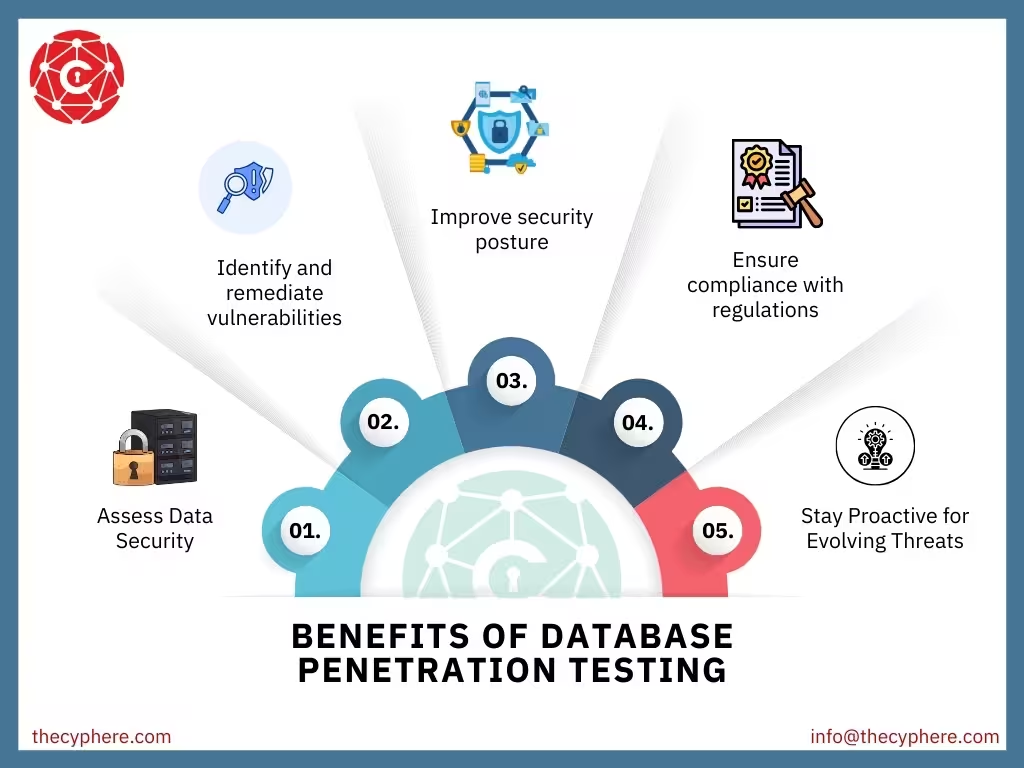
Five benefits of database penetration testing are listed below.
- Assess Data Security: The proposed data security assessment method based on penetration testing achieves an 85% critical-vulnerability detection rate, with a detection response time of 0.15 seconds, improving the efficiency and accuracy of data security assessments, according to a 2024 study by Xiaolu Zhang, titled “Data Security Assessment Method Based on Penetration Testing”.
- Identify and remediate vulnerabilities: Database penetration testing identifies vulnerabilities (such as unpatched software and SQL injection) before attackers can find and exploit them, and provides recommendations for remediation. It also provides risk-based analysis to help prioritise fixes based on severity and potential impact.
- Improve security posture: Database penetration testing improves the security posture of an organisation by detecting and fixing security gaps (overly permissive access, weak access controls) while creating a strong defence against real-world threats (data theft, data leak). It also simulates real-world attacks to check database resilience. This assessment lets security experts refine incident response plans.
- Ensure compliance with regulations: Database penetration helps organisations meet regulatory compliance requirements (PCI DSS) and avoid penalties, legal action, and reputational damage. Businesses minimise the financial impact of data breaches, system downtime and loss of customer trust by addressing vulnerabilities before attackers can exploit them.
- Stay Proactive for Evolving Threats: Database penetration testing helps organisations stay proactive for new attack vectors and evolving threats. Continuous security assessment and improvement in security defences help the database remain resilient against emerging threats and zero-day vulnerabilities.
How often should database penetration be performed?
There is no exact frequency for database penetration testing. As a rule of thumb, database penetration testing should be performed at least once a year, or twice, especially in cases of major infrastructure or policy updates. Regular penetration testing helps reduce database vulnerabilities. This practice should be part of a broader, ongoing risk management process rather than a one-time or infrequent activity.
Factors that determine the frequency of a database penetration test include your business risk profile, compliance requirements, security incidents, and changes to the database infrastructure. Organisations with high-risk profiles (finance, healthcare) require quarterly or even more frequent database penetration testing. Businesses typically conduct database penetration testing annually to meet compliance requirements and industry standards for data security. Organisations usually perform penetration testing after getting a new database, but changes in database infrastructure also increase the need to run a test. A cybersecurity incident or attack should trigger a database penetration test to identify and remediate vulnerabilities, thereby preventing further attacks.
How does database penetration testing improve database security?
Database security is a process of protecting a database from unauthorised access, misuse, or attacks by implementing security measures (data security in transit and at rest, vulnerability protection, and access control). Database penetration improves database security by identifying and fixing database vulnerabilities (SQL injection, weak authentication, and misconfigurations). The organisation enhances the security of the database by understanding how the system behaves under attack and develops an incident response plan to detect, respond to, and recover from real-world attacks. A detailed risk assessment report from pentesters allows security professionals to prioritise security fixes based on the potential impact of vulnerabilities and strengthen database security efficiently.
How important is it to make a database secure?
Databases are prime targets for cyberattacks because they store sensitive business, financial, and personal data. Breaches can lead to severe consequences, including financial loss, reputational damage, legal penalties, and loss of customer trust, according to a 2025 study by Nurayn Mesfer Alqahtani, titled “Security Threats to Databases in E-Commerce Systems: A Systematic Literature Review”.
Common threats include SQL injection, ransomware, unauthorised access, insider threats, and denial of service attacks. These can compromise data confidentiality, integrity, and availability, disrupting operations and exposing organisations to regulatory violations, according to a 2024 study by Xueying Pan, titled “Analysis of Database Security”.
Database security is important to protect sensitive data (personal information, financial data), safeguard against financial loss, reduce insider threats, and maintain regulatory compliance, while building customer trust and ensuring business continuity. Organisations should implement the best database security practices to safeguard their databases against known real-world threats proactively.
What factors make a database insecure?
Seven factors making a database insecure are listed below.
- Lack of database activity monitoring: A database becomes insecure due to a lack of database activity monitoring, as suspicious actions (such as privilege escalation or data filtration) go unnoticed.
- Misconfiguration of database settings: An incorrectly configured database (with open network ports and default settings) exposes the database to attackers who bypass security defences to steal and misuse data.
- Uncontrolled user access: Data breaches happen when attackers exploit old or unused database accounts whose user access is not regularly reviewed and updated by a system administrator.
- Weak authentication mechanism: Weak authentication mechanisms (weak passwords, lack of MFA) make the database insecure because attackers exploit weak mechanisms to gain unauthorised access.
- No data validation: Malicious actors manipulate database queries or commands to extract, delete, update, or export data when the database fails to validate user inputs.
- Unsecured Database APIs: Unsecured APIs make the database vulnerable by providing easy entry points for attackers who can extract sensitive data and exploit the database.
- Insufficient backup: An Insufficient backup system makes the database insecure because security professionals won’t be able to recover data from backup in case of a security breach.
What are the best practices for securing a database?
Seven best practices for securing a database are listed below
-
Use strong authentication: Implement strong authentication on the database and create an additional layer of security by utilising Multi-Factor Authentication (MFA). Security professionals should deactivate default and shared accounts to prevent unauthorised access.
- Apply the principle of least privilege: Apply the principle of least privilege on your database to grant users and systems only the minimal permission required to do a job. Organisations should start with default low access and increase permissions as needed.
- Install a proxy server: Install a proxy server to enhance database security while weeding out unauthorised users from the database. Organisations improve employee privacy, prevent crashes, and control access to the website in the office through proxy servers.
- Encrypt data: Encrypt data in transit and at rest by using strong encryption standards (Transport Layer Security/TLS, Advanced Encryption Standard/AES-256) to protect sensitive data and information stored in the database.
- Ensure regular backups: Regularly back up your database to mitigate the impact of data loss and theft. Data backup enables organisations to restore data fully and minimise downtime in the event of a data breach.
- Enable database auditing and logging: Enable database logging to track database activities and monitor logs for signs of suspicious activity. Organisations should set up alerts for malicious activities in the database (privilege escalation, failed login attempts, sensitive data changes).
- Update the application regularly: Update the application regularly to prevent unauthorised access to the database through unpatched software. Organisations easily prevent zero-day cyberattacks and maintain data security by reducing software exploits.
- Limit Physical Access: Limit physical access to the database by securing it with proper access control and surveillance, so that only authorised personnel can access data as needed.