Key takeaways
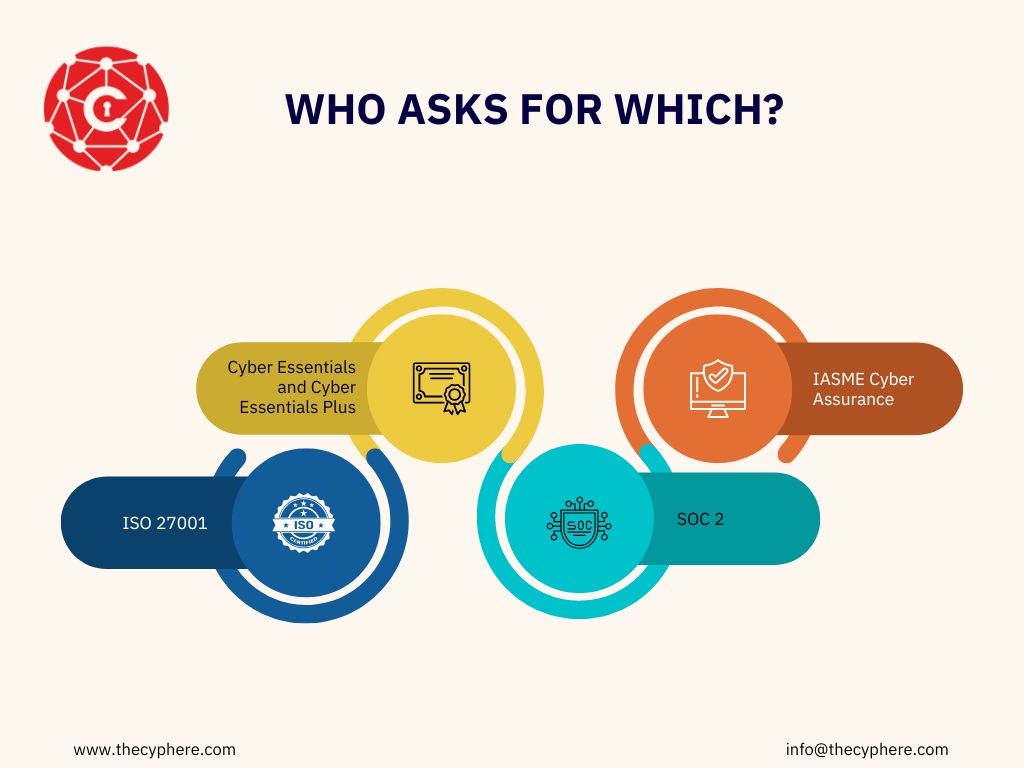
- These schemes are not interchangeable. Cyber Essentials, Cyber Essentials Plus, IASME Cyber Assurance and ISO 27001 are certifications; SOC 2 is an attestation report from a licensed CPA firm; NIST CSF and the NCSC CAF are frameworks with no certificate.
- Who is asking decides the answer. UK public sector, NHS, defence and UK supply chains ask for Cyber Essentials or Plus; international and enterprise buyers ask for ISO 27001; US customers, especially SaaS buyers, ask for SOC 2.
- None of them stands in for another. ISO 27001 does not satisfy a UK contract that names Cyber Essentials, SOC 2 does not test the five controls, and your cloud provider’s certificate says nothing about your own accounts.
- The usual UK order is Cyber Essentials, then Plus, then IASME Cyber Assurance (a recognised alternative to ISO 27001, not an equivalent) or ISO 27001, with SOC 2 added when US customers require it.
If a customer has asked for a security standard, the question is not which is best but which one the person asking will accept, and what each costs you to reach. For most UK organisations that means Cyber Essentials first, because it is the one named in the contract; ISO 27001 when international or enterprise buyers need a management system; SOC 2 only when US customers ask for it.
This page is the wider map: who asks for which, whether one can stand in for another, and the order a UK organisation typically adds them. Our Cyber Essentials vs ISO 27001 comparison goes deeper on that two-way choice.
Five cyber security frameworks at a glance
Cyber Essentials | Cyber Essentials Plus | IASME Cyber Assurance | ISO 27001 | SOC 2 | |
What it is | UK government-backed certification against five technical controls | The same five controls, independently tested on your systems | UK certification adding governance and data protection controls on top of Cyber Essentials | International standard for an information security management system (ISMS) | US attestation report on controls, under AICPA standards |
Who runs it | NCSC sets the requirements; IASME delivers the scheme | NCSC and IASME | IASME | ISO/IEC publish the standard; UKAS accredits UK certification bodies | AICPA sets the Trust Services Criteria |
What it proves | A director or board member declares the controls are in place and an assessor marks the answers | The controls work on a sample of devices and every cloud service | Cyber Essentials plus proportionate governance, risk and data protection controls across the whole organisation | A risk-based management system operates across the scope you define | Controls on a defined system or service met the chosen criteria at a point in time (Type 1) or over a period (Type 2) |
Assessed by | An IASME-licensed certification body | An IASME-licensed certification body | An IASME-licensed certification body (Level 1 verified self-assessment; Level 2 audited) | An accredited certification body, UKAS in the UK | A licensed CPA firm |
Time | Days to weeks | Within 90 days of the basic certificate | Weeks for Level 1; Level 2 adds an audit [HD CONFIRM: typical ICA timings] | Typically six to twelve months | Months; a Type 2 observation period is often 6 to 12 months |
Cost and effort | Lowest: a size-banded assessment fee plus your own time | Low: the basic fee plus an audit fee | Between the two: assessment fee plus governance work; Level 2 adds audit time | High: months of internal time, often consultancy, plus Stage 1, Stage 2 and annual surveillance audit fees | High: internal time plus the CPA firm’s fees for each report |
Validity | 12 months from the day the application is assessed and marked as a pass | 12 months, as Cyber Essentials | 12 months [HD CONFIRM: ICA certificate validity] | Three-year cycle with annual surveillance audits | A report covers a past period; buyers usually want one under 12 months old |
Recognition | UK public sector, NHS, defence, UK supply chains, insurers | As Cyber Essentials, where the buyer wants tested evidence | UK buyers who want more than a technical baseline | International, enterprise and regulated buyers | US customers and SaaS procurement |
Best for | UK SMEs meeting a named contract requirement quickly | NHS Supply Chain, higher-risk contracts, buyers wanting independent proof | UK mid-market organisations asked for governance without a full ISMS | Organisations selling internationally or into regulated enterprise | Software and service providers with US customers |
Who asks for which
Cyber Essentials and Cyber Essentials Plus
Cyber Essentials is what UK buyers name: central government contracts under PPN 014, NHS Supply Chain, the defence supply chain and many private-sector questionnaires (see who requires Cyber Essentials). The NCSC sets the requirements, and IASME licenses the certification bodies that assess you. It is designed to reduce exposure to the most common cyber threats, with the scheme often cited as helping counter up to 80% of common attacks.
Buyers who want the controls tested rather than declared name Plus; the difference between the two levels is in our Cyber Essentials vs Cyber Essentials Plus guide. Both are cheaper and faster than any other route on this page to independent evidence; our cost guide has the figures. Certification is typically renewed annually, so buyers often expect a current certificate.
IASME Cyber Assurance
IASME Cyber Assurance (formerly IASME Governance) builds on Cyber Essentials, adding governance and data protection controls scaled to the size of the organisation. You need a valid Cyber Essentials certificate with at least one month left to run before you start. Level 1 is a verified self-assessment marked by an independent assessor; Level 2 adds an audit of documentation, staff and activities, and needs a Level 1 pass first.
It is a recognised alternative to ISO 27001, not an equivalent, and positioning it as a replacement loses deals. It works where a UK customer asked for ISO 27001 because that is the name they know and would accept a proportionate alternative; see IASME Cyber Assurance for the scheme details. [When Cyphere’s IASME Cyber Assurance article is published, link it here as well.]
ISO 27001
ISO 27001 is what enterprise and international customers require, what regulated sectors expect when they want a management system rather than a control baseline, and the only one of these certifications recognised across multiple countries.
It is a materially larger undertaking than Cyber Essentials: a risk-based approach built around a management system, which also supports compliance work for regulations such as GDPR and HIPAA, audited in two stages by an accredited certification body. That structure starts with a formal risk assessment and is designed for continuous improvement over time. Our two-way comparison has the detail, including the Annex A mapping and how the two scopes differ.
SOC 2
SOC 2 is the US customer’s ask, particularly in software and cloud procurement. It is not a certification: a licensed CPA firm produces an attestation report under AICPA standards against the Trust Services Criteria in scope. Security is always included; availability, processing integrity, confidentiality and privacy are optional.
A Type 1 report covers the design of controls at a point in time. A Type 2 covers operating effectiveness over a period, often six to twelve months, and is what US buyers usually ask for. The report is usually shared under NDA, and a US security team reads the tests and exceptions rather than looking for a badge. UK public sector buyers generally do not ask for SOC 2.
The typical order for a UK organisation
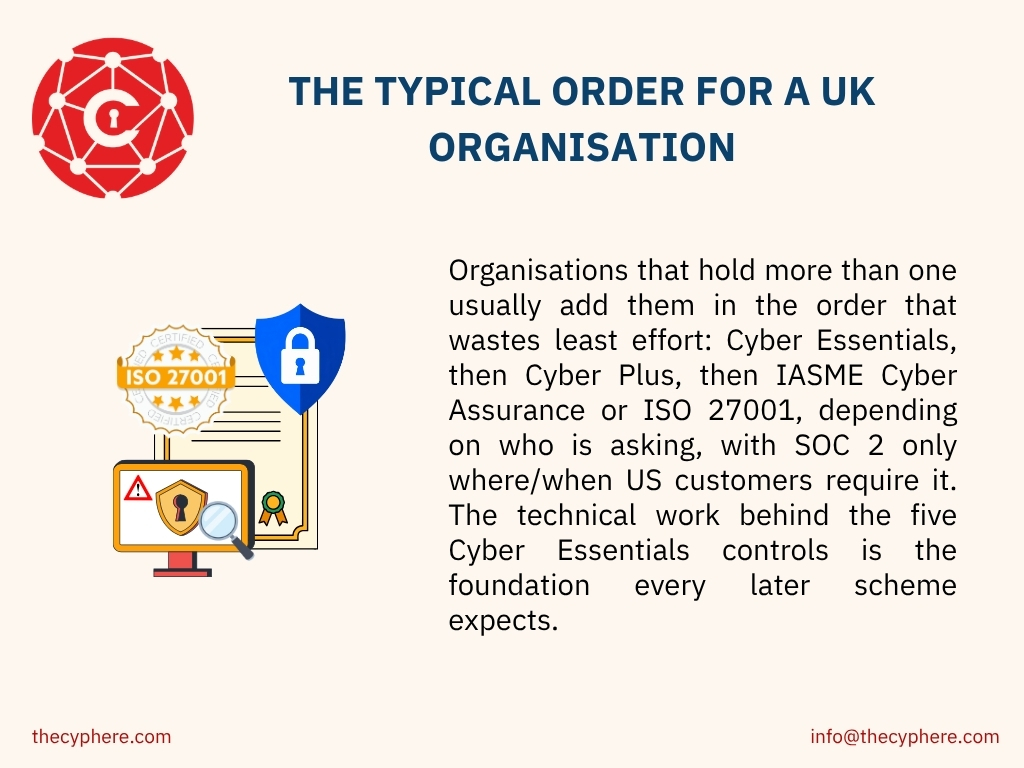
Organisations that hold more than one usually add them in the order that wastes least effort: Cyber Essentials, then Cyber Plus, then IASME Cyber Assurance or ISO 27001 depending on who is asking, with SOC 2 only where/when US customers require it. The technical work behind the five Cyber Essentials controls is the foundation every later scheme expects.
Does one replace another?
No, and the answer is narrower than people searching for a Cyber Essentials equivalent hope.
ISO 27001 does not stand in for Cyber Essentials where a UK buyer names it. PPN 014 expects most ISO 27001 holders to certify to Cyber Essentials as well; an equivalence case has to be independently verified, and NHS Supply Chain refuses ISO 27001 in place of Plus outright.
The test a buyer applies, and the PPN 014 and NCSC wording behind it, are set out in our Cyber Essentials vs ISO 27001 guide; the NHS position is in our NHS suppliers guide.
The same logic runs in every direction. A Cyber Essentials certificate does not satisfy a US customer asking for SOC 2, and a SOC 2 report is not a test of the five controls. Private-sector buyers are more flexible: “Cyber Essentials or equivalent” will often accept ISO 27001, and sometimes a SOC 2 Type 2 report, so read the wording before spending anything.
A supplier’s certificate does not cover you either. Your cloud or hosting provider’s ISO 27001 certificate or SOC 2 report says nothing about your own accounts and settings, and under v3.3 the cloud services you use cannot be excluded from your Cyber Essentials scope (see our scope guide).
Where NIST CSF, CIS Controls and sector schemes fit
Neither NIST CSF nor the CIS Controls produces anything you can hand a buyer. NIST CSF is a voluntary framework; version 2.0 (February 2024) uses six functions (Govern, Identify, Protect, Detect, Respond, Recover). The five Cyber Essentials controls sit almost entirely under Protect; the framework also expects detection, response and recovery, which Cyber Essentials does not assess.
The CIS Critical Security Controls (version 8.1) are 18 prioritised controls in three implementation groups, and Implementation Group 1 covers much of what Cyber Essentials requires.
The NCSC’s own Cyber Assessment Framework (CAF) is different again: a set of outcomes for organisations in scope of the NIS Regulations and other critical functions, which their regulators assess them against; it is not a certification you can buy [HD CONFIRM: CAF wording, add NCSC link].
Sector schemes sit alongside Cyber Essentials rather than replacing it: the NHS Data Security and Protection Toolkit (DSPT), which answers a different question from Cyber Essentials Plus for NHS suppliers, and DCC Level 0 for defence suppliers, which starts with Cyber Essentials certification.
How Cyphere advises on framework choice
Cyphere is a UK-based IASME-licensed certification body for Cyber Essentials, Cyber Essentials Plus and IASME Cyber Assurance Level 1 and Level 2. For ISO 27001 and SOC 2, we help with readiness, including gap analysis for ISO 27001 or SOC 2 preparation, compliance elements, and penetration testing; an independent UKAS-accredited body certifies ISO 27001, and a licensed CPA firm issues the SOC 2 report.
Talk to an IASME-licensed assessor about the right framework
ISO 27001 vs SOC 2 vs Cyber Essentials Certification FAQs
Is there a Cyber Essentials equivalent?
No, there is no exact equivalent. The closest UK alternative is IASME Cyber Assurance, which builds on Cyber Essentials; ISO 27001 is broader and built around risk management, and SOC 2 is a US report, not a certification. Whether a buyer will accept ISO 27001 in place of Cyber Essentials is covered in our two-way guide.
Can SOC 2 replace Cyber Essentials?
No, not automatically. SOC 2 is an attestation report against the Trust Services Criteria you choose, with an auditor’s opinion rather than a certificate, not a test of the five Cyber Essentials controls. Where a buyer names Cyber Essentials, certifying is usually quicker than proving equivalence.
Does Cyphere certify ISO 27001 or SOC 2?
No, Cyphere does neither. For ISO 27001, we prepare you and an independent UKAS-accredited certification body certifies you; SOC 2 reports are issued only by licensed CPA firms [HD CONFIRM: do we offer SOC 2 readiness?].
Do US customers accept Cyber Essentials?
Some accept it as supporting evidence, few as the primary answer; US software buyers typically expect a SOC 2 Type 2 report or ISO 27001. UK companies and organisations outside the UK can still certify to Cyber Essentials when a UK customer asks.
Related Cyber Essentials guides
- What is Cyber Essentials?
- Cyber Essentials vs ISO 27001: the two-way comparison in depth
- Cyber Essentials vs Cyber Essentials Plus
- Is Cyber Essentials mandatory?: who requires it and in what wording
- Cyber Essentials cost