Penetration testing is an authorised security assessment that uses controlled attack techniques to demonstrate the exploitability of defined systems, networks, and applications. It then delivers evidence and remediation guidance to help organisations strengthen their security posture.
The UK Cyber Security Breaches Survey 2025, conducted by the National Cyber Security Centre (NCSC) and the Department for Science, Innovation and Technology (DSIT), reported that 32% of UK businesses identified at least one cyberattack in the last year. Mid-sized organisations were more likely to use third-party penetration testing services as part of their resilience programmes.
According to Fortune Business Insights’ market research, the global penetration testing market is projected to grow from £2.08 billion (USD 2.74 billion) in 2025 to £4.75 billion (USD 6.25 billion) by 2032, at a CAGR of approximately 12.5%. According to Cognitive Market Research’s 2025 market report, the UK penetration testing market size is estimated to be £68.96 million (USD 90.74 million) in 2025, with a projected CAGR of 17.3% for the forecast period.
According to a trends and research report by ZeroThreat AI, titled “Penetration Testing Statistics 2025: Key Insights and Emerging Trends,” 32% of organisations perform penetration tests annually or biannually. Additionally, 51% outsource the service to third-party specialists.
The seven phases of a pentesting process are pre-engagement interactions, reconnaissance, threat modelling, vulnerability analysis, exploitation, post-exploitation, and reporting. Qualified cybersecurity specialists perform penetration testing under the NCSC CHECK framework and use approved assessment methods to uncover real-world security gaps.
The cost to perform penetration testing ranges from £3,500 to £100,000+. The scope of penetration testing includes a written list of in-scope assets (domains, subdomains, IP ranges, cloud accounts, and applications), permitted methods (black-box, grey-box, white-box), evidence requirements, maintenance windows, and escalation contact information.
What is penetration testing in cybersecurity?
Penetration testing is an authorised, simulated attack against defined systems, networks, and applications. It proves exploitable weaknesses and validates security controls under the written rules of engagement.

According to the National Institute of Standards and Technology (NIST) glossary, “penetration testing” is a type of testing that verifies the extent to which a system, device, or process resists active attempts to compromise its security.
According to IBM, a penetration test, or “pen test,” is a security test that launches a mock cyberattack to find security vulnerabilities in a computer system. This includes critical security vulnerabilities that could lead to loss of data, theft, or complete shutdown of a network.
According to Harman Singh (Owner of Cyphere):
“Penetration testing is a proactive security measure to defend against increasing cyber threats (phishing, ransomware, data breaches, insider attacks).”
Organisations resolved only 48% of all vulnerabilities identified during penetration tests, and approximately 69% of high-risk findings, according to a 2025 study by Cobalt titled “State of Pentesting Report 2025.”
Other names for penetration testing include ethical hacking, pen testing, red teaming, white-hat attacks, and vulnerability assessment and penetration testing (VAPT). To define penetration testing clearly: it is an authorised security assessment that proves exploitable weaknesses in target systems.
We define targets, rules of engagement, success criteria, legal authorisation, and evidence requirements before any testing activity starts. The 2025 Verizon Data Breach Investigations Report and IBM’s Cost of a Data Breach 2025 report a global average breach cost of USD 4.44 million. This figure quantifies the financial risk that penetration testing programmes aim to reduce through earlier identification and containment.
How does penetration testing work?
Penetration testing works by executing authorised attack paths within a defined scope. The goal is to prove exploitability, collect evidence, and map remediation across external, internal, and application targets.
Our approach validates theoretical security weaknesses and transforms them into evidence-based findings. These findings include severity ratings, affected target systems (or applications and APIs), and reproducible steps. This enables security, engineering, and audit functions to implement fixes effectively.
According to Cloudflare’s Scans and Penetration Testing Policy, updated on 29 May 2025, authorised testing must target approved assets under explicit rules of engagement. The testing must also produce artefacts for remediation and assurance.
Penetration testing is worth the investment because the evidence it provides reduces breach pathways and improves detection and response workflows. It also delivers compliance artefacts for ISO 27001, SOC 2, and PCI DSS. Penetration testing is particularly important for organisations that handle sensitive data or face regulatory requirements.
What is the history of penetration testing?
The history of penetration testing in computer security dates to 1967. The RAND Corporation and the ARPA task force, led by Willis H. Ware, first used the word “penetration” in IT security research. They recommended formal testing for shared, multi-user computing systems. RAND’s Security Controls for Computer Systems (RAND R609-1, 1967) and Ware’s Security and Privacy in Computer Systems (April–June 1967) described penetration as a methodical process for measuring the strength of security controls in multi-access environments.
The first recorded penetration testing exercise occurred in 1974. The United States Air Force (USAF) ordered a vulnerability analysis of the Multics operating system, which confirmed several exploitable flaws. The USAF Multics Security Evaluation: Vulnerability Analysis (1974) and Paul A. Karger’s peer-reviewed paper presented at the Annual Computer Security Applications Conference (ACSAC, 2002) verified repeatable attack steps. These works created the technical basis for later testing methods.
The 1960s Tiger Teams and J. P. Anderson’s 1972 framework defined the model for controlled attack simulation that mimics real-world attacks. The 1974 USAF Multics evaluation delivered the first empirical results. The 1995 Security Administrator Tool for Analysing Networks (SATAN) applied automated scanning for vulnerability detection. In current IT security operations, penetration testing follows Open Web Application Security Project (OWASP) testing standards and Penetration Testing as a Service (PTaaS) frameworks. These frameworks combine professional testing procedures with pen testing tools for verified vulnerability measurement.
What are the 7 Steps of penetration testing?
Listed below are the 7 steps of the Penetration Testing process.
Pre-Engagement Interactions: The pre-engagement phase in penetration testing formalises the written scope, rules of engagement, legal authorisations, communication plans, and safety controls before any testing begins. This stage involves a customer sponsor who sets risk constraints and a security lead (or development and admin team) who confirms test windows and change request requirements. Legal and Compliance teams sign authorisations. The testing team, including project managers on both sides, agrees on communication channels for status updates, wash-ups, secure information exchange, and escalation points of contact.
Our security team runs a formal kick-off meeting, validates asset ownership, and confirms in-scope domains and IP ranges for each target system. We document change-freeze periods in a signed engagement brief.
This preparatory phase reduces legal risk, protects production systems, and aligns the test with a proactive approach. It ensures prerequisites and kickoff preparations are complete. The phase produces the engagement brief, the scope register, and the contact matrix. These become the control artefacts for the pentest.Intelligence Gathering (Reconnaissance): The Intelligence Gathering step in penetration testing collects verifiable technical and organisational information. This information maps attacker-facing exposure across domains, subdomains, and internet-reachable services. This stage involves enumerating public records, including DNS (Domain Name System) entries, TLS (Transport Layer Security) certificate metadata, software versions, and employee footprints. Our pen testers use these findings to map the target environment.
We conduct this activity using passive methods such as passive DNS lookups, search engine operators, and repository queries. We also use controlled active checks, such as page fingerprinting and service enumeration, to discover hidden vulnerabilities.
This process provides precise external discovery. It reduces false positives in later phases and improves the accuracy of attack-path selection for real assets that impact business operations. This phase results in a reconnaissance dossier containing verified assets, technology stacks, authentication surfaces, exposed management interfaces, and candidate entry points with supporting evidence. It also applies data-protection controls by documenting lawful bases for processing and retaining only evidence that supports the approved scope. These verified assets and exposure findings from Intelligence Gathering become the ranked inputs for threat modelling.Vulnerability Analysis: Vulnerability Analysis in penetration testing identifies and verifies weaknesses that enable the modelled attack paths. This phase prioritises the collected vulnerabilities based on their severity and potential impact. Vulnerability analysis correlates automated tools with manual pen test checks to confirm fundamental flaws in versions, configurations, and access controls.
Our pentesters run both authenticated and unauthenticated tests. We reproduce issues in a safe environment and remove false positives before any proof steps. This phase is important because accurate verification directs effort to defects that attackers can actually exploit. It prevents time loss on noise. The phase produces a vulnerability register listing each confirmed weakness with evidence, preconditions, affected assets, and references to vendor advisories. The confirmed weaknesses from the Vulnerability Analysis serve as authorised input for exploitation.Exploitation: Exploitation in penetration testing proves real impact by executing authorised attacks against confirmed weaknesses under the written rules of engagement. This step involves selecting a specific technique, preparing a minimal-impact payload, and running the attempt on the target system. Our pen testers capture proof, such as command output, and record timestamps for every action. We perform safe exploitation and, for reporting purposes, ensure mapping each attempt to MITRE ATT&CK (Adversarial Tactics, Techniques, and Common Knowledge). We validate success conditions, such as shell access read.
This phase delivers business value because evidence turns security risks into a measured impact that leaders prioritise and teams fix. The speed of attacker activity supports fast, focused action.
According to an analysis by VulnCheck, titled “State of Exploitation: 1H-2025,” 32.1% of known vulnerabilities showed exploitation on or before public disclosure. Additionally, 432 CVEs (Common Vulnerabilities and Exposures) received first-seen exploitation evidence in the first half of 2025. This supports rapid and disciplined exploitation procedures that collect proof and then restore the state. These evidence-backed access proofs from exploitation form the verified input for post-exploitation.Post-Exploitation: Post-Exploitation in penetration testing assesses the limits of access by attempting safe lateral moves and checking for higher privileges. It also confirms which data is reachable and verifies the possibility of persistence within the approved scope. Post-exploitation involves mapping reachable hosts, enumerating trust relationships, testing segmentation, and checking endpoint and identity detections. This phase focuses on maintaining access and assessing lateral movement risks.
Our pen testers perform the post-exploitation stage by running controlled pivoting and executing least-impact commands to verify access. We collect artefacts such as host inventories and token listings, analyse network traffic where authorised, and restore systems immediately after each check. This is a crucial step. Threat actors often move quickly after initial access to escalate their privileges before this initial access connection is lost or due to fear of being detected.
According to the CrowdStrike Global Threat Report 2025, the average eCrime breakout time fell to 48 minutes. The fastest breakout measured 51 seconds, creating a short verification window for lateral-movement controls. The process produces a lateral-movement map, a privilege matrix, a data-at-risk catalogue, and a detection-gap log. These link each action to MITRE ATT&CK tactics such as Privilege Escalation (TA0004) and Lateral Movement (TA0008). It also follows current defence guidance. According to a CISA advisory published in September 2025, intrusions showed discovery and ping sweeps to facilitate lateral movement. The advisory lists concrete containment steps that align with controlled verification during this phase. These artefacts and time-bound observations from Post-Exploitation become the structured evidence set for reporting.Reporting: Reporting in penetration testing delivers a decision-ready document that lists each finding with severity, affected assets, reproducible steps, business impact, and a fix that includes a clear success check. Reporting involves an executive summary for leaders, a technical appendix for engineers, and a remediation tracker with owners and due dates. The penetration test report also includes a retest plan that maps fixes to verification steps.
Our security consultants prepare reports by linking every exploit and observation to MITRE ATT&CK (Adversarial Tactics, Techniques, and Common Knowledge) techniques. We attach time-stamped evidence and define Service Level Agreements (SLA) for remediation and retesting windows. Reporting adds measurable value because high-quality evidence accelerates fixes and supports audits. The UK NCSC (National Cyber Security Centre) CHECK scheme sets standards for assured providers and emphasises scoped, authorised testing with clear deliverables (NCSC Annual Review, 14 October 2025).
Reporting supports risk decisions with market figures. The ICO (Information Commissioner’s Office) received thousands of personal data breach reports up to Q2 2025. This indicates continuing exposure and the need for evidence-based remediation that stands up to regulatory review. Reporting closes the engagement with a retest plan and a continuous-assurance note. This ensures teams can re-verify fixes on schedule and roll findings into vulnerability management and monitoring.Legal Requirements and Authorisation: Penetration testing cannot be performed by anyone. It requires explicit written authorisation for companies to carry out assessments. This is a legal requirement in the UK to ensure the Computer Misuse Act is not violated. UK buyers use assured providers under the NCSC CHECK scheme for government and critical infrastructure work.
Who performs penetration testing?
Qualified cybersecurity professionals perform penetration testing. These professionals deliver authorised penetration testing services on defined systems, networks, and applications. Pentesters provide penetration testing services under written rules of engagement to validate exploitability, assess control effectiveness, and document remediation measures.
Other names for a penetration tester include ethical hacker, security tester, red-team operator, and cybersecurity consultant.
Penetration testing services can be provided by an individual expert as well as a cybersecurity company, such as Cyphere. Cyphere is a penetration testing company that provides cybersecurity and penetration testing services. We hold CREST and IASME accreditations, work across both offensive and defensive security, and operate beyond a simple “report and run” approach. We deliver cloud and web application testing, mobile application security assessments, network and infrastructure penetration testing, and device security assessments. We support compliance programmes and certifications, which include GDPR, ISO 27001, PCI DSS, NHS DSPT, NHS DTAC, and Cyber Essentials Plus.
What are the necessary skills to perform penetration testing?
Listed below are the 6 necessary skills to perform penetration testing.
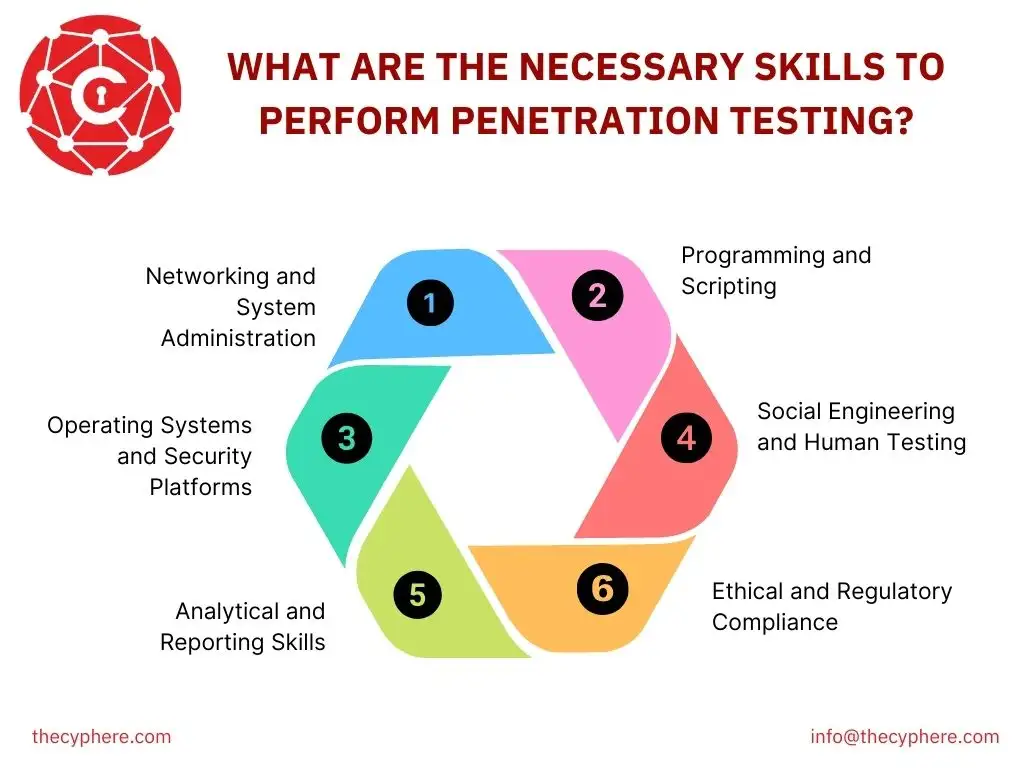
Networking and System Administration: Networking knowledge in penetration testing covers working knowledge of network protocols, i.e. TCP/IP, Active Directory services, including DHCP, DNS, network devices such as firewalls, routers, and operating system internals.
Programming and Scripting: Programming and scripting knowledge in penetration testing allows testers to write payloads, extend tools, and automate exploit proofs. This is a big advantage when working through exploitation scenarios during manual pen testing.
Operating Systems and Security Platforms: Knowledge of both Linux and Windows environments is required to conduct penetration testing effectively. Pen testers must understand how each IT system operates and where security features can be bypassed.
Social Engineering and Human Testing: Social engineering evaluates process and human vulnerabilities through controlled phishing, vishing, or physical entry tests performed under written authorisation.
Analytical and Reporting Skills: Analytical thinking in penetration testing ensures accurate interpretation of test results and effective translation of technical findings into actionable business recommendations.
Ethical and Regulatory Compliance: Ethical hacking principles and compliance knowledge ensure lawful operation under United Kingdom frameworks such as NCSC CHECK and CREST, which mandate documented scope, verified tester roles, and preserved evidence records.
Is penetration testing hard to learn?
Yes, penetration testing is hard to learn because it demands deep system knowledge, hands-on exploitation skills, and continuous study to keep pace with fast-moving attack techniques. Penetration testing requires strong foundations in operating systems, networks, and identity systems. It also requires secure coding and debugging skills in languages such as Python and Bash.
Exploitation formed one-third of initial compromise cases in 2025, according to Mandiant’s M-Trends. The report documented 33 per cent of investigations where exploitation acted as the initial infection vector and a median dwell time of 11 days. This indicates how attackers use deep technical methods to exploit weaknesses that demand detection-aware tradecraft for early containment.
Cybersecurity experts say penetration testing is complex to learn because learners must master operating systems, networks, and web application stacks before the same tools that pen testers use make sense.
Penetration testing is hard to learn. However, learners progress faster when they build fundamentals first, review source code examples, practise daily in labs, document proofs, and align their skills to real attacker timelines as evidenced by 2025 threat reports.
Is DIY penetration testing possible for businesses?
DIY (do-it-yourself) penetration testing means a business runs authorised security tests on its own systems using its own staff, tools, and policies in tightly scoped non-production contexts. DIY penetration testing is possible for a business in limited, clearly scoped situations. These include non-production web applications with disposable test data or read-only test accounts.
Small or less complex businesses with a few internet-facing assets and rollback plans can use DIY penetration testing to get faster feedback and reduce procurement overhead whilst staying within provider testing rules. Regulated or complex estates should avoid DIY penetration testing. Audit expectations, independence requirements, legal guardrails, and system impact risks require accredited third-party testers.
Can AI perform penetration testing?
Yes, AI can perform penetration testing by automating vulnerability discovery, attack simulation, correlation, and reporting. It supports human testers without replacing them. AI penetration testing automates approximately 70 per cent of the testing workflow through automated testing tools such as PentestGPT, Pentest Copilot, and Shennina. These technical tools support planning, scanning, exploitation sequences, and ATT&CK-mapped reporting.
Automated testing excels at speed, breadth, and repeatable coverage across large target sets. Manual pen test approaches excel at creative chaining, safe decision-making during exploitation, and business-impact validation. We prefer human-led, AI-assisted testing because it combines broad automated discovery with accurate, secure, and business-aware results.
How long does a penetration test take?
A penetration test takes a few days for tightly time-boxed scopes, 5-10 business days for a normal web application, 1-3 weeks on average for broader network assessments, and 4-8 weeks for the full cycle of testing. Pen testers need more days when applications have multiple roles and many unique pages. One-week windows struggle when the scope includes large IP addresses (beyond 500), VPN access delays push schedules out, or on-site work stays within about a week per visit.
Mandiant’s M-Trends 2025 reports a global median dwell time of 11 days, and CrowdStrike’s 2025 report shows an average eCrime breakout time of 48 minutes, which justifies realistic test windows and fast evidence turnarounds in reporting and retesting.
How often should you perform penetration testing?
You should perform penetration testing at least annually. We recommend scheduling extra tests after essential changes and considering more frequent or continuous testing for fast-changing environments.
According to the U.S. HIPAA Security Rule update proposal for 2025, regulated healthcare entities are required to conduct penetration testing at least once every 12 months. This requirement sets a clear annual floor for organisations that handle sensitive data.
According to the SOC 2 practice, penetration testing is not strictly mandated. Auditors can accept other controls. This creates variation in real-world cadences for non-regulated businesses that may perform internal tests or external tests as part of risk assessment.
According to 2025 research on continuous exposure management, some programmes advocate testing more frequently than annually and even continuously to keep pace with change. This conflicts with “annual-only” schedules.
What are the examples of penetration testing?
Listed below are 8 examples of penetration testing.
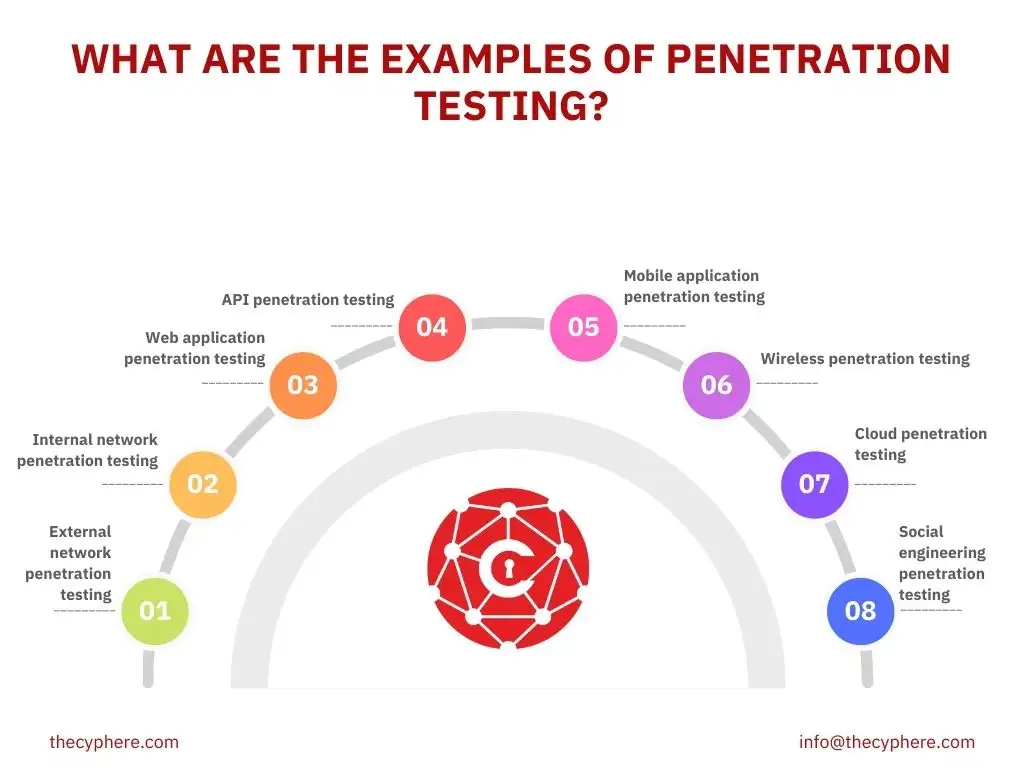
External network penetration testing: External pen test work evaluates Internet-facing assets by proving credential stuffing on remote access portals, outdated TLS (Transport Layer Security) configurations, and exposed administrator interfaces.
Internal network penetration testing: Internal penetration testing assesses corporate networks by demonstrating lateral movement across Windows domains, analysing passwords, auditing configurations, patching, and reviewing authentication, authorisation, account, and Kerberos policies. It also identifies weak SMB signing and misconfigured Active Directory Group Policies to strengthen the organisation’s security posture.
Web application penetration testing: Web application penetration testing examines web applications by proving SQL injection on authentication flows, cross-site scripting in input fields, and broken access control on administrative routes. This testing often requires data validation checks and source code review, where white-box access is provided.
API penetration testing: API penetration testing evaluates REST or GraphQL services by proving broken object-level authorisation, insecure direct object references, and excessive data exposure in responses.
Mobile application penetration testing: Mobile application penetration testing assesses iOS and Android apps by proving insecure on-device data storage, weak transport security, and improper certificate pinning.
Wireless penetration testing: Network pen tests for wireless evaluate Wi-Fi environments by proving weak WPA2-PSK (Wi-Fi Protected Access 2 Pre-Shared Key), rogue access point risks, and captive-portal bypass. Testing often includes analysis of encrypted transport protocols.
Cloud penetration testing: Cloud penetration testing assesses AWS (Amazon Web Services), Azure (Microsoft Azure), or GCP (Google Cloud Platform) accounts by proving insecure IAM (Identity and Access Management) policies and server-side request forgery to the metadata service. Pen testers examine the system’s security by testing unknown vulnerabilities in cloud configurations.
Social engineering penetration testing: Social engineering penetration testing (sometimes called a covert pen test) evaluates human and process controls by proving phishing-driven credential submission, vishing-based token capture, and smishing that directs users to fake portals. This testing evaluates security posture from a human-factors perspective.
All the examples described above are, in fact, types of penetration testing. There are more than 20 types of penetration testing categorised based on their knowledge level, target specificity, execution, compliance, and certification.
What tools are used to perform penetration testing?
Penetration testing tools are specialised software applications that discover assets, identify weaknesses, prove exploitability, and capture evidence under an authorised scope. Our penetration tests involve both automated testing and manual verification.
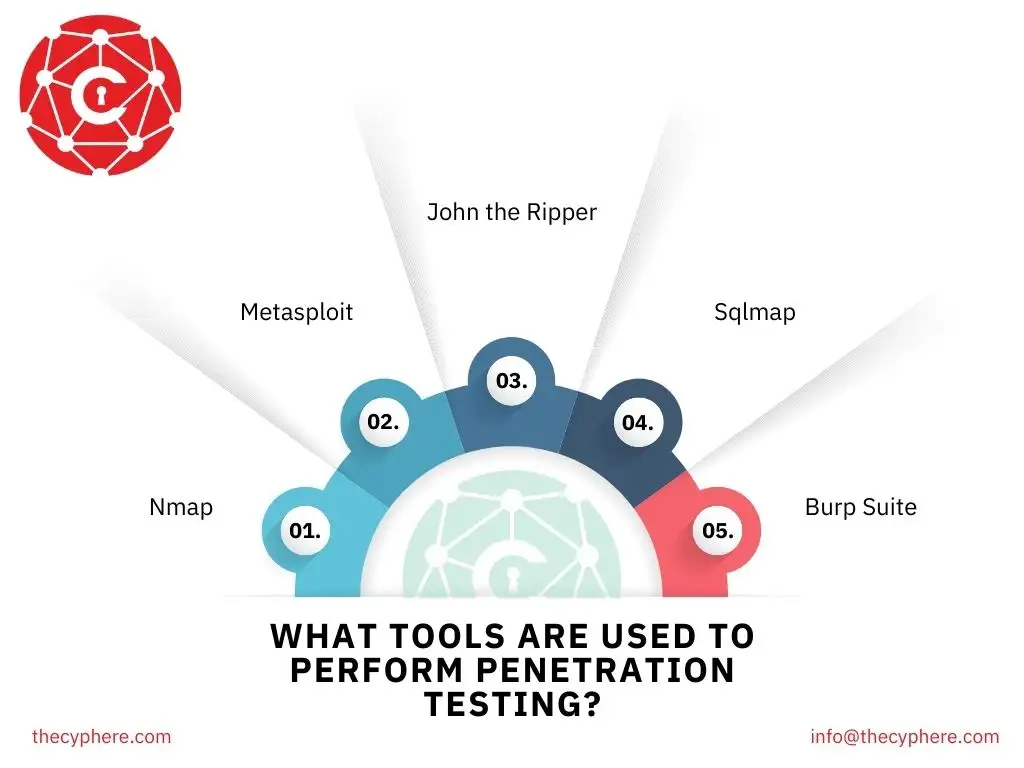
Below, we have listed the five most commonly used penetration testing tools.
Nmap: Nmap is an open-source network scanning tool used to map live systems, open ports, and running services across networks. It is commonly used during reconnaissance to identify targets before active exploitation. Nmap works on both TCP and UDP protocols and supports task automation through its scripting engine (NSE), which helps detect misconfigurations, service versions, and vulnerabilities.
Metasploit: Metasploit is an exploitation framework that includes thousands of tested exploits and payloads. The unique features of Metasploit include its built-in exploit database, integration with vulnerability scanners, and the ability to simulate real attacks. Metasploit helps to identify, exploit, and validate security flaws in remote systems.
John the Ripper: John the Ripper is a password‑cracking tool that tests hashed password strength using dictionary and brute-force attacks. John the Ripper includes support for multiple hash formats, custom wordlists, and hybrid cracking modes.
Sqlmap: Sqlmap is an automation tool that identifies and exploits SQL injection flaws in web applications. The unique features of SQLmap include database fingerprinting, data extraction, and built-in support for multiple DBMS (MySQL, Oracle, PostgreSQL, etc.).
Burp Suite: Burp Suite is an advanced web-application testing platform that intercepts, modifies, and replays traffic between the client and server. Burp Suite includes an interactive HTTP proxy, a request repeater, a scanner, and an intruder module, available in both free and paid versions.
The above mentioned tools are just the main tools used in the penetration testing process. We have compiled 50 penetration testing tools in our detailed article.
How much does penetration testing cost?
The cost to perform penetration testing ranges from £3,500 to £100,000+. The hourly rate for penetration testing ranges from £94 to £275 when derived from standard UK day rates. The daily price of penetration testing in the UK ranges from £1,000 to £1,500 per tester-day. Amounts below £800 per day are often a red flag for scan-only or sub-quality work.
The weekly cost of penetration testing ranges from £4,000 to £10,000+ per tester, based on a five-day project week. The quarterly cost of penetration testing for a business that runs one week of testing each quarter ranges from £48,000 to £96,000 per year at mid-market day rates. The yearly cost for a UK small-to-medium enterprise that commissions one substantial annual test ranges from £10,000 to £30,000+. Larger estates with several scopes exceed £30,000 to £50,000+ per year.
The costs associated with professional CREST penetration testing are minor compared to the potential financial losses from a successful cyber attack.
Multiple factors add to the base cost. Authenticated tests, full evidence (screenshots and packet captures), and a planned retest add £2,000–£5,000 (about 1–3 tester-days). Team seniority and accreditation raise the costs of penetration testing to £1,000 to £1,500 per tester per day. A small external or single web application taking 3 to 5 days costs £2,000 to £4,000. A medium web application with multiple roles and an API taking 7 to 10 days costs £7,000 to £15,000.
You should avoid unqualified teams charging under £800 per day. Low prices often mean automated scans and thin reports that miss security issues. Premium providers above £1,800 per day are justified only for complex or urgent work that requires penetration testing from specialists with prior knowledge of specific sectors.
Choosing a cheap, unqualified pen tester creates significant risks such as professionalism, deliverables quality and environmental risks, utilising tools carelessly. These include missed critical vulnerabilities, scan-only reports lacking evidence, delays in remediation, failed or delayed ISO 27001, Cyber Essentials, or PCI DSS audits, and avoidable service disruption caused by weak scoping and unsafe methods.
What factors affect penetration testing cost?
Listed below are the 5 factors that affect the cost of penetration testing.
Scope size and asset count: Scope size and asset count drive tester-days from £2,000–£4,000 for a 3–5 day mini-scope to £20,000–£50,000+ for multi-week work at UK day-rates of £1,000–£1,500 per day.
Penetration testing methodologies (black box, grey box, white box): Penetration testing methodologies shift effort, with black box increasing reconnaissance and often adding ~20–40% effort, whereas grey/white box focuses time on deeper checks and takes the longest at roughly £9,50–£1,500 per tester-day.
Team seniority and accreditation: Team seniority and accreditation raise day-rates from mainstream £1,000–£1,500/day to £1,600–£1,800+ for CREST or NCSC (National Cyber Security Centre) CHECK leads, with government price lists showing typical bands near £1,200–£1,800/day.
Scheduling and urgency: Scheduling and urgency increase cost when out-of-hours delivery or compressed timelines push rates above the usual £1,000–£1,500 per day, moving into £1,600–£1,800+ per day premium pricing.
Delivery model (one-off vs PTaaS subscription): Delivery model affects cash flow, with one-off projects billed by day and PTaaS spreading cost into subscriptions, typically £4,000–£8,000 per month (and up to £12,000+ per month for enterprise coverage), while still anchored to the same underlying day-rate economics.
Do penetration testing costs vary by test type?
Yes, the cost of penetration testing varies depending on the types of penetration testing conducted. Each type requires a different level of access, technical effort, and evidence across web application, network, cloud, and social engineering scopes.
Web application testing costs £3,500 – £30,000 from small web app to large portals. The price increases with complex authentication, integrations, roles or API logic.
Mobile application testing costs £3,500-£25,000 based on mobile app functionality and platform. The price increases when you test both iOS and Android or deep API integrations.
Network testing costs £2,500-£6,000 (external network scope) and £5,000-£25,000 (internal network scope). The price depends on host count, active directory assets/size and credentialed access.
What is the scope of penetration testing?
The scope of penetration testing is defined by the systems, networks, applications, identities, locations, and rules that testers are authorised to assess, including start and end points, success criteria, constraints, and approvals.
Mitnick Security explains that scoping determines the level of intrusion, where testing begins, and where it must stop, so everyone knows exactly what will be tested and what will be excluded. The scope of penetration testing is essential because it prevents misunderstandings, protects production services, and ties the test to business risk and compliance.
UK NCSC guidance states that commissioning a penetration test requires a clear scope agreed with all relevant risk owners. The GOV.UK service guidance advises making the scope broad enough to cover the whole service, where this approach requires penetration testing.
The penetration testing scope includes named assets and boundaries (specific domains, subdomains, IP ranges, applications), permitted methods (black-box, grey-box, white-box), evidence requirements, and operational rules such as maintenance windows and escalation contacts. A double blind test may be specified where detection and response capabilities are being measured.
Outside the scope are assets that are not listed, third-party systems without written permission, and unsafe actions such as unapproved denial-of-service, data destruction, or uncontrolled lateral movement. Any activity that breaches the agreed rules of engagement is also excluded. This is determined before the pen test begins.
According to the UK Government Service Manual and NCSC guidance, commissioning teams must define clear boundaries and use only approved methods, with exclusions explicitly documented to avoid disruption or legal issues.
What are the benefits and disadvantages of penetration testing?
Listed below are the 6 benefits of penetration testing.
Security strength: Penetration testing strengthens security by turning theoretical weaknesses into verified fixes with clear priority. This commitment to security builds trust with customers and business partners.
Regulatory assurance: Penetration testing enhances regulatory assurance by providing audit-ready evidence for ISO 27001, SOC 2, PCI DSS, and Cyber Essentials Plus.
Cost efficiency: Penetration testing improves cost efficiency by identifying high-impact issues early and assigning remediation to the right owners.
Control validation: Penetration testing validates preventative and detective controls by confirming that they operate as intended under realistic attack conditions. An external test or internal test can improve staff awareness of security protocols by highlighting potential weaknesses and suggesting areas for training.
Operational readiness: Penetration testing advances operational readiness by generating artefacts, timelines, and repeatable scenarios that support blue-team exercises.
Stakeholder trust: Penetration testing strengthens stakeholder trust by delivering a documented scope, clear results, and a scheduled retest outcome.
Listed below are the 7 disadvantages of penetration testing.
Data exposure risk: Penetration testing could accidentally reveal sensitive information, leading to data exposure incidents. These risks highlight the importance of strict scope definition, controlled testing methods, and secure handling of all collected data.
False positives: Penetration testers sometimes over-rely on tools, creating false positive data. Sometimes, either the tool(scanners) flags something that is not really a problem, so sometimes they miss a serious issue. A good penetration tester always performs manual penetration testing by understanding the customer’s business and gets more accurate results than just a scanner.
Planning gaps: Missed planning cycles can make test evidence outdated, especially when organisations fail to schedule follow-up testing after major infrastructure or software changes.
Scope ambiguity: Incomplete or unclear scoping leads to testing gaps when security teams fail to list all in-scope assets, exclusions, and engagement rules.
Service disruption risk: Penetration testing can temporarily cause service instability, a hiccup, or even a brief outage (in severe cases) if it is conducted outside of maintenance windows or without rapid rollback procedures. This risk is higher when testing involves prior knowledge of production dependencies. It’s like testing the limits of a car; you might push it close to the redline.
Resource strain: Testing activities can overload internal teams when owners do not allocate sufficient time for access setup, evidence validation, remediation, and retesting.
Budget variance: Testing costs can exceed forecasts when the agreed scope, access model, or methodology depth expands during delivery.
How is penetration testing different from Security testing and assessment?
The differences between penetration testing and Security testing are listed below.
Penetration Testing vs Vulnerability Scanning: Penetration testing differs from vulnerability scanning in the level of validation. Penetration testing confirms which weaknesses attackers can actually exploit through simulation, while vulnerability scanning only identifies potential risks and reports those issues that may have false positives and require manual verification.
Penetration Testing vs Vulnerability Testing: Penetration testing validates confirmed weaknesses to show real-world impact, whereas vulnerability testing identifies and reports potential issues without verification.
Penetration Testing vs Ethical Hacking: Penetration testing is a structured assessment with a defined scope, objectives, and report, whereas ethical hacking is a broader practice that can include penetration tests, bug bounty programs, and other authorised security evaluations. The goal of ethical hacking is to gain access to a system as malicious attackers do, but without causing any harm.
Penetration Testing vs Red Teaming: Penetration testing proves exploitability on named assets, while red teaming measures detection and response by pursuing defined objectives against the whole organisation.