Physical penetration testing is a proactive security assessment that attempts to bypass or compromise a facility’s physical security measures. Physical penetration testing evaluates perimeter fences, social engineering defences, biometric controls, access card systems, and surveillance infrastructure to determine the risk of a physical breach.
The main process of physical pen testing is preparation, scoping, reconnaissance, infiltration, internal exploitation, exfiltration, and remediation. The methods used in physical penetration tests are social engineering, lock manipulation, access control system bypass, perimeter breach, and surveillance avoidance.
The main tools used in physical pen testing are security testing tools, non-destructive entry tools, bypass equipment, and covert surveillance equipment. The cost of a physical penetration test typically ranges from £3,500 to £40,000+, depending on scope, complexity, and duration. The price of pen testing depends on the scope, size, and duration of the engagement.
A qualified physical penetration testing company delivers actionable findings through realistic attack simulation and comprehensive documentation. Effective providers employ experienced testers with recognised credentials, follow established methodologies, maintain appropriate insurance and legal protections, and deliver detailed remediation guidance.
What is physical penetration testing?
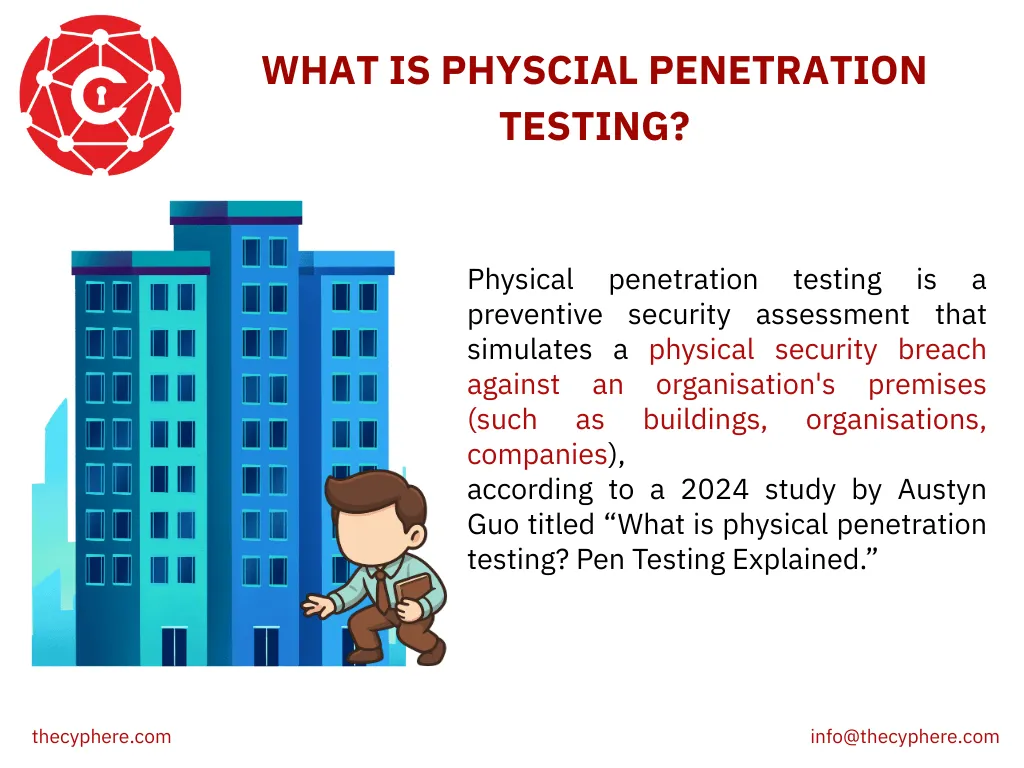
Physical penetration testing is a preventive security assessment that simulates a physical security breach against an organisation’s premises (such as buildings, organisations, companies), according to a 2024 study by Austyn Guo titled “What is physical penetration testing? Pen Testing Explained.”
The history of physical penetration testing started to evolve in the 1970s and 1980s. The early tests of pen testing prioritised breaching perimeter defences such as fences, doors, and basic alarm systems. The process of pen testing was refined in the 1990s, which led to the integration of psychological manipulation and pretexting. Modern penetration testing involves network infrastructure, application servers, web applications, and the Internet of Things (IoT), according to a 2022 study by Claudia Greco et al., titled ‘AI-enabled IoT Penetration Testing: State-of-the-Art and Research Challenges.”
Physical penetration testing evolved into an expert aid with high-level tools, such as hidden entry devices and RFID (Radio Frequency Identification) cloning, in the early 2000s. According to a 2024 study by Austyn Guo titled “What is physical penetration testing? Pen Testing Explained,” the examples of physical pen testing are lock manipulation, social engineering, tailgating (shadowing), impersonation, badge duplication, and dumpster diving.
How does physical penetration testing work?
Physical pen testing functions as a systematic and sequential process from preliminary strategies to final documentation. According to a 2025 study by Chris Brown titled “Physical Penetration Testing: A Complete Overview,” the process of pen testing includes rules of engagement, information gathering, exploitation, and security patches.
According to a 2024 study by Josh Schmidt titled “What is the primary goal of penetration testing?”, the goal of physical pen testing features advancing the security position, evaluating personnel awareness, determining action time, and assessing business impact.
The purpose of physical penetration testing is to determine weaknesses, the security protocols, and legal adherence (such as PCI DSS), according to a 2024 study by Austyn Guo titled “What is physical penetration testing? Pen Testing Explained.”
UK Legal Considerations for Physical Penetration Testing
Physical penetration testing in the UK requires careful attention to legal boundaries to ensure testing activities do not constitute criminal offences. Key legal considerations include:
Letter of Authorisation (LOA): Testers must carry a signed Letter of Authorisation from an authorised company representative at all times during on-site testing. The LOA should include tester names, dates of authorised testing, specific locations covered, and emergency contact details. This document provides legal protection if testers are challenged by security personnel or law enforcement.
Criminal Law Act 1967 and Theft Act 1968: Physical penetration testers must ensure their activities do not constitute trespass, burglary, or theft under UK law. The LOA and Rules of Engagement must explicitly authorise all planned activities.
Computer Misuse Act 1990: If physical testing extends to accessing computer systems (such as plugging into network ports or accessing unlocked workstations), activities must comply with the Computer Misuse Act. Written authorisation must cover any digital access attempts.
Data Protection Act 2018 and UK GDPR: Any personal data observed or obtained during testing (employee names, photographs, credentials) must be handled in compliance with data protection requirements. Testing reports should anonymise individuals where possible.
Private Security Industry Act 2001: Some physical penetration testing activities may fall under Sethe curity Industry Authority (SIA) licensing requirements. Organisations should verify whether their testing provider holds appropriate licenses.
Health and Safety: Testing activities must not create genuine safety risks. Emergency stop procedures should be established for situations where testing could endanger personnel or trigger emergency responses.
Engaging CREST-accredited providers helps ensure that physical penetration testing is conducted within appropriate legal and ethical boundaries.
What is the scope of physical penetration testing?
To secure your premises, you must first define the boundaries of your engagement. A clear scope document ensures your team and the testers stay on the same page; it outlines exactly which assets, buildings, and protocols fall under review.
Facility and Location Parameters
You must identify every site that requires assessment to prevent legal friction. This includes listing specific building addresses alongside external perimeters such as fences, gates, and car parks. You should also define access to internal zones like offices, server rooms, and executive suites. If your business operates in multi-tenant buildings, you must clarify the boundaries for shared spaces to avoid encroaching on third-party territory.
Security Controls and Personnel
Your scope must determine which physical defences the team should attempt to bypass. Testers will typically challenge entry points and electronic access systems, including badge readers or biometric scanners, while assessing mechanical security on server racks and cabinets. Beyond hardware, the exercise should evaluate your surveillance systems and personnel. This involves auditing CCTV coverage, monitoring response times, and testing guard procedures or visitor management protocols.
Methodology and Tactics
Decide how the attack will unfold to dictate the realism of the exercise. You might choose covert testing where staff remain unaware, or opt for an announced test involving the security team. You must also authorise specific pretexts for social engineering and distinguish between destructive and non-destructive entry methods. Furthermore, the document should specify whether the team has permission for out-of-hours testing or if they must stick to standard business periods.
Exclusions and Evidence
Strict boundaries protect your people and your property from harm. You should explicitly exclude no-go zones, such as specific executive floors, and ban prohibited actions like property damage or direct employee confrontation. It is vital to establish emergency “stop-work” triggers for safety. Finally, agree on how the team will document findings; this includes rules for video evidence and the secure handling of any sensitive data or credentials observed during the test.
A well-defined scope prevents misunderstandings; it shields your organisation from unintended consequences while ensuring your most vulnerable areas receive the scrutiny they need.
What is the importance of physical penetration testing for an organisation’s safety?
The importance of physical pen testing involves reconciling the disparity between theoretical security policies and actual implementation, according to a 2024 study by Convoy Group titled “The Importance of Physical Penetration Testing for an Organisation’s Security,”
Physical pen testing validates the human firewall, uncovers hidden flaws, and mitigates hybrid intrusion. Physical penetration testing finds out and fixes the problems, reduces the threat of data extraction, and safeguards the organisations from financial liabilities. According to a 2025 study by Bugcrowd titled “Benefits of Penetration Testing,” the benefits of physical pen testing are reputation management, client trust, risk discovery, investment stratification, improved staff training, and sustained regulatory compliance.
How to Perform Physical Penetration Testing?
Physical penetration testing is a sanctioned security inspection that seeks to breach the customer’s existing physical protection controls, according to a 2024 study by Kozel et al., titled “Research of Penetration Testing Methods.”
Listed below are the 12 steps of performing physical pen testing.
1. Obtain client authorisation & define scope
Obtaining client authorisation is crucial for regulatory and moral adherence, and this step assures the tester is officially sanctioned to conduct all measures and that the enterprise’s mandates are ensured. This phase is completed with the rules of engagement (ROE) and the letter of authorisation (LOA).
The ROE negotiates and specifies the scope, sets timelines, creates restricted zones, and specifies acceleration protocols. The LOA is a brief document verifying that all the penetration testers are permitted operatives.
This step provides the legal reasons for procedures that are classified as encroachment, theft, and burglary. The primary tool to obtain client authorisation is an established and warranted agreement template. The method to obtain client authorisation is a comprehensive stakeholder conference that includes legal and administrative teams.
The output to obtain client authorisation is a validly signed contract featuring the ROE and the certified LOA.
2. Collect OSINT (Open Source Intelligence) on digital and physical assets
Collecting OSINT (Open Source Intelligence) on digital and physical assets specifies the surveillance phase, in which accessible data is legally collected to guide the physical security violation plan. This method systematically examines online data points that include company webpages, news articles, social media forums, and special technical search engines.
Open-source intelligence covers key personnel, determines reporting structures, discovers building floor plans and official photos revealing security details, and establishes the technology stack (via Shodan or Google dorks). OSINT’s key tools are dedicated open-source intelligence frameworks (Maltego, SpiderFoot, and Buscador OSINT Linux VM), search engines (Shodan, ZoomEye, Censys), and simple data extraction.
The primary method of open-source intelligence is non-active surveillance. This approach guarantees complete information compilation while remaining external and discreet.
The output of open-source intelligence is a target profile record featuring designations, snapshots, work proposals, internal terminology, core defence protocols, and detectable physical protection susceptibilities.
3. Map perimeter, entrances, and physical controls
Mapping perimeter, entrances, and physical controls establishes the external inspection stage, which creates a thorough representation of the locale’s security measures. This method inspects the subjective premises from accessible public sectors to record every aspect of the physical security layout.
The map perimeter substantiates the primary open-source intelligence and grants the immediate context required to choose the most vulnerable attack means.
The primary tools used in map perimeters incorporate high-resolution cameras, binoculars, GPS-enabled mapping applications (like Google Maps), and site notebooks. The fundamental method of map perimeter is organised and hidden observation, referred to as walk-through or drive-by surveying.
The output of the map perimeter is a location-marked map and a physical security inventory that specifies the category, location, and operational state of control and detects possible blind zones, maintenance defects, and neglected entry points.
4. Enumerate personnel schedules and access behaviours
Enumerating personnel schedules is the specific surveillance observation phase where testers collect data on the routines, practices, and compliance to distinguish social engineering means. This step is performed through extended and discreet surveillance at several times of day from a secure and external observation point.
Testers register the individuals that enter and exit, their pace, how frequently guards examine IDs, and tailgating occurrences where workers smoke and gather. Tools for listing personnel schedules are binoculars, high-resolution cameras, discreet video recording devices, and minute observation records. The primary method of enumerating personnel schedules is human behavioural analysis and organised event recording.
The output of accessing behaviours is a behavioural pattern record and a vulnerability window framework, which describes exact schedules and workers’ habits that facilitate secure entry.
5. Prepare cover narratives and calibrate entry tools
Preparing cover narratives and calibrating entry tools tells about the functional readiness and compiles OSINT and behavioural data into executable social engineering pretexts. The process of preparing the cover narrative comprises three parts: the first part crafts the false narrative, the second part prepares the operational attire and props, and the third part adjusts and tests all lock-bypassing.
Preparing cover narratives involves a poor narrative of a faulty tool that ensures mission failure or quick detection. The key tools in preparing cover narratives include lock-manipulation sets, bypass tools, custom ID badge printers, and RFID readers and writers for cloning slow-speed and advanced entry passes.
The core method is acting out and tool practice under a limited duration. The output of this step is an examined pretext script that describes a collection of ready props and a calibrated tool kit set for the target’s access control systems.
6. Assess mechanical locks, badge systems, and RFID crypto
Assessing mechanical locks, badge systems, and RFID crypto specifies the targeted technical breach against the three primary categories of physical access control mechanisms. For mechanical locks, testers attempt rapid entry using specialised lock picking tools (such as tension wrenches, rakes, and hooks).
For badge systems, testers use multi-frequency RFID readers/cloners to capture and analyse the raw data transmitted by employee badges. For advanced systems (like MIFARE DESFire), a cryptographic assessment is performed that analyses the air interface for weak key derivation and flawed implementation of challenge-response protocols.
Key tools include professional locksmithing tools, portable Proxmark3 or Flipper Zero devices for RFID/NFC (Near Field Communication) signal analysis and cloning, and specialised software for cracking weak cypher implementations.
The methods are Non-Destructive Entry (NDE) and RF Signal Interception and Replay. The outputs of RFID Crypto include a Lock Resilience Score, a Cloned Credential, and a Cryptographic Vulnerability Report detailing the badge type and frequency.
7. Test tailgating and conduct shoulder-surfing observations
Testing tailgating and conducting shoulder-surfing observations to define the active social engineering attacks used to bypass access controls using human courtesy and proximity. Shoulder-surfing involves observing employees as they input critical credentials, such as keycard PINs or door codes on keypads, or viewing sensitive data on monitors, by positioning the tester nearby.
Tailgating substantiates the organisational security culture. The primary tool of tailgating is the approved pretext that is merged with ordinary props like clipboards or bulky items (the Box Attack). The core methods of tailgating are quick social engineering and unobtrusive entry.
Tailgating and social engineering techniques align with MITRE ATT&CK Initial Access (TA0001), specifically Physical Access (T1190.001) and Valid Accounts (T1078) when credentials are observed or obtained.
The output of tailgating is a success rate that is logged with visual evidence of the breach and a concealed record of any PII or access codes seen during visual spying.
8. Inspect dumpsters and perform media-disposal forensics
Inspecting dumpsters and performing media-disposal forensics defines the discreet phase of data collection centred on extracting incorrectly discarded files and digital media. The dumpster diving implements a methodical search of all external waste holders, recycling bins, and document destroyers near the target premises.
This step provides confidential information such as authorisation, network maps, and direct contender’s data. The primary tools are defensive gear (such as gloves and non-reusable clothing), UV lights, and digital media retrieving tools (software like PhotoRec or TestDisk) that are executed on laptops to retrieve data from discarded memory units.
The method of dumpster diving is low-tech data extraction followed by digital media scrutiny. The output of dumpster diving is a discarded defective file and extracted digital data featuring titles, contact numbers, and possible social engineering avenues.
9. Access restricted zones (server rooms, IT closets, meeting rooms)
Accessing restricted zones is a dangerous and significant action phase, incorporating breaching areas that have the firm’s confidential data. The penetration tester executes a systematic entry attempt leveraging the retrieved record. Accessing restricted zones involves authorisation bypass, false entry, and strategic tailgating during shift changes.
The success of this phase confirms the entire preliminary work, which shifts the test from an abstract flaw to a proven exploitability. The tools used in accessing restricted zones feature cover props, the replicated card, and micro recording devices. The methods used to access restricted zones are coordinated intrusion, impromptu surveying, and effective action.
Accessing restricted physical areas maps to MITRE ATT&CK Collection (TA0009) tactics, including Data from Local System (T1005) when sensitive information is observed or documented.
The output of accessing restricted zones features an entry record specifying the time, method of entry, time spent, and photo evidence, which works as evidence of violation.
10. Validate physical network jacks and deploy sanctioned test devices
Validating physical network jacks and deploying sanctioned test devices specifies the core point where a corporeal breach is leveraged for the digital network. The penetration tester looks for unattended physical network ports (such as ports in walls, floors, and connecting panels) when in the forbidden zone. The penetration tester first confirms the port’s connection and entry level using a laptop or portable device (such as a NetHunter device or Wireshark) to monitor data transmission.
This phase exploits the foundational framework of corporate systems, where physical port security and network segmentation (VLANs) allow any linked device to join a confidential sub-network. The key tools to test physical network jacks include Pocket Network Tappers and custom-built Droppers, and Network Analysis Software (Nmap and Responder).
Network access through physical ports aligns with MITRE ATT&CK Initial Access (TA0001) via Hardware Additions (T1200) and Lateral Movement (TA0008) techniques.
The methods used in this step include system connector authentication and hidden device installation. The output of validating a physical network is the internal entry record that records the location, the subnet ID attained, and evidence of the concept.
11. Execute constrained data-access POCs and preserve the chain of custody
Executing constrained data-access POCs and preserving chain-of-custody (CoC) is the critical testing phase, where the network entry is secured for Proof-of-Concept (POC) for data theft. This step operates with the installed test device and internal tools to attempt to retrieve a single document from a specified confidential location.
This process is limited to read-only access, and only a fragment of the file is retrieved to prove the ability without breaching privacy rules. Tools included in this step are Secure Hashing Utilities (such as PowerShell Get-FileHash or Linux sha256sum) to fingerprint on exposed files, Encrypted Storage Drives, and Digital Logging Software for the uninterrupted CoC record.
The methods employed in the step are restricted internal surveying and forensic proof retention. The output of executing data access is the proof-of-concept evidence file and the final chain-of-custody document, which describes all the records retrieved for the final presentation.
12. Deliver prioritised remediation report and conduct stakeholder debrief
Delivering a prioritised remediation report and conducting a stakeholder debrief translates technical security conclusions into a commercial document. The report merges the Proof-of-Concept (POC) documentation and Chain-of-Custody (CoC) file to confirm the intensity of the breaches.
The tester explains the narrative of the violation to clarify the sequence of breakdowns and focuses on the business risk and the required return on investment (ROI) for proposed solutions. A detailed report explains what happened, how it affects the firm, and how to fix it competently. The tools used in this step include expert report creation software, presentation software for the summary meeting, and a risk prioritisation grid (such as evaluating flaws).
The methods involved in the step are risk-based prioritisation and strategic communication. The output of delivering the report is the Final Prioritised Remediation Report (a formal document) and a Stakeholder Debrief Presentation, which covers the assessment phase and initiates the client’s remediation process.
What testing methods are used in physical penetration testing?
Physical penetration testing methods are a set of adversarial techniques, protocols, and actions (both social and technical) that security professionals utilise to simulate real-world threats that attempt to breach internal controls.
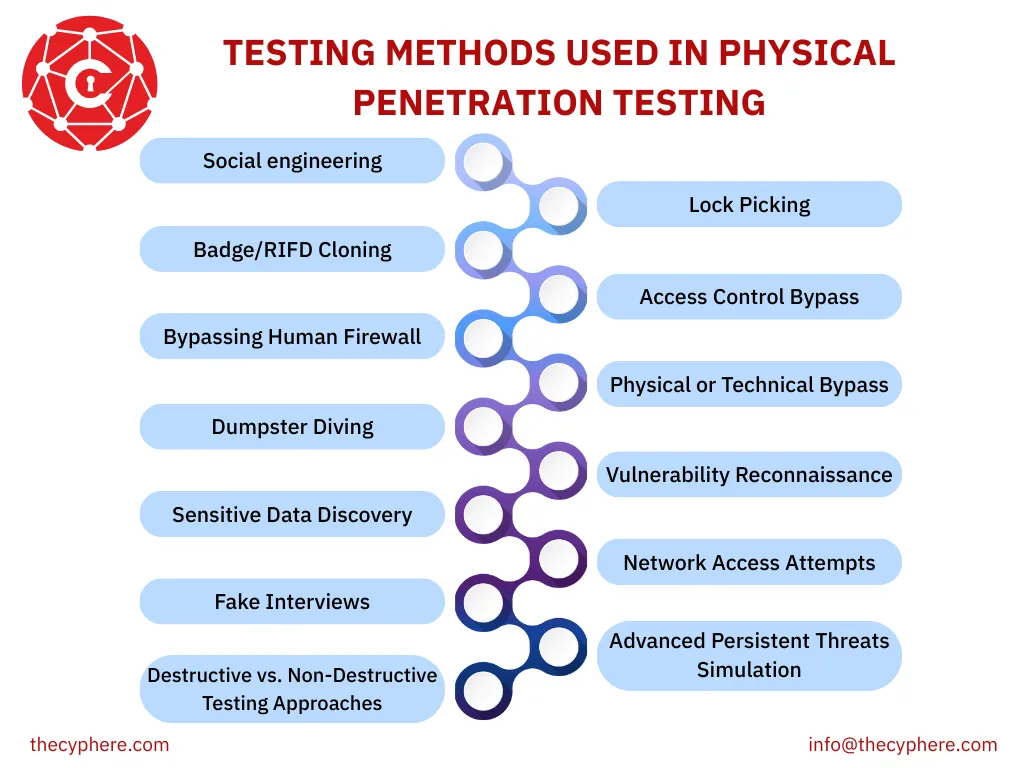
Listed below are the testing methods used in physical penetration testing.
- Social engineering: Social engineering is a psychological manipulation of individuals into performing actions or divulging confidential information. The tester gains access using social engineering by establishing trust or exploiting human helpfulness and authority. Examples of social engineering include a tester calling the main office, posing as an IT technician, and convincing a distant employee to open a secured door remotely to allow contractors in.
- Personnel Deception (Bypassing the human firewall): Bypassing the human firewall is a subset of social engineering techniques that is used to negate or circumvent the protective role of security personnel or vigilant employees through distraction or establishing false authority. For example, a tester flashes a generic, laminated badge that appears official but is completely fake, quickly walking past a security desk while nodding and making noncommittal small talk.
- Lock Picking: Lock picking involves the non-destructive use of specialised hand tools (tension wrench, rakes, and hooks) to manipulate the internal pins of a mechanical lock cylinder. The goal is to bring the pins to the shear line, effectively simulating the correct key. For example, the tester uses a manual pick set to bypass the low-security padlock securing a gate that leads to the building’s loading dock entrance.
- Badge/RIFD Cloning: Badge cloning captures and copies the cryptographic data using portable electronic devices transmitted by a contactless access badge or key fob. For example, a tester uses a device hidden in a backpack to discreetly scan an employee’s badge while standing near them in the elevator or in a crowded lobby.
- Access Control Bypass: Access control bypass utilises tools and techniques to directly defeat the mechanical, electric, or electronic locking mechanism of a door without a key or badge. For example, a tester uses an under-the-door tool to snag the handle or exit-request crash bar on the inside of a door that locks upon closing, opening it from the outside.
- Physical or Technical Bypass: Physical or technical bypass is a general category covering any method of bypassing a barrier using force, specialised tools, or exploiting architectural flaws (physical), or manipulating technology (technical). For example, physical bypass is climbing over a low fence or using the ceiling plenum space to move between rooms, and technical bypass uses a magnet to defeat a reed sensor on a door or window.
- Dumpster Diving: Dumpster diving inspects an organisation’s waste disposal containers to retrieve discarded documents, media, or equipment that contain sensitive credentials, internal protocols, or system information. For example, a tester finds an unshredded memo outlining the WiFi password for the guest network and the specific location of the server room.
- Vulnerability Reconnaissance: Vulnerability Reconnaissance is used to gather intelligence on employee habits, security system placements, and environmental weaknesses. For instance, the tester observes the front entry point for an hour and notes that personnel frequently open the fire exit during lunch breaks for tobacco use.
- Sensitive Data Discovery: Sensitive data discovery looks for unprotected confidential data (such as credentials and proprietary data) to demonstrate the effect of the infiltration. For instance, the tester discovers a password written on a sticky note hidden below a keyboard in an empty desk or logs into an unlocked computer.
- Network Access Attempts: Network access attempts link an authorised device (laptop or hidden computer) to an internal network socket to verify network segmentation and try peripheral transfer within the digital domain. For example, the tester connects to an Ethernet socket in a conference room to check if they can send a signal to limited networks or enter internal cooperation systems.
- Fake Interviews: Fake interviews are used in physical pentesting to grant appointed access to the premises under the false claim of an employment interview. This permits the interviewer-approved time within the premises for low-key data gathering and scrutiny. For instance, the tester uses the wait time before their interview to locate and photograph unsecured network jacks and to observe the PIN pad entry sequence on a nearby door.
- Advanced Persistent Threats Simulation: Advanced persistent is a long-term, multi-vector approach that mimics a sophisticated attack and involves the planting of an unauthorised network device for remote access. For example, the tester successfully hides a small Raspberry Pi implant in a utility closet, which allows the remote team to continue network enumeration over several days.
- Destructive vs. Non-Destructive Testing Approaches: Non-destructive approaches (the standard) cause no permanent damage, and destructive approaches (rare, requiring extreme client approval) involve damaging assets to simulate extreme risks. For example, a non-destructive approach uses a thin shim to open a locked door, and a destructive approach simulates the cutting of a perimeter fence to assess the alarm response.
What tools are used to perform physical penetration testing?
Physical penetration testing tools are any hardware, software, or specialised physical objects used by a security tester to defeat security controls.

Listed below are the tools to perform physical penetration testing.
- RFID or access badge cloners: RFID or access badge cloners are physical penetration testing tools that are used to read, sniff, and duplicate the cryptographic data from contactless access cards. These cloners allow the tester to create a functional duplicate for unchallenged and timed entry into secured areas. A technical vector for bypassing electronic access controls is eliminated without a badge cloner, which forces the test to rely on social engineering.
- Lock picking sets and tension wrenches: Lock picking sets are the physical penetration testing compulsory tools that are used for non-destructively manipulating pin-tumbler locks. Tension wrenches prove the susceptibility of standard door hardware to basic bypass methods. This set invalidates the assessment of an entire class of mechanical defences, which leaves a significant gap in the security report.
- USB Rubber Ducky: USB rubber duckies mimic a keyboard and rapidly execute pre-programmed keystrokes on unattended, locked workstations to run scripts or gather credentials. The absence of a USB Rubber Ducky means the tester cannot easily validate the security policy regarding physical access to employee machines.
- Under-the-door hooks and bypass devices: Under-the-door hooks and bypass devices allow testers to open spring-latched doors or exit-controlled doors. Bypassing the entire locking mechanism without touching the exterior is a failure to use these limits. The test is only for outward-opening or unlocked doors.
- WiFi Pineapple: WiFi Pineapple is used to set up a rogue wireless access point that mimics legitimate networks. Wi-Fi Pineapple captures login credentials, facilitates man-in-the-middle attacks, and demonstrates the lack of wireless monitoring. The ability to test wireless security post-entry is severely hampered without Wi-Fi Pineapple.
- High-quality cameras and recording devices: High-quality cameras and recording devices provide time-stamped evidence (chain-of-custody) of successful breaches. These devices are required for remediation reports without clear documentation and for finding a lack of credibility.
- Portable wireless scanners: Portable wireless scanners identify WiFi networks, Bluetooth devices, and other wireless signals within the target environment. These tools help testers discover rogue access points, assess wireless security configurations, and identify potential entry vectors through wireless infrastructure.
- Radio frequency (RF) scanners: RF scanners detect active radio frequencies, including security guard communications, surveillance system transmissions, and alarm system signals. Understanding the RF environment helps testers avoid detection and identify security system weaknesses.
- Common master keys or bump keys: The common master keys or bump keys are supplementary to quickly assess susceptibility to common key attacks.
- Binoculars: Binoculars are vital for external and passive vulnerability reconnaissance. Binoculars enable the tester to monitor staff conduct, pinpoint security camera settings, and interpret signs from a safe space before the operation begins. Not employing binoculars forces the tester to get hazardously close to the target, which escalates the threat of detection.
- Costumes and disguises: Costumes and disguises are vital to social engineering. These costumes are professional-looking outfits (such as an HVAC uniform and delivery jacket) that set up false authority and remove preliminary suspicion. Costumes facilitate the tester to move unquestioned through protected zones, since an inappropriate camouflage brings about immediate failure and halt of the test.
- Radio communication devices (two-way radios): Two-way radios enable secure coordination between testing team members during multi-person engagements. Testers use encrypted channels to communicate entry status, abort signals, and real-time observations without relying on mobile phones that may be monitored or jammed.
- Wireless access points: Wireless access points are used by the penetration tester who operates with specialised wireless devices (such as an Alfa connector or Aircrack-ng assembly).
- Antenna and receiver equipment: Antenna and receiver devices expand network coverage and signal monitoring capacities. Their neglect jeopardises operational protection, team coordination, and the competence to verify complicated network vulnerabilities.
- Night vision goggles: Night vision goggles provide tactical vision for covert operations in low-light conditions where perimeter fences or entry points are poorly lit.
How long does it take to perform a physical penetration test?
The duration of a physical penetration test spans two weeks to six weeks from initial planning to final report delivery, according to a 2024 study by Strahinja titled “How Often Should You Perform a Penetration Test?” The core on-site execution phase, where the tester attempts to breach security controls, takes 3 to 5 business days. The active time frame is decided based on the scope and complexity of the target. A small location assessment requires three days, whereas a large corporate campus or an engagement involves deep social engineering. The multiple physical targets extend the active testing period to one or two full weeks.
How often should a physical penetration test be performed?
A physical penetration test should be performed once every two to three years. The ideal frequency is adjusted based on risk and change. According to a 2024 study by Strahinja Stankovic titled “How Often Should You Perform a Penetration Test,” high-security environments (such as data centres or R&D facilities) conduct testing annually due to the high value of the assets.
Testing should also be performed immediately following physical renovations or major acquisitions to ensure that the new infrastructure is safe, according to a 2025 study by Tamzid Ahmed titled “What Is Penetration Testing?”
How much does it cost to perform a physical penetration test?
The cost for a physical penetration test is quoted as a fixed project fee based on a daily rate per consultant. According to the 2024 report by Heath Adams from TCM Security titled “How Much Does a Penetration Test Cost in 2025,” the minimum cost for a small and three-day assessment starts around £3,500 to £5,000. The average test, which spans five days with a small team, costs between £8,000 and £15,000. Complex and multi-site engagements can reach a maximum of £30,000 to £40,000+. According to the 2025 report by Ewelina Baran titled “Pricing insights—How much does penetration testing cost?”, physical pen testing providers charge £1,500 to £2,000 per day.
The best ROI is not a direct financial return, but the avoidance of catastrophic loss. The best ROI is breach intervention, client trust and retention, regulatory compliance, long-term cost savings, and strategic security planning. According to a 2024 study by Ahmed et al., titled “Penetration Testing: A Cost-Benefit Analysis of Best Practices Implementation for Software Startups,” the best ROI for physical penetration testers is maintaining customers’ trust and ensuring compliance.
What factors affect the cost of a physical penetration test?
The cost of a physical penetration test is determined by the scope of the work, the labour involved, and the required specialised skills of the testing team. According to 2024 research titled “Penetration Testing Costs: Key Factors, Pricing Insights, and Cost Management,” the following factors directly influence whether the cost lands at the minimum of £3,500 or the maximum of £40,000+ (GBP) for a complex engagement.
- Scope and Size of the Target
- Engagement Duration and Team Size
- Required Methodologies and Depth of Test
- Covert Requirements and Off-Hours Work
- Geographic Location and Logistics
- Reporting and Compliance Needs
What is Cyphere’s approach to performing physical penetration testing?
Cyphere’s approach to performing physical penetration testing provides a CREST-accredited service in the UK. The process initiates with thorough surveillance and data collection. The on-site evaluation simulates a real intruder and addresses key techniques, specifically interpersonal manipulation (such as tailgating and checking the human firewall), lock bypassing, and access control bypass to secure continuous access.
The challenges Cyphere finds are weak access control, poor digital security practices, and a lack of response. Cyphere solves challenges with implementable advice and effective solutions that incorporate risk remediation strategies and risk mitigation methods. Cyphere is among the top physical penetration testing companies in the UK because the focus is on service quality and non-biased documentation that offers users clear insight into security conditions over people, procedures, and technologies.
What are the physical penetration testing best practices we follow?
The best practices in physical penetration testing are listed below.
- Describe the Scope: It is essential to define the scope clearly, including RoE, limits, and prohibited actions, to ensure the testing remains safe, legal, and focused. A clearly articulated scope also prevents miscommunication and aligns expectations between the testing team and the organisation.
- Understand the Goal: Understanding the objectives of the penetration test ensures alignment with organisational priorities, saves time, and delivers meaningful insights. Clearly defined goals also make the findings actionable and relevant to strategic security initiatives.
- Set up a Budget: Establishing a budget allows for determining the type, depth, and duration of testing, ensuring comprehensive coverage without exceeding resources. Adequate budgeting further supports the allocation of appropriate tools, personnel, and contingency measures.
- Follow Protocols: Adhering to established protocols protects sensitive information and ensures confidentiality throughout the engagement. Strict compliance with protocols mitigates the risk of accidental data exposure or operational disruptions.
- Ethics and Safety: Ethical conduct and safety measures are critical, including conducting harmless testing, respecting employees, and implementing immediate termination procedures if necessary. Emphasising ethics safeguards organisational trust and maintains professional integrity.
- Deal with Security Gaps: Addressing identified vulnerabilities and security gaps is essential to reduce risk and prevent recurrence. Prompt remediation ensures that weaknesses are effectively mitigated and organisational resilience is strengthened.
- Arrange the Test Setting: Preparing the test environment with appropriate monitoring and transparency ensures controlled and observable operations. A well-arranged setting also facilitates rapid response to unexpected situations.
- Get an Expert Tester: Engaging experienced penetration testers ensures that confidential information is handled securely and specialised operational environments are understood. Expert testers are capable of identifying subtle vulnerabilities that less experienced personnel might overlook.
- Operational Execution: Executing tests through structured approaches, such as simulated advanced persistent threats, while maintaining chain-of-custody and minimal intrusion, ensures realistic and reliable results. Proper execution allows assessment without disrupting normal business operations.
- Reporting and Debriefing: Comprehensive reporting, including actionable remediation plans, executive summaries, and detailed presentations, is essential. Debriefing facilitates knowledge transfer, lessons learned, and informs continuous improvement of security measures.
How is physical penetration testing different from other penetration testing methodologies?
Physical penetration testing differs from other pentesting types as its main objective is the human factor and the physical setting. The most distinctive feature of physical pen testing is the strong dependence on social engineering, which employs deception and false claims to breach security staff.
According to 2010 research by Trajce et al., titled “Two Methodologies for Physical Penetration Testing Using Social Engineering,” physical testing participates in the conflicting progression with its digital counterparts, such as the important phases of surveillance (gathering OSINT) and violation.
According to a 2024 study by Kozel et al., titled “Research of Penetration Testing Methods,” physical penetration testing uses special techniques like automated vulnerability scanning (Nmap), Nessus, OWASP ZAP, and the use of digital exploitation frameworks (Metasploit) to secure remote access and review source code.
How does physical penetration testing relate to red team testing?
Physical penetration testing can function as either a standalone assessment or as an integrated component within a broader red team engagement. Understanding this relationship helps organisations select the appropriate testing approach based on their security objectives and maturity level.
Red team testing simulates a full-blown cyberattack to test an organisation’s overall security readiness, whilst penetration testing focuses on discovering vulnerabilities within a defined scope. The goal of a penetration test is usually to uncover as many exploitable vulnerabilities as possible, whereas the goal of a red team assessment is to achieve a specific objective, typically to access target data or systems.
Physical penetration testing forms a critical component of comprehensive red team engagements. Red teaming can involve a variety of attack vectors, including social engineering attacks, physical device planting, access card cloning, tailgating, and spear phishing, in an attempt to circumvent existing security measures to establish a foothold and move laterally across the attack surface. Red teams use whatever means they can to gain access, from physically breaking into an office and stealing confidential data to convincing an employee to connect a charging cable.
Physical red teaming or physical penetration testing involves testing the physical security of a facility, including the security practices of its employees and security equipment. Red teamers require broader skills, including social engineering, physical security, and advanced evasion techniques, whilst penetration testers focus primarily on technical vulnerability exploitation.
When to choose standalone physical penetration testing?
Standalone physical testing suits organisations that need to validate specific physical controls, meet compliance requirements, establish baseline security posture, or operate within limited budgets. This approach provides a focused assessment of physical security without the complexity of multi-vector attack simulation.
When to choose integrated red team testing?
Integrated red team testing suits mature organisations that need to test holistic security posture, validate detection and response capabilities, or simulate advanced persistent threats. Unlike penetration testing, red team engagements test any aspect of security, including physical security and employee resistance to social engineering campaigns. A typical red team attack chain might begin with physical intrusion through tailgating or social engineering, progress to deploying rogue network devices once inside, and conclude with technical exploitation from the established internal access point. This integrated approach reveals security gaps that neither standalone physical testing nor standalone technical testing would identify independently.
How to become a physical penetration tester?
To become a physical penetration tester requires unifying digital security basics with specialised interpersonal manipulation and mechanical expertise that takes 2 to 5 years.
According to a 2025 study by Coursera et al., titled “How to become a penetration tester: 2025 career guide,” to become a physical pen tester, you need to establish a strong technical foundation (networking, OS basics) and acquire credentials like OSCP.
The tools required to become a physical penetration tester are Kali Linux, Invicti, Nmap, Burp Suite, and Wireshark, according to a 2023 study by Esra et al., titled “A Survey on Web Application Penetration Testing.” Gain experience from collaborating with Red Teams, concentrate on real security gaps, watch beginner training at cyber conferences, and go to pentesting shops. You can also get a personal protection specialist license, as it leads to an understanding of various personal and locational threats and securities.
Is it easy to become a physical penetration tester?
No, it is not easy to become a physical penetration tester. To become a physical penetration tester, you need to understand a highly cross-functional skill set that extends far beyond standard cybersecurity positions.
According to a 2025 study by Kevin Miller titled “Becoming a Pen Tester: The Essential Guide,” to become a physical penetration tester, you need to have technical knowledge, know-how of the landscape, and problem-solving skills.
An experienced physical pentester must excel in three demanding domains: social engineering, mechanical bypasses, and digital security fundamentals, according to a 2024 study by Derry et al., titled “Cypher: Cyber Security Intelligent Penetration-Testing Helper for Ethical Researchers.” The work includes extended legal and moral risks that require thorough strategies and compliance with severe regulations of engagement.
How much can you earn after becoming a physical penetration tester?
A physical penetration tester in the UK can earn from £25,000 to £40,000 annually at entry level. Mid-level roles typically pay between £40,000 and £65,000. Experienced physical penetration testers with specialised skills earn between £60,000 and £85,000+, with senior consultants or team leads potentially exceeding £90,000 in high-demand markets.
Salary varies significantly based on certifications held, years of experience, employer type (consultancy vs. in-house), and geographic location within the UK.