Protecting sensitive data and maintaining customer trust is paramount, and demonstrating your data security commitment is equally important. One way to achieve this is by obtaining a Cyber Essentials certification. But what are the differences between “cyber essentials vs cyber essentials plus”, and how do they impact your organisation’s cybersecurity strategy?
Today, we will explore these two certifications, emphasising their importance and critical distinctions. By the end, you will understand how these certifications can fortify your business against cyber attacks and help you stay ahead in cybersecurity.
Key Points About Cyber Essentials Scheme
- Cyber Essentials and Cyber Essentials PLUS are two certification levels offered by IASME and backed by the UK Government.
- Obtaining a certification helps organisations meet regulatory requirements, build trust with customers, and reinforce their security posture.
- Certifications require an independent audit by a certified body and vulnerability scans. Partnering with experienced providers like Cyphere ensures compliance and enhanced cybersecurity measures.
Understanding Cyber Essentials and Cyber Essentials PLUS
The Cyber Essentials Scheme is a UK government-backed cybersecurity certification scheme to protect organisations from common cyber attacks. Developed by the National Cyber Security Centre (NCSC), Cyber Essentials certification demonstrates a business’s commitment to data protection and cybersecurity.

Two certification levels are available: Cyber Essentials (Level 1) and Cyber Essentials PLUS (Level 2). Level 1, or Cyber Essentials Basic, focuses on implementing five essential security controls to protect against the most common cyber threats. On the other hand, Cyber Essentials PLUS involves a more rigorous assessment process, providing a higher level of assurance and protection against cyber criminals.
Businesses can significantly improve their cybersecurity posture by understanding and meeting the requirements for cyber essentials.
The Importance of Cyber Security Certification
A certification is nothing if the defined controls in its guidance are not implemented in letter and spirit. A quick Google search will show why so many companies have been breached, such as PCI DSS and GDPR, which were certified.

When an organisation achieves Cyber Essentials certification, it reaps several benefits. It’s a clear demonstration of their commitment to data protection and cybersecurity, which in turn builds trust with customers and partners. Furthermore, it helps meet prerequisites as suppliers, enables you to step in the door at various marketplaces, and secures your position in the supply chain, especially when dealing with specific government contracts requiring Cyber Essentials certification.
Difference Between Cyber Essentials and Cyber Essentials PLUS
Even though both Cyber Essentials and Cyber Essentials PLUS certifications share the goal of safeguarding organisations from cyber threats, there are noticeable differences in terms of certification requirements and the business benefits.
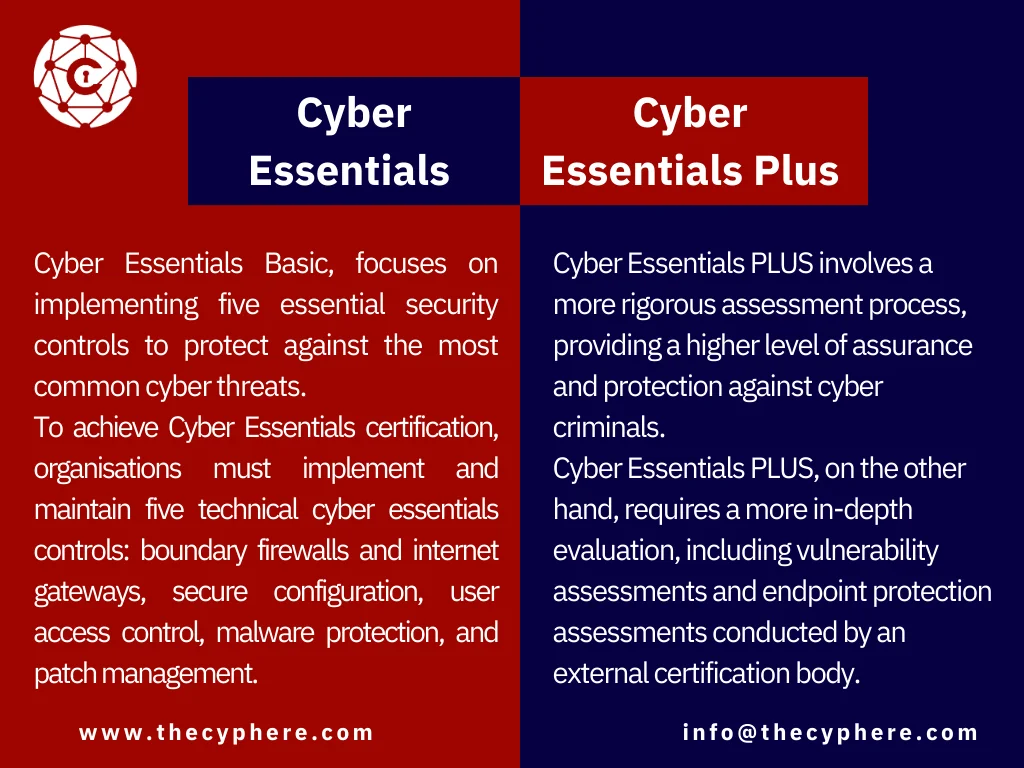
The primary distinctions lie in the assessment methods, technical controls, and vulnerability scans
For example, Cyber Essentials involves a self-assessment process, whereas Cyber Essentials PLUS requires an independent audit conducted by a certification body like Cyphere.
Cyber Essentials Plus Checklist
Cyber Essentials Assessment Methods: Self-Assessment vs Independent Audit
To achieve Cyber Essentials self-assessment, organisations must demonstrate their compliance with the five key controls. This process is less rigorous and relies on the honesty and accuracy of the organisation’s responses via a self-assessment questionnaire.
However, Cyber Essentials PLUS takes it further with an independent audit conducted by a certification body covering additional security controls. During this assessment, the base scope is taken from your submission for the Cyber Essentials self-assessment within three months. This audit evaluates the effectiveness of the organisation’s security measures, infrastructure, and controls, providing a more accurate representation of its cybersecurity posture.
Partnering with a CREST-accredited provider like Cyphere offers additional benefits, such as independent audit approaches and technical expertise.
Technical Controls and Vulnerability Scans
To achieve Cyber Essentials certification, organisations must implement and maintain five technical cyber essentials controls: boundary firewalls and internet gateways, secure configuration, user access control, malware protection, and patch management.
Cyber Essentials PLUS, on the other hand, requires a more in-depth evaluation, including vulnerability assessments to check for the latest security patches and endpoint protection assessments, just like an external audit. Vulnerability scans are crucial in detecting security weaknesses, allowing organisations to take corrective measures before cybercriminals exploit them.
With Cyber Essentials PLUS certification, organisations can attain a more robust level of cybersecurity assurance by undergoing an independent audit and implementing the required technical controls. This helps protect sensitive data from cyber threats and enhances customer trust and confidence in the organisation’s security measures.
Costs and Timeframes for Certification
The costs and timeframes for obtaining Cyber Essentials and Cyber Essentials PLUS certifications vary depending on the certification body and the size of your organisation. Generally, Cyber Essentials certification starts from £600 + VAT and increases based on the organisation’s size. Cyphere offers this for free if you opt for a security assurance project such as an annual IT health check or penetration testing with us.
Obtaining Cyber Essentials PLUS certification can be more lengthy and costly, as it involves a more extensive evaluation of your organisation’s security protocols. Our CE+ costs start from £1899 for a small-size organisation, going up to £4000 in most small and medium enterprises cases, varying based on the organisation size and complexity of the certification process.
If your objective is Cyber Essentials Plus and you undergo annual pen tests, why not try it with us this year? For your trust, we will ensure CE+ plus is mapped with pen testing to offer cost-effective, quality-focused outputs.
Business Benefits
Cyber Essentials certification provides businesses with a foundational level of cybersecurity assurance through a self-assessment questionnaire. This basic certification helps organisations demonstrate their commitment to cybersecurity, which can enhance customer trust and potentially open doors to certain government contracts. However, it primarily relies on the organisation’s self-reported compliance with five key security controls without external verification.
Cyber Essentials Plus certification offers a more comprehensive assessment, including a third-party audit. It takes quite an effort for an organisation to achieve certification and show the effectiveness of security controls. This higher level of assurance can lead to tangible business benefits, such as reductions in cyber insurance premiums and stronger support for cybersecurity initiatives from senior management. The rigorous assessment process encourages a proactive approach to cybersecurity, ensuring the organisation’s systems are robust against the ever-increasing cyber threat landscape and aligning with best practices.
The Role of Cyber Essentials in Government Contracts
Since 2014, Cyber Essentials Plus certification has been mandatory for UK government contract bidders across regulated industries via their procurement systems. These contracts often handle sensitive and personal information.

Securing a Cyber Essentials certification allows organisations to display their commitment to data protection and cybersecurity to prospective clients, thereby enhancing their probability of landing lucrative government contracts.
Achieving Cyber Essentials PLUS Certification
An organisation must have a Cyber Essentials certification within three months before applying for Plus certification. It is not mandatory to have Cyber Essentials self-assessment through the same certification body as IASME issues all certificates. Certification bodies are just one vehicle to support the certification scheme. During CE+ discussions, your submission for Cyber Essentials certification will be used as a scope, and any significant deviations will require a new Cyber Essentials certification.
Cyphere offers cost-effective solutions for organisations seeking to attain Cyber Essentials PLUS certification without first obtaining Cyber Essentials certification. Organisations can streamline the certification process by partnering with a reliable and experienced certification body like Cyphere and ensure they meet the necessary security requirements.
Cyphere’s economical solutions do more than save organisations time and costs. They also offer the added reassurance of collaborating with a world-class service provider that has streamlined processes to ensure we support your risk identification and remediation phases. By obtaining Cyber Essentials PLUS certification, organisations can demonstrate their commitment to cybersecurity and enhance their reputation among clients and partners.
The Certification Process and Selecting a Certification Body
Obtaining Cyber Essentials and Cyber Essentials Plus certifications begins with selecting a certification body, such as Cyphere, to assist in the end-to-end certification process. Choosing a dependable and experienced certification body like Cyphere offers numerous advantages, including a streamlined certification process, technical proficiency, and the assurance of working with a CREST-accredited provider.
Collaborating with a trustworthy certification body like Cyphere offers organisations the following benefits:
- Helping you build cyber security business case with your senior management
- Guidance and support to ensure first-time certification pass
- 12 months support on cyber security matters beyond cyber essentials certificate
- Readiness audit to take out the risk of failing and repaying cycles
- Access to IASME Cyber Essentials Plus Assessor and consultations
Organisations can effectively achieve these goals by working with a world-class service provider like Cyphere.
Enhancing Cyber Security with Penetration Testing and Security Audits
Should your business also provide regular pen tests, Cyphere’s CREST penetration testing services could help you in addition to the cyber essentials certification process. Get in touch to get a budget-friendly quote to schedule both exercises, saving time and money with two separate exercises.
Maintaining Your Cyber Essentials Certification
To maintain a Cyber Essentials certification, organisations must conduct annual reviews and keep abreast of the latest cybersecurity requirements and guidelines issued by the NCSC. This ensures continued compliance with the evolving cybersecurity landscape and demonstrates the organisation’s commitment to enhancing security measures and protecting sensitive data.
Summary
In conclusion, Cyber Essentials and Cyber Essentials PLUS certifications are critical in protecting organisations from cyber threats and maintaining customer trust. By understanding the key differences between the two levels of certification, organisations can make informed decisions regarding their cybersecurity strategy and choose the appropriate certification for their needs.
With the ever-evolving landscape of cyber threats, organisations must prioritise their cybersecurity measures and stay ahead. By obtaining Cyber Essentials certification and partnering with a world-class service provider like Cyphere, organisations can safeguard their sensitive data, secure government contracts, and enhance their overall security posture.
Frequently Asked Questions
What is the difference between Cyber Essentials and Cyber Essentials Plus?
Cyber Essentials provides a basic level of assurance, while Cyber Essentials Plus offers an advanced level of assessment and assurance.
Do I need Cyber Essentials to get Cyber Essentials Plus?
You must complete the Cyber Essentials assessment before getting Cyber Essentials Plus. Alternatively, you can do a Cyber Essentials Plus assessment within three months of your last Cyber Essentials certification.
What is the Cyber Essentials Plus scheme?
Cyber Essentials Plus is the highest level of certification offered under the Cyber Essentials scheme. It provides rigorous tests of an organisation’s cyber security systems through vulnerability scans to protect against basic hacking and other online threats.
What is the cost of obtaining Cyber Essentials and Cyber Essentials PLUS certifications?
Cyber Essentials certification starts from £400 + VAT, while Cyber Essentials PLUS costs from £1899 to £4000, depending on the organisation’s size. Cyphere offers free basic certification for Cyber Essentials if you qualify based on your penetration testing requirements.
Is there a Cyber Essentials requirement for General Data Protection Regulation?
GDPR deals with the privacy of individuals’ data and has no direct requirement link stated by the UK govt or EU.
How do penetration testing and security audits enhance cybersecurity measures?
Penetration testing and security audits help organisations identify weaknesses in their cybersecurity measures, provide a comprehensive view of their overall infrastructure, and stay ahead of potential threats.
What is the difference between ISO 27001 and Cyber Essentials Plus?
Cyber Essentials Plus covers five key controls and doesn’t deal with organisational areas for security, such as people and processes. ISO 27001 covers many more aspects of security aimed at the entire organisation and is more comprehensive. You can’t interchange and apply either as a replacement for another.